Wholesale Basmati Rice Suppliers for German Distributors in 2026
German distributors seeking consistent quality, stable pricing, and reliable logistics benefit most from sourcing directly from Pakistani Basmati exporters rather than through intermediaries. Here is why: Pakistan remains the largest supplier of premium traditional Basmati varieties, offers multiple processing grades, and provides stronger customization options for European importers.
German food importers continue to expand their rice portfolios because consumer demand for premium ethnic foods and long-grain aromatic rice remains strong across retail, foodservice, and private-label sectors. Buyers evaluating sourcing options should first understand how the market works before reviewing supplier specifications. A useful starting point is understanding the broader trade landscape discussed in Pakistan’s growing role in global Basmati rice exports .
The term Wholesale Basmati Rice Suppliers Germany refers to exporters, processors, traders, and sourcing partners that supply Basmati rice in commercial quantities to German distributors, wholesalers, supermarkets, ethnic food chains, and foodservice companies.
Pakistan supplies several recognized varieties including 1121 Basmati, Super Kernel Basmati, and 1509 Basmati. AHK Rice operates as a Pakistani exporter that mills, grades, sorts, packages, and exports these varieties to international markets through complete export processing and logistics management.
What Are the Available Solutions for German Basmati Rice Importers?
Direct Pakistani exporters provide the highest control, trading companies provide flexibility, and European stockists provide faster delivery but higher costs for German distributors seeking consistent Basmati supply.
German distributors generally source Basmati rice through three primary channels.
Direct Pakistani Exporters
Direct exporters cultivate relationships with farmers, mill paddy, grade rice, inspect quality, package products, and ship containers directly to buyers.
Direct sourcing provides:
- Lower procurement costs
- Greater specification control
- Custom packaging options
- Better traceability
- Direct quality communication
AHK Rice belongs to this category because it manages sourcing, milling, grading, packaging, and export operations from Pakistan.
International Trading Companies
Trading companies purchase rice from multiple mills and resell it internationally.
Benefits include:
- Multiple origins
- Flexible sourcing
- Smaller purchase quantities
Limitations include:
- Reduced traceability
- Less production visibility
- Additional margins
European Stock Holders
European stock holders import rice in advance and distribute locally.
Benefits include:
- Faster replenishment
- Reduced lead times
- Local inventory availability
Limitations include:
- Higher pricing
- Limited customization
- Restricted packaging options
These sourcing models solve different procurement challenges, which makes comparison essential before selecting a supplier strategy.
How Do Different Wholesale Basmati Supply Approaches Compare?
Direct exporters offer the strongest value, trading firms provide sourcing flexibility, and local stockists deliver the shortest lead times for urgent replenishment requirements.
Specification Comparison Table
| Attribute | Direct Pakistani Exporters | Trading Companies | European Stockists |
|---|---|---|---|
| Price Per MT | Lowest | Medium | Highest |
| Product Traceability | High | Medium | Medium |
| Custom Packaging | Extensive | Limited | Limited |
| Lead Time | 25–40 Days | 30–45 Days | 3–10 Days |
| Grade Availability | Full Range | Mixed | Limited Range |
| Container Flexibility | High | Medium | Low |
| Quality Visibility | Direct | Partial | Limited |
Price remains one of the largest decision factors for German distributors.
Direct procurement typically reduces procurement costs because exporters eliminate intermediary margins. For example, a distributor importing 10 containers annually can generate substantial savings compared with sourcing through multiple trading layers.
Quality consistency also differs significantly between sourcing methods. Direct exporters inspect paddy, mill rice, grade kernels, sort defects, test moisture, certify specifications, and dispatch sealed containers. Trading firms frequently aggregate products from multiple mills, which increases specification variation.
Packaging flexibility creates another difference. German private-label buyers often require multilingual labeling, retail packs, and customized branding. Direct exporters usually provide these services at origin.
These comparisons establish the operational differences between sourcing channels. The next question focuses on specific Basmati grades preferred in German and European markets.
Which Basmati Grades Do German and EU Markets Prefer?
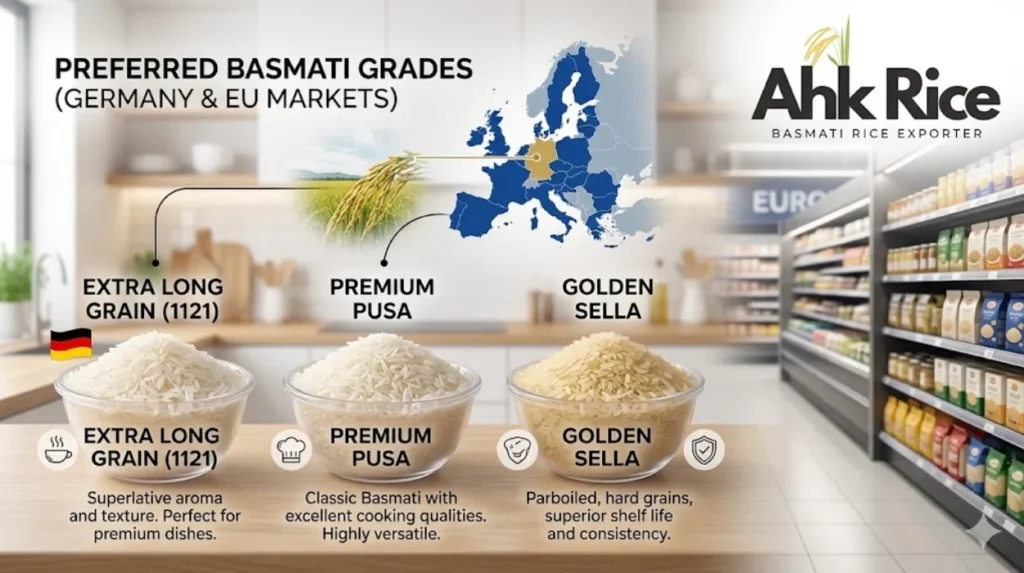
1121 Steam Basmati, 1121 Golden Sella, and Super Kernel Basmati dominate premium retail and foodservice demand across Germany and wider European markets.
European buyers evaluate rice according to grain length, aroma, cooking performance, shelf life, and consumer preferences.
1121 Steam Basmati
1121 Steam Basmati is processed through steam treatment before milling.
Key specifications:
| Specification | Typical Range |
|---|---|
| Grain Length | 8.30–8.50 mm |
| Broken Rice | 2–5% |
| Moisture | 12–13% |
| Shelf Life | 12–18 Months |
German retail brands often prefer 1121 Steam because consumers associate it with premium cooking quality and bright grain appearance.
1121 Golden Sella Basmati
1121 Golden Sella undergoes parboiling before milling.
Key specifications:
| Specification | Typical Range |
|---|---|
| Grain Length | 8.30–8.50 mm |
| Broken Rice | 2–5% |
| Moisture | 12–13% |
| Shelf Life | 18–24 Months |
Golden Sella lasts longer than Steam rice. In non-climate-controlled warehouses, Golden Sella maintains quality for extended periods. Foodservice distributors handling large inventory volumes often select this specification.
Super Kernel Basmati
Super Kernel Basmati is the traditional Pakistani Basmati variety recognized for aroma.
Key specifications:
| Specification | Typical Range |
|---|---|
| Grain Length | 7.00–7.40 mm |
| Aroma | Strong Natural Aroma |
| Shelf Life | 12–18 Months |
Traditional ethnic retailers frequently prefer Super Kernel because consumers recognize its authentic fragrance.
Grade selection influences pricing, inventory planning, and customer satisfaction. The next section compares regional preferences and commercial considerations.
How Do German and EU Regional Preferences Differ?
Germany favors premium retail grades, while broader EU foodservice channels often prioritize shelf life, inventory efficiency, and cost management.
German Retail Market Preferences
German consumers increasingly purchase premium packaged rice.
Preferred grades include:
- 1121 Steam Basmati
- Super Kernel Basmati
- Premium Extra Long Grain Basmati
Retailers prioritize:
- Aroma
- Grain appearance
- Cooking performance
- Packaging presentation
Wider EU Foodservice Preferences
Foodservice operators prioritize operational efficiency.
Preferred grades include:
- 1121 Golden Sella
- 1121 Steam
- Cost-optimized blends
Foodservice buyers focus on:
- Inventory stability
- Yield after cooking
- Shelf life
- Cost per serving
Price Per MT Comparison
| Product Grade | Germany Retail Focus | EU Foodservice Focus |
|---|---|---|
| 1121 Steam | Premium | Moderate |
| 1121 Golden Sella | Moderate | Premium |
| Super Kernel | Premium | Limited |
Average market prices fluctuate according to harvest conditions, freight costs, and currency movements. Premium grades generally command higher prices because grain length and aroma characteristics increase consumer demand.
Regional demand patterns influence sourcing strategy. The next section examines which procurement approach works best for different importer profiles.
Which Method Works Best for Different Import Scenarios?
Direct exporters suit large distributors, stockists suit urgent buyers, and trading firms suit diversified sourcing programs with multiple origin requirements.
Decision Framework
| Buyer Situation | Recommended Method | Reason |
|---|---|---|
| Private Label Retailer | Direct Exporter | Packaging control |
| Ethnic Food Distributor | Direct Exporter | Grade consistency |
| Emergency Replenishment | European Stockist | Fast delivery |
| Multi-Origin Importer | Trading Company | Source diversity |
| Large Container Program | Direct Exporter | Cost efficiency |
Large distributors benefit from direct relationships because specification consistency supports long-term customer contracts.
Small distributors with unpredictable demand may benefit from local inventory availability because container-level commitments create higher capital requirements.
Importers operating several product categories often prefer trading companies because supplier consolidation simplifies procurement administration.
The sourcing method should align with business objectives, inventory strategy, and customer expectations. Understanding advantages and limitations helps finalize supplier selection.
What Are the Pros and Cons of Each Supply Option?
Direct exporters deliver maximum control, trading companies provide sourcing flexibility, and stockists offer convenience at higher procurement costs.
Direct Exporters
Pros:
- Lower landed costs
- Complete traceability
- Direct quality control
- Packaging customization
- Full specification transparency
Cons:
- Longer lead times
- Container commitments
- Import management responsibility
Trading Companies
Pros:
- Multiple sourcing options
- Flexible procurement
- Consolidated supplier network
Cons:
- Reduced transparency
- Additional margins
- Variable quality sources
European Stockists
Pros:
- Fast replenishment
- Local inventory
- Simplified purchasing
Cons:
- Higher pricing
- Limited customization
- Reduced product selection
A distributor importing several containers annually usually gains more value from direct exporter relationships because volume offsets longer shipping timelines.
Pros and cons clarify operational tradeoffs. The final section focuses on critical decision factors before selecting a supplier.
What Decision Factors Should German Distributors Evaluate Before Choosing a Supplier?
Quality consistency, certification, logistics capability, packaging flexibility, and export experience determine long-term supplier performance more than price alone.
German food importers should evaluate suppliers using measurable criteria.
Quality Verification
Inspect:
- Grain length reports
- Broken percentage reports
- Moisture test reports
- Quality certificates
- Laboratory results
Processing Capability
Verify:
- Milling facilities
- Colour sorting systems
- Metal detection systems
- Packaging lines
- Quality inspection procedures
Export Documentation
Review:
- Commercial Invoice
- Packing List
- Certificate of Origin
- Phytosanitary Certificate
- Bill of Lading
Logistics Capability
Assess:
- Container loading experience
- Shipping network access
- Port handling capability
- Documentation accuracy
- Delivery performance
Packaging Options
Confirm:
- Retail packs
- PP bags
- BOPP bags
- Private-label packaging
- Multilingual labeling
Supplier evaluation determines long-term procurement success. Buyers seeking deeper market-share analysis and supplier selection insights should also review how Pakistani exporters are strengthening their position across European markets in our analysis of Pakistan’s Basmati performance across Germany and the wider EU market in 2026 .
Frequently Asked Questions
What is the most imported Basmati rice grade in Germany?
1121 Steam Basmati remains one of the most imported grades because German consumers prefer premium appearance, long grain length, and consistent cooking performance.
Why do German importers source rice from Pakistan?
Pakistan supplies authentic Basmati varieties, competitive export pricing, established milling infrastructure, and large-scale export capacity.
What shelf life does Basmati rice typically offer?
1121 Steam generally provides 12–18 months, while 1121 Golden Sella often provides 18–24 months under proper storage conditions.
Which Basmati grade is best for foodservice distributors?
1121 Golden Sella is frequently preferred because it offers longer storage stability and excellent cooking yield.
How long does Basmati rice shipping take from Pakistan to Germany?
Typical transit times range from 25–40 days, depending on shipping schedules, routing, and port operations.