What Determines 1121 White Basmati Rice FOB Pakistan and CIF UAE Rates in International Trade
1121 White Basmati Rice FOB Pakistan and CIF UAE rates depend primarily on paddy prices, milling quality, export specifications, freight costs, and buyer requirements. Here is why: every stage from cultivation in Punjab to delivery at a UAE port adds measurable value and cost. Understanding each pricing component helps importers compare quotations accurately instead of selecting suppliers based only on the lowest price.
International rice buyers frequently compare quotations without understanding why one supplier offers a higher or lower rate. A difference of USD 20–50 per metric ton often reflects variations in grain length, broken percentage, moisture level, polishing quality, packaging material, freight charges, and documentation rather than excessive profit margins. Buyers who evaluate complete specifications reduce purchasing risks and improve consistency.
AHK Rice supplies 1121 White Basmati Rice through complete processing, grading, packaging, inspection, and export management for buyers across more than fifteen countries. Buyers comparing suppliers should first understand how export pricing works before requesting quotations. Learn more about the complete export process in our guide on how Pakistani Basmati rice moves from mill to international buyers.
Unlike domestic wholesale prices, export quotations combine agricultural costs, processing expenses, logistics, compliance, and destination-specific transportation. Every component influences the final FOB Pakistan and CIF UAE value.
What determines 1121 White Basmati Rice FOB Pakistan rates?
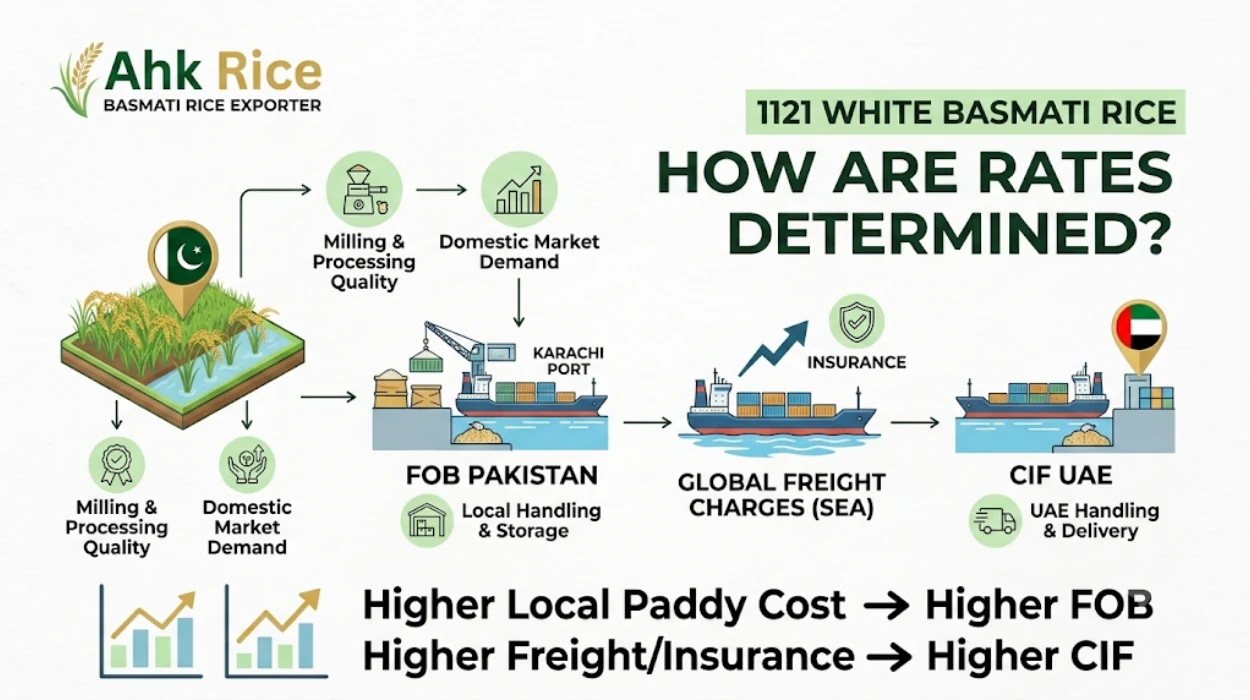
FOB Pakistan prices are determined by paddy procurement costs, milling recovery, export grade, packaging specifications, inland logistics, inspection expenses, and exporter operating costs. Each element contributes directly to the final quotation presented to international buyers.
What does FOB mean?
FOB stands for Free on Board. Under this international trade term, the exporter delivers the cargo onto the vessel at the designated Pakistani port. The buyer assumes responsibility for ocean freight, marine insurance, and destination charges after loading.
FOB quotations therefore include every activity completed inside Pakistan before shipment.
Major pricing factors
| Pricing Factor | Effect on FOB Price |
|---|---|
| Paddy purchase price | Highest cost component |
| Milling recovery | Better recovery lowers production cost |
| Grain specification | Premium grades increase value |
| Broken percentage | Lower broken percentage increases price |
| Packaging type | Premium bags increase export cost |
| Inland transportation | Fuel prices affect trucking charges |
| Export documentation & inspection | Compliance costs vary by destination |
How does paddy pricing influence export quotations?
Paddy represents the largest production expense. Harvest quality determines milling yield and finished grain quality. Higher-quality paddy produces longer whole grains and fewer broken kernels during milling.
For example:
- Fresh premium paddy creates higher head rice recovery.
- Poor-quality paddy increases broken grain.
- Mixed varieties reduce export consistency.
- Higher moisture raises drying expenses.
Pakistan’s major harvest season strongly influences pricing trends throughout the export year (source: Pakistan Bureau of Statistics, FY2024–25).
How do processing specifications affect FOB value?
Export specifications directly determine production costs.
Typical specification variables include:
| Specification | Premium Export Grade |
|---|---|
| Grain Length | 8.30 mm+ |
| Moisture | 12–13% |
| Broken | 2–5% |
| Purity | 95–100% |
| Damaged Grains | Below 0.5% |
| Chalky Grains | Minimal |
| Foreign Matter | Nil after grading |
Producing tighter specifications requires additional sorting, polishing, color sorting, grading, inspection, and quality verification. Those additional processing stages increase production costs but reduce buyer complaints after arrival.
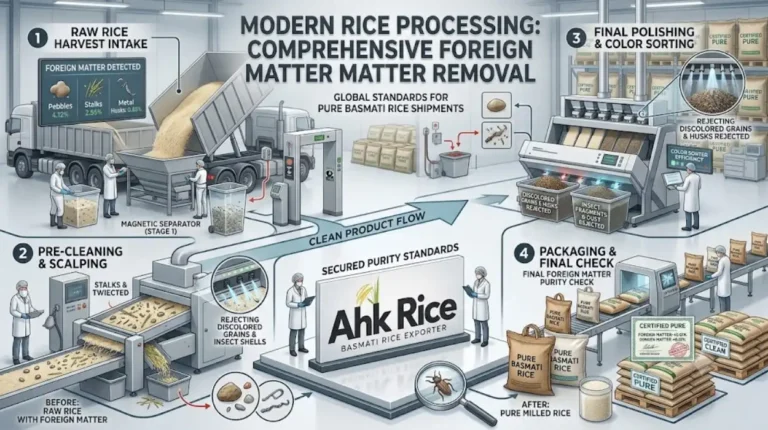
AHK Rice follows multiple processing stages including:
- Cleaning
- De-husking
- Whitening
- Polishing
- Length grading
- Color sorting
- Metal detection
- Quality inspection
- Export packaging
Each stage improves consistency before shipment.
A buyer comparing only FOB prices without comparing specifications evaluates incomplete information. The next comparison therefore examines why CIF UAE quotations differ even when the FOB supplier remains the same.
What determines CIF UAE rates for 1121 White Basmati Rice?
CIF UAE prices include the complete FOB value plus ocean freight, marine insurance, destination shipping conditions, and vessel availability. Freight fluctuations explain most quotation differences between suppliers offering identical FOB prices.
Under CIF (Cost, Insurance, and Freight), the exporter pays transportation and insurance until the shipment reaches the agreed UAE port.
A CIF quotation includes:
- FOB Pakistan value
- Ocean freight
- Marine insurance
- Shipping documentation
- Container booking costs
Freight costs fluctuate throughout the year depending on:
- Container availability
- Fuel prices
- Shipping line schedules
- Port congestion
- Seasonal demand
- Global trade routes
For example, freight increases during periods of high container demand immediately raise CIF quotations while leaving FOB values unchanged.
Importers comparing CIF offers should therefore request separate visibility of FOB value and freight cost. Transparent quotations simplify supplier comparisons and improve procurement decisions.
What are the available solutions for managing 1121 White Basmati Rice import costs?
The most effective solutions are comparing FOB and CIF quotations, selecting the correct export grade, optimizing packaging, planning seasonal purchases, and partnering with an experienced exporter. Each solution affects the landed cost differently and should match the buyer’s business model.
Importers do not reduce procurement costs by choosing the lowest quotation alone. Successful buyers compare the complete specification, logistics, and quality package. A quotation that appears cheaper may contain a higher broken percentage, shorter grain length, or lower milling quality. Those differences often increase customer complaints after arrival.
Available procurement approaches
| Solution | Best For | Main Advantage | Limitation |
|---|---|---|---|
| Buy on FOB terms | Experienced importers | Greater freight control | Buyer manages shipping |
| Buy on CIF terms | New importers | Simplified logistics | Freight depends on exporter |
| Purchase premium grade | Retail brands | Higher consumer satisfaction | Higher purchase price |
| Purchase commercial grade | Catering and food service | Lower procurement cost | Less visual appeal |
| Sign seasonal contracts | Large distributors | Stable pricing | Requires volume commitment |
Each approach serves a different commercial objective. Retail supermarkets generally prioritize grain appearance and consistency, while institutional buyers often focus on overall landed cost.
How do export grades influence pricing?
Higher grades require additional processing. Every extra grading stage removes defects and improves uniformity.
Typical commercial grades include:
| Grade | Average Grain Length | Broken | Common Market |
|---|---|---|---|
| Premium | 8.30 mm+ | 2% | UAE Retail |
| Standard Export | 8.20 mm+ | 5% | GCC Wholesale |
| Commercial | 8.10 mm+ | 10% | Food Service |
| Economy | Below 8.00 mm | 15%+ | Industrial Processing |
Premium grades command higher FOB values because additional sorting, polishing, and inspection improve presentation.
1121 White Basmati Rice Specification Comparison
| Attribute | Premium Grade | Standard Export | Commercial Grade |
|---|---|---|---|
| Grain Length | 8.30 mm+ | 8.20 mm+ | 8.10 mm+ |
| Broken Percentage | 2% | 5% | 10% |
| Moisture | 12–13% | 13% | 13–14% |
| Purity | 99% | 98% | 95% |
| Milling Quality | Excellent | Very Good | Good |
| Packaging Options | 1–50 kg | 5–50 kg | 25–50 kg |
| Typical Buyer | Supermarkets | Wholesalers | Catering Companies |
Every specification should appear on the proforma invoice before production begins. Clear specifications prevent disputes after delivery.
The available purchasing solutions now establish the foundation for comparing regional buying preferences.
How do different international markets compare when importing 1121 White Basmati Rice?
The UAE generally prefers premium white rice with superior appearance, while African markets frequently prioritize competitive pricing and commercial grades. Purchasing priorities influence both FOB quotations and final CIF costs.
Different markets evaluate rice differently because consumer expectations vary.
UAE Market Preference
The UAE imports premium packaged rice for supermarkets, hospitality businesses, and branded distributors.
Preferred specifications include:
- 8.30 mm+ grain length
- 2–5% broken
- Bright white appearance
- High purity
- Attractive retail packaging
Retail buyers value visual consistency because consumers compare rice before purchasing.
African Market Preference
Many African importers prioritize affordability while maintaining acceptable cooking quality.
Typical preferences include:
- 5–10% broken
- Commercial export grades
- Bulk packaging
- Competitive landed cost
- High container utilization
Bulk food distributors usually purchase larger volumes and focus on cost efficiency instead of premium appearance.
Price Comparison per Metric Ton
| Pricing Component | FOB Pakistan | CIF UAE |
|---|---|---|
| Premium Grade | Higher | Higher |
| Standard Grade | Moderate | Moderate |
| Commercial Grade | Lower | Lower |
| Ocean Freight | Buyer Pays | Included |
| Marine Insurance | Buyer Pays | Included |
Actual quotations change according to harvest conditions, freight availability, and international demand. Buyers should compare quotations issued on the same date for accurate evaluation.
Shelf Life Comparison
| Specification | Shelf Life | Recommended Storage |
|---|---|---|
| Premium White Basmati | 18–24 Months | Cool, dry warehouse |
| Standard Export Grade | 18 Months | Moisture-controlled storage |
| Commercial Grade | 12–18 Months | Proper ventilation |
Proper storage preserves aroma, cooking quality, and grain integrity. Warehouses should maintain low humidity and protect bags from direct sunlight.
Pros and Cons of Premium vs Commercial Grades
| Premium Grade | Commercial Grade |
|---|---|
| Superior appearance | Lower procurement cost |
| Better retail acceptance | Suitable for catering |
| Higher consumer confidence | Better budget management |
| Lower broken percentage | Higher broken percentage |
| Higher selling price | Lower resale margin |
A UAE supermarket chain usually benefits from premium specifications because customers expect long, uniform grains. A catering company serving large institutions often benefits from commercial grades because cost efficiency outweighs cosmetic appearance.
What is the best purchasing method for different types of buyers?
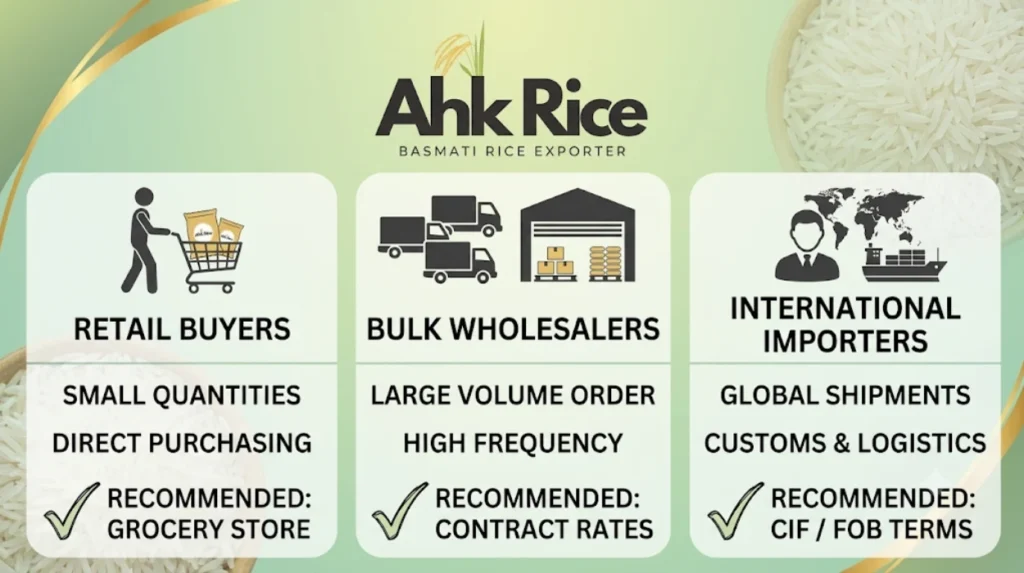
The best purchasing method depends on business size, inventory strategy, sales channel, and logistics capability. Retail distributors benefit from premium CIF shipments, while experienced importers often reduce costs through FOB purchasing and independent freight management.
Every importer has different procurement objectives. A supermarket chain, a foodservice distributor, and a rice wholesaler evaluate quotations differently because each serves a different customer segment.
Retail Importers
Retail brands compete through product presentation and consumer confidence.
Recommended specification:
- Premium Grade
- 2–5% Broken
- 8.30 mm+ Grain Length
- Printed retail packaging
- CIF delivery
Retail shelves reward consistency. Uniform grain length and bright polishing improve repeat purchases.
Wholesale Distributors
Wholesale businesses balance quality with inventory turnover.
Recommended specification:
- Standard Export Grade
- 5% Broken
- 25 kg or 40 kg PP bags
- FOB or CIF depending on logistics capability
Wholesale buyers usually purchase multiple containers throughout the year. Stable specifications simplify repeat ordering.
Food Service and Catering
Hotels, restaurants, and catering companies prioritize cooking performance over visual appearance.
Recommended specification:
- Commercial Grade
- 5–10% Broken
- Bulk packaging
- Competitive landed cost
Large kitchens focus on consistency after cooking rather than polished appearance inside the bag.
Experienced Importers
Experienced importers normally negotiate freight independently.
Advantages include:
- Better freight negotiation
- Multiple shipping line options
- Greater shipment flexibility
- Better container planning
FOB purchasing becomes more economical when buyers regularly import several containers each month.
First-Time Importers
New importers usually prefer CIF quotations because logistics remain under one supplier.
Benefits include:
- Easier budgeting
- Simplified documentation
- Lower operational complexity
- Single supplier coordination
This approach minimizes coordination between freight forwarders, insurers, customs brokers, and exporters.
Decision Framework
| Buyer Type | Recommended Trade Term | Recommended Grade | Main Priority | Best Choice |
|---|---|---|---|---|
| Supermarket | CIF | Premium | Brand Image | Premium White Basmati |
| Food Distributor | FOB or CIF | Standard | Cost & Quality | Standard Export Grade |
| Catering Company | FOB | Commercial | Lowest Cost | Commercial Grade |
| Rice Wholesaler | FOB | Standard | Margin | Standard Grade |
| New Importer | CIF | Premium | Simplicity | Complete Export Service |
This framework helps buyers match specifications with commercial objectives instead of purchasing solely by price.
What decision factors should buyers evaluate before accepting a quotation?
The most important decision factors are rice specifications, quotation transparency, exporter capability, documentation, packaging quality, shipment schedule, and quality assurance. Buyers who compare these factors reduce commercial risk and improve long-term supply stability.
Price represents only one part of an international rice transaction.
Professional buyers compare the complete export package before confirming production.
Product Specifications
Verify every technical specification.
Checklist:
- Grain length
- Broken percentage
- Moisture level
- Purity
- Crop year
- Color
- Packaging
Every specification should appear on the Proforma Invoice.
Export Documentation
Complete documentation accelerates customs clearance.
Typical documents include:
- Commercial Invoice
- Packing List
- Certificate of Origin
- Phytosanitary Certificate
- Fumigation Certificate
- Bill of Lading
- Quality Inspection Certificate
Destination countries may require additional certifications before cargo clearance.
Packaging Quality
Packaging protects grain quality during transport.
Common export options include:
- 1 kg retail bags
- 5 kg laminated bags
- 10 kg PP bags
- 20 kg woven bags
- 25 kg PP bags
- 40 kg PP bags
- 50 kg PP bags
Strong packaging reduces moisture absorption and handling damage throughout the supply chain.
Quality Control
Professional exporters inspect rice before dispatch.
Typical inspection stages include:
- Inspect raw paddy
- Test moisture
- Grade grain length
- Verify purity
- Inspect packaging
- Test finished product
- Seal containers
Systematic quality verification minimizes claims after delivery.
Production Capacity
Large buyers should verify production capability before placing seasonal contracts.
Questions to ask include:
- Monthly production capacity
- Milling capability
- Color sorting systems
- Packaging flexibility
- Container loading capacity
- Export destinations served
Reliable production supports consistent deliveries during peak demand periods.
Communication and Transparency
Professional exporters provide detailed quotations instead of simple price lists.
A complete quotation should identify:
- Rice grade
- Crop year
- Grain specifications
- Packaging
- FOB or CIF terms
- Port of loading
- Delivery schedule
- Payment terms
Transparent quotations simplify supplier comparisons and reduce misunderstandings.
1121 White Basmati Rice FOB Pakistan and CIF UAE rates are determined by product quality, export specifications, logistics, and shipping costs rather than a single market price. Buyers who compare complete quotations instead of headline prices make better purchasing decisions and reduce long-term procurement risks.
The most competitive quotation is not always the lowest quotation. Premium grain length, lower broken percentage, advanced milling, stronger packaging, and reliable documentation all contribute to higher product value. These specifications improve customer satisfaction, reduce claims, and strengthen brand reputation in competitive markets like the UAE.
Importers should compare grain specifications, packaging, shipment terms, documentation, freight charges, and exporter capabilities before placing an order. Evaluating these factors together provides a complete understanding of the landed cost and overall value. Once you have compared the available options and determined the right specification, continue with our guide on requesting today’s 1121 White Basmati Rice FOB Pakistan and CIF UAE quotation for UAE imports to understand the quotation process, sampling procedure, lead times, and commercial terms.
Frequently Asked Questions (FAQs)
What is the difference between FOB Pakistan and CIF UAE pricing?
FOB (Free on Board) includes all costs until the rice is loaded onto the vessel at the Pakistani port. CIF (Cost, Insurance, and Freight) includes the FOB value plus ocean freight and marine insurance to the destination port in the UAE.
Which factors have the greatest impact on 1121 White Basmati Rice export prices?
The biggest pricing factors are paddy procurement cost, grain quality, broken percentage, milling recovery, packaging type, freight charges, exchange rates, and seasonal supply.
Why do two exporters offer different FOB prices for similar rice?
Different exporters use different paddy sources, milling technologies, quality standards, packaging materials, and production efficiencies. A lower quotation may also represent a different grade or specification.
Which grade is most popular in the UAE?
Premium 1121 White Basmati Rice with 8.30 mm+ grain length, 2–5% broken, and high purity is commonly preferred by supermarkets, retail brands, hotels, and premium food distributors in the UAE.
How long can 1121 White Basmati Rice be stored?
When stored in a cool, dry warehouse with controlled humidity, properly packed 1121 White Basmati Rice generally maintains its quality for 18–24 months.