How Moisture Levels Affect Grain Breakage in Pakistan Basmati Rice Exported to Saudi Arabia
Pakistan Basmati rice exported to Saudi Arabia achieves the highest milling recovery and customer satisfaction when moisture levels remain within the recommended export range throughout harvesting, processing, storage, and shipping. Moisture management directly determines grain breakage, head rice yield, appearance, cooking quality, and commercial value.
Saudi Arabia remains one of the largest importers of premium Pakistani Basmati rice, with consumers expecting long, intact grains that elongate during cooking. Even a slight variation in moisture content can increase broken grains during milling and handling, reducing export grades and lowering market value. Maintaining stable moisture levels has therefore become one of the most important quality control measures across Pakistan’s Basmati export supply chain.
Exporters increasingly rely on calibrated moisture testing, controlled drying systems, climate-managed warehouses, and moisture-resistant packaging to protect grain quality from Punjab processing facilities to Saudi distribution networks. If you want to understand the science behind moisture management before evaluating export specifications, read our guide on:
What is the relationship between moisture content and grain breakage in Pakistan Basmati rice?
Moisture content determines the physical strength of every rice kernel. Rice that becomes too dry turns brittle and breaks easily during milling, grading, transport, and packaging. Rice with excessive moisture develops internal stress, quality deterioration, and storage risks that also reduce the percentage of whole grains reaching Saudi buyers.
Moisture content refers to the percentage of water present inside each rice grain. It is measured using calibrated digital moisture meters before milling, after drying, during storage, and before container loading.
For Pakistani Basmati rice, exporters generally maintain moisture within internationally accepted export specifications of approximately 12.5% to 14%, depending on customer requirements, processing method, and contractual agreements in 2026.
When moisture drops below the recommended level, kernels lose flexibility. During whitening and polishing, mechanical pressure causes fractures that reduce head rice yield.
When moisture exceeds recommended limits, grains become softer. Uneven drying later creates internal cracks that eventually appear during milling or transportation.
Every stage influences grain integrity:
- Harvest timing
- Mechanical drying
- Storage humidity
- Milling pressure
- Container loading
- Ocean transportation
- Warehouse conditions in Saudi Arabia
Consistent moisture control protects grain strength throughout the export chain.
How do different moisture management approaches compare for Saudi Arabia exports?
Modern moisture management combines controlled drying, digital testing, humidity-controlled storage, protective packaging, and continuous quality inspection. Traditional methods depend heavily on weather conditions and manual judgement, producing greater moisture variation and higher grain breakage during export operations.
Exporters today use multiple systems rather than relying on a single drying method.
Moisture Management Comparison
| Specification | Traditional Drying | Controlled Mechanical Drying |
|---|---|---|
| Moisture consistency | Moderate | Excellent |
| Grain breakage risk | Higher | Lower |
| Head rice recovery | Variable | High |
| Processing speed | Weather dependent | Predictable |
| Quality consistency | Inconsistent | Uniform |
| Export reliability | Medium | High |
| Suitability for Saudi market | Limited for premium grades | Preferred for premium exports |
Modern processing plants monitor moisture repeatedly rather than measuring only once before shipment.
AHK Rice processes Pakistan Basmati rice through integrated quality control procedures that include moisture monitoring, milling optimisation, grading, sorting, packaging, and export documentation before shipment to international markets.
Which moisture control solutions are available for Pakistan Basmati rice exporters?
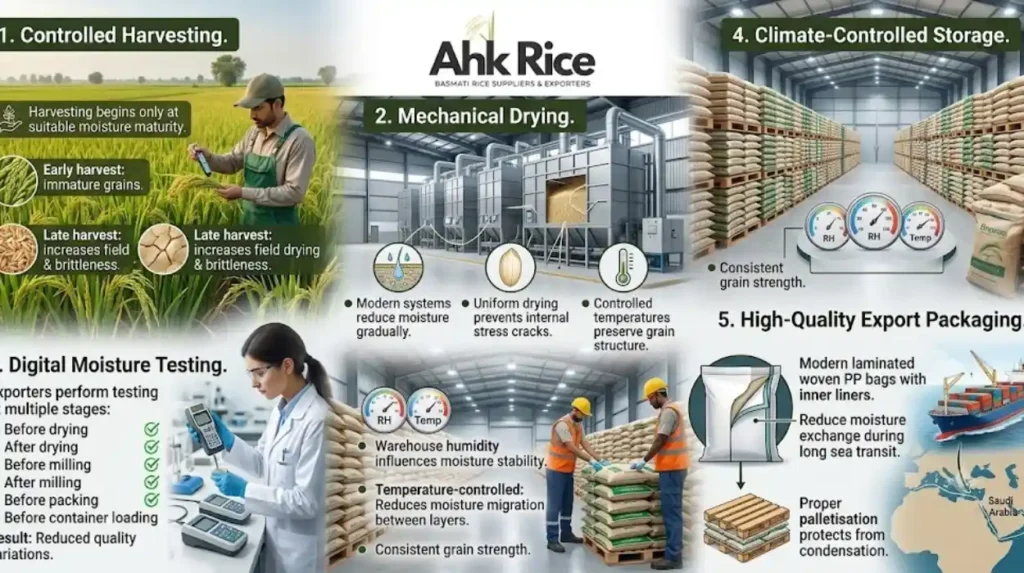
Several complementary moisture control solutions work together rather than independently. The strongest export systems integrate controlled harvesting, precision drying, digital moisture measurement, climate-controlled storage, and protective packaging to minimise grain breakage while maintaining export-grade quality throughout transportation to Saudi Arabia.
1. Controlled harvesting
Harvesting begins only after crop maturity reaches suitable moisture conditions.
Early harvesting produces immature grains.
Late harvesting increases field drying and brittleness.
2. Mechanical drying
Modern drying systems reduce moisture gradually.
Uniform drying prevents stress cracks inside kernels.
Controlled temperatures preserve grain structure.
3. Digital moisture testing
Exporters perform testing at multiple stages:
- Before drying
- After drying
- Before milling
- After milling
- Before packing
- Before container loading
Multiple checkpoints reduce unexpected quality variations.
4. Climate-controlled storage
Warehouse humidity influences moisture stability.
Temperature-controlled facilities reduce moisture migration between grain layers.
This maintains consistent grain strength.
5. High-quality export packaging
Modern laminated woven PP bags with inner liners reduce moisture exchange during long sea transit.
Proper palletisation also protects bags from condensation.
How do export grades respond differently to moisture variation?
Premium export grades require tighter moisture consistency because long whole kernels command significantly higher market prices. Lower commercial grades tolerate slightly greater breakage, but moisture control remains essential for maintaining food safety, appearance, and customer acceptance.
Different Pakistan Basmati varieties respond differently during milling.
1121 Basmati has exceptionally long grains.
Its length creates higher commercial value but also increases sensitivity to improper moisture management.
Super Kernel Basmati demonstrates excellent cooking quality but still requires stable moisture to maintain whole grain recovery.
1509 Basmati offers high productivity and good milling performance while benefiting from controlled drying.
Premium Saudi retailers generally prioritise:
- High head rice percentage
- Uniform grain size
- Minimal broken kernels
- Bright appearance
- Excellent cooking elongation
Moisture directly influences every one of these quality characteristics.
How do Saudi Arabian buyers compare export grades and pricing?
Saudi importers evaluate moisture alongside grain purity, broken percentage, head rice recovery, appearance, ageing, and cooking performance. Premium grades with lower breakage consistently achieve stronger commercial positioning despite higher production costs and stricter quality management requirements.
Below is a general comparison based on 2026 international export trends.
Saudi Market Comparison
| Factor | Premium Retail Market | Food Service & Wholesale |
|---|---|---|
| Preferred grade | Extra-long premium Basmati | Standard premium Basmati |
| Broken tolerance | Very low | Moderate |
| Moisture consistency | Extremely important | Very important |
| Typical export price | Higher | Moderate |
| Visual appearance | Highest priority | High priority |
| Consumer expectations | Premium presentation | Value with quality |
| Purchase focus | Brand quality | Volume efficiency |
Indicative 2026 export pricing varies by variety, ageing period, packaging specifications, freight conditions, and contract volume. Premium extra-long Basmati typically commands a higher price per metric tonne than standard commercial grades because lower breakage improves milling recovery and market value.
How does shelf life compare under different moisture conditions?
Correct moisture significantly extends storage stability by reducing deterioration, preserving aroma, protecting grain appearance, and maintaining cooking quality. Poor moisture control shortens commercial shelf life through quality degradation, increased breakage, and elevated storage risks during international logistics.
Shelf Life Comparison
| Storage Condition | Expected Commercial Shelf Life |
|---|---|
| Recommended export moisture with controlled storage | Up to 24 months |
| Recommended moisture with standard warehouse storage | 18–24 months |
| Excess moisture exposure | Reduced stability |
| Excessively dry grain | Increased physical breakage |
| Poor warehouse humidity management | Faster quality deterioration |
Proper storage benefits exporters and Saudi importers equally.
Quality remains more consistent throughout wholesale distribution and retail sale.
What are the advantages and disadvantages of different moisture control strategies?
Every moisture control strategy improves export quality differently. Integrated quality management consistently produces the best commercial results because it addresses every stage where grain breakage can occur instead of solving only one processing problem.
| Strategy | Advantages | Limitations |
|---|---|---|
| Natural drying | Lower equipment cost | Weather dependent |
| Mechanical drying | Uniform moisture | Higher investment |
| Multiple moisture testing | Better quality assurance | Additional inspection time |
| Climate-controlled storage | Stable grain quality | Infrastructure cost |
| Premium export packaging | Better transit protection | Higher packaging expense |
Example 1
A shipment dried uniformly and tested before loading reaches Saudi Arabia with excellent head rice recovery and consistent appearance.
Example 2
Rice dried unevenly develops internal stress cracks.
Although grains appear normal before shipment, milling recovery declines and broken kernels increase.
Which moisture management method works best for different export situations?
The optimal approach depends on export objectives, customer specifications, shipment size, storage duration, and destination market requirements. Premium Saudi retail programmes benefit most from comprehensive moisture control throughout the entire export process rather than isolated quality inspections.
Decision Framework
| Export Situation | Recommended Approach | Reason | Expected Outcome | Priority |
|---|---|---|---|---|
| Premium retail | Full moisture control system | Highest quality | Maximum head rice yield | Very High |
| Food service | Controlled drying + testing | Consistent quality | Reduced breakage | High |
| Long storage | Climate-controlled warehousing | Moisture stability | Better shelf life | High |
| Mixed container exports | Multiple inspection points | Quality consistency | Lower claims | High |
| Custom branded exports | Integrated quality assurance | Brand protection | Premium customer satisfaction | Very High |
The strongest results always come from combining multiple quality management systems rather than depending on one technology alone.
What factors should importers evaluate before selecting a Pakistani Basmati supplier?
Supplier selection should focus on measurable quality controls instead of marketing claims. Reliable exporters provide documented moisture testing, calibrated inspection systems, consistent grading procedures, traceable processing records, and internationally recognised food safety certifications supporting every shipment.
Importers should evaluate several technical factors:
- Moisture testing procedures
- Milling recovery performance
- Head rice percentage
- Broken grain limits
- Processing technology
- Warehouse management
- Container loading procedures
- Packaging quality
- Export documentation
- Laboratory verification
Independent inspection before shipment further increases confidence.
Quality assurance should remain consistent from procurement through final export loading.
Moisture management is one of the most influential factors affecting grain breakage in Pakistan Basmati rice exported to Saudi Arabia. Stable moisture levels preserve kernel strength, improve milling recovery, reduce broken grains, protect cooking quality, and support longer commercial shelf life. Read
Reviewing verified moisture test reports before placing your next Pakistan Basmati rice import order
Modern exporters increasingly combine controlled harvesting, precision drying, repeated digital moisture testing, climate-managed storage, and protective export packaging to achieve consistent quality across international supply chains. These integrated systems help maintain premium Basmati characteristics from Punjab processing facilities to Saudi wholesalers, retailers, and food service businesses.
For importers evaluating suppliers, documented quality control processes are more valuable than general quality claims. Verified moisture management demonstrates that an exporter actively protects grain integrity before shipment, reducing quality variation and supporting dependable long-term supply relationships.
Frequently Asked Questions
What is the ideal moisture level for Pakistan Basmati rice exported to Saudi Arabia?
The ideal moisture content for export-quality Pakistan Basmati rice is generally between 12.5% and 14%, depending on buyer specifications and export contracts. Maintaining this range helps reduce grain breakage, preserves cooking quality, and supports longer shelf life.
Why does low moisture increase grain breakage?
When rice becomes too dry, the kernels lose flexibility and become brittle. During milling, polishing, packaging, and transport, these brittle grains are more likely to crack, increasing the percentage of broken rice.
How is moisture content measured before exporting Basmati rice?
Exporters use calibrated digital moisture meters at multiple stages, including after harvesting, drying, milling, storage, and before container loading. Regular testing ensures the shipment meets customer and international quality requirements.
Does moisture content affect the shelf life of Basmati rice?
Yes. Proper moisture levels help maintain aroma, texture, and grain quality for up to 24 months under suitable storage conditions. Excess moisture or overly dry rice can shorten shelf life and reduce commercial value.
Which Pakistan Basmati varieties require the most precise moisture control?
Premium long-grain varieties such as 1121 Basmati, Super Kernel Basmati, and 1509 Basmati all benefit from precise moisture management. Because 1121 has exceptionally long kernels, it requires particularly careful handling to minimise breakage.
Why do Saudi Arabian importers request moisture test reports?
Moisture test reports verify that the rice meets agreed quality specifications before shipment. These reports help importers reduce quality risks, maintain consistent product standards, and protect the value of premium Basmati rice imports.