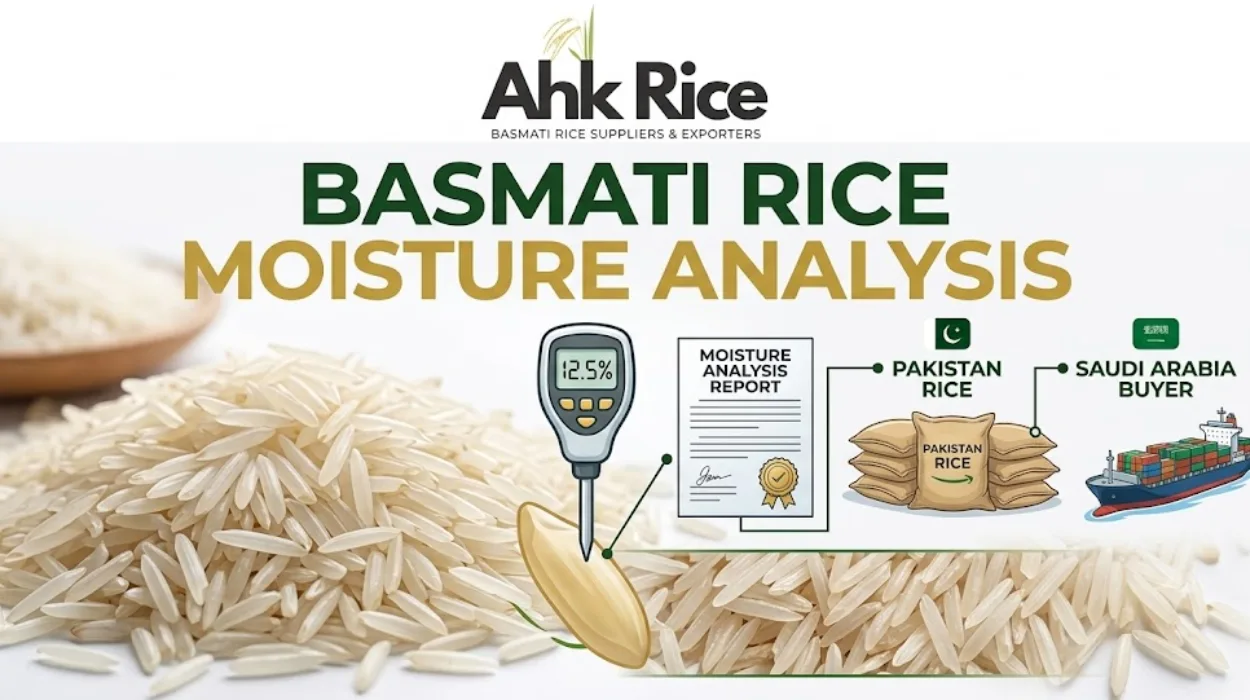
Pakistan Basmati Rice Exporter Providing Moisture Analysis Reports for Saudi Buyers
Saudi Arabian rice buyers reduce import risk by choosing a Pakistan Basmati rice exporter that provides verified moisture analysis reports before shipment. Laboratory-backed testing, transparent documentation, and controlled logistics help protect grain quality, simplify customs procedures, reduce storage losses, and ensure the rice reaches distributors, wholesalers, and food service businesses in the expected condition. Before comparing suppliers, it is useful to understand how moisture testing is performed before export, as explained in our guide:
How Is Moisture Content Tested in Pakistan Basmati Rice Before Export to Saudi Arabia?
When evaluating exporters, buyers should also compare the types of moisture certificates and laboratory reports provided by suppliers. Our detailed guide:
What Moisture Test Reports Do Saudi Arabian Rice Importers Request from Pakistan Suppliers?, explains the documents that experienced Saudi importers commonly request before confirming large-volume orders.
What is the best solution for ensuring moisture-safe Pakistan Basmati rice exports to Saudi Arabia?
The most reliable solution is selecting an exporter that performs standardized moisture testing, documents every production lot, stores rice under controlled conditions, verifies moisture before container loading, and provides complete reports with every shipment. This approach reduces commercial risk, improves storage stability, and supports smoother import clearance throughout Saudi Arabia.
Moisture content directly affects the commercial value of exported Basmati rice. Excess moisture increases the possibility of fungal development, grain discoloration, reduced shelf life, and quality disputes after arrival. Low moisture can also reduce grain weight and negatively influence cooking performance.
AHK Rice follows moisture verification throughout processing rather than testing only at the final stage. Every export batch is evaluated before packing, after packing when required, and immediately before container loading to confirm consistency.
Saudi Arabian importers generally prefer documented moisture values because warehouse conditions vary between Jeddah, Dammam, Riyadh, and other distribution centers. Maintaining export moisture within internationally accepted specifications helps preserve rice quality during ocean freight and local storage.
The first mention of our Saudi Arabia export services explains how AHK Rice manages quality control, documentation, packaging, and shipment planning specifically for Saudi buyers.
AHK Rice also provides traceable laboratory records that match production lots, helping buyers maintain quality assurance records for wholesalers, supermarkets, hospitality companies, and institutional food service operations.
Why choose Saudi Arabia export services from AHK Rice?
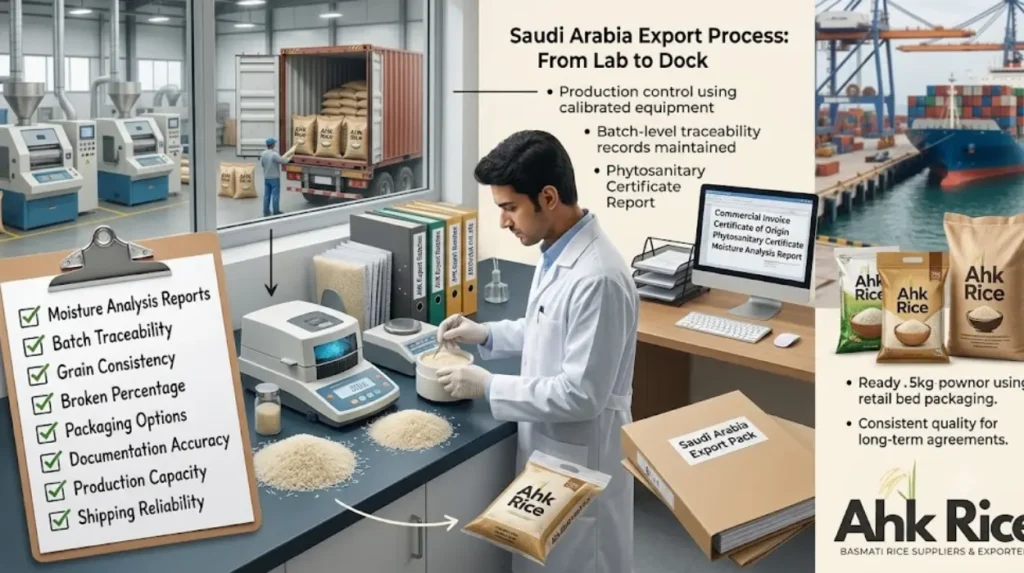
Saudi Arabian buyers benefit from exporters that combine laboratory testing, production control, export documentation, packaging flexibility, dependable shipping schedules, and responsive communication. A structured export process minimizes uncertainty, supports repeat purchasing, and creates confidence throughout every stage of international rice procurement and delivery.
Choosing an exporter involves much more than comparing prices.
Saudi buyers normally evaluate:
- Moisture analysis reports
- Batch traceability
- Grain consistency
- Broken percentage
- Packaging options
- Documentation accuracy
- Production capacity
- Shipping reliability
AHK Rice integrates these requirements into one export workflow.
Each production lot is processed using calibrated equipment before moisture testing is completed. Laboratory records are maintained alongside production references, allowing buyers to match reports with individual export batches.
Packaging options include retail packs, food service bags, and bulk export packaging depending on importer requirements.
Export documentation typically includes commercial invoices, packing lists, certificates of origin, phytosanitary certificates where applicable, fumigation certificates when required, and moisture analysis reports requested by buyers.
Because Saudi importers often purchase multiple containers over long-term agreements, consistency becomes more valuable than occasional low pricing.
AHK Rice focuses on repeatable quality standards rather than variable shipment quality.
What results can buyers expect from moisture analysis reports?
Verified moisture reports provide measurable quality assurance before shipment, reduce inspection disputes, improve storage performance, support predictable cooking quality, lower the risk of moisture-related claims, and help buyers confidently distribute Pakistan Basmati rice across Saudi Arabia’s wholesale and retail markets after import.
Importers purchasing without documented moisture analysis assume greater commercial risk.
Laboratory reports provide confidence before containers leave Pakistan.
Expected outcomes include:
- Better storage stability
- Reduced condensation risk during transport
- Lower probability of mould development
- Improved grain appearance
- More consistent cooking performance
- Easier warehouse management
- Greater confidence for downstream buyers
For distributors supplying supermarkets, documented quality reduces customer complaints.
For food service businesses, moisture consistency contributes to predictable cooking yields.
For wholesalers, verified reports simplify negotiations with secondary buyers because objective quality documentation already exists.
AHK Rice prepares moisture reports using recognized testing procedures before shipment. Buyers receive documentation that corresponds with the exported production lot.
This documentation becomes particularly valuable when multiple containers are imported over several months because quality consistency can be monitored across every shipment.
How long does shipping take from Pakistan to Saudi Arabia?
Transit time depends on the destination port, shipping schedule, customs processing, and container availability. Planning production together with vessel booking helps buyers receive products according to agreed commercial timelines while maintaining moisture-controlled handling throughout the export process and international transportation.
Although vessel schedules change throughout the year, average shipping timelines during 2026 generally fall within these ranges.
| Saudi Destination | Typical Sea Transit After Departure |
|---|---|
| Jeddah Islamic Port | 8–12 days |
| Dammam | 10–15 days |
| King Abdullah Port | 8–12 days |
| Jubail | 11–16 days |
Production normally requires additional preparation before shipment.
Typical export workflow includes:
| Stage | Estimated Duration |
|---|---|
| Order confirmation | 1 day |
| Production scheduling | 2–3 days |
| Processing and grading | 2–4 days |
| Laboratory moisture testing | 1 day |
| Packaging | 1–2 days |
| Container loading | 1 day |
| Export documentation | 1–2 days |
AHK Rice coordinates production with shipping schedules to reduce warehouse waiting time before vessel departure.
Planning ahead becomes especially important during periods of increased export demand.
How does the sample process work, and what does it cost?
Professional exporters provide representative samples before production confirmation, allowing buyers to evaluate grain quality, moisture levels, cooking characteristics, packaging suitability, and commercial specifications before placing larger purchase orders for container shipments to Saudi Arabia.
Sampling reduces uncertainty.
Instead of relying only on specifications, buyers can physically inspect the rice.
A typical process includes:
Step 1 – Requirement discussion
The buyer specifies variety, grain length, packaging, moisture expectations, broken percentage, and order quantity.
Step 2 – Sample preparation
Representative samples are selected from available production lots.
Step 3 – Laboratory verification
Moisture testing is completed before dispatch when requested.
Step 4 – International courier
Samples are shipped using international courier services.
Step 5 – Buyer evaluation
The importer evaluates appearance, aroma, cooking quality, moisture consistency, and packaging.
Step 6 – Commercial confirmation
Production begins after approval.
Typical sample-related costs during 2026 include:
| Item | Typical Cost Range |
|---|---|
| Product sample | Often complimentary for qualified buyers |
| Laboratory moisture analysis | USD 20–50 depending on scope |
| Courier delivery | USD 45–120 depending on destination and weight |
| Additional laboratory testing | Based on requested analyses |
AHK Rice discusses sampling requirements before dispatch so buyers understand which services are included and which independent laboratory analyses may involve additional charges.
What factors affect the overall export price?
Export pricing depends on rice variety, grade, moisture specification, packaging, laboratory testing requirements, order volume, freight rates, seasonal harvest conditions, and destination logistics. Evaluating the complete delivered value usually produces better purchasing decisions than comparing product price alone across suppliers.
Several variables influence final pricing.
Rice variety is one of the largest factors.
Premium aged Basmati generally commands higher prices than recently processed rice.
Packaging also changes costs.
Retail packaging requires additional materials and production compared with bulk export sacks.
Laboratory testing requirements may increase quality assurance expenses when buyers request expanded analytical reports beyond standard moisture verification.
Ocean freight fluctuates according to shipping market conditions.
Container availability also affects transportation costs during periods of high demand.
Large contracts often improve production efficiency because fixed costs are distributed across greater shipment volumes.
AHK Rice discusses these variables transparently before contract confirmation so buyers understand the complete commercial structure rather than only the product price.
How can Saudi buyers get started with a reliable Pakistan Basmati rice exporter?
Successful import projects begin with clear specifications, transparent communication, documented quality requirements, representative sampling, confirmed production planning, and complete export documentation. Following a structured procurement process significantly improves long-term supplier relationships and reduces avoidable commercial risks for both parties throughout international trade.
The first step is defining the exact commercial specification.
This includes:
- Rice variety
- Grade
- Required moisture level
- Packaging format
- Quantity
- Destination port
- Delivery schedule
- Documentation requirements
The exporter then prepares a commercial proposal based on these specifications.
Sample approval follows before production begins.
Laboratory moisture verification is completed before shipment documentation is finalized.
Containers are loaded according to agreed specifications before export.
Throughout this process, AHK Rice maintains communication with buyers regarding production progress, documentation, vessel schedules, and shipment status.
For Saudi importers seeking dependable quality, laboratory-backed moisture analysis, structured export procedures, and transparent documentation, selecting an experienced exporter reduces uncertainty throughout the supply chain.
Frequently Asked Questions
What is a moisture analysis report for Pakistan Basmati rice?
A moisture analysis report is a laboratory document that verifies the moisture percentage of a rice shipment before export. It helps Saudi buyers confirm quality, storage stability, and compliance with agreed specifications.
What documents are provided with a Saudi Arabia rice shipment?
Typical export documents include the commercial invoice, packing list, certificate of origin, phytosanitary certificate (where required), fumigation certificate (if requested), and moisture analysis report.
How does the sample approval process work?
The exporter prepares representative rice samples, conducts requested laboratory testing, ships the samples by courier, and begins production only after the buyer approves the sample.
Is the product sample free?
Many exporters provide complimentary product samples for qualified buyers, while courier charges and specialized laboratory testing are usually billed separately.
What affects the export price of Pakistan Basmati rice?
Pricing depends on the rice variety, grade, moisture specification, packaging type, order quantity, laboratory testing requirements, freight costs, and seasonal market conditions.
Why should buyers choose AHK Rice?
AHK Rice provides moisture-controlled processing, laboratory-backed quality reports, flexible packaging options, transparent documentation, and reliable export support for Saudi importers.
How can I request a quotation from AHK Rice?
You can submit your product specifications, required quantity, packaging preferences, destination port, and documentation requirements through the AHK Rice request form to receive a customized export quotation.