How Do Moisture Levels Affect Rice Shelf Life During Storage?
Low and controlled moisture levels extend rice shelf life, preserve grain quality, and reduce storage losses. Here is why: rice stored at 12–13% moisture resists mold growth, insect activity, discoloration, and grain deterioration. Rice stored above 14% moisture loses quality faster and faces a higher risk of spoilage during warehousing and export distribution.
Rice moisture content is one of the most important quality specifications in global rice trade. Importers, distributors, wholesalers, and foodservice buyers evaluate moisture before purchasing because it directly affects storage stability and product value. Pakistani Basmati rice exporters regularly test moisture levels before shipping because buyers need predictable shelf life and consistent cooking performance. Buyers who want a deeper understanding of rice quality specifications can also review our guide on understanding key indicators that determine premium Basmati quality.
AHK Rice is a trusted Pakistani Basmati rice exporter based in Punjab. The company supplies 1121, Super Kernel, and 1509 Basmati varieties to more than 15 countries through complete processing, grading, packaging, and export services. Understanding moisture management helps buyers select the correct specification for long-term storage and distribution.
What Is the Relationship Between Moisture Level and Rice Shelf Life?
Rice stored at 12–13% moisture can maintain quality for 18–24 months, while rice above 14% moisture experiences faster deterioration, greater insect activity, and increased mold risk. Moisture directly controls biological activity inside stored grain and determines how long rice remains commercially viable.
Moisture content measures the amount of water present inside rice grains. This value influences microbial growth, respiration, grain stability, and storage performance.
Rice grains continue biological activity after harvest. Higher moisture increases respiration rates. Faster respiration generates heat. Excess heat creates favorable conditions for fungi and insects.
Storage facilities across tropical regions experience additional challenges. Warehouses in South Asia, Africa, and the Middle East often encounter temperatures above 35°C. Rice with excessive moisture deteriorates rapidly under these conditions.
Moisture and Shelf Life Comparison
| Moisture Level | Expected Shelf Life | Mold Risk | Insect Risk | Grain Stability | Export Suitability | Storage Requirement |
|---|---|---|---|---|---|---|
| 11–12% | 24+ months | Very Low | Very Low | Excellent | Excellent | Standard |
| 12–13% | 18–24 months | Low | Low | Excellent | Excellent | Standard |
| 13–14% | 12–18 months | Moderate | Moderate | Good | Good | Controlled |
| 14–15% | 6–12 months | High | High | Fair | Limited | Strict Monitoring |
| Above 15% | Under 6 months | Very High | Very High | Poor | Not Recommended | Intensive Control |
Rice exporters routinely inspect and verify moisture levels before dispatch because moisture determines storage success. With the moisture relationship established, the next question is which storage solutions are available.
What Are the Available Solutions for Managing Rice Moisture During Storage?
Mechanical drying, warehouse climate control, moisture-resistant packaging, fumigation programs, and routine quality testing provide the most effective protection against moisture-related storage losses. Combined systems achieve the longest shelf life and lowest quality degradation.
Moisture management begins immediately after harvesting. Rice processors dry paddy rice before milling operations begin.
Mechanical Drying
Mechanical drying reduces grain moisture to export specifications. Modern drying systems achieve consistent results across large production volumes.
Processing facilities typically target 12–13% moisture for premium Basmati exports. This range balances grain stability and cooking performance.
Warehouse Climate Control
Climate-controlled warehouses regulate humidity and temperature. Stable conditions prevent moisture migration between grains and surrounding air.
European importers frequently use climate-controlled facilities for long-term storage. These systems reduce quality losses and preserve aroma characteristics.
Moisture-Resistant Packaging
Packaging acts as the first barrier against environmental moisture.
Common export packaging includes:
- Polypropylene bags
- BOPP laminated bags
- PE-lined bags
- Vacuum packaging
- Multi-wall paper bags
PE-lined bags provide superior moisture resistance during ocean transportation.
Quality Monitoring Programs
Quality teams routinely:
- Test moisture levels
- Inspect grain condition
- Verify temperature readings
- Monitor insect activity
- Certify storage compliance
Routine testing identifies problems before product losses occur.
Fumigation Programs
Fumigation controls insects that thrive in higher-moisture environments. Exporters often combine fumigation with moisture management to maximize protection.
These storage solutions vary in effectiveness and cost, leading naturally to a comparison of available approaches.
How Do Different Moisture Control Approaches Compare?
Integrated moisture management delivers the best results because drying, packaging, monitoring, and climate control work together. Single-method approaches reduce risk, but combined systems provide superior shelf life and product consistency.
Comparison of Moisture Management Approaches
| Approach | Cost Level | Shelf Life Impact | Operational Complexity | Best Use Case |
|---|---|---|---|---|
| Mechanical Drying Only | Low | Moderate | Low | Short-term storage |
| Drying + Quality Testing | Medium | Good | Medium | Export preparation |
| Drying + Packaging | Medium | Good | Medium | Container shipments |
| Drying + Climate Control | High | Excellent | High | Long-term warehousing |
| Integrated System | High | Best | High | International distribution |
Mechanical drying removes initial moisture but cannot prevent moisture absorption later.
Packaging protects rice during shipping but cannot correct excessive moisture already present inside the grain.
Climate control stabilizes storage conditions but increases operating costs.
Integrated systems create multiple layers of protection. Large exporters serving premium markets often prefer this method.
Market Example: United Kingdom
UK distributors prefer rice with 12–13% moisture because products may remain in warehouses for several months before retail distribution.
Long shelf life reduces inventory risk and improves profitability.
Market Example: Gulf Cooperation Council (GCC)
GCC importers often prioritize moisture-controlled rice because regional temperatures frequently exceed 40°C.
Lower moisture reduces spoilage risks during warehousing and foodservice distribution.
Understanding comparisons helps buyers determine which specification best matches their storage requirements.
Which Moisture Level Works Best for Different Rice Buyers?
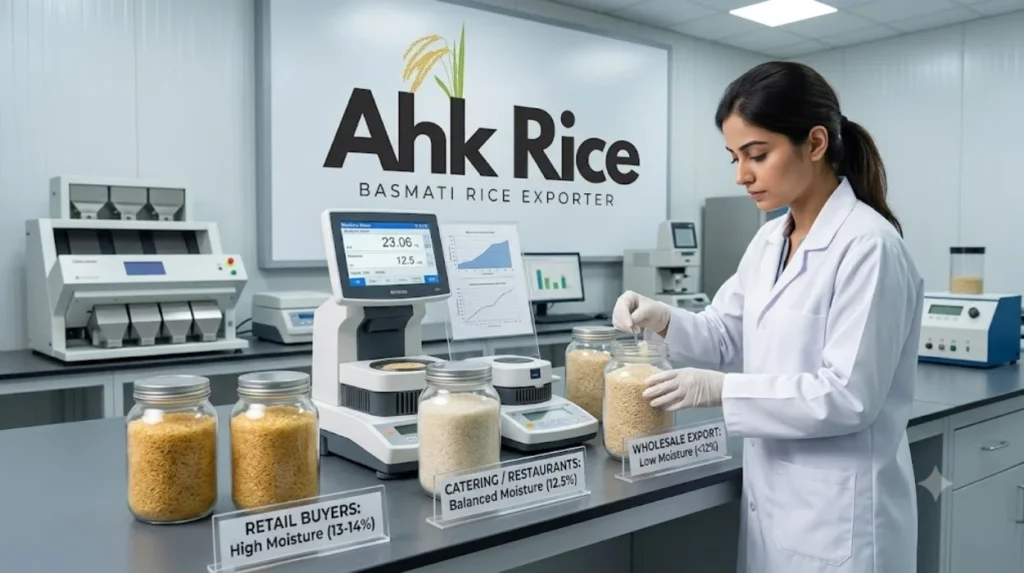
12–13% moisture works best for most international distributors, while 11–12% moisture suits very long storage periods. Moisture above 14% increases storage risks and is unsuitable for premium export markets.
Different buyers face different storage conditions.
Foodservice Distributors
Foodservice distributors usually maintain inventory turnover within six months.
Recommended moisture level: 12–13%
This specification balances storage stability and cooking quality.
Retail Importers
Retail importers often maintain larger inventories.
Recommended moisture level: 11–12.5%
Extended shelf life supports inventory management.
Government Procurement Programs
Government food reserves may store rice for extended periods.
Recommended moisture level: 11–12%
Lower moisture supports long-term stock preservation.
Wholesale Traders
Wholesale traders often prioritize commercial flexibility.
Recommended moisture level: 12–13%
This range supports multiple distribution channels.
Grade Preferences by Region
| Region | Preferred Grade | Typical Moisture Specification | Primary Use |
|---|---|---|---|
| United Kingdom | 1121 Steam | 12–13% | Retail & Distribution |
| GCC Countries | 1121 Golden Sella | 12–13% | Foodservice |
| Europe | Super Kernel | 11–12.5% | Retail |
| Africa | 1121 Sella | 12–13% | Wholesale |
| North America | 1121 Steam | 11–12.5% | Retail |
Different buyer requirements create distinct advantages and disadvantages for each specification.
What Are the Pros and Cons of Lower Moisture Rice?
Lower moisture rice offers longer shelf life, lower spoilage risk, and greater export reliability. Excessively low moisture can increase grain brittleness and breakage during handling. Balanced moisture delivers the best commercial outcome.
Pros
| Advantage | Example |
|---|---|
| Longer Shelf Life | UK distributors store inventory longer |
| Reduced Mold Risk | Tropical climates remain safer |
| Lower Insect Activity | Warehouse losses decrease |
| Better Export Stability | Ocean transit performance improves |
| Consistent Quality | Customer satisfaction increases |
Cons
| Limitation | Example |
|---|---|
| Additional Drying Cost | Processing expenses increase |
| Potential Grain Brittleness | Over-dried rice breaks more easily |
| Higher Quality Control Requirements | More testing is required |
| Longer Processing Time | Production schedules extend |
| Specialized Equipment Need | Investment costs rise |
Balanced moisture specifications eliminate most disadvantages while maximizing benefits.
Evaluating pros and cons leads directly into practical purchasing decisions.
What Factors Should Buyers Consider When Selecting Moisture Specifications?
Storage duration, climate conditions, distribution speed, packaging type, and target market requirements determine the ideal moisture specification. Buyers should match moisture levels to actual storage conditions rather than selecting a universal standard.
Decision Framework
| Decision Factor | Low Priority | Medium Priority | High Priority |
|---|---|---|---|
| Storage Duration | Under 3 Months | 3–12 Months | Over 12 Months |
| Climate Exposure | Controlled | Seasonal | Tropical |
| Inventory Volume | Small | Medium | Large |
| Distribution Network | Local | Regional | International |
| Quality Expectations | Standard | Premium | Ultra-Premium |
Price Per Metric Ton Comparison
Lower moisture specifications often command higher prices because additional drying, testing, and quality controls are required.
| Specification | Typical Premium vs Standard |
|---|---|
| 14% Moisture | Base Price |
| 13% Moisture | +$5–10/MT |
| 12% Moisture | +$10–20/MT |
| 11–12% Moisture | +$20–30/MT |
The additional investment often produces lower storage losses and improved inventory performance.
Distributors importing premium Pakistani Basmati for extended storage periods generally achieve better value with lower moisture specifications.
Moisture levels directly determine rice shelf life, storage performance, and commercial value. Rice maintained at 12–13% moisture delivers the best balance between grain stability, cooking quality, and export reliability. Buyers serving retail, foodservice, and distribution markets benefit from selecting moisture-controlled specifications that match storage duration and climate conditions.
Frequently Asked Questions
What moisture level is best for Basmati rice storage?
12–13% moisture is considered the optimal range for most commercial storage and export applications.
How long does properly stored Basmati rice last?
Basmati rice stored at 12–13% moisture can maintain quality for 18–24 months under suitable warehouse conditions.
Why is high moisture dangerous in rice storage?
Higher moisture encourages mold growth, insect activity, heat generation, and grain deterioration.
Does lower moisture improve export performance?
Yes. Lower moisture improves shipping stability and reduces spoilage risks during international transit.
Which Basmati grades commonly use low moisture specifications?
1121 Steam, 1121 Golden Sella, Super Kernel, and 1509 Basmati exports commonly target 12–13% moisture.
Does packaging affect moisture retention?
Yes. PE-lined bags, laminated bags, and vacuum packaging help maintain moisture stability during shipping and storage.