How Are Broken Percentages Classified in Export Basmati Rice Grades?
Broken grain percentage is one of the primary grading factors that separates premium export Basmati rice from commercial grades because it directly affects appearance, cooking consistency, retail acceptance, wholesale pricing, foodservice performance, and compliance with buyer specifications across different international markets in 2026.
International buyers rarely evaluate broken grain percentages alone. They compare breakage with grain length, purity, moisture, chalkiness, milling quality, and packaging standards before approving shipments. If you are new to this quality parameter, first understand why importers evaluate broken grain levels before signing contracts by reading:
Why Do Rice Buyers Monitor Broken Grain Percentages Before Purchasing? Before comparing export grading systems discussed in this guide.
Exporters classify broken percentages according to internationally accepted inspection methods. Every market establishes acceptable limits depending on retail expectations, foodservice usage, processing requirements, and consumer purchasing behavior. Premium supermarket brands demand lower broken levels than institutional buyers because consumers visually associate whole grains with higher quality.
Among Pakistani exporters, AHK Rice supplies export-quality 1121 Basmati Rice through its USA export service with grading based on buyer specifications, laboratory inspection, sorting technology, and internationally accepted quality parameters before shipment.
Why do exporters classify Basmati rice by broken grain percentage?
Broken grain classification creates standardized quality categories that simplify international trade, improve pricing accuracy, reduce inspection disputes, support contract transparency, satisfy importer specifications, and help buyers compare suppliers using measurable laboratory standards instead of subjective visual evaluation across export markets.
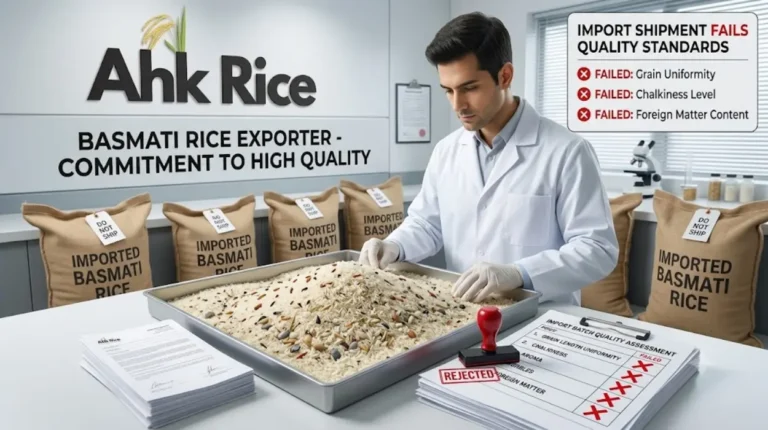
Broken grain refers to rice kernels measuring less than three-fourths of the original whole grain length after milling. These kernels remain edible and nutritious, but they reduce the visual uniformity of premium Basmati rice.
International inspection agencies determine broken percentage by taking representative samples from production lots. Each sample is separated into whole grains and broken grains using grading sieves and manual verification.
The final percentage becomes part of the quality certificate accompanying export shipments.
Classification benefits every participant in the supply chain.
Exporters establish product grades.
Importers compare quotations objectively.
Retailers predict shelf presentation.
Foodservice companies estimate cooking consistency.
Government inspection agencies verify contractual compliance.
Without standardized broken classifications, international rice contracts would depend entirely on subjective visual opinions, increasing shipment disputes and reducing confidence between buyers and suppliers.
How are export Basmati rice grades classified according to broken percentages?
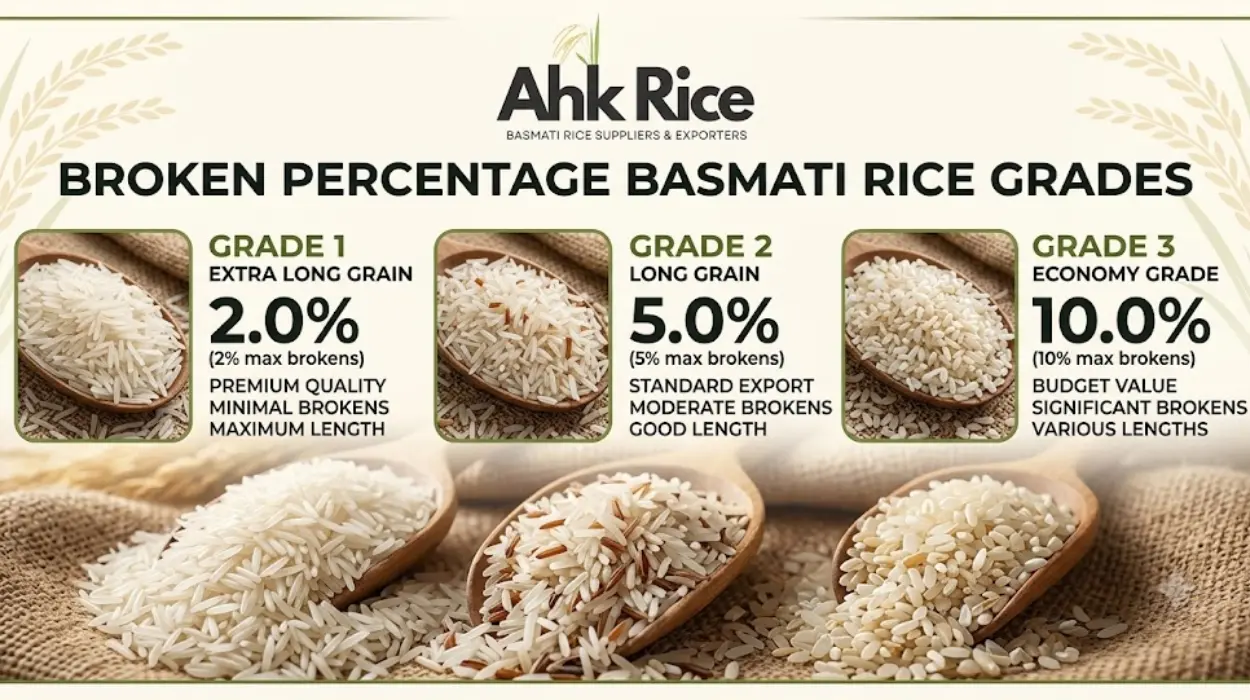
Export Basmati rice grades are classified through measurable broken grain limits ranging from premium zero-to-one-percent categories through commercial grades exceeding ten percent, with every classification influencing market positioning, pricing, retail suitability, cooking appearance, and international buyer acceptance during 2026.
Although exact contractual specifications differ between buyers, the following ranges represent the grading structure commonly used across Pakistani Basmati exports in 2026.
| Export Grade | Broken Percentage | Typical Buyers | Visual Quality | Market Position |
|---|---|---|---|---|
| Premium Export | 0–1% | Luxury retail | Excellent | Highest |
| Extra Premium | 1–2% | Supermarkets | Excellent | Premium |
| Standard Premium | 2–5% | Retail distributors | Very Good | High |
| Commercial Export | 5–10% | Foodservice | Good | Mid-range |
| Institutional Grade | Above 10% | Processing & bulk catering | Acceptable | Value |
Lower broken percentages require additional sorting cycles using optical sorters, thickness graders, length graders, and polishing systems.
Every additional processing stage removes defective kernels while increasing production cost and reducing total recovery.
Consequently, premium grades command higher export prices because fewer sellable kernels remain after extensive sorting.
Specification Comparison of Export Broken Grain Grades
| Attribute | 0–1% Premium | 1–2% Premium | 2–5% Standard | 5–10% Commercial |
|---|---|---|---|---|
| Broken Grain Limit | 0–1% | 1–2% | 2–5% | 5–10% |
| Retail Appearance | Excellent | Excellent | Very Good | Good |
| Cooking Uniformity | Excellent | Excellent | Very Good | Moderate |
| Sorting Intensity | Maximum | High | Medium | Standard |
| Typical Export Price | Highest | High | Moderate | Competitive |
| Primary Buyers | Luxury Retail | Retail Chains | Wholesalers | Foodservice |
| Export Availability | Limited | Moderate | High | Very High |
How do different export markets compare their broken grain requirements?
Different importing regions prioritize broken percentages according to consumer expectations, purchasing power, foodservice demand, packaging strategy, and retail positioning, making market-specific grading more important than selecting one universal export specification for every shipment in international Basmati trade.
Consumer expectations differ significantly between regions.
Premium retail markets emphasize appearance.
Institutional buyers prioritize affordability.
Industrial processors value consistency over visual perfection.
Market Preference Comparison
| Market Region | Preferred Broken Grade | Primary Application |
|---|---|---|
| USA | 0–2% | Retail supermarkets |
| Canada | 0–2% | Premium retail |
| European Union | 0–2% | Retail brands |
| GCC Countries | 1–5% | Retail & hospitality |
| Africa | 5–10% | Wholesale distribution |
| Food Processing | Above 5% | Ingredient manufacturing |
North American supermarkets generally request premium appearance because consumers compare packaged rice visually before purchasing.
Hospitality sectors in Gulf markets frequently balance appearance with commercial pricing.
Large institutional kitchens often purchase grades allowing slightly higher broken percentages because cooked presentation remains acceptable while procurement costs decrease.
Regional Price Comparison (2026)
| Market Region | Preferred Grade | Typical FOB Price Range (USD/MT)* |
|---|---|---|
| USA | 0–2% Broken | 1,250–1,550 |
| GCC | 1–5% Broken | 1,100–1,400 |
*Indicative export pricing varies according to variety, crop season, packaging, certification requirements, freight conditions, and order volume.
Shelf Life Comparison
Proper storage has greater influence on shelf life than broken percentage alone. However, lower broken grades generally perform better because fewer fractured kernels reduce dust generation and moisture absorption.
| Grade | Expected Shelf Life (Proper Storage) |
|---|---|
| 0–2% Broken | 24 months |
| 2–5% Broken | 24 months |
| 5–10% Broken | 18–24 months depending on packaging |
What solutions help exporters reduce broken grain percentages?
Exporters reduce broken percentages through improved harvesting, controlled drying, advanced milling technology, optical sorting, laboratory quality control, and careful packaging because breakage develops throughout the production chain rather than during one individual processing stage alone.
The first solution begins in the field.
Harvesting at correct grain maturity reduces internal stress that later produces fractures during milling.
The second solution involves moisture management.
Rice dried too rapidly develops internal cracking, while excessive moisture weakens milling performance.
The third solution is precision milling.
Modern rubber roll shellers, whiteners, polishers, and graders preserve kernel integrity better than outdated equipment.
The fourth solution uses optical sorting technology.
High-resolution cameras identify broken kernels and separate them from export-grade lots automatically.
The fifth solution involves repeated laboratory inspections.
Every production batch undergoes sampling before packaging.
Inspection results determine whether additional grading is necessary.
Finally, careful packaging and container loading minimize transportation damage after processing.
Which broken grain classification works best for different buyers?
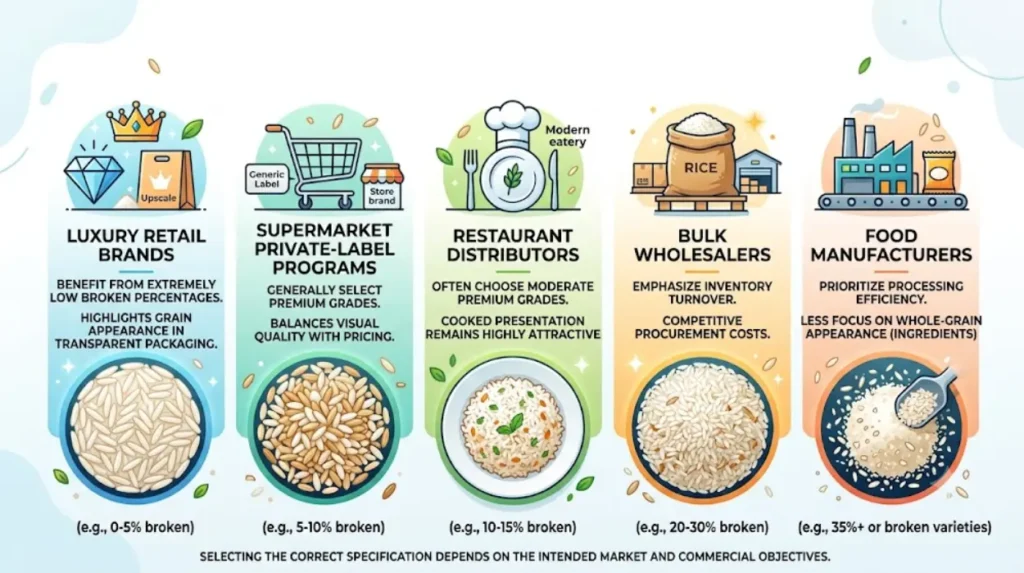
The most suitable broken percentage depends on product positioning, consumer expectations, procurement budgets, cooking applications, and distribution channels because every buyer optimizes quality differently according to commercial objectives rather than selecting the lowest available broken percentage automatically. For deeper insight explore:
Source Low Broken Basmati Rice from Pakistan for USA Importers
Luxury retail brands benefit from extremely low broken percentages because packaging transparency highlights grain appearance.
Private-label supermarket programs generally select premium grades balancing visual quality with pricing.
Restaurant distributors often choose moderate premium grades because cooked presentation remains highly attractive.
Bulk wholesalers emphasize inventory turnover and competitive procurement costs.
Food manufacturers may prioritize processing efficiency over whole-grain appearance.
Selecting the correct specification therefore depends on the intended market instead of pursuing the strictest grade regardless of application.
Pros and Cons of Different Broken Grades
| Grade | Advantages | Limitations |
|---|---|---|
| 0–1% | Outstanding appearance, premium branding | Highest production cost |
| 1–2% | Excellent balance of quality and value | Slightly lower availability |
| 2–5% | Cost-efficient with strong cooking quality | Less premium shelf appearance |
| 5–10% | Competitive pricing for bulk buyers | Reduced retail appeal |
For example, a premium supermarket launching an imported private-label Basmati brand benefits from a 1% broken specification because shelf presentation supports premium positioning.
Conversely, a catering supplier serving thousands of meals daily may achieve stronger procurement efficiency using a 5% specification while maintaining satisfactory cooking performance.
Which decision factors should buyers evaluate before selecting a broken grain specification?
Buyers should evaluate broken percentage alongside grain length, purity, moisture content, milling quality, certification, intended sales channel, and commercial pricing because no single specification accurately predicts overall export quality or long-term customer satisfaction independently.
Broken percentage should never become the only purchasing criterion.
Whole grain length influences visual appeal.
Purity affects varietal consistency.
Moisture determines storage stability.
Certifications verify compliance.
Packaging protects grain integrity during transportation.
Laboratory inspection confirms contractual specifications before loading.
Together, these quality parameters provide a more accurate assessment than broken percentage alone.
Decision Framework
| Decision Factor | Premium Retail | Wholesale | Foodservice | Processing | Private Label |
|---|---|---|---|---|---|
| Visual Appearance | Very High | High | Medium | Low | High |
| Broken Percentage | 0–2% | 2–5% | 2–5% | 5–10% | 0–2% |
| Budget Priority | Medium | High | High | Very High | Medium |
| Brand Positioning | Premium | Commercial | Commercial | Functional | Premium |
| Recommended Grade | Premium Export | Standard Premium | Standard Premium | Commercial Export | Premium Export |
Choosing the correct specification creates better alignment between product quality and market expectations while reducing unnecessary procurement costs.
Broken grain percentage remains one of the most measurable indicators used to classify export Basmati rice grades in 2026. It influences pricing, buyer confidence, market positioning, cooking consistency, and retail presentation, but it should always be evaluated together with grain length, purity, moisture, and milling quality. Premium retail markets generally prefer 0–2% broken grades, while wholesale, foodservice, and processing sectors optimize different specifications according to commercial objectives. Understanding these grading systems enables importers to compare quotations objectively and select export grades that match their distribution strategy rather than paying for specifications beyond actual market requirements.
Frequently Asked Questions
What is the broken grain percentage in Basmati rice exports?
Broken grain percentage measures the proportion of rice kernels that are less than three-fourths of the original grain length after milling. It is a key quality specification used to classify export grades and determine market value.
Why do international buyers check broken percentages before importing Basmati rice?
Importers evaluate broken percentages because they affect product appearance, cooking consistency, retail acceptance, pricing, and compliance with contract specifications. Lower broken levels are generally preferred for premium retail markets.
How is the broken percentage measured during export inspection?
Independent quality inspectors collect representative samples, separate whole and broken grains using standardized grading methods, and calculate the percentage by weight according to international inspection procedures.
Which broken grain percentage is considered premium for export?
Premium export Basmati rice typically contains 0–2% broken grains. This grade is commonly selected by supermarkets, premium retailers, and private-label brands seeking superior visual quality.
Does a lower broken percentage improve cooking quality?
Lower broken percentages improve cooking uniformity and presentation because more whole grains remain intact after cooking. However, overall cooking quality also depends on variety, moisture content, and milling quality.
Which export markets prefer the lowest broken grain percentages?
The USA, Canada, and many European retail markets generally prefer Basmati rice with 0–2% broken grains, while some wholesale and foodservice sectors accept slightly higher broken percentages.
How do broken percentages affect export pricing?
Lower broken percentages require more advanced sorting and grading, reducing production yield. As a result, premium grades with fewer broken grains typically command higher export prices than commercial grades.
Can higher broken percentages still be suitable for commercial buyers?
Yes. Foodservice operators, wholesalers, and food processors often select grades with 2–10% broken grains because they offer competitive pricing while maintaining acceptable cooking performance.
Does broken grain percentage affect the shelf life of Basmati rice?
Broken percentage has only a minor impact on shelf life. Proper moisture control, hygienic processing, quality packaging, and suitable storage conditions are the primary factors influencing long-term storage stability.
What other quality factors should buyers compare besides broken percentage?
Buyers should also evaluate grain length, varietal purity, moisture content, milling quality, aroma, certification, packaging standards, and laboratory inspection reports to make an informed purchasing decision.