How Can Buyers Assess a Rice Exporter’s International Track Record?
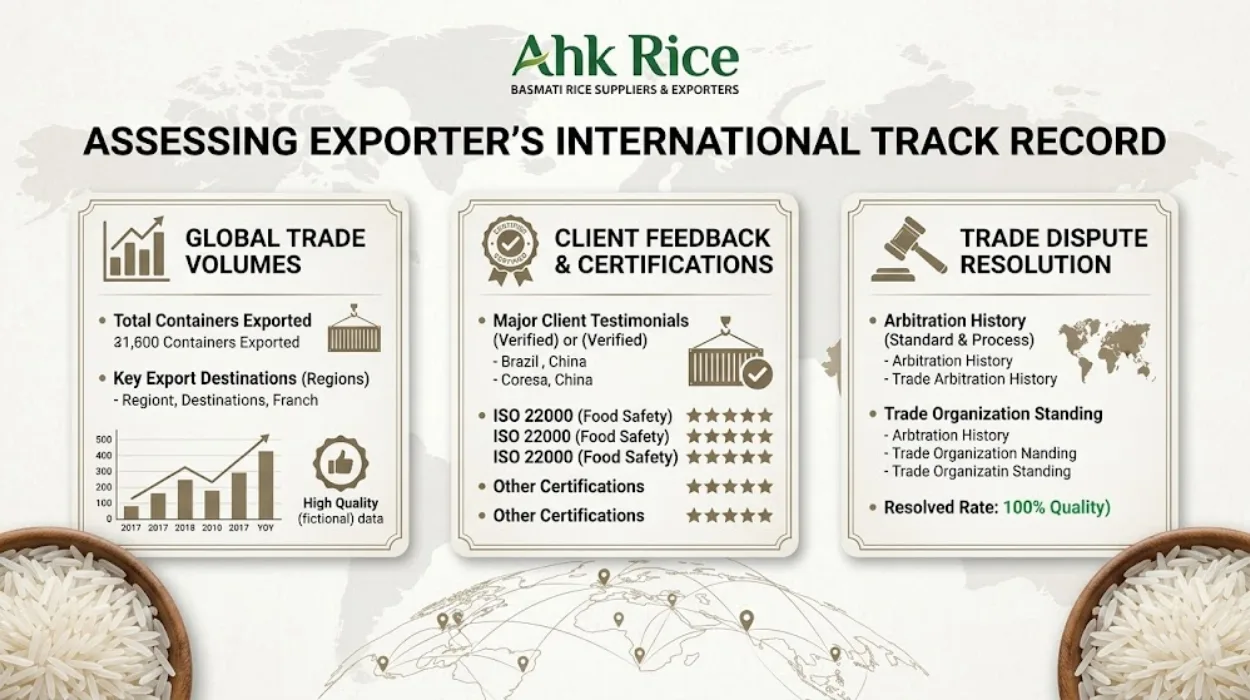
Buyers should assess export history through shipment evidence, destination coverage, repeat-order performance, documentation accuracy, product consistency, and claims handling rather than years in business alone. A strong international record demonstrates operational reliability across different markets, specifications, regulations, and logistics conditions.
International experience matters because rice exporting involves more than producing a specification. A supplier must coordinate sourcing, milling, grading, testing, packaging, documentation, container loading, customs procedures, and ocean freight. Pakistan’s rice sector remains globally significant in 2026. USDA forecasts Pakistan’s 2025/26 rice exports at about 4.7 million metric tons, while Basmati exports reached 326,591 metric tons during the first four months of the marketing year. Pakistani Basmati was trading around $1,000 per metric ton FOB in March 2026.
For buyers learning why a supplier’s previous international shipments matter, understanding:
Why export history matters when selecting rice suppliers provides the necessary foundation before comparing individual exporters.
What are the available solutions for assessing an exporter’s international track record?
Buyers have four practical assessment solutions: export-document verification, customer and shipment reference checks, market-by-market trade-data analysis, and a supplier audit. Combining these methods creates stronger evidence because each method measures a different part of international execution reliability across the supply chain.
1. Export-document verification
Export documents provide direct evidence of international trading activity. Buyers can request redacted Bills of Lading, Certificates of Origin, commercial invoices, packing lists, phytosanitary certificates, fumigation certificates, and inspection reports.
A Bill of Lading identifies the exporter, consignee, vessel, loading port, destination port, shipment date, and cargo information. It therefore helps establish whether an exporter has handled actual international shipments.
The documents should match the supplier’s claimed markets and product categories. A supplier claiming extensive USA experience should be able to demonstrate familiarity with American import documentation, destination requirements, packaging specifications, and port procedures.
2. Customer and shipment references
References measure performance that documents cannot fully establish. A buyer can ask for references from importers, distributors, wholesalers, foodservice companies, or private-label customers.
Useful questions include shipment frequency, specification consistency, communication quality, documentation accuracy, delivery performance, and claims resolution.
One reference is insufficient. Three references across different markets provide a stronger commercial picture. A repeat buyer is particularly valuable because repeated orders indicate that the supplier maintained acceptable performance after the initial transaction.
3. Market-by-market trade-data analysis
Trade data shows whether an exporter operates within established international rice flows. Pakistan Bureau of Statistics publishes monthly and annual external-trade statistics, including export data by commodity and country. Its current database includes monthly releases through 2026.
Buyers should compare the exporter’s claimed destinations with known Pakistani rice markets. Pakistan’s FY2024 Basmati exports reached 773,995 MT, with major destinations including the UAE, Saudi Arabia, Oman, Italy, the United Kingdom, the United States, Germany, and Canada.
Trade data does not prove that one specific exporter supplied every shipment. It validates the market environment and helps buyers identify whether the supplier’s claimed destination expertise fits established trade patterns.
4. Supplier audit
A supplier audit examines physical and operational capability. Buyers can inspect paddy receiving, cleaning, de-husking, polishing, grading, optical sorting, laboratory testing, packaging, storage, and container-loading systems.
For larger contracts, a third-party inspection company can verify production capability and shipment specifications. This approach is especially important when the buyer requires recurring monthly volumes.
AHK Rice operates from Punjab and provides end-to-end processing covering sourcing, milling, grading, sorting, packaging, and export documentation. Its published international market coverage includes the USA, UAE, Saudi Arabia, UK, Germany, China, Malaysia, Indonesia, Qatar, Turkey, Morocco, Ivory Coast, the Philippines, and Vietnam.
How do different approaches compare when evaluating rice exporters?
Trade-data verification proves that a supplier or country has shipped rice internationally, while references reveal performance. Supplier audits show operational capability. A buyer should combine these approaches because export records without quality evidence cannot prove specification consistency or repeat-order reliability.
| Assessment Attribute | Export Documents | Customer References | Trade Data | Supplier Audit |
|---|---|---|---|---|
| Shipment evidence | Strong | Medium | Strong at market level | Strong |
| Product consistency | Medium | Strong | Weak | Strong |
| Destination expertise | Strong | Strong | Strong | Medium |
| Production capability | Weak | Medium | Weak | Strong |
| Documentation capability | Strong | Strong | Weak | Strong |
| Repeat-order reliability | Medium | Strong | Medium | Strong |
| Verification cost | Low–Medium | Low | Low | Medium–High |
Export documents are the fastest starting point. References provide stronger evidence of commercial behavior. Trade data establishes market context. An audit provides the strongest operational verification but requires more time and cost.
The most effective assessment sequence starts with low-cost documentary checks, continues with references and samples, and ends with a physical or third-party audit for significant contracts.
Which approach works best for different buyer cases?
Different buyer situations require different assessment depth. A first-time importer needs documentary and sample verification. A distributor placing recurring containers needs shipment and capacity evidence. A private-label retailer needs compliance, packaging, and repeat-order records. Large contracts require an independent audit.
First-time importer
A first-time importer should prioritize export documents, product samples, certifications, and a small trial shipment.
The objective is to verify whether the supplier can meet the agreed specification before committing to recurring containers. The buyer should compare sample results against the contract specification for grain length, broken percentage, moisture, foreign matter, color, aroma, and cooking performance.
Wholesale distributor
A distributor needs deeper evidence because inventory interruptions can affect multiple customers.
The assessment should include monthly export capacity, container-loading history, production scheduling, warehouse capacity, repeat-order references, and shipment performance. A supplier that can process one successful container but cannot maintain recurring allocations presents a different risk profile from an exporter with documented repeat shipments.
Private-label retailer
Private-label buyers need additional packaging and compliance evidence. The exporter must understand artwork approval, packaging materials, barcode requirements, labeling specifications, retail pack sizes, and destination-market documentation.
A supplier with strong bulk-export history may still require additional evaluation before handling branded retail programs.
Large institutional buyer
Large contracts justify the most comprehensive assessment. Buyers should combine trade records, references, laboratory testing, production audits, certification verification, financial documentation, and third-party pre-shipment inspection.
The evaluation should also establish contingency arrangements for raw-material shortages, vessel delays, packaging disruptions, and specification failures.
What are the advantages and disadvantages of each export-history assessment method?
Document checks offer speed and low cost but limited operational insight. References reveal actual buyer experience but depend on truthful contacts. Trade data establishes market credibility but not individual performance. Audits provide the deepest verification but require more time, coordination, and expense.
Export-document verification
Pros: It is fast, inexpensive, and directly connected to shipment activity. Documents also reveal whether the exporter understands international trade procedures.
Cons: Documents do not prove that the same supplier consistently maintained quality across multiple orders. They also require careful validation because a document can demonstrate one shipment rather than a long-term performance record.
Customer references
Pros: References reveal communication, quality consistency, delivery performance, and claims handling. They are especially valuable for understanding repeat-order behavior.
Cons: Suppliers normally select favorable references. Buyers should therefore request references from different markets and customer types.
Trade-data analysis
Pros: Government trade data provides an independent view of market activity. Pakistan Bureau of Statistics maintains historical and monthly export datasets, allowing buyers to compare current market patterns with previous periods.
Cons: Trade statistics generally show country-level or commodity-level activity. They do not automatically establish that a specific supplier completed every reported shipment.
Supplier audits
Pros: Audits verify physical infrastructure, processing systems, quality-control procedures, storage, packaging, and loading capability.
Cons: Audits require time and expense. They are therefore most appropriate for high-volume, recurring, private-label, or strategically important contracts.
How do Middle Eastern and North American markets differ when assessing export experience?
Middle Eastern buyers generally prioritize established Basmati grades, consistent bulk specifications, competitive FOB pricing, and reliable replenishment. North American buyers place greater emphasis on documentation, labeling, compliance, packaging, and long-distance supply planning alongside product consistency.
Middle East: UAE and Saudi Arabia
The UAE and Saudi Arabia are established markets for Pakistani Basmati. Pakistan’s FY2024 Basmati exports to the UAE reached 149,092 MT, while Saudi Arabia received 101,909 MT. Saudi Arabia recorded particularly strong growth, with Basmati export quantity increasing 80.4% year over year in FY2024.
Preferred grades commonly include 1121 Basmati, Super Kernel, Steam, White, and Sella grades. Buyers serving restaurants and foodservice often prioritize cooking performance, elongation, aroma, and low breakage.
As a practical 2026 FOB benchmark, Pakistani Basmati was around $1,000/MT in March 2026, according to USDA reporting. Premium 1121 specifications, processing grade, packaging, and order volume can move the final quotation above or below this benchmark.
For shelf life, commercially packed Basmati rice commonly carries an approximately 18–24 month quality window when stored in dry, controlled conditions. Buyers should use the supplier’s approved product specification and packaging declaration rather than assuming one universal shelf-life period.
North America: USA
The USA requires a different assessment emphasis because shipments travel longer distances and importers often operate through distributors, wholesalers, ethnic retailers, restaurants, and private-label programs.
1121 Basmati and Super Kernel are strong candidates for premium long-grain applications. Buyers should evaluate FDA-related import documentation, labeling, packaging, fumigation, phytosanitary documentation where applicable, inspection reports, and the exporter’s familiarity with American port procedures.
AHK Rice’s USA export service covers 1121, Super Kernel, and 1509 Basmati varieties and publishes specifications including grain length, moisture, broken grains, packaging, and destination-port requirements.
The published USA specification for one 1121 Steam offering lists an average grain length of 8.3 mm+, moisture under 12.5%, and broken grains under 1%. Actual purchase specifications should always be confirmed in the signed commercial specification because grades and tolerances vary by contract.
For price comparison, the approximately $1,000/MT March 2026 Pakistani Basmati FOB benchmark provides a useful starting point, but USA landed cost adds ocean freight, insurance where applicable, customs-related costs, port charges, and domestic logistics.
What should buyers consider before selecting an experienced rice exporter?
Export history becomes commercially useful when buyers connect it to measurable decision factors: destination experience, product-grade familiarity, shipment frequency, documentation quality, claims resolution, price stability, and repeat-order capability. The strongest supplier profile balances proven market reach with product-specific execution evidence.
| Decision Factor | What Buyers Should Verify | Evidence |
| Destination experience | Previous shipments to the target country | Bills of Lading, references |
| Product expertise | Experience with exact variety and grade | Samples, specifications |
| Quality consistency | Repeat compliance with tolerances | Lab and inspection reports |
| Logistics reliability | Shipment scheduling and documentation | Shipping records |
| Commercial stability | Pricing and repeat-order capability | Contracts, quotations, references |
The first decision factor is destination experience. An exporter experienced in Saudi Arabia may understand bulk Basmati procurement but still need additional verification for USA labeling or documentation.
The second is product-specific experience. Buyers should evaluate experience with the exact grade rather than accepting a general claim such as “Basmati exporter.” A supplier selling 1121, Super Kernel, and 1509 varieties should be assessed separately for each specification.
The third factor is quality consistency. A single approved sample does not prove that every future shipment will match it. Buyers should establish measurable tolerances for moisture, broken grains, grain length, foreign matter, color, and purity.
The fourth factor is logistics reliability. International track record should include evidence of vessel booking, container loading, export documentation, and shipment communication.
The fifth factor is commercial stability. Buyers should compare quotations on an equivalent FOB or CIF basis, with the same variety, grade, packaging, quantity, inspection requirements, and shipment window.
What is the best decision framework for comparing rice exporters?
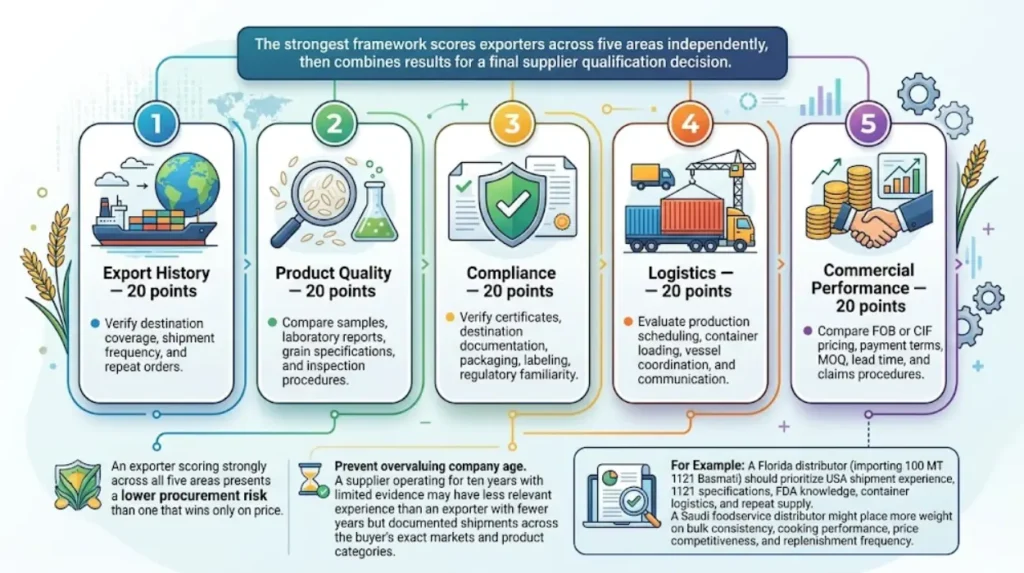
The strongest decision framework scores exporters across five areas: verified export history, product-specific quality, destination compliance, shipment reliability, and commercial consistency. Buyers should score each area independently before combining results into an overall supplier qualification decision.
A practical scoring model uses 20 points for each category:
- Export history — 20 points: Verify destination coverage, shipment frequency, and repeat orders.
- Product quality — 20 points: Compare samples, laboratory reports, grain specifications, and inspection procedures.
- Compliance — 20 points: Verify certificates, destination documentation, packaging, labeling, and regulatory familiarity.
- Logistics — 20 points: Evaluate production scheduling, container loading, vessel coordination, and communication.
- Commercial performance — 20 points: Compare FOB or CIF pricing, payment terms, MOQ, lead time, and claims procedures.
An exporter scoring strongly across all five areas presents a lower procurement risk than one that wins only on price.
The framework also prevents buyers from overvaluing company age. A supplier operating for ten years with limited destination evidence may provide less relevant experience than an exporter with fewer years but documented shipments across the buyer’s exact markets and product categories.
For example, a Florida distributor importing 100 MT of 1121 Basmati should prioritize USA shipment experience, 1121 specification consistency, FDA-related documentation knowledge, container logistics, and repeat supply capacity. A Saudi foodservice distributor may place greater weight on bulk grade consistency, cooking performance, price competitiveness, and replenishment frequency.
Export history is therefore not a marketing claim. It is a qualification category supported by documents, references, trade data, samples, inspections, and repeat-order evidence.
For buyers moving from supplier evaluation toward a specific USA sourcing decision:
Import Pakistani Basmati Rice from an Experienced Exporter to Florida, USA should be inserted immediately after this decision framework section, before the final conclusion. This placement moves the reader naturally from evaluating export-track-record criteria to assessing an experienced exporter for the Florida market without interrupting the informational flow.
Frequently Asked Questions
How can buyers verify a rice exporter’s international track record?
Buyers can verify export history through Bills of Lading, commercial invoices, Certificates of Origin, shipment records, customer references, trade data, and third-party supplier audits. These sources show whether an exporter has completed international shipments and handled destination-specific requirements.
Why does export history matter when selecting a rice supplier?
Export history demonstrates practical experience with international logistics, documentation, quality control, customs procedures, packaging, and shipment scheduling. A supplier with repeat export activity is better positioned to manage recurring orders than one with limited international experience.
What documents should buyers request from a rice exporter?
Buyers can request redacted Bills of Lading, commercial invoices, packing lists, Certificates of Origin, phytosanitary certificates where applicable, fumigation certificates, inspection reports, laboratory analysis, and product specifications.
How do customer references help evaluate a rice exporter?
Customer references provide evidence about actual supplier performance. Buyers can ask previous customers about product consistency, shipment reliability, communication, documentation accuracy, delivery performance, and how the exporter handled quality claims.
Can trade data prove that a specific rice exporter is reliable?
Trade data can confirm that rice is regularly exported from a country to particular markets, but it does not independently prove the performance of one exporter. Buyers should combine trade statistics with shipment documents, references, samples, and inspections.
What should buyers check in a rice supplier audit?
A supplier audit should examine paddy sourcing, milling, cleaning, grading, polishing, optical sorting, laboratory testing, storage, packaging, production capacity, quality-control procedures, and container-loading systems.
Which rice grades should USA buyers evaluate?
USA buyers commonly evaluate grades such as 1121 Basmati, Super Kernel, and 1509 Basmati. The correct choice depends on the intended application, including restaurants, distributors, wholesalers, ethnic retail, foodservice, or private-label programs.
Which rice grades are commonly preferred in the UAE and Saudi Arabia?
UAE and Saudi Arabian buyers commonly evaluate 1121 Basmati, Super Kernel, Steam, White, and Sella grades. Selection depends on cooking requirements, customer segment, packaging format, price target, and distribution strategy.
How much does Pakistani Basmati rice cost per metric ton in 2026?
A March 2026 USDA report placed Pakistani Basmati around $1,000 per metric ton FOB. Actual prices vary according to variety, grade, processing, packaging, order quantity, payment terms, and shipment destination.
What is the typical shelf life of exported Basmati rice?
Commercially packed Basmati rice commonly has an approximately 18–24 month quality window when stored under suitable dry and controlled conditions. Buyers should confirm the exact shelf life stated on the supplier’s product specification and packaging.
How should buyers compare two rice exporters?
Buyers should compare verified export history, product-specific quality, destination compliance, production capacity, shipment reliability, documentation, customer references, pricing, payment terms, MOQ, and claims procedures rather than comparing FOB price alone.
Is company age enough to prove rice-exporting experience?
No. Company age alone does not demonstrate shipment performance. Buyers should evaluate the number and frequency of international shipments, destination coverage, repeat orders, product expertise, documentation capability, and customer references.
What is the best way to assess a rice exporter for a large contract?
For a large contract, buyers should combine document verification, customer references, product sampling, laboratory testing, trade-data research, certification checks, production audits, and third-party pre-shipment inspection.
How does export experience reduce procurement risk?
Export experience helps demonstrate that a supplier has already managed international documentation, container logistics, quality specifications, customs procedures, and destination-market requirements. This evidence can reduce uncertainty when buyers establish recurring supply contracts.