AHK Rice Offers Traceable Pakistani Basmati Rice Solutions Across Scotland
AHK Rice offers a traceable Pakistani Basmati rice supply solution for Scottish importers, wholesalers, retailers, and food-service buyers. Here is why: the supply model connects Punjab sourcing, milling, grading, inspection, packaging, documentation, and UK shipment tracking. The result is clearer procurement control from farm to Scottish warehouse.
Scottish buyers evaluating transparent sourcing can first review why Scottish food buyers are looking for transparent rice supply chains. The commercial decision then depends on grade, specification, traceability, sample approval, landed cost, and delivery timing.
What is the best solution for traceable Pakistani Basmati rice in Scotland?
The best solution is a documented export chain covering farm sourcing, controlled milling, laboratory testing, traceability records, inspection, compliant packaging, and shipment tracking through UK arrival.
AHK Rice sources Pakistani Basmati from Punjab and manages processing through export preparation. Available varieties include 1121, Super Kernel, and 1509 Basmati. Each variety can be specified around grain length, moisture, broken percentage, polishing, packing, and intended use.
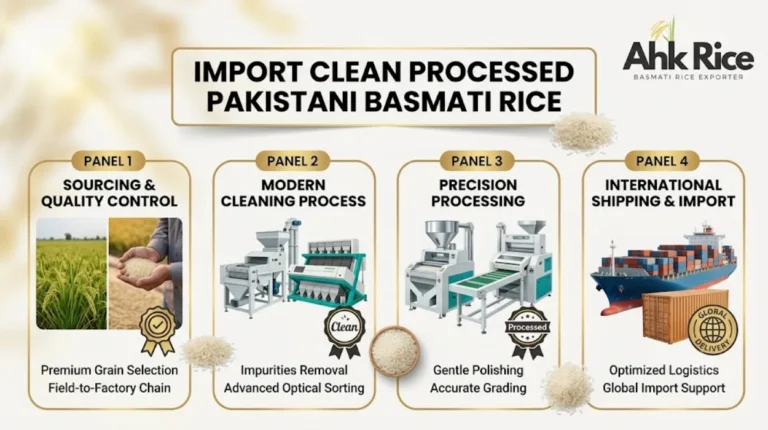
Traceability starts with the raw material. Farm-linked sourcing supports identification of the rice origin before milling. Processing then moves through cleaning, dehusking, whitening, polishing, grading, sorting, and packing according to the required specification.
Quality control provides the next verification point. AHK Rice states that shipments undergo pre-shipment inspection, with internationally recognized organizations such as SGS and Bureau Veritas available for independent verification.
Scottish importers also need documentation that supports customs and food-supply records. Standard export documentation can include the commercial invoice, packing list, Bill of Lading, Certificate of Origin, phytosanitary certificate, and fumigation report.
For buyers comparing supplier systems, how businesses track Basmati rice movement from farm to shelf provides the broader comparison framework. The purchasing decision should then move from traceability claims to measurable specifications.
Why choose AHK Rice for Scottish Basmati rice procurement?
AHK Rice combines Punjab sourcing, controlled processing, custom packaging, export documentation, inspection options, and shipment tracking into one procurement workflow for Scottish buyers.
AHK Rice operates from Bucheki, Nankana Sahib, Punjab, a major Basmati-producing area. The company supplies 1121, Super Kernel, and 1509 varieties for international markets. Its export model covers processing, grading, colour sorting, customized packaging, documentation, and shipment coordination.
The first commercial advantage is specification control. Buyers can establish the required variety, grain profile, moisture target, broken percentage, packing format, crop requirement, and destination before production begins.
The second advantage is inspection visibility. AHK Rice can arrange third-party inspection through SGS or equivalent providers. The buyer covers optional third-party inspection costs. This creates an independent verification point before container loading.
The third advantage is packaging flexibility. AHK Rice supplies PP, jute, cloth, non-woven, box, and other packaging formats across its export catalogue. UK-focused products also support custom labels and traceability information.
The fourth advantage is shipment visibility. AHK Rice provides tracking information for UK shipments and identifies Felixstowe, Liverpool, and Southampton as UK port options for Basmati exports.
With the supplier model established, the next decision is whether the expected quality, delivery, and documentation outcomes justify procurement.
What results can Scottish buyers expect?
Scottish buyers can expect specification-led procurement, documented quality checks, traceable packing, export documentation, shipment tracking, and UK delivery planning based on the selected port and freight schedule.
Quality results begin with the approved sample. AHK Rice provides samples of up to 20 kg, while the buyer pays courier and phytosanitary certificate costs. Sample charges can be waived in the final commercial arrangement after successful order confirmation.
A practical sample workflow is straightforward:
- Select the grade and define grain, moisture, broken, colour, and packing requirements.
- Request the sample using the required destination and product specification.
- Approve the sample after cooking, appearance, aroma, grain separation, and laboratory review.
- Confirm the contract with quantity, packaging, Incoterm, payment terms, and destination.
- Complete quality inspection before shipment using internal or independent verification.
- Prepare export documents for the Scottish importer and customs process.
- Load the container after final approval and document verification.
- Dispatch the shipment through the selected shipping line and UK port.
- Track delivery until UK arrival and customs clearance.
What does the sample cost?
The rice sample can be up to 20 kg at no product charge under AHK Rice’s stated sample policy. Courier and phytosanitary certificate charges remain buyer-paid. Optional SGS or equivalent inspection is also buyer-paid.
The exact courier and certificate amount depends on destination, weight, service level, and current carrier charges. A fixed sample-shipping price should therefore be confirmed in the quotation rather than assumed.
How long does shipping to Scotland take?
For UK Basmati shipments, AHK Rice publishes approximately 21–28 days for sea transit and identifies Felixstowe, Liverpool, and Southampton as UK port options.
Another AHK Rice UK export workflow gives 25–35 days as a broader warehouse-ready timeline after export handling, depending on customs and delivery requirements.
For Scotland, the final timeline also depends on the selected UK port, customs clearance, inland haulage, and warehouse location. Buyers should therefore evaluate total delivery time rather than ocean transit alone.
How does pricing work for Scottish Basmati rice?

Basmati rice pricing depends on variety, grade, crop, grain specification, order volume, packaging, inspection, Incoterm, freight, and destination handling rather than one fixed market price.
Grade selection creates the first price difference. Premium 1121 Basmati generally serves buyers seeking extra-long grain presentation, while Super Kernel provides another premium long-grain option. 1509 can provide a different balance between cooking performance and procurement cost.
Packaging creates the second variable. Standard bulk PP packaging usually differs from custom retail packaging because printed bags, labels, artwork, packing sizes, and additional handling affect the commercial calculation.
Volume creates another pricing effect. Full-container purchasing usually provides a more efficient freight structure than small shipments. AHK Rice states that wholesale pricing varies according to grade, volume, and packing.
Incoterms also change the final comparison. FOB Karachi places more freight responsibility with the buyer. CIF incorporates ocean freight to the agreed destination port. Insurance remains a separate consideration unless specifically included in the commercial terms.
For Scottish procurement, compare quotations using the same specification. A £/MT comparison is meaningful only when grade, broken percentage, moisture, packing, Incoterm, destination port, and inspection requirements match.
Which specifications should Scottish buyers confirm before ordering?
Scottish buyers should confirm variety, grain length, moisture, broken grains, foreign matter, crop, processing type, packing, certification, inspection, and delivery terms before approving production.
| Specification | Commercial decision |
|---|---|
| Variety | 1121, Super Kernel, or 1509 |
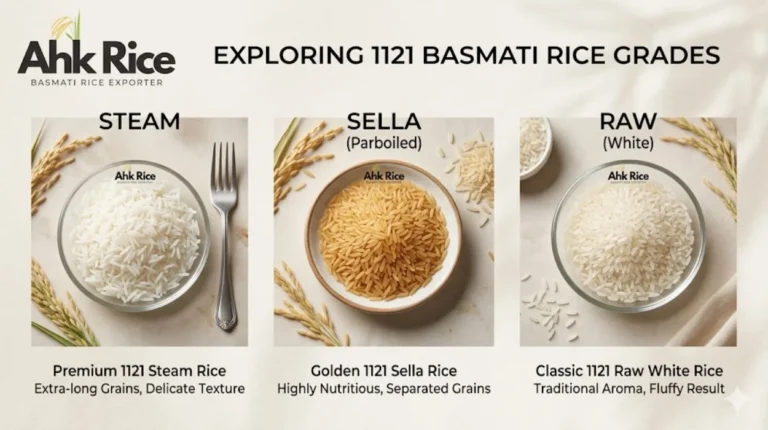
| Processing | White, Steam, or Sella |
| Moisture | Confirm buyer-approved maximum |
| Broken grains | Confirm contracted percentage |
| Grain length | Match retail or food-service positioning |
| Packing | PP, jute, cloth, box, or custom |
| Certification | Phytosanitary, fumigation, origin, HACCP, ISO, Halal |
| Inspection | Internal or SGS/equivalent |
| Incoterm | FOB, CFR/CNF, or CIF |
| Destination | UK port plus Scottish warehouse |
AHK Rice publishes UK specifications showing examples such as 8.3 mm+ grain length, under 12.5% moisture, and under 1% broken grains for a listed UK Basmati specification. These figures should be treated as product-specific rather than universal requirements.
A contract should therefore state the exact specification instead of relying on the general term “premium Basmati.”
How should a Scottish importer decide between suppliers?
Choose the supplier that can document product identity, quality controls, sample approval, export documentation, inspection, shipment tracking, and the final landed specification without gaps.
| Decision factor | Buyer question | Preferred evidence |
|---|---|---|
| Traceability | Can the batch origin be documented? | Farm and batch records |
| Quality | Can specifications be tested? | Lab report and inspection |
| Product | Does the sample match production? | Approved reference sample |
| Logistics | Can shipment progress be tracked? | Booking and tracking details |
| Documentation | Are export records complete? | Invoice, COO, Phyto, B/L |
| Cost | Is the comparison like-for-like? | Itemized commercial quotation |
AHK Rice fits this decision model through its integrated sourcing, processing, packaging, inspection, and export workflow. Its website also states that shipments can undergo third-party pre-shipment inspection.
The strongest procurement decision is not simply the lowest price. It is the supplier that delivers the required grade at a controlled specification with predictable documentation and logistics.
How can a Scottish buyer get started with AHK Rice?
Start with the product specification, destination, quantity, packing, and Incoterm; then approve the sample before confirming the commercial order and shipment schedule.
AHK Rice’s quotation process requests the buyer’s company information, destination port, product selection, packing, quantity in metric tons, and preferred Incoterm.
A buyer should prepare these details before the first enquiry:
- Product: 1121, Super Kernel, or 1509.
- Processing: White, Steam, or Sella.
- Quantity: Required metric tons.
- Packing: Bulk or retail specification.
- Destination: Preferred UK port or Scottish delivery point.
- Quality: Grain, moisture, broken, purity, and crop requirements.
- Inspection: Internal approval or independent inspection.
- Incoterm: FOB, CFR/CNF, or CIF.
- Documents: Required certificates and import records.
AHK Rice can then prepare the sample and commercial specification for approval. The buyer evaluates the sample before production, confirms the contract, and proceeds through inspection, documentation, loading, and dispatch.
For a Scottish wholesaler replacing an inconsistent supplier, this workflow reduces specification ambiguity. For a retailer launching a private-label Basmati line, it creates a defined path from sample approval to custom packaging. For food-service buyers, it supports repeat procurement around a documented grade.
AHK Rice therefore offers more than a shipment of Pakistani Basmati. It provides a specification-led procurement structure designed around traceability, quality verification, packaging control, and UK delivery planning.
Scottish buyers ready to define their required variety, quantity, packaging, destination, and Incoterm can request a customized quotation from AHK Rice.
Frequently Asked Questions
Is AHK Rice suitable for Scottish Basmati rice importers?
AHK Rice supplies Pakistani Basmati for UK wholesale and retail markets.
Available varieties include 1121, Super Kernel, and 1509.
UK shipment workflows include inspection and export documentation.
UK ports include Felixstowe, Liverpool, and Southampton.
Scottish delivery requires additional inland transport after UK arrival.
How much does an AHK Rice sample cost?
Up to 20 kg of rice can be supplied without a product charge.
The buyer pays courier and phytosanitary certificate costs.
Optional third-party inspection is also buyer-paid.
Exact courier charges depend on destination and shipment weight.
Sample costs may be credited or waived after a successful order.
How long does Pakistani Basmati take to reach Scotland?
UK sea transit is commonly stated at 21–28 days by AHK Rice.
A broader warehouse-ready timeline can reach 25–35 days.
Port congestion can affect the final schedule.
Customs clearance adds another operational stage.
Scottish inland delivery follows UK port arrival.
What Basmati grades can Scottish buyers source?
AHK Rice supplies 1121, Super Kernel, and 1509 Basmati.
Processing options include white, Steam, and Sella varieties.
Grain length and broken percentage can be specified contractually.
Packing can be customized for wholesale or retail use.
The approved sample should define the production reference.
What documents accompany Pakistani Basmati rice exports?
Common documents include the commercial invoice and packing list.
A Bill of Lading records the ocean shipment.
A Certificate of Origin establishes export origin.
Phytosanitary and fumigation documents support plant-health compliance.
Additional inspection or certification documents can be arranged when required.
Why is traceability important for Scottish rice buyers?
Traceability connects product identity with sourcing, processing, testing, packing, and shipment records.
It helps buyers verify contracted specifications before dispatch.
It also supports supplier accountability after delivery.
Batch documentation improves procurement records for repeat orders.
The result is a more controlled rice supply chain.