Why Do Pennsylvania Wholesalers Assess Supplier Production Capacity?
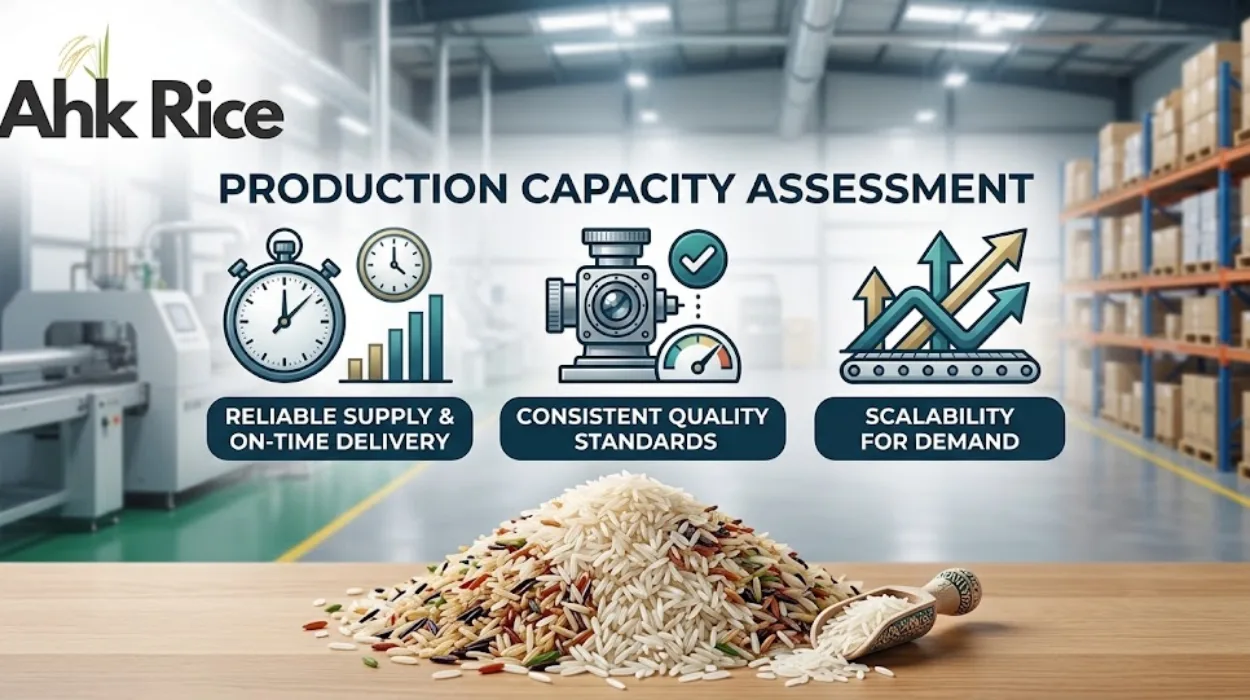
Pennsylvania wholesalers assess rice supplier production capacity because delivery performance depends on more than the quantity available in one warehouse. Production capacity shows how much rice a supplier can process, grade, pack, inspect, and prepare for export within a defined period. It also indicates whether the supplier can repeat the same specification across multiple shipments.
For Pakistani Basmati rice, this assessment is important because wholesale buyers often purchase container quantities rather than small retail lots. A supplier must coordinate paddy procurement, milling, aging, processing, sorting, grading, packaging, quality inspection, documentation, and container loading. A capacity review connects these production stages with the buyer’s required shipment schedule.
AHK Rice operates from Punjab, Pakistan, where Basmati rice production and processing are concentrated. Its export range includes 1121 Basmati, Super Kernel, and 1509 rice varieties, with processing, packaging, and export activities managed across the supply chain.
What does supplier production capacity mean for Pennsylvania rice wholesalers?
Supplier production capacity is the quantity of rice a processor can consistently produce, process, pack, inspect, and prepare for shipment during a defined period while maintaining agreed specifications, quality controls, and export documentation requirements.
Production capacity has several dimensions. Milling capacity measures how much paddy enters processing equipment. Processing capacity measures how much milled rice passes through cleaning, sorting, grading, and polishing stages. Packing capacity measures how much finished rice enters bags or private-label packaging.
Export capacity adds another layer. A supplier needs enough finished stock, packaging materials, inspection resources, documentation capacity, and loading availability to complete an order.
For example, a wholesaler ordering 5 containers of 1121 Steam Basmati requires more than 5 containers of rice existing in storage. The exporter must verify the specification, complete final processing, pack the product, arrange inspection, prepare documents, and load the containers.
Capacity therefore represents a controlled production system rather than a single inventory figure.
Why do Pennsylvania wholesalers evaluate production capacity before purchasing rice?
Wholesalers evaluate production capacity because consistent capacity reduces supply interruptions, protects inventory planning, supports repeat orders, and establishes whether a supplier can fulfill contracted quantities without sacrificing grain specifications, packaging accuracy, inspection controls, or shipment preparation.
Pennsylvania wholesalers serve distributors, supermarkets, restaurants, foodservice operators, ethnic grocery stores, and independent retailers. Each sales channel creates different replenishment requirements.
A wholesaler with several retail customers needs predictable replenishment. A foodservice distributor needs stable pack sizes and cooking characteristics. A private-label buyer needs consistent packaging and product specifications across production lots.
Supplier capacity affects each requirement.
A processor with controlled capacity can schedule procurement and production against confirmed orders. It can allocate machinery, labor, packaging materials, laboratory testing, and loading resources according to shipment requirements.
The assessment also separates production capacity from sales claims. A supplier stating that it has rice available does not automatically demonstrate that it can repeat the same quantity and specification every month.
This is why Pennsylvania buyers examine production records, facility capabilities, processing stages, warehouse capacity, previous shipment history, and order lead times.
What are the main components of rice supplier production capacity?
Rice production capacity consists of raw-material availability, milling throughput, processing equipment, grading systems, storage space, packaging lines, quality-control resources, labor, utilities, and export logistics that together determine reliable finished-rice output.
Paddy procurement capacity
Paddy procurement determines the foundation of rice supply. Pakistani Basmati varieties are grown mainly in Punjab, particularly across areas associated with traditional Basmati cultivation.
Procurement controls include variety identification, crop sourcing, moisture measurement, impurity checks, and lot segregation. Examples include 1121 Basmati, Super Kernel, and 1509 Basmati.
Milling capacity
Milling converts paddy into edible rice. The process removes the husk and separates the rice kernel from other material.
A supplier assesses milling capacity through equipment throughput, operating schedules, recovery rates, and maintenance controls.
Processing and sorting capacity
Processed rice passes through cleaning, destoning, grading, color sorting, and other controlled stages.
These operations remove stones, foreign material, immature grains, discolored kernels, broken rice, and other unwanted fractions. Mechanical sorting and optical color sorting help establish uniformity.
Grading capacity
Grading separates rice according to characteristics such as grain length, broken percentage, moisture, milling quality, and appearance.
For example, 1121 Basmati is recognized for its long, slender grain profile. Super Kernel is another Pakistani Basmati category used in export markets. 1509 is also processed into white, steam, and parboiled-style commercial specifications.
The exact commercial grade must appear in the buyer’s specification rather than relying only on a variety name.
Packaging capacity
Packaging capacity determines how quickly finished rice enters export-ready bags.
Common formats include 5 kg, 10 kg, 20 kg, 25 kg, and 40 kg or larger commercial packs. The actual pack format depends on the destination market, buyer specification, and container-loading plan.
Storage capacity
Storage protects finished rice between processing and shipment. Warehouses require controlled handling, cleanliness, pest-management procedures, lot identification, and stock rotation.
Storage capacity also separates raw paddy from finished rice. This distinction matters because inventory that has not completed processing is not equivalent to export-ready stock.
How does rice move through a supplier’s production process?
Rice production follows a controlled sequence from paddy procurement to export loading: receiving, inspection, cleaning, drying when required, milling, sorting, grading, optional steaming or parboiling, final testing, packaging, storage, documentation, and container loading.
The first stage is receiving. Paddy or processed rice enters the facility and is checked against purchasing specifications.
The second stage is cleaning. Dust, straw, stones, metal, and other foreign material are removed using mechanical equipment.
The third stage involves moisture management. Moisture is measured because excessive moisture affects storage stability, processing performance, and final quality.
The fourth stage is milling. Paddy passes through husking and separation equipment. Milling removes the husk and produces brown rice before further processing.
The fifth stage is whitening or polishing, depending on the commercial specification. The surface layers are removed to produce the required appearance.
The sixth stage is grading and sorting. Screens separate kernels by size, while optical sorters remove visually defective grains.
The seventh stage is specialized processing. Steam or parboiling processes are used for products such as 1121 Steam and 1509 Steam Basmati. These processes change the physical characteristics of the grain and influence cooking performance.
The eighth stage is final inspection. Testing checks parameters specified in the purchase contract. Examples include moisture, broken kernels, foreign matter, grain length, damaged grains, and appearance.
The ninth stage is packaging. Approved rice enters the selected retail or commercial bags.
The final stages are warehousing, export documentation, container inspection, loading, and dispatch.
This sequence explains why capacity must be evaluated across the complete production chain.
How does production capacity affect rice delivery performance?
Production capacity affects delivery performance by determining how quickly a supplier converts raw material into approved finished rice and coordinates packaging, inspection, documentation, container loading, and dispatch against a confirmed shipment schedule.
A delivery schedule starts before the container reaches the port. Production must finish first.
For example, a Pennsylvania wholesaler ordering 2 containers needs the exporter to reserve raw material or finished stock, schedule processing, confirm packaging, complete quality checks, prepare documents, and arrange loading.
A supplier with adequate capacity can assign each stage to a production schedule.
A capacity shortage creates bottlenecks. Milling equipment can become a constraint. Packaging lines can become overloaded. Laboratory testing can delay release. Warehouse congestion can slow container preparation.
These constraints directly affect shipment readiness.
Pennsylvania buyers evaluating delivery performance should therefore examine both production capacity and historical execution. A supplier’s previous shipment records provide evidence of how its stated capacity performs under actual commercial conditions.
For buyers comparing production systems, the relationship between capacity and delivery is also covered in:
How production capacity affects rice delivery performance.
Which rice grades and specifications require capacity planning?
Capacity planning applies to every commercial rice specification because different varieties, processing methods, grain grades, broken percentages, packaging formats, and quality requirements consume different production, sorting, storage, and packing resources.
Pakistan’s export Basmati sector includes several commercial categories.
1121 Basmati is widely traded as white and steam-processed rice. It is associated with very long, slender grains and strong demand in international markets.
Super Kernel Basmati is another established Pakistani Basmati category. It is commonly supplied as white rice and follows buyer-defined specifications for grain appearance, broken percentage, moisture, and milling quality.
1509 Basmati is processed into specifications including white and steam varieties. Its production planning requires separate control when buyers require a specific processing method.
Commercial grades also differ by broken percentage. A buyer can specify premium whole-grain rice, lower-broken commercial grades, or other contractual specifications.
Packaging creates another capacity variable. A supplier packing 25 kg export sacks has a different line requirement from a private-label program using 5 kg retail bags.
Capacity planning must therefore begin with the final specification.
Which markets import Pakistani Basmati rice?
Pakistani Basmati rice is exported to markets across the Middle East, North America, Europe, Africa, and Asia, with buyers selecting varieties and specifications according to local consumption, distribution, packaging, foodservice, and regulatory requirements.
The Middle East is an important destination for Pakistani rice. Saudi Arabia and the United Arab Emirates have established demand for Basmati rice used by households, restaurants, retailers, and foodservice distributors.
North American markets also purchase Pakistani Basmati. The United States has demand from ethnic grocery stores, wholesalers, restaurants, foodservice distributors, and private-label programs.
European markets apply their own food-import and labeling requirements. Buyers evaluate product specifications alongside regulatory documentation.
African markets include importers serving retail and foodservice channels. Product selection depends on consumer preferences, price positioning, grain characteristics, and packaging requirements.
For Pennsylvania wholesalers, the United States market adds domestic import requirements to the supplier’s export responsibilities. The buyer therefore evaluates both the product and the exporter’s ability to provide accurate commercial and food-safety documentation.
Which certifications and compliance documents apply to rice exports?
Rice exporters serving international buyers operate within food-safety, facility, traceability, labeling, and import-control requirements, while the exact certifications and documents depend on the destination country, product, buyer specification, and applicable regulatory framework.
Food-safety management certifications can include ISO 22000 and HACCP-based systems. HACCP means Hazard Analysis and Critical Control Points. It identifies biological, chemical, and physical hazards and establishes controls at defined production stages.
Other certification schemes can include BRCGS, FSSC 22000, Halal certification, and organic certification where applicable.
For United States shipments, importers also deal with U.S. Food and Drug Administration requirements. Facilities involved in food production and foreign food suppliers must meet applicable U.S. food-import rules.
Export documentation commonly includes the commercial invoice, packing list, bill of lading, certificate of origin where required, phytosanitary documentation where applicable, and other destination-specific certificates.
Certification is not identical to capacity. A certificate demonstrates compliance with a defined standard or scheme. Production capacity demonstrates operational ability. Pennsylvania wholesalers should evaluate both.
What problems occur when wholesalers ignore supplier capacity?
Ignoring supplier capacity creates predictable commercial problems: delayed production, inconsistent specifications, packaging bottlenecks, missed loading schedules, stock shortages, rushed quality checks, and difficulty maintaining repeat supply during periods of high market demand.
One common misconception is that warehouse inventory equals production capacity. It does not. A warehouse containing 10 containers today does not prove that the supplier can produce another 10 containers next month.
Another misconception is that large machinery automatically guarantees reliable delivery. Equipment requires maintenance, labor, raw materials, packaging supplies, utilities, and quality controls.
A third problem occurs when buyers assess only annual output. Annual capacity does not explain monthly production availability. A supplier can report a high annual figure while facing short-term bottlenecks.
A fourth issue is specification mismatch. A supplier can have sufficient total rice volume but insufficient stock of the exact variety, grade, processing type, or packaging format required by the buyer.
A fifth problem involves peak-season demand. When multiple customers place orders simultaneously, capacity allocation becomes important. Production schedules, inventory reserves, packaging materials, inspection slots, and container bookings must remain coordinated.
How should Pennsylvania wholesalers assess rice supplier capacity?
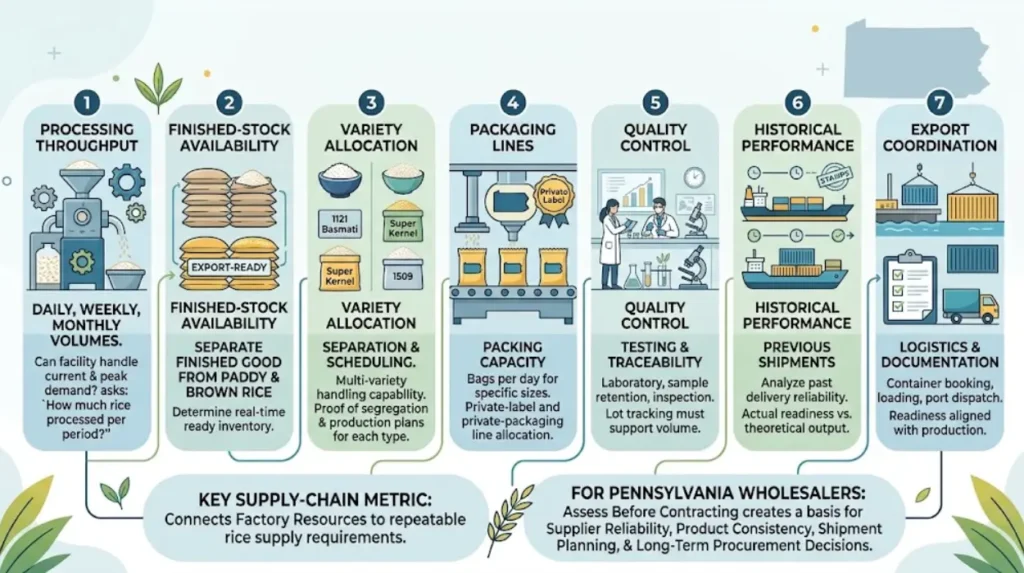
Pennsylvania wholesalers should assess capacity through measurable evidence covering processing throughput, available stock, variety allocation, packaging lines, warehouse space, quality-control resources, previous shipments, production lead times, and documentation readiness.
The first measure is processing throughput. Buyers should ask how much rice the facility processes within a day, week, and month.
The second measure is finished-stock availability. The buyer should distinguish export-ready rice from paddy, brown rice, and partially processed inventory.
The third measure is variety allocation. A supplier handling 1121, Super Kernel, and 1509 should demonstrate how each product is segregated and scheduled.
The fourth measure is packaging throughput. The buyer should confirm whether the required bag size and private-label format fit the facility’s packing capacity.
The fifth measure is quality-control capacity. Laboratory testing, sample retention, inspection, and lot traceability must support the production volume.
The sixth measure is historical performance. Previous commercial shipments show whether production schedules translate into actual container readiness.
The seventh measure is export coordination. Documentation, container booking, loading, and port dispatch must align with production completion.
Production capacity is therefore a practical supply-chain metric. It connects factory resources with the buyer’s actual requirement for repeatable rice supply.
For Pennsylvania wholesalers, assessing this capacity before contracting creates a clearer basis for evaluating supplier reliability, product consistency, shipment planning, and long-term procurement decisions.
Frequently Asked Questions
Why do Pennsylvania wholesalers assess rice supplier production capacity?
Pennsylvania wholesalers assess production capacity to confirm that a rice supplier can process, pack, inspect, and ship required quantities consistently. Capacity evaluation reduces risks linked to shortages, delays, inconsistent specifications, and missed replenishment schedules.
What does rice supplier production capacity include?
Rice supplier production capacity includes paddy procurement, milling throughput, sorting, grading, steaming or parboiling, packaging, warehouse space, quality-control resources, labor, and export preparation. These components determine how much finished rice a supplier can deliver within a defined period.
How does production capacity affect rice delivery performance?
Production capacity affects delivery performance by determining how quickly rice moves from raw material through processing, testing, packaging, documentation, and container loading. Capacity bottlenecks at any stage can delay shipment readiness.
Which Pakistani Basmati varieties require production capacity planning?
Production capacity planning applies to 1121 Basmati, Super Kernel Basmati, and 1509 Basmati. Each variety can require different processing, grading, sorting, packaging, and inventory arrangements based on the buyer’s specification.
Does warehouse inventory prove that a rice supplier has sufficient production capacity?
No. Warehouse inventory only shows available stock at a specific time. Production capacity measures the supplier’s ability to repeatedly process and prepare additional quantities while maintaining the required rice specification.
What production information should Pennsylvania wholesalers request from rice suppliers?
Wholesalers should request information about processing throughput, finished-stock availability, variety allocation, packaging capacity, quality-control procedures, warehouse capacity, production lead times, previous shipment performance, and export documentation readiness.
Which certifications apply to Pakistani rice exporters?
Applicable certifications depend on the buyer, product, and destination market. Common food-safety systems and certifications include HACCP, ISO 22000, FSSC 22000, BRCGS, Halal, and organic certification where applicable.
Which markets import Pakistani Basmati rice?
Pakistani Basmati rice is exported to markets across the Middle East, North America, Europe, Africa, and Asia. Major commercial destinations include Saudi Arabia, the United Arab Emirates, and the United States.
What problems occur when a wholesaler ignores supplier production capacity?
Ignoring production capacity can result in delayed shipments, insufficient inventory, packaging bottlenecks, inconsistent product specifications, rushed inspections, and difficulty fulfilling repeat orders during periods of high demand.
Is annual production capacity enough to evaluate a rice supplier?
No. Annual capacity does not show short-term availability. Wholesalers should also evaluate monthly throughput, current production schedules, finished inventory, processing lead times, packaging capacity, and previous shipment performance.
How can Pennsylvania wholesalers compare rice suppliers by production capacity?
They can compare suppliers using measurable criteria such as monthly processing volume, finished-stock availability, processing equipment, packaging throughput, warehouse capacity, quality-control resources, lead times, and documented shipment history.