How Can Importers Evaluate a Rice Supplier’s Export Performance?
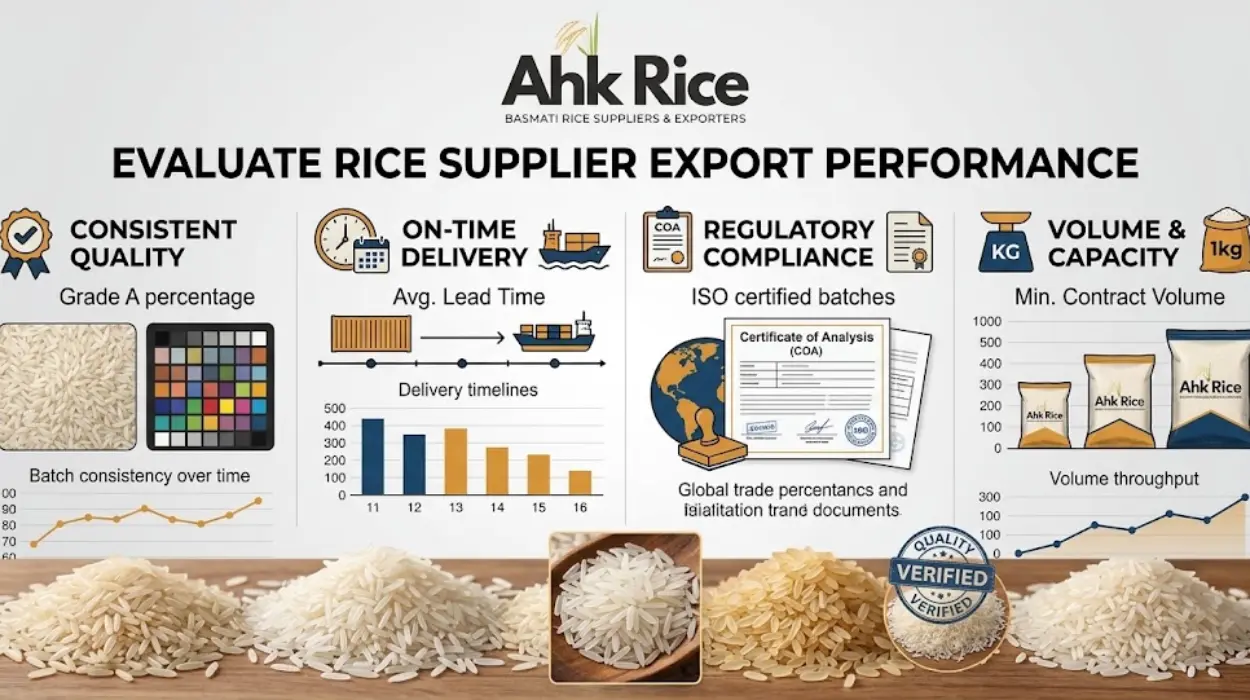
Importers should evaluate a rice supplier by comparing verified shipment history, product consistency, documentation accuracy, delivery performance, production capacity, compliance, and market-specific experience, rather than judging suppliers only by price or years in business. Export performance becomes measurable when buyers connect shipment records with specifications, destination requirements, repeat orders, and corrective-action history.
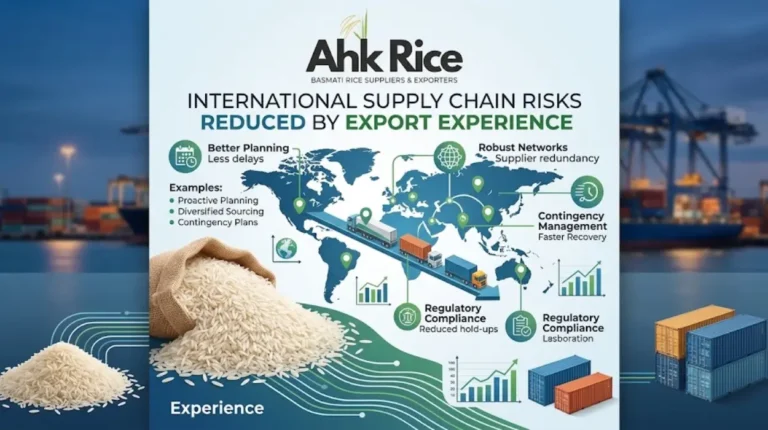
A supplier with a long export history is not automatically the strongest supplier. Buyers need to understand what that history proves and whether it matches their own procurement requirements. This is why understanding:
How export history influences rice supplier selection decisions provides the right foundation before comparing individual exporters. In 2026, Pakistan’s official trade statistics continue to provide monthly and annual export data, while U.S. food importers must also consider supplier performance within their Foreign Supplier Verification Program (FSVP) responsibilities.
What are the available solutions for evaluating rice supplier export performance?
Importers have four practical evaluation methods: shipment-history verification, documentation and compliance review, product-performance testing, and a combined supplier scorecard that measures commercial, technical, operational, and regulatory performance together.
The first method is shipment-history verification. Buyers examine previous destinations, shipment frequency, quantities, repeat customers, container activity, and the supplier’s ability to serve markets with different requirements. Pakistan’s FY2024 data shows the scale of the country’s Basmati export sector: Basmati exports reached 773,995 MT worth US$877 million, with major destinations including the UAE, Saudi Arabia, the United States, Italy, and the United Kingdom.
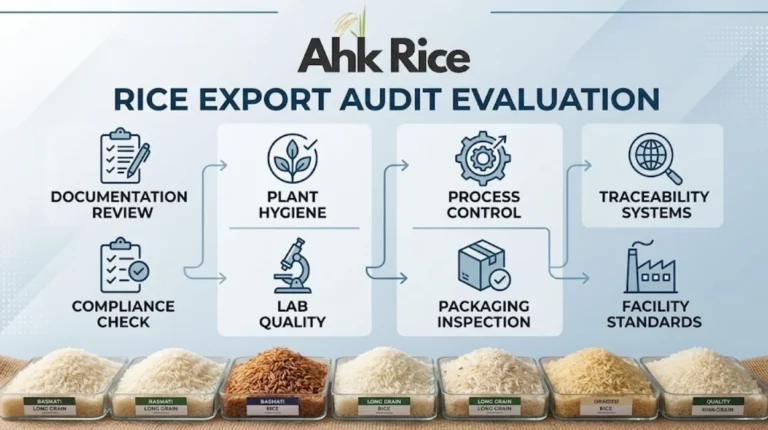
The second method is documentation and compliance verification. A buyer reviews commercial invoices, packing lists, certificates of origin, phytosanitary documentation where applicable, inspection reports, shipping documents, food-safety records, and destination-specific compliance evidence. For U.S. imports, FSVP requires the importer to evaluate the food and foreign supplier, conduct appropriate verification activities, and maintain an FSVP for covered food-supplier relationships.
The third method is product-performance testing. Samples should be evaluated against the agreed specification for grain length, broken percentage, moisture, milling quality, purity, appearance, aroma, cooking performance, packaging, and other contractual requirements. A supplier that provides a good sample but cannot reproduce the same specification in commercial shipments has weak export performance.
The fourth method is the combined supplier scorecard. This is the strongest approach because it prevents one attractive metric from hiding another weakness. A supplier may offer a low FOB price but have inconsistent specifications. Another may have excellent product quality but weak documentation. A scorecard evaluates both before a purchase decision is made.
How do different approaches compare?
Shipment history proves market experience, documentation proves regulatory discipline, product testing proves physical consistency, and a scorecard combines all three into a repeatable procurement decision that can be applied across suppliers, varieties, destinations, and contract sizes.
| Evaluation attribute | Shipment-history method | Compliance-review method | Product-testing method | Integrated scorecard |
|---|---|---|---|---|
| Export experience | Strong | Moderate | Weak | Strong |
| Product consistency | Limited evidence | Moderate | Strong | Strong |
| Documentation control | Moderate | Strong | Limited | Strong |
| Delivery reliability | Strong | Moderate | Weak | Strong |
| Regulatory suitability | Moderate | Strong | Moderate | Strong |
| Price-performance analysis | Moderate | Limited | Strong | Strong |
| Long-term supplier risk | Moderate | Strong | Moderate | Strong |
Shipment history is useful because it shows whether an exporter has actually moved commercial quantities across borders. It becomes more valuable when the records relate to the same product and destination that the buyer is considering.
Compliance review is essential when the destination has strict food-import controls. In the United States, imported food must meet applicable U.S. requirements, and FDA can refuse entry when regulated products fail those requirements. FDA also states that food facilities involved in producing, storing, or handling imported food must meet applicable registration and import requirements.
Product testing provides the strongest evidence about the physical commodity. For Basmati rice, this can include grain length, moisture, broken percentage, foreign matter, damaged grains, milling quality, aroma, and cooking characteristics. However, one laboratory or pre-shipment sample cannot prove long-term delivery reliability.
The integrated scorecard therefore gives importers the strongest decision structure. It turns supplier evaluation from a subjective conversation into a documented procurement process.
Which supplier-performance method works best for different cases?
Large-volume buyers should prioritize the integrated scorecard, new importers should begin with shipment and compliance verification, foodservice buyers should emphasize cooking consistency, and distributors should combine product specifications with repeat-delivery evidence.
For a new importer, the first priority is verifying whether the supplier has legitimate export experience. The buyer should request destination references, previous shipment evidence, product specifications, certificates, and sample documentation. The objective is to reduce the risk of selecting a supplier based only on an attractive quotation.
For a large distributor, production capacity becomes equally important. A supplier must be capable of producing the required quantity without changing the agreed grade. A distributor ordering 100 MT per month needs a different supplier assessment from a small retailer purchasing one container occasionally.
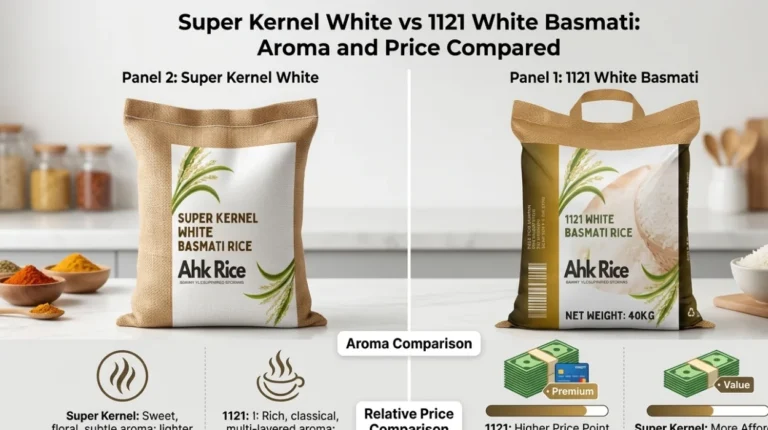
For restaurants and foodservice operators, cooking performance deserves a higher score. 1121 Basmati, Super Kernel, and 1509 Basmati can serve different commercial positioning strategies. The buyer should compare elongation, aroma, texture, absorption, and batch-to-batch cooking results alongside commercial specifications.
For U.S. importers, supplier verification must also connect to the importer’s FSVP responsibilities. FDA identifies supplier performance as part of the risk-based evaluation used by covered importers when approving suppliers and determining verification activities.
For private-label distributors, packaging capability matters more. The supplier must reproduce the approved artwork, bag size, net weight, labeling information, lot identification, and shipping marks consistently across purchase orders.
How should buyers compare two important rice-import regions?
Saudi Arabian buyers generally place greater emphasis on aromatic Basmati grades, appearance, cooking performance, and established Gulf distribution patterns, while U.S. buyers require strong documentation, supplier verification, labeling control, and compliance alongside consistent commercial-grade rice.
Saudi Arabia
Saudi Arabia is a major destination for Pakistani Basmati. Pakistan’s FY2024 Basmati exports to Saudi Arabia reached 101,909 MT, valued at US$112 million. The quantity increased 80.4% from FY2023, showing the importance of the market for Pakistani Basmati exporters.
Saudi buyers commonly evaluate premium aromatic grades such as 1121 Basmati, Super Kernel, and selected Sella or Steam specifications. The supplier assessment therefore needs to focus on grain appearance, aroma, length, cooking performance, moisture control, packaging, and the ability to repeat the approved grade.
A practical 2026 FOB reference for Pakistani 1121 Basmati is approximately US$1,135–1,205 per MT, depending on processing and specification. These are indicative market quotations rather than fixed transaction prices, so buyers should compare like-for-like specifications before judging supplier competitiveness.
United States
The United States requires a broader evaluation because product quality is only one part of import risk. U.S. food importers must meet FDA requirements, and covered FSVP importers must evaluate foreign suppliers and maintain verification procedures. FDA’s current FSVP framework specifically connects supplier performance with supplier approval and verification decisions.
For U.S. distributors, 1121 Basmati, Super Kernel, and 1509 Basmati can be evaluated according to retail positioning, foodservice requirements, grain length, cooking performance, packaging, and customer demand. A supplier’s ability to provide consistent documentation and repeatable specifications is as important as the initial price.
Indicative Pakistani FOB prices around July 2026 placed premium Basmati in roughly the US$1,165–1,205 per MT range for products such as 1121 White and Super Kernel, although final prices depend on grade, packing, quantity, inspection, freight, and contract terms.
| Market region | Preferred evaluation focus | Typical grade preference | Indicative FOB reference | Shelf-life planning |
| Saudi Arabia | Aroma, appearance, cooking, moisture | 1121, Super Kernel, Sella/Steam | US$1,135–1,205/MT | Usually 12–24 months when properly packed and stored |
| United States | Compliance, documentation, consistency, packaging | 1121, Super Kernel, 1509 | US$1,165–1,205/MT for comparable premium grades | Usually 12–24 months when properly packed and stored |
Shelf life should not be treated as a universal supplier-performance number. It depends on moisture, milling condition, packaging material, warehouse temperature, humidity, pest control, and storage practices. Buyers should therefore request the supplier’s declared shelf-life specification and storage conditions rather than comparing an unsupported number.
What are the advantages and disadvantages of each evaluation approach?
Shipment records provide real-world evidence but can hide current weaknesses; laboratory testing proves product quality but not logistics; compliance records reduce regulatory risk but do not prove commercial consistency; integrated scorecards provide the broadest supplier assessment.
Shipment-history verification
The advantage is direct evidence. A supplier that has repeatedly shipped comparable rice to international buyers has demonstrated operational experience.
The limitation is that historical success does not guarantee current performance. Production conditions, management, raw-material availability, freight conditions, and market requirements can change.
Documentation and compliance review
The advantage is traceability. Buyers can establish whether the exporter understands the paperwork required for international trade and the destination market.
The limitation is that complete documents do not guarantee excellent rice. A supplier can have accurate paperwork and still deliver inconsistent grain quality.
Product and laboratory testing
The advantage is objective quality measurement. A buyer can compare the actual rice against contractual specifications before approving a shipment.
The limitation is sample size. A sample represents only the tested lot. Buyers need lot-based inspection and retained samples when managing recurring contracts.
Integrated supplier scorecard
The advantage is balance. It measures the supplier from commercial, operational, quality, and compliance perspectives.
The limitation is administrative effort. Buyers must collect evidence, assign scores, update supplier records, and review performance after every shipment.
What five decision factors should importers use before approving a supplier?
Importers should score export history, specification consistency, documentation, delivery performance, and commercial reliability separately, then approve suppliers only when the evidence meets the buyer’s product, market, volume, and regulatory requirements.
| Decision factor | What to verify | Suggested evidence |
| Export history | Destination markets, shipment frequency, repeat orders | Shipment records and references |
| Product consistency | Grain length, broken %, moisture, purity | COA, inspection and retained samples |
| Documentation | Export and destination-market paperwork | Previous shipment document set |
| Delivery performance | Production, loading and transit execution | Shipment schedule and delivery records |
| Commercial reliability | Price stability, communication, corrective action | Quotations, contracts and issue logs |
The first factor is export history. Buyers should distinguish between total exports and relevant exports. A supplier shipping 10,000 MT of non-Basmati rice is not automatically experienced in supplying 1121 Basmati to Ohio distributors.
The second factor is specification consistency. Buyers should compare pre-shipment samples with commercial lots. A strong supplier maintains agreed specifications instead of treating every order as a new quality target.
The third factor is documentation. The supplier should provide accurate and consistent records that allow the importer, customs broker, food-safety team, and warehouse operator to trace the shipment.
The fourth factor is delivery performance. Buyers should measure promised production dates, container loading dates, document release, port departure, and arrival against agreed timelines.
The fifth factor is commercial reliability. A professional supplier communicates changes early, explains quality deviations, documents corrective actions, and maintains clear contract terms.
How can an importer build a supplier-performance score?
A practical score can allocate 25% to product consistency, 20% to export history, 20% to compliance and documentation, 20% to delivery performance, and 15% to commercial reliability for an objective 100-point supplier comparison.
A buyer can score each supplier from 0 to 100 using verified evidence. Product consistency receives the largest allocation because the physical commodity determines whether the purchase meets the buyer’s commercial requirements.
Export history receives 20%. This measures relevant international shipments, not simply company age. Compliance and documentation also receive 20% because missing or inaccurate records can delay clearance or create regulatory problems.
Delivery performance receives another 20%. The buyer should calculate the percentage of shipments that met agreed production and dispatch milestones. Commercial reliability receives 15%, covering quotation accuracy, response time, contract clarity, and corrective-action performance.
For example, Supplier A may score 92 for product consistency but 65 for delivery performance. Supplier B may score 84 for product consistency and 93 for delivery. A distributor requiring predictable replenishment may prefer Supplier B even if Supplier A offers a slightly lower price.
This approach prevents price from becoming the only decision criterion.
What should importers request before signing a rice supply contract?
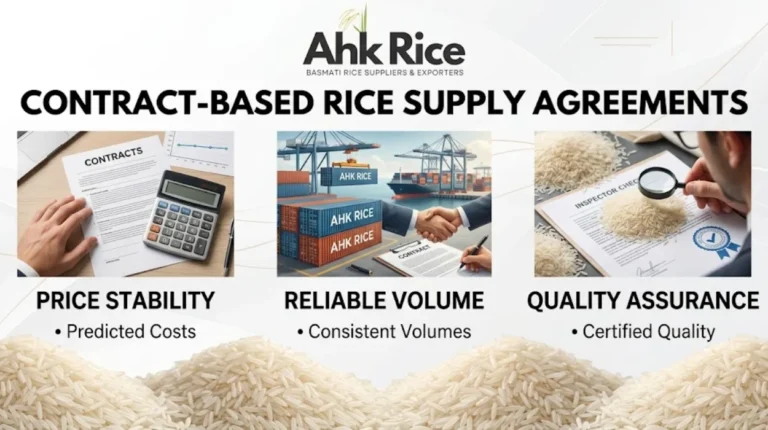
Before contracting, buyers should request product specifications, recent shipment evidence, sample and laboratory documentation, compliance records, packaging details, production capacity, inspection procedures, delivery commitments, and commercial terms that can be measured after each shipment.
A supplier evaluation file should contain the approved product specification and sample. It should identify variety, processing type, grain-length requirement, broken percentage, moisture target, packaging format, net weight, tolerance levels, and inspection method.
The buyer should also request evidence of recent international shipments. The most useful evidence relates to the same variety, grade, packaging format, and destination market.
For U.S. programs, the buyer should establish how supplier documentation supports the importer’s FSVP process. FDA states that covered importers must use supplier-performance and food-risk evaluations to determine appropriate verification activities.
For larger programs, the buyer should evaluate production capacity before signing an annual contract. Capacity should be assessed against the contracted monthly quantity, peak-season requirements, milling capacity, warehouse capacity, packaging capability, and availability of raw material.
AHK Rice operates from Punjab and supplies Pakistani Basmati varieties including 1121, Super Kernel, and 1509, with end-to-end processing, custom packaging, and export preparation. For buyers comparing suppliers, these capabilities should be evaluated through the same objective criteria applied to every exporter: specification control, documentation, shipment execution, capacity, and destination-market suitability.
How does a strong supplier evaluation lead to a better import decision?
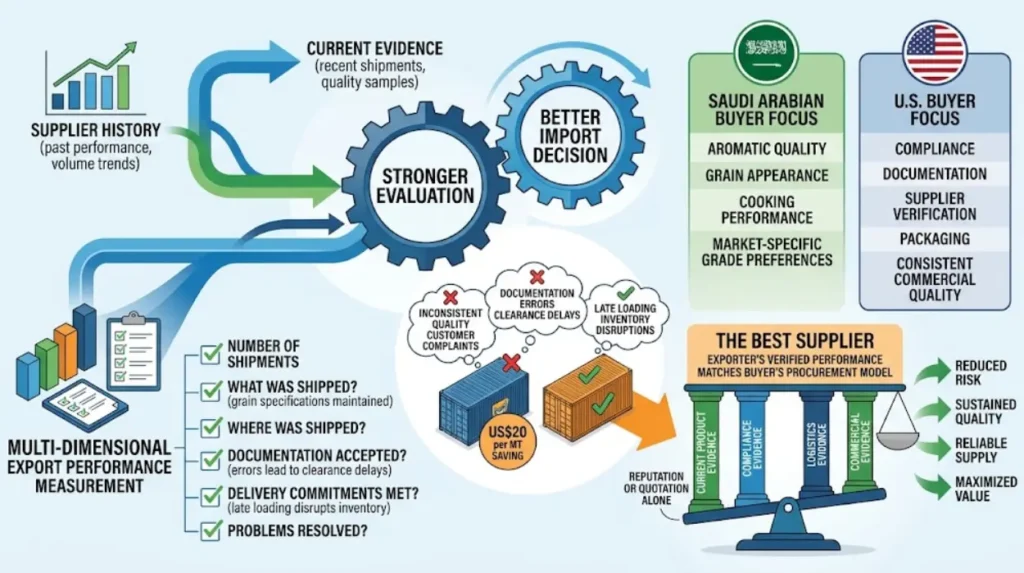
The strongest evaluation connects supplier history with current evidence, then matches that evidence to the buyer’s destination, grade, volume, compliance requirements, price target, and delivery schedule rather than selecting an exporter from reputation or quotation alone.
Export performance is therefore a multi-dimensional measurement. A supplier’s number of shipments is only the starting point. Importers need evidence showing what was shipped, where it was shipped, whether specifications were maintained, whether documents were accepted, whether delivery commitments were met, and how problems were resolved.
The comparison becomes especially important when two suppliers offer similar FOB prices. A US$20 per MT saving can disappear quickly if inconsistent grain quality causes customer complaints, documentation errors delay clearance, or late loading disrupts inventory planning.
For Saudi Arabian and U.S. buyers, the evaluation criteria are not identical. Saudi buyers can place greater weight on aromatic quality, grain appearance, cooking performance, and market-specific grade preferences. U.S. buyers must place greater weight on compliance, documentation, supplier verification, packaging, and consistent commercial quality.
The best supplier is therefore the exporter whose verified performance matches the buyer’s procurement model. This makes export history useful, but only when it is combined with current product, compliance, logistics, and commercial evidence.
For an Ohio-focused procurement program, the next decision stage is to assess a supplier against the specific requirements of the destination market, product grade, shipment volume, and ongoing supply arrangement; this is where the decision-focused article:
Partner with AHK Rice for Ohio Basmati Rice Import Programs should be introduced.
Frequently Asked Questions
How can importers evaluate a rice supplier’s export performance?
Importers can evaluate export performance by reviewing shipment history, destination markets, product consistency, documentation accuracy, delivery records, production capacity, and repeat-order evidence.
Why does export history matter when selecting a rice supplier?
Export history shows whether a supplier has experience handling international shipments, destination requirements, customs documentation, logistics, and recurring commercial orders.
What documents should importers request from a rice supplier?
Importers should request product specifications, certificates of analysis, inspection reports, certificates of origin, phytosanitary documents where applicable, packing lists, commercial invoices, and relevant compliance records.
How should buyers compare two rice suppliers?
Buyers should compare suppliers using product quality, export history, documentation, delivery performance, production capacity, price per MT, packaging capability, and destination-market experience.
What rice quality specifications should importers check?
Key specifications include rice variety, grain length, broken percentage, moisture content, purity, damaged grains, foreign matter, milling quality, aroma, cooking performance, packaging, and shelf-life conditions.
How important is shipment history when evaluating a rice exporter?
Shipment history is important because it provides evidence of actual international trade activity. Buyers should focus on shipments involving the same rice variety, grade, destination, and approximate volume they intend to purchase.
Should importers choose a rice supplier based only on price?
No. Price should be evaluated alongside quality, documentation, delivery reliability, compliance, packaging, production capacity, and the total cost of supply. A lower FOB price can create higher costs if quality or delivery problems occur.
How can buyers measure rice supplier reliability?
Buyers can measure reliability by tracking promised versus actual production dates, container loading, document release, shipment departure, delivery performance, specification compliance, and corrective actions after each shipment.
What is a rice supplier performance scorecard?
A supplier performance scorecard is a structured evaluation system that assigns scores to factors such as product consistency, export history, compliance, delivery performance, and commercial reliability.