How Do Wholesale Buyers Select Reliable Rice Categories?
Wholesale buyers select reliable rice categories by matching grade, grain specification, price, shelf life, market demand, and supplier consistency before comparing quotations. Here is why: a low FOB price does not guarantee the right cooking performance, storage stability, or repeat shipment quality.
Wholesale procurement starts with the end market. GCC distributors often prioritize parboiled Sella grades for catering and bulk cooking. UK and Scottish wholesalers commonly evaluate white Basmati for retail and foodservice channels. Buyers should first understand the product structure through the 1121 Basmati guide for global importers before comparing supplier offers.
Reliable rice categories also depend on processing control. AHK Rice supplies 1121, Super Kernel, and 1509 varieties from Punjab through integrated processing, grading, packaging, inspection, and export logistics. The AHK Rice export service covers these activities within one supply process, allowing buyers to evaluate product and supplier performance together.
What are the available rice sourcing solutions?
Wholesale buyers have five main sourcing solutions: direct exporters, trading companies, agents, contract suppliers, and tender-based procurement. Each method changes price visibility, specification control, communication speed, minimum order requirements, and responsibility for shipment quality.
Direct exporter sourcing
Direct exporter sourcing connects the importer with a processor or exporter in the producing country. The buyer can define grain length, broken percentage, moisture, processing grade, packaging, and shipment terms directly.
AHK Rice represents this model from Punjab. Its supply structure covers procurement, milling, grading, sorting, packaging, documentation, and container loading. This reduces the number of commercial handoffs between origin processing and export shipment.
Trading company procurement
Trading companies purchase from mills and resell to importers. This approach can provide access to several origins or grades through one commercial contact. The trade-off is reduced visibility into the original processing operation.
Trading companies remain useful for buyers needing mixed products or smaller purchasing programs. Buyers should request the mill source, specification sheet, inspection records, and shipment history before approving the supplier.
Agent-based purchasing
Agents connect buyers with exporters and mills. They can help negotiate prices, communicate local requirements, and identify available stock.
Agent procurement works best when the buyer already has a clear specification. The buyer should maintain direct approval of samples and contractual specifications to prevent substitution.
Contract supply
Contract supply establishes recurring shipments under agreed specifications. Buyers can define annual volumes, delivery windows, packaging, quality parameters, and commercial terms.
This approach suits distributors with predictable demand. A fixed specification also makes each shipment easier to compare against the previous lot.
Tender procurement
Tender procurement focuses on price, specification compliance, documentation, and delivery capability. Government institutions, large foodservice organizations, and major distributors can use this model.
Tender purchasing works well for standardized products. It becomes less effective when buyers require frequent specification changes or custom packaging.
With the available sourcing models defined, the next question is how their commercial and operational differences affect wholesale decisions.
How do different approaches compare?
Direct exporters provide the strongest specification control, while trading companies offer broader sourcing access and agents provide market coordination. Contract supply adds continuity, while tenders emphasize competitive pricing and documented compliance.
| Attribute | Direct Exporter | Trading Company | Agent | Contract Supplier | Tender Procurement |
|---|---|---|---|---|---|
| Specification control | High | Medium | Medium | Very high | High |
| Price transparency | High | Medium | Medium | High | Very high |
| Supplier visibility | High | Medium | Low–Medium | High | Medium |
| Shipment consistency | High | Medium | Depends on exporter | Very high | Contract-dependent |
| Custom packaging | High | Medium | Depends on mill | High | Contract-dependent |
| Communication | Direct | Indirect | Coordinated | Direct | Formal |
| Best use case | Repeat wholesale imports | Multi-source buying | Market access | Recurring demand | Large standardized tenders |
The strongest model depends on the buyer’s operating structure. A Scottish wholesaler serving retail customers needs different controls from a GCC catering distributor buying 20 containers for institutional kitchens.
What should buyers compare before selecting a category?
Buyers should compare grain length, broken percentage, moisture, processing type, packaging, certification, shipment history, and landed cost. These specifications determine whether the rice performs correctly after import.
A specification sheet should remain the commercial reference. Verbal descriptions such as “premium,” “extra-long,” or “best quality” do not provide enough purchasing control.
The most useful comparison starts with measurable attributes. Grain length controls appearance. Broken percentage influences presentation and yield. Moisture affects storage stability. Processing type changes cooking performance and shelf life.
Price should therefore remain one variable rather than the complete decision criterion.
Which rice categories fit different wholesale markets?
GCC wholesalers generally favor 1121 Sella and other parboiled Basmati grades, while UK and Scottish buyers commonly evaluate white Basmati for retail and foodservice. The correct category depends on cooking requirements, storage conditions, customer positioning, and target purchase price.
Which categories suit GCC wholesale buyers?

GCC buyers frequently prioritize long-grain parboiled rice for mandi, kabsa, biryani, catering, and institutional foodservice. 1121 Golden Sella and 1121 Creamy Sella provide strong grain integrity and visual separation after cooking.
Super Kernel also serves premium retail and foodservice channels. Its traditional aroma and long-grain profile make it suitable for buyers targeting premium Basmati positioning.
Saudi Arabia, UAE, Qatar, Oman, Kuwait, and Bahrain represent important Basmati destinations in the Gulf region (source: REAP export data, December 2025). Buyers in these markets evaluate grain length, moisture, broken percentage, cleanliness, packaging, and cooking performance.
Which categories suit UK and Scottish buyers?
UK wholesalers commonly evaluate white Basmati for retail and foodservice because the product offers a clean appearance and familiar cooking profile. Scottish wholesalers can also use 1121, Super Kernel, and 1509 according to customer segment.
UK buyers face additional emphasis on documentation, traceability, food safety, packaging, and destination compliance. White 1121 provides premium long-grain positioning, while 1509 can support more price-sensitive foodservice programs.
Scottish wholesale procurement therefore benefits from category segmentation. Premium retail can prioritize 1121 White or Super Kernel. Catering buyers can compare 1121 Sella and 1509 according to cooking yield and procurement cost.
Market preference should determine the specification before the supplier quotation is evaluated.
How does price per metric ton compare between markets?
FOB pricing is primarily determined at origin, while destination market cost changes through freight, insurance, customs, port charges, clearance, and inland delivery. A current indicative Pakistan benchmark places premium Basmati around $1,135–$1,205 per MT FOB Karachi.
Indicative July 2025-origin pricing shows 1121 Sella around $1,135–$1,175/MT, while 1121 White and Super Kernel were around $1,165–$1,205/MT (source: PakistanRice.com, July 2026 price listing). These figures provide a comparison benchmark rather than a fixed quotation.
| Market region | Typical category focus | Indicative origin comparison | Main cost consideration |
|---|---|---|---|
| GCC | 1121 Sella, Golden Sella, Creamy Sella | $1,135–$1,205/MT FOB | Freight, destination charges, packaging |
| UK / Scotland | 1121 White, Super Kernel, 1509 | $1,165–$1,205/MT FOB | Freight, compliance, clearance, inland delivery |
GCC buyers can favor Sella because parboiling supports firm grains during high-volume cooking. UK buyers can favor white Basmati when appearance and retail presentation dominate the purchasing decision.
The final landed cost must include every destination expense. UAE importers calculate landed cost from export price, freight, insurance, customs, port expenses, clearance, and inland transport (source: AHK Rice UAE landed-cost analysis, July 2026).
Price comparison becomes useful only after the product specification remains identical.
How does shelf life affect rice category selection?
Processing type strongly influences storage stability, with Golden Sella offering longer practical storage than Steam under comparable controlled conditions. AHK Rice specifications identify approximately 18 months for Golden Sella in suitable storage, compared with around 12 months for Steam.
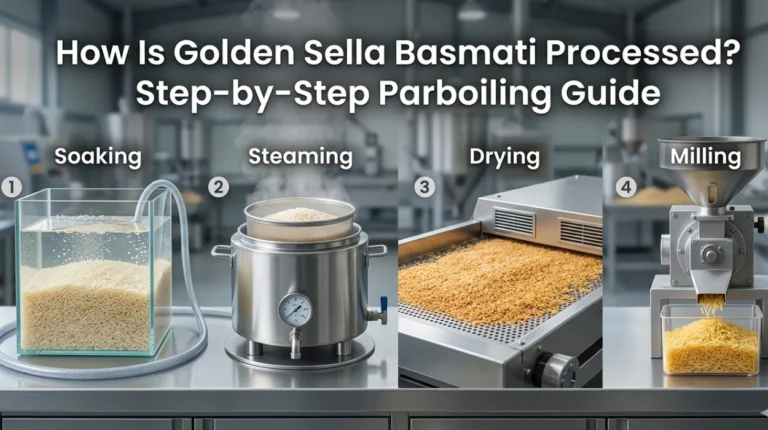
Golden Sella undergoes parboiling before milling. The process strengthens kernels and improves resistance during handling and cooking. The longer storage window supports distributors carrying larger inventories.
Steam rice offers a different value proposition. Its processing provides grain strength while retaining a lighter appearance than Golden Sella. Buyers with faster stock rotation can prioritize Steam when colour and cooking profile match customer demand.
Moisture control remains critical for every category. Export-oriented Basmati commonly targets approximately 12–13% moisture for stable storage and transport (source: AHK Rice moisture comparison, July 2026).
Storage conditions also matter. Warehouses should protect rice from excessive humidity, heat, pests, and direct exposure to moisture. A long shelf-life specification cannot compensate for poor warehouse management.
With price and shelf life compared, buyers can now match individual rice categories to specific procurement cases.
Which method works best for different wholesale cases?
Direct exporter sourcing works best for recurring container buyers, contract supply suits predictable demand, and trading companies work best for buyers needing broader product access. The right model depends on volume, specification complexity, market requirements, and purchasing frequency.
Premium retail importer
A premium retail importer should prioritize 1121 White or Super Kernel. The buyer should specify grain length, broken percentage, moisture, packaging, labelling, and certification requirements.
Direct exporter sourcing provides strong control over these attributes. The buyer can approve a physical sample before confirming the production specification.
High-volume catering distributor
A catering distributor should prioritize 1121 Golden Sella or Creamy Sella where firm grain and cooking separation are essential. Large kitchens benefit from repeatable cooking performance across multiple containers.
Contract supply adds value because the buyer can maintain the same specification across recurring shipments.
Price-sensitive foodservice buyer
A price-sensitive buyer can evaluate 1509 Basmati. AHK Rice describes 1509 as suitable for foodservice because it combines long grain, cooking yield, availability, and competitive procurement economics.
This category can support restaurants, catering companies, institutional kitchens, and food manufacturers where cost per serving matters.
Multi-market distributor
A distributor serving several markets should use a multi-category supply program. 1121, Super Kernel, and 1509 can cover premium, mainstream, and value-oriented demand.
One exporter can simplify procurement when the buyer needs several specifications. The buyer should still maintain separate product codes and approval samples for each grade.
These examples show why category selection must follow customer use rather than supplier availability.
What are the pros and cons of each rice sourcing strategy?
Direct sourcing offers stronger control but requires more procurement management; trading offers convenience but reduces origin visibility; contracts improve consistency but require accurate demand planning. Each approach creates a different balance between control, flexibility, and commercial risk.
| Strategy | Main advantage | Main limitation | Suitable example |
|---|---|---|---|
| Direct exporter | Strong specification control | Requires buyer due diligence | Scottish wholesale importer |
| Trading company | Convenient multi-source access | Less mill visibility | Mixed-grade distributor |
| Agent | Local negotiation support | Dependency on exporter selection | New market entrant |
| Contract supply | Repeatable shipments | Requires volume planning | GCC catering distributor |
| Tender | Competitive bidding | Less flexibility | Institutional buyer |
No strategy eliminates procurement risk. Buyers reduce risk through documented specifications, representative samples, inspection, approved packaging, and clear Incoterms.
The strongest purchasing process therefore combines a suitable sourcing model with measurable quality controls.
What decision factors should wholesale buyers use?
Wholesale buyers should rank specification consistency, landed cost, supplier reliability, market fit, and storage performance before selecting a rice category. These five factors provide a practical framework for comparing suppliers without allowing a low quotation to dominate the decision.
| Decision factor | What to verify | Why it matters |
|---|---|---|
| Specification | Grain length, broken %, moisture, purity | Protects product consistency |
| Landed cost | FOB, freight, duty, clearance, delivery | Measures real profitability |
| Supplier reliability | Export history, capacity, shipment records | Reduces supply disruption |
| Market fit | Grade, cooking profile, packaging | Aligns product with customers |
| Storage performance | Processing type, moisture, shelf life | Protects inventory value |
Specification should receive the first review. Buyers cannot compare two prices accurately when the broken percentage or processing grade differs.
Landed cost should follow specification approval. Freight and destination charges can materially change the final purchasing cost.
Supplier reliability should then be verified through documentation, production capability, quality inspection, and shipment history. A supplier with repeatable operations provides greater value than a supplier offering an isolated low price.
Market fit determines resale performance. A lower-cost grade becomes expensive when customers reject its cooking characteristics or appearance.
Storage performance completes the framework. Distributors holding larger inventories need a category that matches their warehouse conditions and stock rotation.
How should a wholesale buyer build a reliable rice procurement program?
A reliable procurement program starts with market requirements, converts them into measurable specifications, validates samples, compares landed costs, and then establishes repeat shipment controls. This sequence prevents buyers from selecting rice based on price before confirming product suitability.
Start by defining the customer segment. Separate premium retail, mainstream wholesale, foodservice, catering, and institutional demand.
Next, define the product specification. Record variety, processing grade, grain length, broken percentage, moisture, packaging, certification, and acceptable tolerances.
Then request a representative sample. The sample should reflect the specification intended for commercial production. Buyers should evaluate appearance, aroma, cooking expansion, grain separation, and breakage.
After approval, compare FOB and landed costs. Include freight, insurance, customs, port charges, clearance, and local transport.
Finally, establish shipment controls. Use the approved specification as the reference for repeat orders. Require pre-dispatch inspection and maintain records for every shipment.
This process turns rice procurement from price shopping into specification management.
What is the final decision for wholesale rice buyers?
The best wholesale rice category is the one that matches the destination market, customer use, storage requirement, and landed-cost target while maintaining consistent specifications across shipments. 1121, Super Kernel, and 1509 each serve different commercial positions.
GCC buyers can prioritize Sella grades for high-volume cooking. UK and Scottish buyers can evaluate White Basmati for retail and foodservice. 1509 provides a practical option for cost-sensitive foodservice programs.
Reliable sourcing then depends on the supplier’s ability to reproduce the specification. Buyers should evaluate milling, grading, sorting, testing, packaging, documentation, and shipment coordination as one procurement system.
AHK Rice supplies Pakistani Basmati from Punjab across 15+ countries, including 1121, Super Kernel, and 1509. Its integrated processing and export structure allows buyers to evaluate product specifications alongside supply capability.
For the Scottish market specifically, the planned AHK Rice Supports Scottish Wholesale Buyers with Export Supply Programs” should be used after this article’s decision framework, where readers have already compared categories and are ready to evaluate a supply program.
Frequently Asked Questions
How do wholesale buyers select reliable rice suppliers?
Wholesale buyers compare product specifications, supplier capacity, quality controls, export documentation, pricing, shipment performance, packaging, and market suitability. Samples and inspection records should confirm that the supplier can reproduce the agreed specification across commercial shipments.
Which Basmati rice is best for GCC wholesalers?
1121 Golden Sella and Creamy Sella are strong choices for GCC wholesale applications requiring firm grains, long elongation, and reliable cooking separation. Super Kernel also serves premium retail and foodservice channels where aroma and traditional Basmati characteristics matter.
Which Basmati rice is suitable for Scottish wholesalers?
Scottish wholesalers can evaluate 1121 White and Super Kernel for premium retail and foodservice demand. 1509 can support price-sensitive foodservice programs. Final selection should follow customer requirements, packaging format, cooking performance, and landed cost.
Is FOB price enough to compare rice suppliers?
No. FOB price covers the origin-side commercial basis but does not represent the buyer’s final cost. Freight, insurance, customs, port charges, clearance, inland delivery, packaging, and destination requirements can materially change landed cost.
Which rice grade has the longest shelf life?
Golden Sella generally provides longer storage stability than Steam under suitable controlled conditions. AHK Rice identifies approximately 18 months for Golden Sella and around 12 months for Steam. Actual performance depends on moisture and warehouse conditions.
Why should wholesale buyers request rice samples?
Samples allow buyers to verify grain length, appearance, aroma, cooking expansion, separation, and breakage before committing to commercial volume. A representative sample also provides a physical reference for comparing future shipments against the approved specification.
What are the main rice varieties supplied by AHK Rice?
AHK Rice supplies 1121, Super Kernel, and 1509 Pakistani Basmati varieties. These varieties can be processed into different export grades and packaged according to market requirements, allowing wholesale buyers to align product selection with retail, foodservice, and catering demand.