How Do Retailers Build Successful Imported Rice Product Lines?
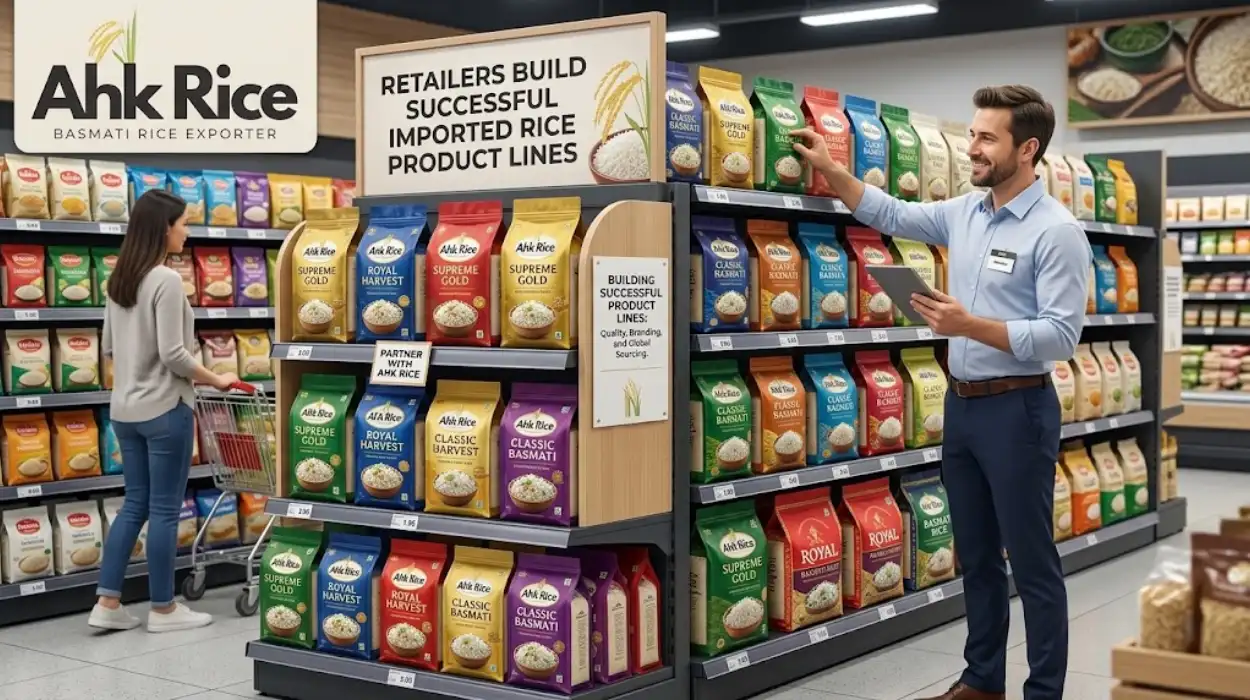
Retailers build successful imported rice product lines by matching rice grade, retail format, price position, shelf life, and market demand before contracting supply. Here is why: a strong product line balances consumer choice with stock rotation, compliance, margin, and dependable replenishment.
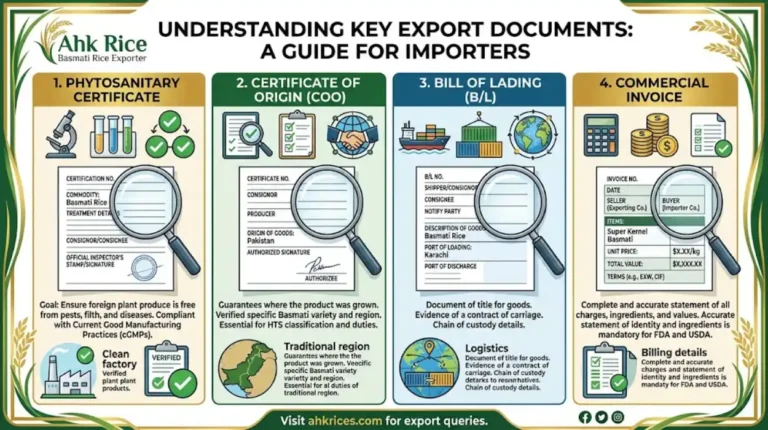
Imported rice product lines work best when each SKU has a defined commercial role. A retailer can use 1121 Steam for premium everyday sales, Super Kernel for a mid-premium tier, and Golden Sella for customers seeking firmer cooking performance. A complete guide to how Pakistani Basmati moves from cultivation to export explains how cultivation, milling, grading, testing, certification, packaging, and shipping connect before retail distribution.
AHK Rice supplies 1121, Super Kernel, and 1509 Basmati from Punjab through controlled processing, grading, sorting, custom packaging, and export documentation. Retailers therefore need to evaluate the product specification before evaluating the supplier relationship. The strongest product line starts with clear SKU roles rather than simply adding more rice varieties.
What are the available solutions for building an imported rice product line?
Retailers can choose direct exporter sourcing, private-label programs, distributor supply, UK co-packing, or hybrid sourcing models; each option changes cost control, specification control, packaging flexibility, compliance responsibility, and scalability.
Direct exporter sourcing connects the retailer with the producing country. The exporter mills, grades, tests, packs, and dispatches rice according to an agreed specification. This model provides stronger origin control and works well for retailers planning repeat container purchases.
Private-label sourcing adds brand ownership to direct sourcing. The retailer controls the brand name, artwork, pack size, positioning, and retail price. The exporter controls the rice specification and export preparation. This approach suits supermarkets and independent chains building differentiated own-brand ranges.
Distributor sourcing places another commercial layer between the origin mill and retailer. The distributor may hold stock locally and provide smaller quantities. This improves replenishment flexibility but can increase the final cost per kilogram and reduce direct visibility into origin processing.
UK co-packing separates rice procurement from retail packaging. A retailer can purchase bulk rice and arrange consumer packing closer to the destination market. This can support small launches, frequent artwork changes, and lower initial inventory commitments.
Hybrid sourcing combines origin processing with destination-side flexibility. A retailer can import standardized bulk rice while using local packaging or distribution services. The approach works when demand is uncertain but the retailer still needs control over the core specification.
With the available sourcing models established, the next question is how retailers should compare them commercially.
How do different imported rice approaches compare?
Direct exporter and private-label models generally provide the strongest specification and margin control, while distributors and co-packers provide greater flexibility for smaller volumes, rapid testing, and localized retail operations.
The main difference is control. Direct sourcing gives the retailer greater influence over variety, broken percentage, moisture, packaging, and shipment specifications. Distributor sourcing gives more flexibility but usually reduces direct control over the origin supply chain.
Private label creates another advantage. The retailer owns the consumer-facing identity instead of competing only on an existing supplier brand. The model can support separate good-better-best price tiers using different grades while maintaining one retail brand architecture.
Seven-attribute specification comparison
| Attribute | Direct exporter | Private label | Distributor | UK co-packer |
|---|---|---|---|---|
| Origin control | High | High | Medium | Medium |
| Specification control | High | Very high | Medium | Medium |
| Packaging flexibility | High | Very high | Medium | Very high |
| Typical cost efficiency | High | High | Medium | Medium |
| Minimum-volume suitability | Medium | Medium | High | High |
| Traceability | High | High | Medium | Medium |
| Brand ownership | Retailer-dependent | Full retailer control | Usually limited | Full retailer control |
The table shows why retailers should not compare sourcing methods only by quoted price. A lower purchase price can become less attractive after additional packaging, warehousing, compliance, or distributor margins are included.
Retailers should also define the role of every SKU. A premium 1121 Steam pack should not compete directly with a value-oriented 1509 pack under the same price message. Product architecture becomes stronger when grain specification and consumer positioning support each other.
The next comparison focuses on the two major regional patterns most relevant to imported Pakistani Basmati retail.
Which rice grades suit different market regions?
UK and Northern Ireland retail generally favour premium White and Steam Basmati, while GCC markets place stronger emphasis on Steam, Sella, and Golden Sella for retail, catering, and storage-intensive distribution.
UK and Northern Ireland retail
UK retail buyers commonly use 1121 White, 1121 Steam, Super Kernel, and selected 1509 grades across premium, mainstream, ethnic grocery, and private-label channels. European retail systems place strong importance on appearance, packaging, labelling, traceability, and consistent consumer performance.
Northern Ireland requires particular regulatory attention because food entering Northern Ireland follows a different framework from Great Britain. Retailers must confirm the applicable rules for their supply route before contracting products.
For Great Britain, imported cereals must meet relevant food hygiene, labelling, packaging, pesticide, and contaminant requirements. GOV.UK also identifies specific controls that can apply to rice and other cereals.
A UK retail line can therefore use 1121 Steam as the premium flagship, 1121 White as the clean everyday option, and Super Kernel as a value-controlled premium SKU. Smaller packs such as 1 kg, 2 kg, 5 kg, and 10 kg can create different household purchase points.
GCC retail and foodservice
GCC markets commonly prioritize 1121 Golden Sella, 1121 Steam, Super Kernel, and Sella grades. Gulf buyers place greater emphasis on grain integrity, cooking stability, storage performance, and suitability for large-volume dishes.
Golden Sella uses parboiling before milling. The process strengthens the kernel and supports stronger cooking performance. This makes the grade particularly relevant for catering, foodservice, and distribution environments where rice may remain in inventory for longer periods.
GCC demand also creates opportunities for separate retail and foodservice lines. Retail packs can emphasize premium appearance and grain length. Larger foodservice packs can emphasize cooking yield, durability, and cost per serving.
Price per MT comparison
Indicative July 2026 FOB Karachi references place major 1121 Basmati grades around $1,135–$1,205 per MT, before freight, destination charges, packaging, inspection, and inland delivery. GCC destination costs then rise according to the delivery lane and import structure.
Indicative grade-level references show 1121 Steam around $1,180–$1,320/MT, 1121 Golden Sella around $1,150–$1,280/MT, Super Kernel Steam around $980–$1,120/MT, and 1509 Steam around $900–$1,020/MT. These figures are market indicators rather than fixed quotations.
Shelf-life comparison
Commercial shelf life depends on processing, moisture, packaging, warehouse conditions, and the supplier’s declared specification. UK retail planning commonly uses controlled warehouse conditions, while GCC distribution requires stronger attention to heat and humidity.
White Basmati commonly supports approximately 12 months of commercial shelf-life planning under suitable storage. Super Kernel can commonly fall within a 12–18 month planning range. GCC buyers using Golden Sella can plan around 18–24 months where the declared specification and storage conditions support that period.
The regional comparison shows that successful product lines should adapt the grade mix to market conditions rather than use one universal SKU strategy.
Which method works best for different retailer cases?
Private-label direct sourcing works best for established retailers, distributor sourcing suits smaller or variable-volume buyers, and hybrid models work best when retailers need brand control without committing to large consumer-pack inventories.
Supermarket chains benefit from private-label direct sourcing because they can standardize grain length, broken percentage, pack weight, artwork, and replenishment schedules. The retailer can build a consistent own-brand architecture across multiple stores.
Independent retailers can use distributor supply when their annual demand is too small for direct container programs. The distributor carries more inventory risk and can split larger import quantities into smaller deliveries.
New retail brands can use a hybrid approach. The retailer can validate demand through a limited range before expanding into additional grades. This avoids creating excessive inventory across slow-moving SKUs.
Ethnic grocery retailers can prioritize recognizable grades and cooking characteristics. Super Kernel and 1121 often support premium aromatic positioning, while 1509 can provide a more cost-controlled option for price-sensitive shoppers.
Foodservice-linked retailers need different specifications. Golden Sella can support catering-oriented lines because parboiling strengthens grain structure. Retailers serving restaurants should therefore separate household products from foodservice specifications.
The best method depends on volume, brand ownership, storage capacity, and the retailer’s ability to manage international procurement.
What are the pros and cons of each approach?
Direct sourcing improves control and margin potential, private label builds differentiation, distributors reduce inventory complexity, and co-packing increases flexibility while adding another operational layer.
Direct exporter sourcing provides strong traceability and specification control. The disadvantage is the need to manage larger purchase volumes, international documentation, freight, customs, and inventory planning.
Private label creates a defensible retail identity. The retailer controls pack design and consumer positioning. The disadvantage is greater responsibility for artwork, compliance, forecasting, and minimum order quantities.
Distributor sourcing simplifies replenishment. A retailer can order smaller quantities and avoid managing every international shipment. The disadvantage is reduced control over origin processing and potentially higher per-unit costs.
Co-packing provides strong packaging flexibility. A retailer can modify consumer formats without changing the bulk rice source. The disadvantage is an additional handling stage that can increase cost and traceability complexity.
A successful retailer therefore chooses the model that matches operational capability rather than selecting the lowest initial rice price.
What decision factors should retailers evaluate before ordering?
Retailers should evaluate grade fit, target price, shelf life, packaging, compliance, order volume, traceability, and supply reliability together because each factor affects the commercial performance of the complete SKU.
The first factor is consumer positioning. Premium shelves require grain length, aroma, appearance, and packaging that justify the retail price.
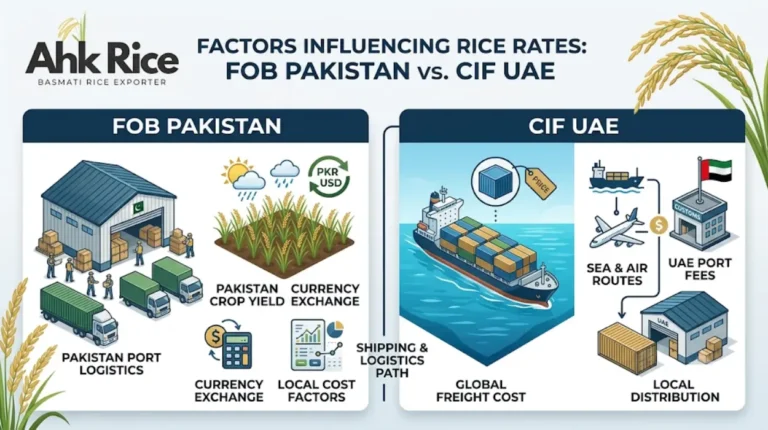
The second factor is landed cost. FOB price alone does not determine profitability. Freight, insurance, packaging, port charges, customs, inspection, warehousing, and inland transport all contribute to the final cost.
The third factor is stock rotation. A retailer with slower sales needs a specification that supports longer commercial storage and reliable packaging protection.
The fourth factor is compliance. Imported rice must satisfy applicable food standards, labelling requirements, contaminant controls, and import documentation. UK guidance confirms that imported cereals must meet applicable food hygiene and regulatory requirements.
The fifth factor is supply reliability. Retailers need repeat shipments that match the approved sample. Consistent grain length, moisture, broken percentage, purity, packaging, and documentation reduce commercial disruption.
Five-row decision framework
| Decision factor | UK/Northern Ireland retail | GCC retail/foodservice |
|---|---|---|
| Grade priority | 1121 Steam, 1121 White, Super Kernel | 1121 Golden Sella, Steam, Super Kernel |
| Main selling point | Appearance, aroma, brand presentation | Cooking stability, durability, storage |
| Indicative FOB reference | ~$1,135–$1,205/MT for major 1121 grades | ~$1,135–$1,205/MT for major 1121 grades |
| Shelf-life planning | Often around 12 months for White | Golden Sella commonly planned around 18–24 months |
| Best sourcing model | Private-label direct sourcing | Direct exporter or hybrid sourcing |
This framework gives retailers a practical way to connect product specifications with market requirements. It also prevents price from becoming the only purchasing criterion.
How should retailers build a successful multi-SKU rice line?
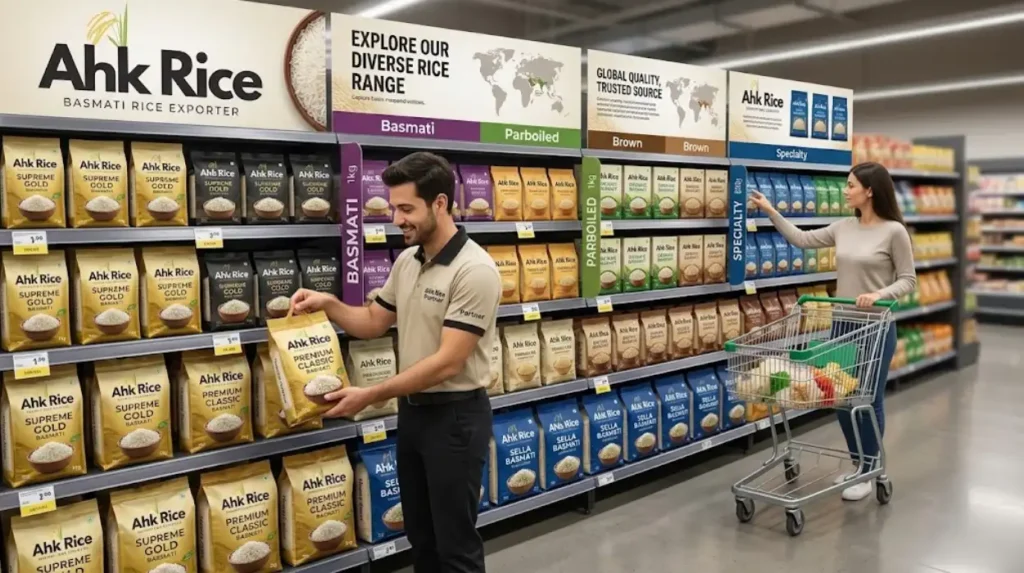
Retailers should begin with three clearly differentiated SKUs, assign each a consumer role, validate demand, then expand the range only when sales data supports additional grades or pack sizes.
A practical starting range can contain one premium 1121 SKU, one mainstream Super Kernel SKU, and one value-oriented 1509 SKU. This structure creates visible differentiation without overwhelming shoppers.
The premium SKU should lead with grain length, aroma, cooking performance, and packaging quality. The mainstream SKU should balance quality and price. The value SKU should provide an accessible entry point without damaging the premium products.
Packaging should reinforce those differences. Pack weight, artwork, colour hierarchy, preparation information, origin information, and cooking instructions should remain consistent across the range while clearly separating each product tier.
AHK Rice can support this structure through its Punjab-based processing system covering 1121, Super Kernel, and 1509, alongside grading, sorting, custom packaging, and export preparation. AHK Rice Pakistani Basmati rice export and processing service
Retailers should also use an approved sample as the commercial reference. The specification should define variety, grain length, broken percentage, moisture, foreign matter, purity, packaging, and other agreed quality parameters. Every repeat shipment should be checked against that specification.
The result is a product line built around measurable differences rather than superficial SKU expansion.
What is the final approach for retailers entering imported rice?
The strongest approach is a specification-led product architecture combining direct origin sourcing, differentiated grades, controlled packaging, documented compliance, realistic landed costs, and a replenishment plan matched to each retail channel.
Retailers should avoid building ranges around variety names alone. 1121, Super Kernel, and 1509 become commercially useful only when each variety has a defined consumer purpose.
UK and Northern Ireland retailers can emphasize 1121 Steam and White for premium retail presentation. GCC retailers can place greater emphasis on Golden Sella and Steam where cooking stability and storage performance carry greater weight.
Price should remain a commercial input rather than the sole decision. A lower FOB price can lose its advantage after packaging, freight, compliance, storage, and slow stock rotation are included.
The final supplier evaluation should therefore combine specification control, quality testing, traceability, packaging capability, documentation accuracy, shipment reliability, and landed-cost transparency.
For retailers moving from category evaluation toward supplier selection, the next decision-focused resource can be placed here: AHK Rice helps Northern Ireland retailers source premium Basmati rice. This link should appear after the retailer has reviewed the decision framework, because that is the point where informational intent naturally changes into supplier evaluation.
Frequently Asked Questions
What rice grades should retailers stock?
Retailers can start with 1121 Steam, 1121 White, Super Kernel, and 1509. The exact mix should reflect consumer demand, price positioning, storage conditions, and retail channel.
Is private-label rice better for retailers?
Private-label rice gives retailers stronger control over packaging, positioning, and consumer identity. It works best for retailers with sufficient volume and a defined brand strategy.
How much does Basmati rice cost per MT?
Indicative 2026 FOB Karachi pricing for major 1121 Basmati grades is approximately $1,135–$1,205 per MT. Actual landed cost depends on grade, packaging, freight, inspection, and destination charges.
Which Basmati grade has the longest shelf-life?
Golden Sella generally provides stronger commercial storage performance than White or Steam Basmati because parboiling strengthens the grain. Retailers should always use the supplier’s declared shelf-life specification.
What should retailers check before approving an imported rice supplier?
Retailers should check variety, grain length, broken percentage, moisture, foreign matter, purity, testing procedures, packaging, certifications, traceability, export documentation, and shipment consistency.
Which market prefers Golden Sella Basmati?
GCC markets commonly prefer Golden Sella for retail, catering, and foodservice applications because the parboiled grain provides strong cooking stability and storage performance.
How many SKUs should a new rice brand launch?
A three-SKU launch provides a practical starting structure. One premium, one mainstream, and one value-oriented product can test consumer demand without creating excessive inventory complexity.
What is the most important factor in imported rice retail?
Specification consistency is the most important operational factor. Consumers expect the same cooking performance from every repeat purchase, making consistent grading, testing, packaging, and supply essential.