Why Do Massachusetts Importers Prefer Experienced Rice Exporters?
Massachusetts importers prefer experienced rice exporters because export history demonstrates repeated performance across production, quality control, documentation, shipping, and customs processes. A supplier with verifiable shipment experience gives buyers measurable evidence of operational consistency instead of relying only on quotations or product samples.
A rice exporter is a company that prepares rice for international sale and manages the commercial and regulatory activities required to move the product from the producing country to a foreign buyer. Experience means more than operating for a certain number of years. It means completing export transactions with documented product specifications, shipment records, quality procedures, packaging controls, and international documentation.
Massachusetts buyers operate within the U.S. food-import framework. Imported food must satisfy U.S. requirements, and FDA states that imported food is subject to the same legal requirements as domestically produced food. Facilities involved in manufacturing, processing, packing, or holding food for U.S. consumption must meet applicable registration requirements, while importers must comply with Prior Notice procedures.
For rice importers, experience therefore becomes a practical procurement indicator. A supplier that has completed repeated international shipments has an established process for handling specifications, laboratory documentation, packing, container loading, shipping paperwork, and communication with buyers.
Pakistan is also a major rice-producing and exporting origin. USDA’s April 2026 Pakistan Grain and Feed Annual forecasts Pakistan’s 2026/27 rice production at 9.8 million metric tons and rice exports at 5.0 million metric tons, compared with a projected 4.7 million metric tons of exports in 2025/26.
How does export experience work as a reliability indicator?
Export experience works as a reliability indicator by providing a history that buyers can evaluate across multiple shipments. Each completed transaction creates evidence about specification compliance, documentation accuracy, shipment preparation, communication, and the supplier’s ability to repeat the same commercial process.
A single successful shipment does not establish long-term reliability. A repeat shipment history provides stronger evidence because the supplier has already operated through multiple procurement cycles.
Consider a Massachusetts distributor ordering 25 metric tons of 1121 Basmati rice. The buyer needs the agreed variety, grain characteristics, moisture specification, packaging format, labeling, quantity, documents, and shipping schedule to remain consistent. If the supplier has completed similar export orders, the buyer can evaluate historical performance against those requirements.
Export history also separates production capability from commercial execution. A mill can have large processing capacity without having strong export controls. International sales require coordination between milling, sorting, grading, packaging, laboratory testing, documentation, freight arrangements, and customs procedures.
The U.S. Foreign Supplier Verification Program, or FSVP, also makes supplier performance relevant to import compliance. FDA requires covered importers to evaluate foreign suppliers and conduct appropriate verification activities based on food and supplier risk. Verification activities include supplier record review, sampling and testing, and, when appropriate, onsite audits.
This makes export history useful evidence during supplier evaluation. It does not replace the importer’s FSVP responsibilities. Instead, it gives the importer documented supplier-performance information that can support its evaluation.
What are the key components of an experienced rice exporter’s operation?
The key components include raw-material sourcing, milling, aging where applicable, sorting, grading, laboratory testing, packaging, quality inspection, documentation, container loading, freight coordination, and shipment tracking. Experienced exporters connect these stages into one controlled export process.
Raw-material sourcing
Rice quality begins with the paddy or processed rice selected for production. Pakistani Basmati rice is associated primarily with growing regions in Punjab, where suitable climate, soil, irrigation, and traditional cultivation support Basmati production.
An exporter must control incoming raw material against defined specifications. Examples include variety, grain characteristics, moisture, foreign matter, broken grains, immature grains, and purity.
Milling and processing
Milling removes the husk and produces edible rice. Processing requirements depend on the product type.
White rice undergoes milling and polishing processes designed to produce the specified appearance and grain condition. Steam and parboiled products use additional controlled processing before drying, milling, sorting, and packing.
Sorting and grading
Modern rice processing uses mechanical sorting systems to separate grains according to physical characteristics. Color sorters remove discolored grains and other visual defects. Length graders separate grains according to size.
Grades can include 1121 Basmati, Super Kernel Basmati, and 1509 Basmati. Commercial specifications can then distinguish white, steam, and parboiled or Sella forms. Each grade requires its own specification rather than relying on the generic term “Basmati.”
Laboratory and quality control
Quality control establishes whether the finished rice matches the agreed specification. Typical checks include moisture, broken percentage, grain length, foreign matter, damaged grains, chalky grains, and sensory characteristics where applicable.
A consistent exporter records these results and links them to production lots. This creates traceability between the finished shipment and the production process.
Packaging and documentation
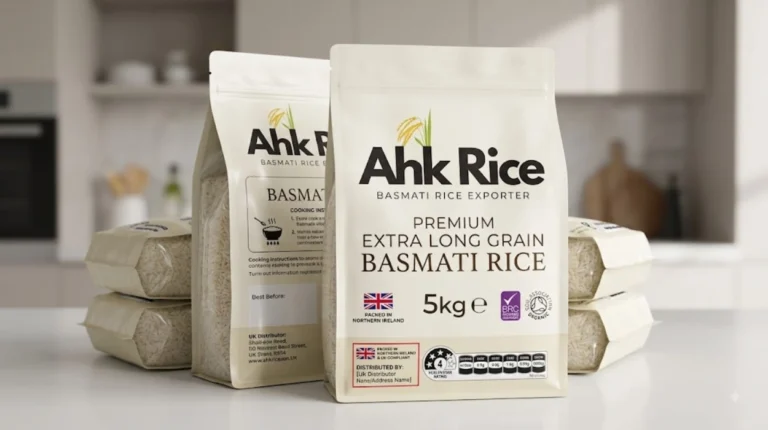
Packaging protects the rice during handling, storage, and transportation. Commercial formats include consumer packs and larger wholesale bags. Examples include 5 kg, 10 kg, 20 kg, 25 kg, and 40 kg formats, depending on the buyer and market.
Export documentation provides the commercial and regulatory record of the shipment. Common documents include commercial invoices, packing lists, certificates of origin, bills of lading, and applicable health, phytosanitary, inspection, or laboratory documents.
For U.S. shipments, food facilities and importers also operate within FDA requirements concerning facility registration, Prior Notice, food safety, and labeling.
Why does consistency matter more than a single low rice price?
Consistency matters because importers sell rice repeatedly, while a low price applies to only one transaction. Stable specifications reduce product variation, customer complaints, repacking problems, inventory disruption, and the commercial risk created when different shipments perform differently.
A Massachusetts wholesaler serving restaurants, supermarkets, or ethnic grocery stores needs predictable rice performance. If one shipment contains longer grains, another contains more broken grains, and a third has different cooking behavior, the buyer faces downstream quality problems.
Specification consistency also affects private-label programs. A private-label importer must maintain the same product identity across repeated purchase orders. Packaging, grade, grain characteristics, net weight, labeling, and quality parameters must remain aligned with the approved specification.
An experienced exporter establishes a production specification before shipment. The specification becomes a reference point for procurement, processing, inspection, and final release.
This is why buyers should compare suppliers using measurable attributes instead of years in business alone. A supplier with 15 years of business activity but weak shipment records provides less useful evidence than a supplier with documented and consistent export transactions.
What benefits does export history provide to Massachusetts rice buyers?
Export history provides Massachusetts buyers with evidence for supplier evaluation, quality verification, documentation review, shipment planning, and continuity assessment. It reduces uncertainty because buyers can examine previous commercial performance instead of judging supplier capability from a single sample or quotation.
The first benefit is supplier verification. Buyers can review previous markets, shipment volumes, product categories, and customer requirements to understand whether the exporter has handled comparable orders.
The second benefit is quality continuity. Repeated export transactions demonstrate whether the supplier can reproduce a defined specification over multiple production cycles.
The third benefit is documentation competence. International shipments require coordinated commercial and regulatory documents. Experienced exporters understand how these documents connect to the physical shipment.
The fourth benefit is logistics coordination. Rice moves through several stages before reaching the importer. Production must finish before packing. Packing must finish before container loading. The container must be documented and released before international transportation begins.
The fifth benefit is problem resolution. Export history reveals how a supplier handles deviations, document corrections, inspection findings, packaging changes, and shipment issues. FDA’s FSVP framework specifically considers a foreign supplier’s food safety history and responsiveness to correcting previous problems when evaluating supplier performance.
Which Massachusetts businesses use experienced rice exporters?
Experienced rice exporters serve businesses that require repeatable rice specifications, including wholesalers, food distributors, ethnic grocery suppliers, restaurant suppliers, foodservice companies, and private-label importers. Their requirements differ, but each depends on predictable international supply.
A rice wholesaler purchases larger quantities for redistribution. Its priority is stable specifications and shipment continuity.
A food distributor supplies multiple commercial customers. It needs reliable documentation, packaging, product identification, and inventory planning.
A restaurant supplier focuses strongly on cooking performance and repeatability. A change in grain type or processing can affect menu preparation and portion consistency.
An ethnic grocery supplier often requires recognizable Basmati varieties and specific consumer-pack sizes. Examples include 1121 Basmati, Super Kernel, and 1509 Basmati in different processing forms.
A private-label importer requires tighter coordination because the exporter must follow an approved product specification and packaging design across repeated purchase orders.
For each use case, the central question remains the same: can the supplier reproduce the agreed product and complete the export process repeatedly?
What should Massachusetts importers verify before selecting an experienced exporter?
Importers should verify actual shipment history, product specifications, quality records, food-safety documentation, facility information, packaging capability, export documents, inspection procedures, and communication processes. Experience becomes meaningful only when it is supported by verifiable operational evidence.
Buyers should begin with product history. The exporter should identify the rice varieties and processing types it has supplied internationally.
Next, buyers should review specification control. A specification should identify measurable characteristics such as variety, grain length, broken percentage, moisture, purity, packaging weight, and allowable defects.
The next area is food-safety verification. The importer should establish the applicable FSVP process and collect supplier documentation required for its risk-based evaluation. FDA states that FSVP importers must develop, maintain, and follow an FSVP for each food and foreign supplier, unless an exemption or modified requirement applies.
Buyers should then examine export documentation. Documents should correspond with the actual product, quantity, packaging, shipment, and origin.
The final area is shipment consistency. Buyers should compare several previous shipments rather than relying on one successful transaction. This reveals whether the supplier’s process remains stable across different production and shipping periods.
A structured review of:
How export history reflects supplier reliability and consistency helps buyers turn historical shipment information into a practical supplier-evaluation framework.
What common misconceptions exist about experienced rice exporters?
The most common misconception is that experience means the exporter has operated for many years. True export reliability requires evidence of repeated compliant shipments, stable specifications, controlled processing, accurate documentation, and effective responses to quality or logistics problems.
Another misconception is that a large factory automatically means reliable exports. Production capacity and export execution are different capabilities. A mill can process substantial volumes while lacking strong documentation or shipment coordination.
A third misconception is that a product sample proves future shipment quality. A sample demonstrates the characteristics of one lot. It does not establish whether the exporter can reproduce those characteristics across 5, 10, or 20 shipments.
Another misconception is that certification alone proves supplier reliability. Certifications provide evidence of compliance with specific standards or systems. They do not replace commercial performance records.
Certifications and documentation should therefore be evaluated according to their purpose. Depending on the product and buyer requirements, relevant records can include food-safety management certifications, laboratory reports, certificates of origin, phytosanitary documentation, inspection certificates, and FDA-related facility or import documentation.
The importer remains responsible for determining which requirements apply to its transaction. FDA requires imported food to be safe, sanitary, and properly labeled, and shipments can be inspected or detained when requirements are not met.
How should Massachusetts importers measure exporter reliability?
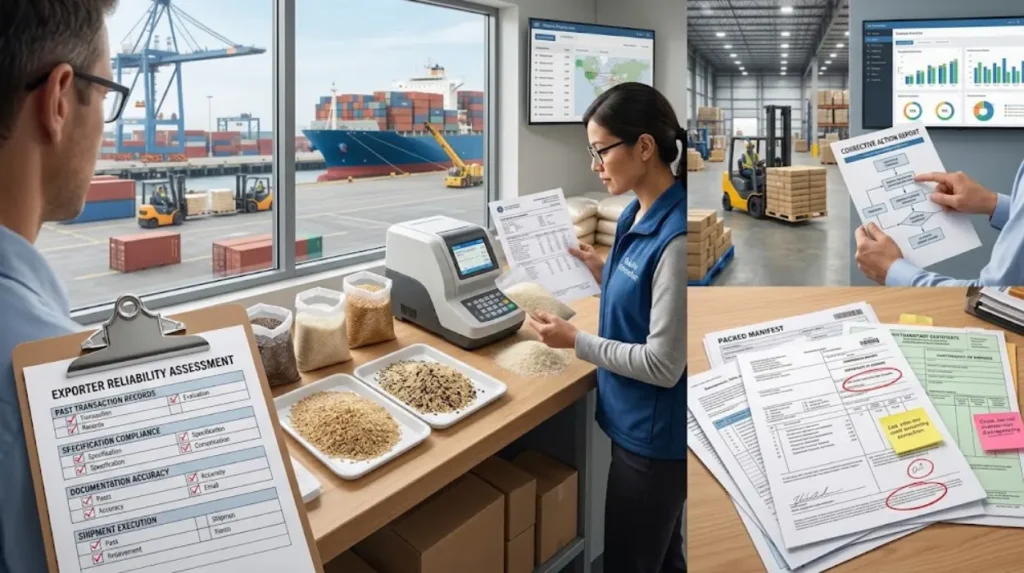
Massachusetts importers should measure reliability through repeat shipment performance, specification compliance, documentation accuracy, food-safety records, response to corrective actions, and delivery execution. These measurable indicators provide stronger evidence than company age, marketing claims, or the lowest quoted price.
A practical evaluation starts with the supplier’s previous export transactions. Buyers should identify whether the exporter has supplied the same rice grade, packaging format, and commercial quantity required for the planned program.
The next measurement is specification compliance. Compare laboratory results and inspection records against the approved specification.
Documentation accuracy should also be measured. Repeated discrepancies between invoices, packing lists, certificates, and physical cargo indicate weak process control.
Shipment execution provides another measurement. Buyers should examine whether previous orders were prepared and dispatched according to agreed commercial schedules.
Finally, buyers should examine corrective-action history. A reliable exporter does not avoid problems by hiding them. It documents deviations, identifies causes, implements corrective actions, and verifies closure.
This approach turns “experienced exporter” from a marketing description into a measurable procurement criterion. For Massachusetts importers, that distinction matters because international rice procurement involves food safety, product quality, regulatory compliance, logistics, and commercial continuity in every shipment.
Frequently Asked Questions
Why do Massachusetts importers prefer experienced rice exporters?
Massachusetts importers prefer experienced rice exporters because proven shipment history demonstrates consistency in product quality, documentation, processing, packaging, and international logistics.
What should Massachusetts importers check in a rice exporter’s history?
Importers should review previous export markets, product varieties, shipment volumes, quality records, inspection reports, documentation accuracy, and evidence of repeat shipments.
Does export experience guarantee consistent rice quality?
Export experience does not automatically guarantee quality. Buyers should verify repeated compliance with specifications for moisture, broken grains, grain length, purity, packaging, and other agreed parameters.
Which Pakistani Basmati rice varieties are commonly exported to international markets?
Common Pakistani Basmati varieties include 1121 Basmati, Super Kernel Basmati, and 1509 Basmati. These varieties are supplied in different processing forms, including white, steam, and Sella rice.
What certifications and documents should Massachusetts rice importers review?
Importers should review applicable food-safety certifications, laboratory reports, certificates of origin, phytosanitary documents, inspection records, facility information, and FDA-related import documentation based on the shipment requirements.