AHK Rice Provides Complete Export Documentation for Colorado Buyers
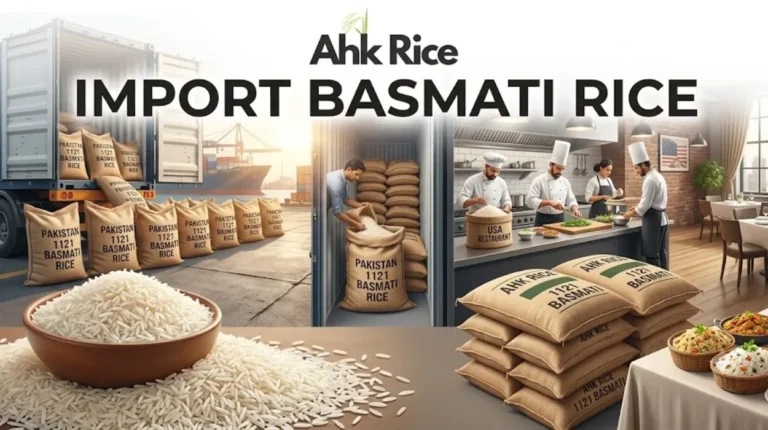
Colorado rice importers should select a Pakistani supplier that treats export documentation as part of the product specification, not as paperwork completed after production. For a commercial Basmati shipment, the supplier must coordinate product details, commercial documents, shipping records, food-import information, and supporting compliance data before the container reaches the United States.
For buyers evaluating this issue in detail,
Why Colorado importers review rice export documentation before ordering provides the informational foundation. At the decision stage, however, the important question is whether the exporter can turn that documentation requirement into a repeatable shipment process.
For buyers evaluating the operational side,
How export documentation supports smooth customs clearance explains how accurate commercial, shipping, and compliance records reduce clearance friction. At the decision stage, however, the important question is whether the exporter can turn that documentation requirement into a repeatable shipment process.
AHK Rice approaches the Colorado market around that requirement. A buyer should receive documentation that corresponds with the actual rice specification, packing configuration, quantity, origin, shipment, and commercial transaction. This reduces the risk of mismatched information between the exporter, freight forwarder, customs broker, FDA-related filings, and receiving business.
What is the best solution for Colorado buyers importing Pakistani rice?
The best solution is an exporter-controlled documentation process that connects rice specifications, commercial invoices, packing lists, certificates, shipping records, and U.S. food-import requirements before dispatch, giving Colorado buyers one consistent shipment file.
Documentation problems often begin before a container leaves Pakistan. A supplier may quote one specification, mill another specification, pack a different configuration, and then issue documents containing inconsistent descriptions. Even when the rice itself is acceptable, discrepancies can create questions during customs processing.
A stronger process starts with one approved commercial specification. The exporter confirms the variety, grade, grain characteristics, moisture specification, broken percentage, packaging, net weight, gross weight, number of bags, and container quantity. Those details then flow into the commercial documentation.
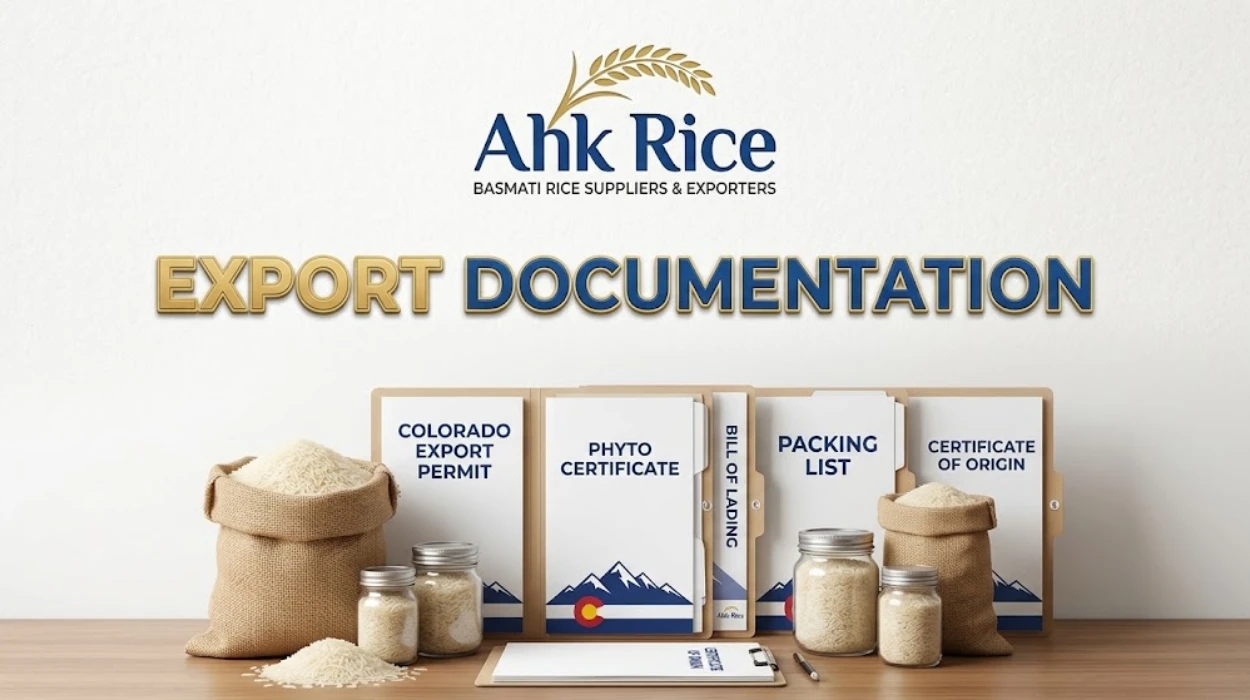
Typical export documentation for a commercial rice shipment can include a commercial invoice, packing list, certificate of origin, bill of lading, relevant inspection or quality documentation, and certificates required by the transaction or destination. The exact document set depends on the product, contract, shipping terms, carrier, and U.S. entry requirements.
For U.S. food imports, FDA requirements are also important. Imported food must meet applicable U.S. requirements, and FDA states that food facilities required to register must maintain registration while imported food shipments generally require Prior Notice before arrival.
Prior Notice is particularly relevant because it is not simply a supplier-side certificate. Information about the food article, manufacturer, quantity, and shipment must be available to the party submitting the filing. FDA explains that Prior Notice can be transmitted through the CBP interface or the FDA Prior Notice System Interface.
AHK Rice therefore treats documentation as a controlled export workflow. The objective is not to produce a larger stack of papers. The objective is to make each document describe the same commercial shipment.
Why should Colorado importers choose the USA export service?
Colorado buyers benefit from a USA-focused export service because the supplier can coordinate Pakistani production and export documentation with the information required for U.S. import processing, reducing avoidable discrepancies between supplier, broker, carrier, and buyer.
The USA export service is relevant when a Colorado importer needs more than a product quotation. A commercial buyer may be purchasing for wholesale distribution, ethnic grocery supply, restaurants, foodservice, or private-label packaging. Each application can require different packaging, documentation, labeling, and shipment planning.
AHK Rice can structure the export process around the buyer’s approved specification. That starts with product selection and continues through sampling, confirmation, production, inspection, packing, documentation, container loading, and dispatch.
The practical benefit is traceability. If the buyer approves 1121 Basmati rice in a defined packing format, the commercial documents should reflect that same product. If the buyer requires a particular certificate or laboratory report, it should be identified before shipment rather than discovered when the container is already moving.
FDA also makes clear that imported food can be inspected at U.S. ports and that noncompliant products can be detained. Imported foods must meet the applicable legal requirements, including relevant labeling and food-safety requirements.
This makes exporter selection a risk-control decision. A low product price does not compensate for an avoidable documentation problem that delays release, creates storage exposure, or requires additional broker intervention.
AHK Rice provides the commercial coordination needed to make the documentation process repeatable. The buyer still retains responsibilities that belong to the U.S. importer, customs broker, or other U.S.-based parties. The exporter should not be represented as replacing those parties.
What documents should a Colorado rice importer expect before shipment?
A Colorado importer should expect a shipment-specific document package covering commercial value, quantity, packing, origin, transportation, product quality, and applicable food-import information, with every document checked against the final approved specification before the container departs.
A practical documentation checklist can include:
| Document or record | Commercial purpose |
|---|---|
| Commercial invoice | Establishes seller, buyer, product, quantity, value, and sale terms |
| Packing list | Shows package count, weights, packing configuration, and shipment details |
| Certificate of origin | Identifies the country of origin where required |
| Bill of lading | Records the ocean transportation contract and shipment details |
| Quality or inspection report | Supports agreed product specifications when required |
| Certificate of analysis | Provides laboratory or quality data when included in the contract |
| Product specification sheet | Defines the agreed grade and technical characteristics |
| FDA-related shipment information | Supports the U.S. import filing process where applicable |
| Other destination-specific certificates | Added when required by the transaction or applicable regulation |
The exact package should never be treated as universal. Requirements can vary according to product, packaging, importer, broker, entry conditions, and applicable regulations.
FDA’s current guidance also emphasizes that food facilities may have registration obligations and that food facility registration information should be handled carefully. In July 2026, FDA specifically warned businesses not to share FFR credentials or sensitive registration information with unauthorized third parties.
That is important for Colorado buyers because documentation control includes information security. A legitimate exporter should provide the information necessary for the commercial and import process without requesting passwords or compromising the buyer’s regulatory accounts.
How does the export documentation process work from sample to shipment?
A reliable process begins with product identification, moves through paid sample preparation and approval, continues into production and inspection, and ends with document verification against the loaded container before the shipment is released to the carrier.
The sample stage should be treated as a commercial specification exercise rather than simply sending a retail packet.
Step 1: Product selection.
The buyer identifies the required variety, grade, grain profile, processing type, packaging, quantity, and intended application. For example, a Colorado distributor may request long-grain Basmati suitable for wholesale repacking or restaurant supply.
Step 2: Sample quotation.
The exporter confirms sample availability and courier arrangements. An illustrative international sample budget can be approximately US$75–US$200 for a small commercial sample shipment, depending on sample weight, courier destination, packaging, and service level.
Step 3: Product sample preparation.
The exporter prepares representative samples according to the proposed commercial specification. If several grades are being compared, each sample should be clearly identified.
Step 4: Optional laboratory testing.
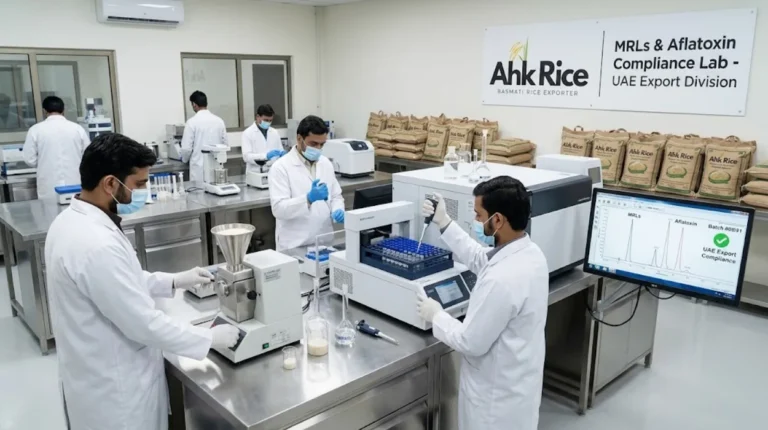
Where the buyer requires independent testing, an illustrative laboratory budget may range from US$150–US$400+ per sample, depending on the number of parameters tested and the laboratory selected. Typical tests may cover moisture, broken percentage, grain dimensions, purity, or other contractual parameters. The actual laboratory fee should be confirmed before testing.
Step 5: Buyer approval.
The buyer evaluates appearance, grain length, cooking performance, aroma, packaging, and laboratory results where applicable. Approval should identify the exact commercial specification.
Step 6: Commercial order.
The supplier issues the commercial quotation or sales documentation based on the approved product. Quantity, packaging, Incoterms, payment terms, and shipment schedule are confirmed.
Step 7: Production and quality control.
The rice is processed, graded, sorted, packed, and inspected according to the approved specification.
Step 8: Documentation preparation.
The invoice, packing list, origin documentation, transportation information, quality records, and other applicable documents are prepared from the final shipment data.
Step 9: Container loading.
Container quantity, package count, weights, seal information, and shipment details are reconciled with the documentation.
Step 10: Final document review.
The exporter checks that the product description, quantity, weights, consignee information, shipment information, and other relevant details are consistent before dispatch.
For a Colorado buyer, this process provides a clear audit trail from the sample that was approved to the commercial cargo that arrives.
How long does shipping from Pakistan to Colorado take?
A realistic planning range for Pakistani rice delivered into Colorado is commonly about 35–50 days from shipment readiness to inland delivery, although port congestion, transshipment, customs processing, rail availability, and trucking can extend the timeline.
Colorado is an inland destination, so an ocean shipment from Pakistan normally involves international transportation to a U.S. gateway followed by inland movement to the buyer. The final transit time therefore depends on the selected port, vessel routing, transshipment, customs release, rail or truck availability, and delivery location.
For procurement planning, buyers can use the following working ranges rather than treating them as guaranteed transit commitments:
| Market / destination | Indicative planning range |
| U.S. West Coast gateway | 25–40 days |
| Colorado delivery after ocean arrival | Additional 7–15 days |
| Pakistan-to-Colorado total planning range | Approximately 35–50 days |
| Documentation preparation | Usually begins before vessel departure |
| Customs/FDA processing | Variable and controlled by the U.S. import process |
These are planning ranges, not fixed carrier schedules. A purchase contract should use the actual sailing schedule and agreed shipment terms.
The distinction matters because a Colorado buyer should not calculate inventory only from the ocean transit time. Inland transportation and import processing also consume time. A buyer running a restaurant-distribution or wholesale program should therefore build safety stock around the complete supply chain.
AHK Rice can use the buyer’s required delivery window to plan production and shipping milestones, but final transit remains subject to carriers, ports, customs, inspections, weather, and other logistics conditions.
What results can Colorado buyers expect from complete documentation?
The expected result is a more controlled import process, clearer broker communication, faster identification of discrepancies, stronger shipment traceability, and fewer avoidable document corrections when the commercial shipment moves from Pakistan through the U.S. import process.
Documentation cannot guarantee customs release. No exporter can responsibly promise that every shipment will clear within a fixed number of hours because U.S. government review, inspection, broker processing, carrier schedules, and other variables remain outside the supplier’s control.
The measurable benefit is better preparation.
A Colorado importer can compare the approved product specification against the commercial invoice. The packing list can be checked against the actual number of bags and weights. Shipping documents can be reconciled with the container information. Quality reports can be matched to the agreed product.
This also supports repeat purchasing. When the first shipment becomes the reference point for later orders, the importer has a documented specification instead of relying on memory or informal communication.
The broader U.S. rice market remains commercially significant. USDA’s April 2026 global rice outlook reported U.S. rice import activity while also revising Pakistan’s 2026 export outlook amid international competition and shipment trends.
For Colorado businesses, that reinforces the importance of supplier reliability. The decision is not simply which exporter can offer rice today. It is which exporter can reproduce the required product and documentation package across future shipments.
What factors affect the cost of importing rice into Colorado?
Colorado import cost depends on rice grade, quantity, packaging, processing, laboratory testing, freight terms, insurance, port charges, inland transportation, customs services, and documentation requirements, so the product price alone cannot represent landed cost.
The first major variable is the rice specification. Extra-long-grain Basmati, steam-treated rice, white rice, packaging format, and private-label requirements can carry different production costs.
The second is order quantity. A full-container commercial program can produce a different unit economics profile from a small trial shipment because ocean freight, documentation, packaging, and handling costs are distributed across more rice.
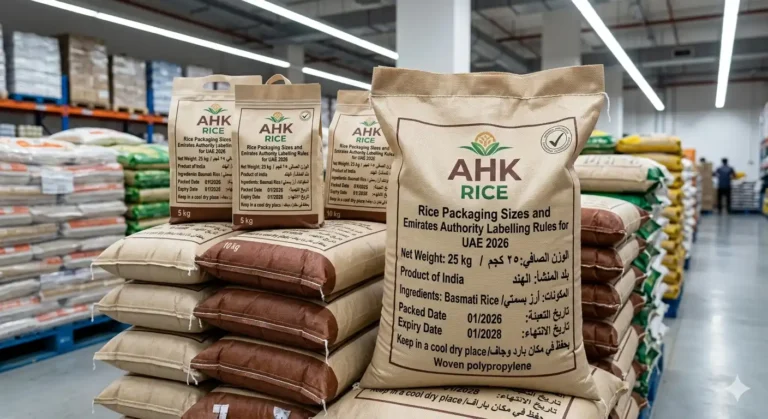
The third is packaging. Bulk commercial bags, retail-ready packaging, custom printed bags, and private-label formats require different materials, printing, filling, and handling.
The fourth is logistics. Freight rates vary according to carrier, route, season, container availability, port selection, and destination. Colorado adds inland transportation after the U.S. port.
The fifth is compliance and testing. Additional laboratory analysis, inspection requirements, special certificates, or label development can increase the transaction cost.
The sixth is the commercial term. FOB, CFR, CIF, or another agreed Incoterm changes which party pays particular transportation and insurance costs.
For that reason, buyers should compare suppliers using landed cost per metric ton, not simply the quoted rice price. A useful calculation is:
Landed cost = product value + origin charges + ocean freight + insurance where applicable + U.S. destination charges + customs/broker costs + inland delivery + other applicable charges.
Any duties, taxes, fees, examinations, storage, demurrage, or other government and logistics charges should be evaluated according to the actual entry and transaction.
How should Colorado buyers decide whether AHK Rice is the right supplier?
Colorado buyers should choose AHK Rice when the supplier can demonstrate specification control, responsive documentation, representative sampling, transparent commercial terms, realistic shipping planning, and a repeatable process connecting product approval with final export records.
The decision should be based on evidence rather than a generic claim of reliability.
Ask for the product specification before ordering. Confirm which documents will be supplied. Establish who handles U.S. customs entry and FDA-related filings. Confirm the packaging and net weight. Request the sample before committing to a larger order. Agree on inspection and testing requirements where appropriate.
Then compare the supplier’s communication against the commercial complexity of the order.
AHK Rice is positioned for buyers that need Pakistani rice supply combined with export coordination. Its value is strongest when the buyer needs a supplier capable of managing the sequence from product selection to shipment documentation rather than treating documentation as an administrative afterthought.
A strong supplier relationship should also make the second shipment easier than the first. Once a specification, packing format, inspection process, document template, and logistics route are established, future purchase orders can operate from a defined commercial baseline.
That is the decision advantage Colorado buyers should seek: not merely a supplier that can export one container, but a supplier that can build a repeatable export program.
How can Colorado buyers get started with AHK Rice?
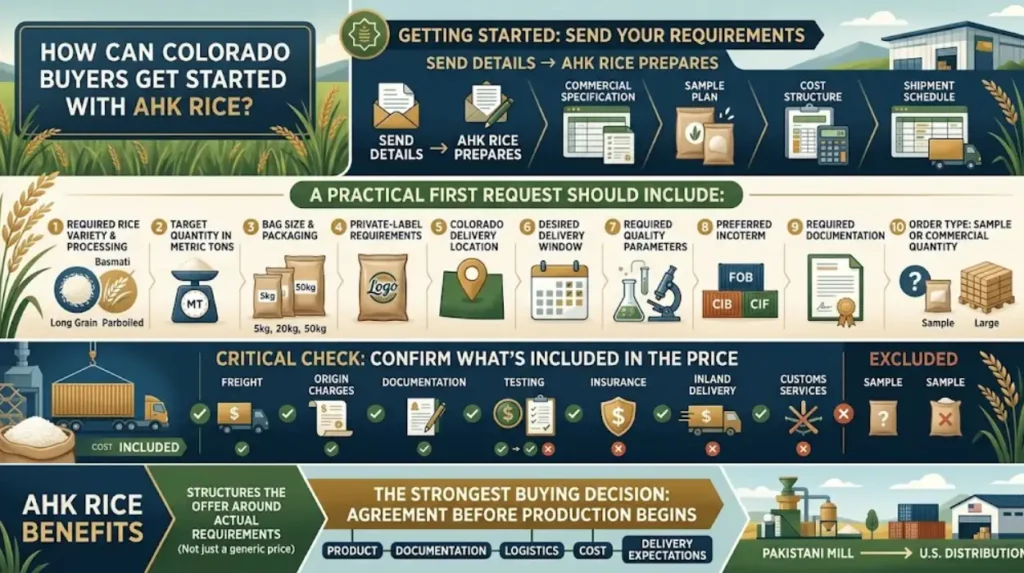
Colorado buyers can start by sending the required rice variety, grade, packaging, quantity, destination, delivery preference, and documentation requirements, allowing AHK Rice to prepare a commercial specification, sample plan, cost structure, and shipment schedule for review.
A practical first request should include:
- Required rice variety and processing type.
- Target quantity in metric tons.
- Bag size and packaging preference.
- Private-label requirements if applicable.
- Colorado delivery location.
- Desired delivery window.
- Required quality or laboratory parameters.
- Preferred Incoterm.
- Required certificates or documentation.
- Whether the order begins with a sample or moves directly to commercial quantity.
For a first transaction, buyers should avoid approving a quotation without confirming what is included in the price. Ask whether freight, origin charges, documentation, testing, insurance, inland delivery, and customs-related services are included or excluded.
AHK Rice can then structure the offer around the actual commercial requirement rather than providing a generic rice price.
The strongest buying decision is one where product, documentation, logistics, cost, and delivery expectations are agreed before production begins. For Colorado importers, that approach creates a clearer path from Pakistani mill to U.S. distribution and gives both sides a defined reference point for repeat orders.
To begin a Colorado rice import program with AHK Rice, request a commercial quotation.
Frequently Asked Questions
What export documents does AHK Rice provide for Colorado buyers?
AHK Rice can coordinate commercial invoices, packing lists, certificates of origin, bills of lading, quality documentation, product specifications, and other applicable export records for Pakistani rice shipments to Colorado.
Does AHK Rice provide FDA-related import documentation?
AHK Rice can provide the shipment and product information required for the U.S. import process. Colorado importers should coordinate FDA filings, Prior Notice, customs entry, and importer-specific compliance responsibilities with their U.S. customs broker and relevant authorities.
How long does Pakistani rice take to reach Colorado?
A practical planning range is approximately 35–50 days from shipment readiness to Colorado delivery. Actual transit depends on vessel routing, transshipment, U.S. port congestion, customs processing, rail or trucking availability, and the final delivery location.
Can Colorado buyers receive rice samples before placing an order?
Yes. Buyers can request representative samples before committing to commercial quantities. Sample costs depend on sample weight, courier service, destination, packaging, and any laboratory testing requested.
How much does a rice sample cost?
An international commercial sample shipment may typically cost around US$75–US$200, depending on the courier and sample requirements. Laboratory testing, when requested, can add approximately US$150–US$400 or more depending on the testing parameters.
What Pakistani rice varieties can Colorado importers source?
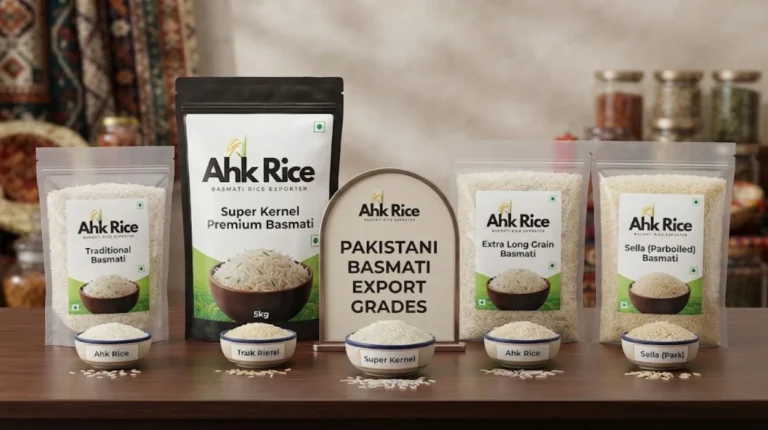
Colorado buyers can evaluate Pakistani Basmati varieties such as 1121, Super Kernel, and 1509, subject to the required grade, processing method, packaging format, quantity, and commercial specification.
What affects the landed cost of Pakistani rice in Colorado?
Landed cost depends on the rice specification, order quantity, packaging, origin charges, ocean freight, insurance where applicable, U.S. port charges, customs and broker costs, inland transportation, testing, and other applicable fees.
Can AHK Rice arrange private-label rice for Colorado buyers?
Private-label programs can be structured around the buyer’s required packaging, specifications, quantity, labeling requirements, and commercial terms. Packaging and labeling details should be confirmed before production begins.