AHK Rice Pakistan 1509 Steam Basmati Rice Supply for Indonesian Foodservice
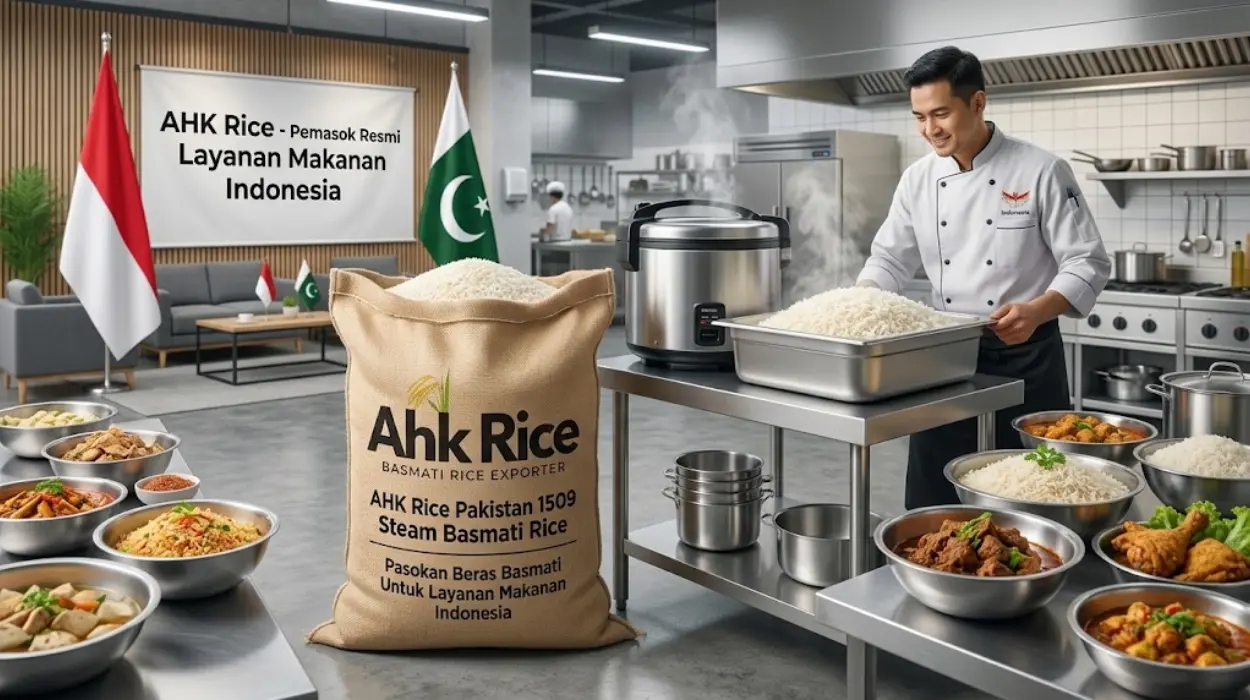
AHK Rice 1509 Steam Basmati is a strong commercial option for Indonesian foodservice buyers seeking long-grain Basmati performance, controlled specifications, and direct Pakistan export coordination. Here is why: 1509 Steam combines extra-long grain characteristics with steam processing, competitive positioning, and a specification-led supply process. Indonesian buyers can use it for restaurants, hotels, catering kitchens, biryani operators, and foodservice distributors. Before procurement, buyers should understand what makes Pakistan 1509 Basmati suitable for Indonesian foodservice buyers and then approve the exact commercial specification.
What is the best solution for Indonesian foodservice buyers?
The best solution is specification-controlled 1509 Steam supplied against agreed grain length, moisture, broken percentage, packaging, quantity, inspection, and shipment requirements. Foodservice buyers need repeatable cooking results rather than simply a low FOB price. 1509 Steam can support large-batch preparation where grain appearance, separation, and consistent texture affect portion quality.
AHK Rice approaches the product through processing and export controls rather than treating the shipment as generic rice. The workflow covers paddy selection, cleaning, dehusking, polishing, grading, colour sorting, inspection, packaging, documentation, and container loading. This structure reduces uncertainty between sample approval and commercial shipment.
The available Pakistan Trade Portal specification for 1509 Steam identifies extra-extra-long grain, moisture below 15%, broken below 5%, silky polishing, and hygienic cleaning and sorting. The listed minimum order quantity is 25,000 kg. These figures provide a market reference, but Indonesian buyers should contract against their final agreed specification. (source: Pakistan Trade Portal)
Which specifications matter most for foodservice?
Grain length, moisture, broken percentage, purity, cooking texture, packaging, and crop year should form the core purchasing specification. These variables directly affect kitchen performance, inventory handling, and customer presentation.
| Specification | Commercial consideration |
|---|---|
| Variety | 1509 Basmati |
| Processing | Steam |
| Grain | Extra-extra-long grain |
| Moisture | Target agreed before contract |
| Broken | Target agreed before contract |
| Sorting | Colour and quality sorting |
| Packaging | Foodservice or private-label format |
Indonesia already records commercial imports of 1509 Basmati under HS 10063050, showing that the variety has an established import pathway. Recent trade records include 1509 Basmati shipments packed in 25 kg and 20 kg formats for Indonesian buyers. (source: Volza trade records)
With the product specification established, the next decision is choosing an exporter capable of maintaining that specification.
Why choose AHK Rice for 1509 Steam supply?
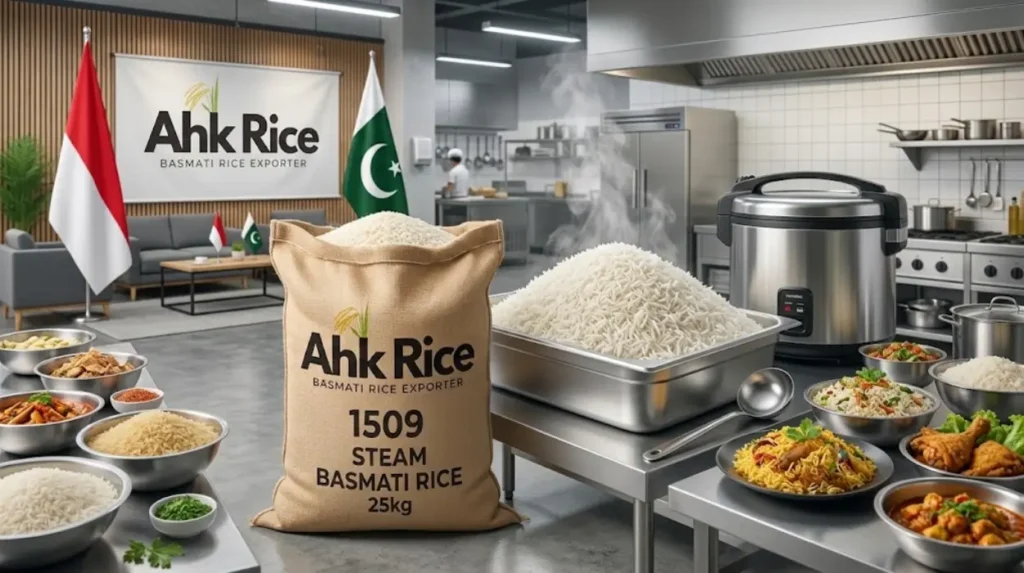
AHK Rice offers an integrated sourcing process covering processing, grading, sorting, packaging, export documentation, sampling, container loading, and shipment coordination from Pakistan. This matters because foodservice buyers cannot evaluate supplier performance from grain appearance alone. They need repeatable specifications and clear commercial responsibility.
AHK Rice can structure the order around the buyer’s required quantity, destination, packaging, inspection requirements, and Incoterm. Buyers can also request private-label packaging where the commercial program requires branded foodservice or distributor packs. The AHK Rice export service provides the direct route for defining these requirements.
AHK Rice also supports a sample-first procurement approach. A buyer should approve the same specification that will appear on the commercial contract. The sample should therefore represent the proposed grade, moisture range, broken percentage, polish, packaging, and cooking characteristics.
Indonesia’s regulatory environment makes specification and documentation particularly important. Indonesia classifies Basmati as a special rice category under its commodity framework, while government guidance distinguishes special rice from ordinary consumer rice. (source: Badan Pangan Nasional)
Indonesian import procedures can also involve import approvals, importer documentation, technical verification, and shipment information. Current Indonesian trade guidance states that foodservice-specific import applications can require distribution plans covering hotels, restaurants, catering, and other approved channels. (source: Directorate General of Foreign Trade Indonesia)
AHK Rice therefore fits best where the buyer wants one coordinated process from product approval through shipment preparation. The commercial objective is not simply to purchase rice. It is to establish a repeatable supply specification.
How does the AHK Rice sample process work, and what does it cost?
The sample process should begin with a defined specification, followed by sample dispatch, dry-grain inspection, cooking evaluation, commercial approval, and bulk-order confirmation. AHK Rice states that samples of up to 20 kg can be provided, while the buyer covers sample shipping. Buyers may also use their own courier account.
What should Indonesian buyers test?
Buyers should test grain uniformity, moisture, broken percentage, aroma, elongation, firmness, separation, and cooked appearance before approving the shipment. Dry inspection identifies visible quality differences. Cooking tests reveal whether the rice meets the foodservice requirement.
A practical sample process is:
- Define the 1509 Steam grade, quantity, packaging, destination, and target specification.
- Request the representative sample from AHK Rice.
- Inspect grain length, colour, broken grains, foreign matter, and uniformity.
- Cook the sample using the restaurant’s normal preparation method.
- Evaluate elongation, separation, firmness, aroma, and holding performance.
- Approve the exact specification for commercial production.
- Confirm the quotation, Incoterm, documentation, and shipment schedule.
Sample cost should not be confused with product cost. Rice quantity, courier charges, packaging, phytosanitary requirements, and laboratory testing can create separate expenses. A fixed courier amount should not be assumed because international rates vary by weight, dimensions, destination, carrier, and service level.
The commercial rule is simple: approve the same specification that will be loaded into the container. A sample using one moisture level or broken percentage should not represent a bulk order using another specification.
For buyers comparing varieties before approval, the 1509 Steam versus 1121 Steam comparison for Indonesia provides a useful decision layer.
What shipping time should Indonesian foodservice buyers plan for?
Karachi-to-Indonesia ocean planning should allow roughly 18–28 days of sailing time, with additional time for production, documentation, port handling, customs, and inland delivery. Current commercial shipping information lists approximately 18–28 days from Karachi to Tanjung Priok and Surabaya. (source: PakistanRice.com)
| Indonesian destination | Practical ocean planning |
|---|---|
| Jakarta / Tanjung Priok | 18–28 days |
| Surabaya | 18–28 days |
| Inland Jakarta delivery | Add local clearance and transport |
| Inland Surabaya delivery | Add local clearance and transport |
A separate logistics benchmark shows approximately 20–22 days for Karachi-to-Jakarta LCL routing through Singapore. FCL schedules can differ by carrier and sailing. (source: Flexport)
Shipping days should therefore be treated as planning ranges rather than guaranteed arrival dates. Production, inspection, documentation, vessel booking, transshipment, port congestion, customs clearance, and inland delivery can extend the final lead time.
AHK Rice can coordinate the export sequence around the required shipment window. Indonesian foodservice distributors should place replenishment orders before operational inventory reaches its minimum level.
With sampling and shipping understood, the remaining commercial question is the final landed cost.
What factors affect the price of 1509 Steam Basmati Rice?
The final price depends on grade specification, quantity, packaging, processing, inspection, destination port, freight, Incoterm, insurance, and payment terms. A buyer should compare total landed cost rather than comparing FOB rice prices alone.
| Cost factor | Buyer decision |
|---|---|
| Rice specification | Confirm grade and quality limits |
| Quantity | Confirm metric tons and container plan |
| Packaging | Select foodservice or private label |
| Processing | Confirm sorting and polishing requirements |
| Freight | Quote the actual destination |
| Inspection | Define third-party requirements |
| Incoterm | Select FOB, CFR/CNF, or CIF |
| Documentation | Confirm Indonesian import requirements |
A recent Pakistan Trade Portal listing provides a reference price of $1.39 per kg for one 1509 Steam specification. That equals approximately $1,390 per metric ton before destination-specific logistics and buyer-specific requirements. The listing is not an AHK Rice quotation and should not be treated as a current landed price. (source: Pakistan Trade Portal)
AHK Rice should quote against the buyer’s actual quantity and destination. Freight rates change with carrier availability, equipment, route, fuel charges, and booking dates. Packaging can also materially change the commercial cost.
Indonesian buyers should additionally account for import approvals, inspection, customs charges, port handling, inland transportation, and applicable taxes or duties. Indonesia’s import framework can require verification of rice type, quantity, origin, broken percentage, shipping timing, and destination port. (source: Indonesian Directorate General of Customs and Excise regulations)
The best price is therefore the lowest compliant landed cost that delivers the required cooking performance consistently.
What results can be expected from the right supplier?
A specification-controlled supply can improve cooking consistency, purchasing predictability, inventory planning, documentation control, and repeat-order performance. These outcomes matter more to foodservice operators than a small difference in the initial FOB price.
Cooking consistency is the first commercial result. Large kitchens need rice that behaves predictably across repeated batches. Stable grain specifications help chefs standardize water ratios, cooking times, portions, and presentation.
Supply consistency is the second result. A documented specification gives the buyer a measurable reference for future containers. This reduces disputes caused by changes in grain length, broken percentage, moisture, packaging, or polish.
Operational planning is the third result. Known production and shipping windows help distributors maintain sufficient stock before restaurant demand creates an urgent replenishment requirement.
AHK Rice supports this decision through processing, grading, sorting, inspection, packaging, documentation, and container coordination. AHK Rice can therefore serve buyers who need a direct Pakistan supply route rather than several disconnected sourcing arrangements.
How should an Indonesian buyer get started?
Start with the product specification, request a representative sample, evaluate cooking performance, confirm the landed quotation, verify import requirements, and approve production before container loading. This sequence converts a product inquiry into a controlled procurement process.
- Specify 1509 Steam grade, broken percentage, moisture, packaging, quantity, and destination.
- Request the representative sample and applicable quality documents.
- Test the rice using the foodservice kitchen’s normal cooking method.
- Approve the specification after dry-grain and cooked-rice evaluation.
- Confirm Incoterm, freight, inspection, documentation, and shipment timing.
- Prepare the Indonesian importer documentation and applicable approvals.
- Schedule production, final inspection, packing, container loading, and dispatch.
AHK Rice gives the buyer a clearer path from sample approval to commercial shipment. AHK Rice can coordinate the specification, AHK Rice can support export documentation, and AHK Rice can coordinate container dispatch from Pakistan.
The buying decision is straightforward. Choose 1509 Steam when the Indonesian foodservice channel needs long-grain Basmati characteristics, controlled cooking performance, and competitive commercial positioning. Choose a specification-led supplier when repeatability matters as much as the first shipment.
For a buyer-ready quotation based on your quantity, destination port, packaging, and specification, request an export quote from AHK Rice.
Frequently Asked Questions
Is Pakistan 1509 Steam Basmati suitable for Indonesian restaurants?
Yes, 1509 Steam can suit Indonesian restaurant and catering operations requiring long-grain Basmati.
Its steam processing supports firm grain structure during cooking.
Foodservice buyers should approve cooking performance through a representative sample.
The final specification should define moisture, broken percentage, and packaging.
AHK Rice can structure supply around the buyer’s commercial requirements.
How much sample rice can AHK Rice provide?
AHK Rice states that samples of up to 20 kg can be provided.
The buyer covers international sample shipping costs.
Buyers may also use their own courier account.
Additional testing or certification requirements can create separate charges.
The final commercial arrangement should confirm whether approved sample costs are credited.
How long does shipping from Pakistan to Indonesia take?
Current commercial planning indicates approximately 18–28 days of ocean sailing.
Jakarta and Surabaya are commonly used destination points.
Actual delivery requires additional production and clearance time.
Transshipment and port congestion can change vessel schedules.
Buyers should therefore plan inventory using a delivery buffer.
What determines the landed price of 1509 Steam?
Landed cost depends on specification, quantity, packaging, freight, destination, inspection, and Incoterm.
FOB price does not represent the final warehouse cost.
Indonesia-specific clearance and import requirements also affect total expenditure.
Private-label packaging can increase the commercial price.
AHK Rice should quote against the buyer’s exact destination and requirements.
What should buyers compare before approving AHK Rice?
Buyers should compare specification consistency, sample performance, documentation, shipping planning, and total landed cost.
Grain length alone does not establish commercial suitability.
Cooking performance should match the restaurant’s operating method.
The bulk shipment should match the approved sample specification.
AHK Rice can then coordinate production and export against the agreed requirements.