Reduce Import Risks with AHK Rice Supply Programs in Kentucky
Kentucky rice importers should reduce procurement risk by choosing an exporter that controls specifications, sampling, processing, inspection, documentation, packaging, and shipment coordination before the purchase order is finalized. AHK Rice provides a Pakistan-origin supply program for U.S. buyers that connects product specifications with export execution, helping importers avoid quality variation, documentation gaps, shipment delays, and unexpected procurement costs.
Before selecting a supplier, Kentucky buyers should understand the procurement risks discussed in:
Why Kentucky importers should reduce procurement risks early. Early evaluation is particularly important for wholesalers, distributors, ethnic grocery suppliers, restaurant groups, and private-label businesses that depend on repeat Basmati rice shipments rather than one-time purchases.
What is the best solution for reducing rice import risks in Kentucky?
The best solution is a specification-controlled supply program that verifies rice quality before production, approves samples before bulk processing, coordinates export documentation, and monitors shipment execution through delivery. This approach reduces uncertainty across product quality, compliance, logistics, pricing, and repeat-order performance.
A Kentucky importer should not evaluate a Pakistani rice exporter only from an FOB quotation. The commercial decision should begin with the exact product specification. That specification should define variety, grade, grain length, moisture, broken percentage, foreign matter, purity, milling condition, packaging, quantity, tolerance, inspection requirements, and delivery terms.
AHK Rice supplies Pakistani Basmati varieties including 1121, Super Kernel, and 1509. Its export operation covers paddy sourcing, processing, grading, color sorting, packaging, inspection, and export documentation. This integrated structure gives a buyer one supply channel instead of coordinating multiple independent parties.
For Kentucky buyers, this matters because a shipment can create costs long before it reaches a warehouse. A specification mismatch can affect retail positioning, cooking performance, customer acceptance, and repeat sales. A documentation error can delay clearance. A missed vessel connection can disrupt inventory planning.
A practical procurement program therefore establishes five controls before bulk dispatch:
| Procurement control | Buyer requirement | Risk reduced |
|---|---|---|
| Product specification | Written grade and tolerance | Quality mismatch |
| Pre-shipment sample | Approved reference sample | Batch variation |
| Inspection | Laboratory or third-party verification | Undetected defects |
| Documentation | Complete export and import data | Clearance delays |
| Shipment planning | Confirmed vessel and destination | Delivery uncertainty |
Buyers should also compare prospective exporters using capacity, processing control, certifications, export history, documentation capability, and repeat-order consistency. AHK Rice reports ISO 22000:2018, HACCP, ISO 9001:2015, GMP, and Halal certifications and offers third-party pre-shipment inspection through organizations including SGS and Bureau Veritas.
Why should Kentucky buyers choose the AHK Rice USA service?
Kentucky buyers should choose a USA-focused rice supply program when they need specification-based Pakistani Basmati, export documentation, sample approval, private-label options, container coordination, and a defined shipping process rather than an isolated commodity quotation.
The USA Basmati rice export service is structured around U.S. import requirements and direct shipment from Karachi to U.S. ports. AHK Rice states that its USA process includes inquiry and quotation, sample approval, contract confirmation, production, shipment, and delivery coordination.
The commercial advantage is control. A Kentucky importer can establish the product specification before the container is produced. The approved sample then becomes a commercial reference for the bulk shipment.
This is particularly useful when the buyer sells under a private label. Packaging, label information, product description, net weight, lot identification, and destination-market requirements need to be considered before production rather than corrected after the container is already moving.
U.S. food importers also have regulatory responsibilities. FDA states that imported food must meet U.S. requirements for safety, sanitation, and labeling. Facilities that manufacture, process, pack, or hold regulated food may need FDA registration, while imported food shipments generally require Prior Notice before arrival.
The importer remains responsible for U.S. compliance, so an exporter should provide accurate commercial and product information that supports the importer’s customs and food-safety process. AHK Rice can support the export documentation side, while the Kentucky importer should coordinate with its customs broker and compliance professionals for its specific entry.
The current 2026 environment also makes disciplined sourcing important. USDA’s April 2026 Pakistan Grain and Feed Annual forecasts Pakistan rice production at approximately 9.8 million metric tons for 2026/27 and rice exports at approximately 5.0 million metric tons, compared with a projected 4.7 million metric tons for 2025/26.
That forecast indicates substantial export availability, but buyers should still reserve supply according to their own demand cycle instead of assuming that a low spot quotation guarantees future availability.
How many shipping days should Kentucky importers allow?
Kentucky importers should plan approximately 25–35 days for the Pakistan-to-U.S. ocean movement and allow additional time for U.S. port clearance, inland transportation, and final delivery to Kentucky, with actual timing depending on port, vessel schedule, transshipment, and carrier conditions.
AHK Rice currently describes its USA shipment timeline as approximately 25–35 days door-to-door from Karachi to major U.S. ports such as New York or Los Angeles. For a Kentucky buyer, however, the final inland leg must be added because Kentucky is not a coastal destination.
A practical planning range is:
| Stage | Planning range |
| Sample courier to Kentucky | 5–7 days |
| Production and export preparation | Quote-specific |
| Karachi ocean movement to U.S. port | About 25–35 days overall target |
| U.S. customs and FDA processing | Variable |
| Port-to-Kentucky inland movement | Variable |
| Total procurement cycle | Usually longer than ocean transit |
Sample delivery is faster because it normally moves by courier. AHK Rice states that 1–5 kg samples can be shipped to the USA through DHL or FedEx in approximately 5–7 days. Its USA service also states that samples can be supplied up to 20 kg, with the buyer covering courier and applicable phytosanitary certificate costs.
Kentucky buyers should therefore avoid setting their inventory reorder point around the ocean transit number alone. A more reliable purchasing model considers production time, vessel booking, port handling, customs clearance, inland transportation, warehouse receiving, and safety stock.
What is the full rice sample process and what does it cost?
A commercial sample process should begin with the buyer’s specification, continue through sample preparation and courier dispatch, include physical and cooking evaluation, and end with written approval before bulk production. Sample rice may be free while courier and certification expenses remain buyer responsibilities.
The first step is to send the exporter the intended variety, grade, quantity, packaging format, destination, and target application. A Kentucky wholesaler may require 1121 Basmati for retail packs, while a restaurant distributor may prioritize cooking performance, aroma, elongation, and breakage.
The second step is specification confirmation. The exporter should confirm whether the requested specification can be produced consistently and identify any tolerance that needs agreement before sampling.
The third step is sample preparation. AHK Rice states that U.S. buyers can request samples of products such as 1121 Sella or Super Kernel Basmati and receive them through air courier.
The fourth step is sample evaluation. The importer should inspect grain appearance, uniformity, broken percentage, odor, foreign matter, moisture information, cooking expansion, texture, aroma, and post-cooking appearance. The sample should be evaluated using the same commercial criteria that will apply to the container.
The fifth step is approval. The buyer should retain the approved sample and specification sheet as the reference for the bulk order.
The sixth step is commercial confirmation. The exporter issues the quotation or proforma invoice based on the approved product, quantity, packaging, Incoterm, and destination requirements.
Cost should be separated into product cost and sampling logistics. AHK Rice states that up to 20 kg of sample rice can be provided free, while the client pays courier and phytosanitary certificate costs where applicable.
Because courier and certificate charges change by destination, weight, courier account, and documentation requirement, Kentucky buyers should request the current sample logistics cost rather than rely on a fixed published amount.
What results can Kentucky buyers expect from a controlled supply program?
A controlled supply program should produce more predictable product quality, clearer landed-cost planning, fewer specification disputes, better documentation readiness, stronger shipment visibility, and a repeatable purchasing process that can support Kentucky inventory requirements over multiple orders.
The first expected result is specification consistency. When the approved sample and written specification become the commercial reference, the buyer has a defined benchmark for bulk production.
The second result is better procurement visibility. AHK Rice handles processing, grading, color sorting, packaging, export documentation, and container loading within its integrated export model. This reduces the number of separate operational handoffs that a buyer must manage.
The third result is better compliance preparation. FDA requires imported food to comply with U.S. food laws, and Prior Notice must be submitted before applicable food shipments arrive. A documented export process makes it easier for the importer and customs broker to work from consistent shipment information.
The fourth result is improved inventory planning. Kentucky distributors can align purchase quantities with warehouse capacity and reorder cycles instead of purchasing only when inventory becomes critically low.
The fifth result is improved repeat-order control. The buyer can compare each new shipment against the original specification and approved reference rather than treating every container as a separate purchase.
For example, a Kentucky distributor requiring 100 MT every two months could approve one specification, establish packaging requirements, schedule production windows, and maintain a forward purchasing calendar. This is more stable than requesting a new spot quotation after every stockout.
What factors determine the final rice import price?
The final price depends on rice variety and grade, quantity, processing requirements, packaging, inspection, Incoterm, freight, destination, currency, documentation, and market conditions; therefore, Kentucky buyers should compare complete landed cost rather than FOB price alone.
Rice pricing begins with the variety. 1121 Basmati, Super Kernel, and 1509 can carry different commercial values based on grain characteristics, processing, demand, and availability.
Grade also matters. Steam, white, Sella, and other processing specifications require different production processes and can affect the final quotation.
Packaging is another variable. Standard export bags may differ substantially in cost from customized private-label packaging. Bag material, printing, size, palletization, and labeling requirements can change the total order value.
Quantity affects economics as well. Larger orders can improve production and freight efficiency, while smaller purchases may carry higher per-unit logistics costs.
Inspection and certification requirements should be priced separately when applicable. A buyer requesting third-party inspection, additional laboratory testing, or specific documentation may increase the transaction cost but gain stronger verification.
Freight is especially important for a Kentucky importer. The relevant commercial comparison should include the chosen Incoterm, ocean freight, U.S. port charges, customs brokerage, applicable duties and fees, inland transportation, and warehouse delivery.
CBP notes that commercial imports may involve customs entry requirements, brokerage, bonds, merchandise processing fees, and harbor maintenance fees depending on the shipment and entry circumstances.
The correct buying question is therefore not “Which exporter has the lowest FOB price?” It is “Which supplier provides the lowest commercially acceptable landed cost while maintaining the required specification and delivery reliability?”
How can Kentucky importers make the final supplier decision?
Kentucky importers should approve a supplier only after comparing product specification, sample performance, compliance readiness, shipment planning, commercial terms, capacity, and repeat-order controls against the requirements of their own distribution or foodservice operation.
The final decision can be structured around five questions:
| Decision factor | Buyer test | Approval signal |
| Specification | Does the supplier reproduce the required grade? | Written specification and approved sample |
| Quality control | Is bulk rice independently verifiable? | Inspection or laboratory evidence |
| Compliance | Can shipment information support U.S. entry? | Complete export documentation |
| Logistics | Is the delivery window realistic? | Vessel and shipment plan |
| Continuity | Can the supplier support repeat demand? | Confirmed production capacity |
AHK Rice is positioned as a direct Pakistan-origin exporter rather than a purely brokerage-based sourcing channel. The company states that it has supplied international buyers across 15 countries and provides integrated processing and export services from Punjab.
Buyers should still perform their own commercial due diligence. The strongest decision is based on documented specifications, approved samples, clear contractual terms, inspection procedures, realistic logistics, and the supplier’s ability to reproduce the agreed product.
The comparison framework from the stage:
How Do Buyers Identify Reliable Rice Export Partners?, should be used before final supplier approval, particularly when comparing more than one exporter.
How should a Kentucky importer start with AHK Rice?
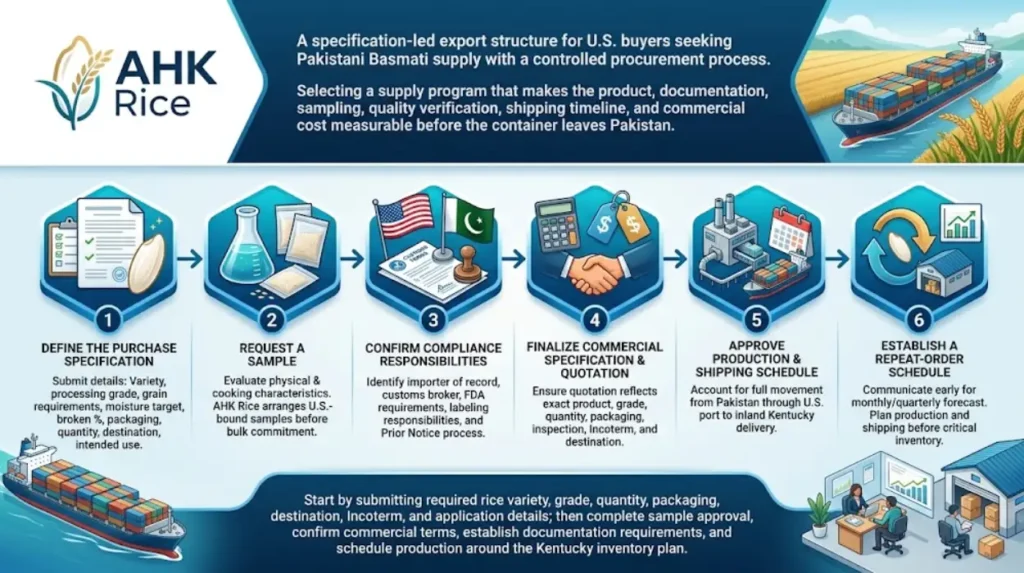
Start by submitting the required rice variety, grade, quantity, packaging, destination, Incoterm, and application details; then complete sample approval, confirm commercial terms, establish documentation requirements, and schedule production around the Kentucky inventory plan.
The first action is to define the purchase specification. Include variety, processing grade, grain requirements, moisture target, broken percentage, packaging, quantity, destination, and intended use.
The second action is to request a sample. AHK Rice can arrange U.S.-bound samples, allowing the buyer to evaluate physical and cooking characteristics before making a bulk commitment.
The third action is to confirm compliance responsibilities. The Kentucky importer should identify its importer of record, customs broker, FDA requirements, labeling responsibilities, and Prior Notice process. FDA and CBP requirements apply independently of the exporter’s commercial quotation.
The fourth action is to finalize the commercial specification and quotation. AHK Rice should receive the exact product requirements so the quotation reflects the actual rice grade, quantity, packaging, inspection, Incoterm, and destination.
The fifth action is to approve the production and shipping schedule. For Kentucky, procurement planning should account for the full movement from Pakistan through the U.S. port and onward inland delivery.
The sixth action is to establish a repeat-order schedule. A buyer with predictable monthly or quarterly demand should communicate its forecast early so production and shipping can be planned before inventory becomes critical.
For Kentucky importers, the strongest decision is not simply choosing a Pakistani rice supplier. It is selecting a supply program that makes the product, documentation, sampling, quality verification, shipping timeline, and commercial cost measurable before the container leaves Pakistan. AHK Rice provides that specification-led export structure for U.S. buyers seeking Pakistani Basmati supply with a controlled procurement process.
For a Kentucky purchase specification, sample request, and current commercial quotation, request a quote from AHK Rice.
Frequently Asked Questions
What rice varieties does AHK Rice supply to Kentucky importers?
AHK Rice supplies Pakistani Basmati varieties including 1121, Super Kernel, and 1509. Buyers can specify white, steam, or Sella processing according to their market and application requirements.
How does AHK Rice reduce import risks for Kentucky buyers?
AHK Rice reduces procurement risk through specification confirmation, sample approval, controlled processing, quality inspection, export documentation, packaging coordination, and shipment planning before the order is dispatched.
How long does rice shipping from Pakistan to Kentucky take?
Ocean transportation from Karachi to major U.S. ports is generally planned around 25–35 days. Kentucky buyers should allow additional time for U.S. customs clearance, port handling, and inland transportation.
Can Kentucky buyers receive rice samples before placing a bulk order?
Yes. AHK Rice can arrange samples for U.S. buyers. Samples can be evaluated for grain appearance, purity, broken percentage, aroma, cooking performance, texture, and other agreed specifications before bulk production.
How much does a rice sample from AHK Rice cost?
AHK Rice states that sample rice can be provided free up to specified quantities, while the buyer is responsible for courier and applicable phytosanitary certificate costs. Exact logistics costs depend on shipment weight and destination.
What specifications should Kentucky importers provide when requesting a quotation?
Buyers should provide the rice variety, processing type, grade, grain requirements, moisture specification, broken percentage, packaging format, order quantity, destination, inspection requirements, and preferred Incoterm.
Does AHK Rice provide private-label rice packaging?
Yes. AHK Rice offers custom packaging options for export buyers. Kentucky importers should provide their packaging size, artwork, labeling requirements, bag material, and quantity requirements before production.
What quality checks should Kentucky rice importers request?
Importers should evaluate grain length, broken percentage, moisture, foreign matter, purity, milling quality, color, aroma, and cooking performance. Third-party inspection or laboratory testing can also be included when commercially required.