Get CIF/FOB Quote for 1509 Basmati Rice
A specification-based FOB or CIF quotation is the right solution for buying 1509 Basmati rice because grade, grain length, broken percentage, moisture, packing, quantity, destination, and freight change the final cost. Here is why: a comparable quote must define both the rice specification and delivery terms before price is accepted.
1509 Basmati rice is a long-grain variety cultivated in Punjab, Pakistan. AHK Rice supplies 1509 for wholesale, catering, retail, and export programmes. Typical export specifications include 8.10–8.50 mm raw grain length, controlled moisture, low broken percentage, and multiple processing grades.
Buyers can first review the 1509 Sella rice guide for bulk cooking to understand cooking performance. Buyers comparing processing costs can also review 1509 Steam and Golden Sella grade differences before requesting commercial pricing.
What is the best solution for getting a 1509 Basmati quote?
The best solution is a written specification followed by a shipment-specific FOB or CIF quotation covering grade, quantity, packaging, destination port, inspection, freight, insurance, and documentation. This structure prevents buyers from comparing incomplete prices.
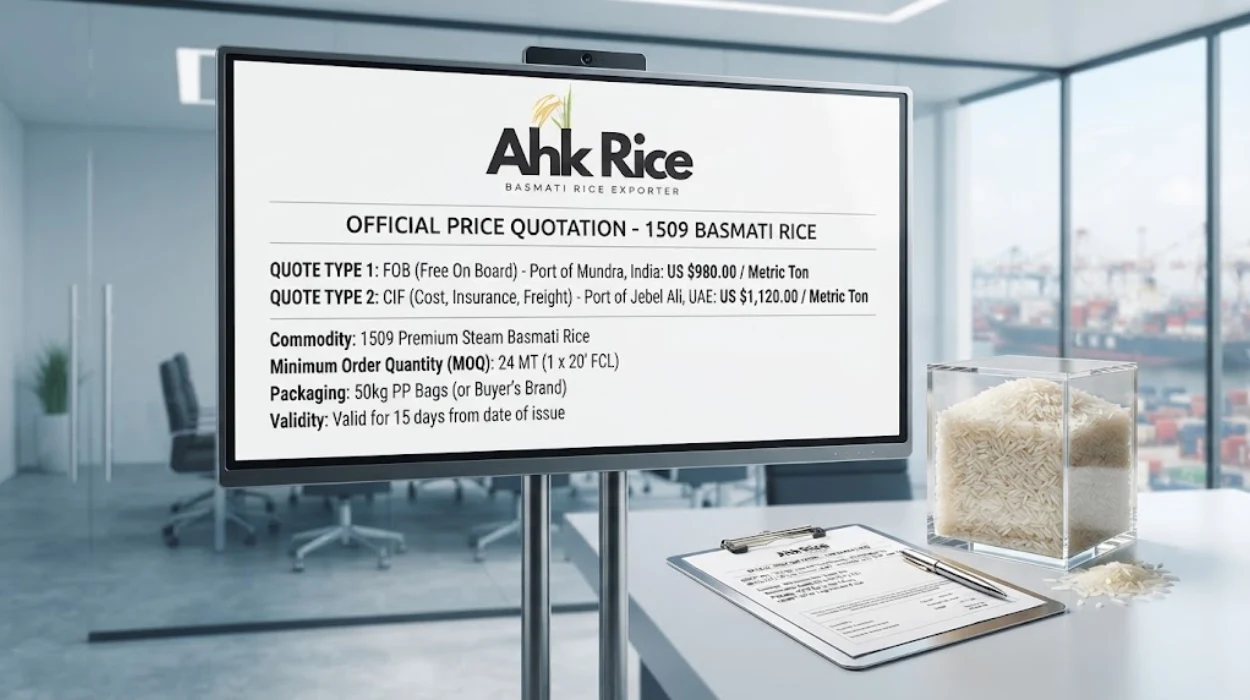
FOB Karachi places the main freight arrangement with the buyer after the cargo reaches the agreed loading point. CIF includes the agreed cost of goods, insurance, and ocean freight to the named destination port.
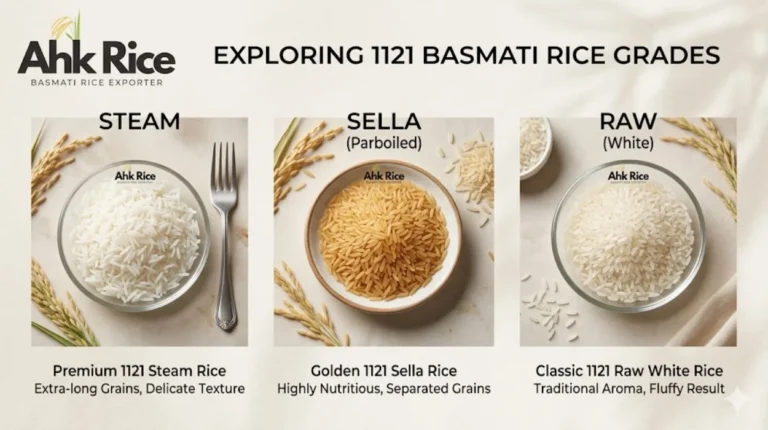
The quotation should identify the exact 1509 grade. AHK Rice offers White, Brown, Steam, Parboiled, Golden Sella, Creamy Sella, and Sella processing grades.
Each grade creates a different commercial position. Steam suits buyers prioritising white appearance and fast cooking. Golden Sella suits bulk cooking and longer storage requirements. White 1509 suits buyers seeking a natural white appearance and competitive procurement.
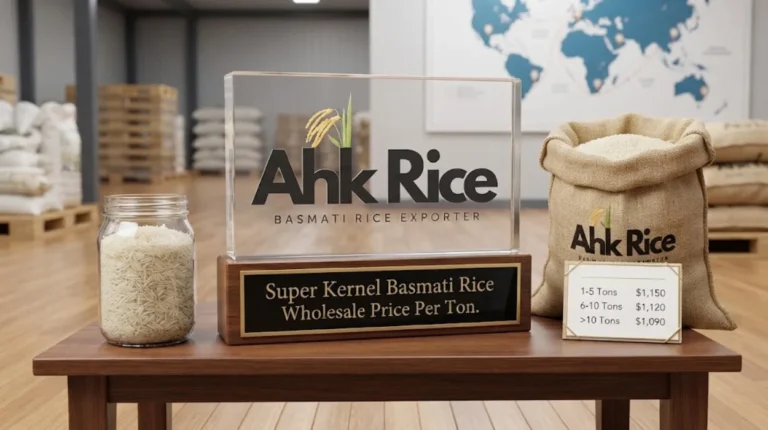
A 2026 external market reference places 1509 Basmati around US$900–US$1,150 per MT across FOB, CFR, and CIF reference positions. This is an indicative market reference, not a firm AHK Rice offer.
The specification therefore comes before the final number. With the quotation structure established, the next question is how AHK Rice manages that specification.
Why choose AHK Rice for 1509 Basmati export?
AHK Rice combines paddy sourcing, milling, grading, sorting, packaging, inspection, documentation, and shipment preparation within one export workflow. This gives buyers one specification across procurement, production, quality control, and container loading.
AHK Rice sources 1509 from Punjab and manages the product through export preparation. The process covers paddy procurement, cleaning, dehusking, grading, colour sorting, packing, inspection, and container loading.
The commercial advantage is specification control. Buyers can define grain length, moisture, broken percentage, packaging, quantity, and destination requirements before production begins.
AHK Rice also supports custom packaging. Common export formats include 25 kg, 40 kg, and 50 kg bags, with additional private-label options depending on the contract.
Quality verification can include grain-length measurement, moisture testing, broken-grain analysis, purity inspection, container checks, and export documentation.
The result is a quotation tied to a physical product specification rather than a generic “1509 rice” price. That distinction becomes important when comparing suppliers.
What results can be expected from a 1509 Basmati shipment?
Buyers can expect a defined product specification, approved sample, controlled processing, documented export preparation, and destination-based shipment planning. The commercial result depends on the agreed grade, quantity, inspection standard, packaging, freight route, and Incoterm.
1509 Basmati provides long grains and strong cooking performance for bulk foodservice. AHK Rice specifications commonly target approximately 8.0–8.3 mm grain length, 12–13% moisture, 1–2% broken grains, and 95–98% purity, depending on the contracted grade.
Cooking performance should be confirmed through an actual buyer sample. Commercial kitchens should test soaking, water ratio, cooking time, grain separation, cooked yield, and holding performance.
Shipping planning also depends on destination. AHK Rice route information gives the following practical sea-transit ranges:
| Market | Indicative sea transit |
|---|---|
| UAE | 12–18 days |
| Saudi Arabia | 18–22 days |
| Iraq | 18–28 days |
| Indonesia | 18–28 days |
| East Africa | 20–28 days |
| Europe | 25–35 days |
| USA/Canada | 30–40 days |
These are planning ranges, not guaranteed delivery dates. Production, vessel booking, port congestion, customs clearance, transshipment, and inland delivery can extend the complete order cycle.
For Indonesia, AHK Rice also publishes routes around 18–24 days to Jakarta, 20–26 days to Surabaya, and 22–28 days to Medan. Destination-specific planning should therefore be included in the quotation.
With performance and logistics defined, the next decision is how the final FOB or CIF price is calculated.
What factors affect the 1509 Basmati FOB or CIF price?
The final price depends on grade, grain specification, broken percentage, moisture, quantity, packaging, inspection, destination port, freight, insurance, and payment terms. A lower headline FOB price can become more expensive after destination costs are added.
| Pricing factor | Commercial effect |
|---|---|
| 1509 processing grade | Changes processing and market position |
| Grain length | Higher specifications can increase cost |
| Broken percentage | Tighter limits require stronger sorting |
| Moisture | Controlled levels support storage performance |
| Quantity | Container volume affects unit economics |
| Packaging | Private-label packaging adds production requirements |
| Inspection | Third-party testing can add cost |
| Freight | Changes the CIF landed price |
| Insurance | Included within CIF structure |
| Destination port | Determines freight and delivery costs |
FOB pricing is useful for buyers with established freight arrangements. CIF pricing is useful for buyers wanting a clearer port-level landed figure.
A buyer requesting CIF should provide the exact destination port. “CIF Saudi Arabia” is incomplete because Jeddah and Dammam can carry different freight and handling costs.
A buyer requesting FOB should confirm the loading port, usually Karachi for Pakistani rice exports. The quotation should also state whether inspection, fumigation, certification, and other export services are included.
How does the 1509 Basmati sample process work?
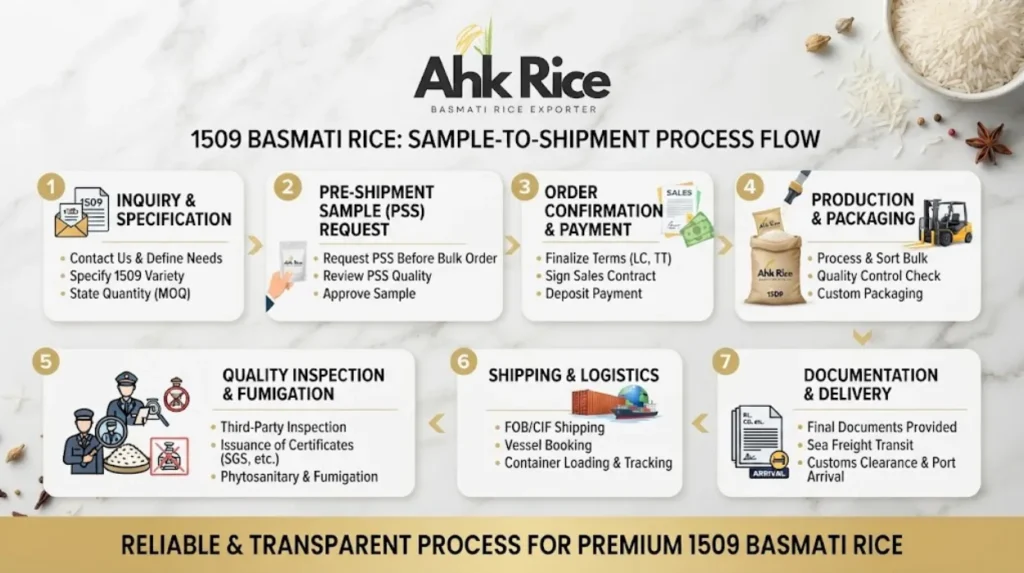
The sample process starts with specification selection, followed by sample preparation, courier dispatch, buyer testing, approval, and commercial quotation. AHK Rice can provide up to 20 kg for sampling, while the buyer covers courier and applicable phytosanitary charges.
Sample process
- Define the grade: Select White, Steam, Golden Sella, Creamy Sella, Brown, Parboiled, or Sella according to the intended application.
- Define the specification: Confirm grain length, broken percentage, moisture, purity, packaging, and quantity.
- Prepare the sample: AHK Rice selects representative rice from the relevant export-grade lot.
- Arrange courier: Provide the buyer’s courier account or confirm the available courier method.
- Dispatch the sample: AHK Rice prepares and dispatches the approved sample after receiving shipping instructions.
- Test the rice: Check appearance, aroma, grain length, cooking time, elongation, separation, texture, and cooked yield.
- Approve the specification: Confirm the exact specification that should appear in the commercial quotation and contract.
- Request the quote: Receive the FOB or CIF quotation against the approved product specification.
Sample cost depends on destination and courier. AHK Rice’s published 2026 guidance places typical sample-related courier and certification costs around US$30–US$80 for smaller sample shipments. Product samples can remain free under the applicable AHK Rice sampling programme.
This process reduces procurement risk because the buyer evaluates the physical rice before committing container volume.
What documents should buyers request with the quotation?
Buyers should request a commercial specification, quotation, packing details, certificate requirements, inspection terms, and export documents applicable to the destination. The final document set depends on the importing country’s regulations and the contracted shipment.
Typical export documentation includes:
- Commercial invoice
- Packing list
- Certificate of origin
- Phytosanitary certificate
- Bill of lading
- Fumigation certificate
- Certificate of analysis when required
- Third-party inspection report when contracted
The buyer should also confirm HS classification, destination import requirements, labelling rules, and any country-specific food safety controls.
The commercial specification should remain consistent across the sample, quotation, proforma invoice, contract, production lot, and inspection report.
Documentation control connects the approved sample to the physical shipment. That connection is essential for repeat purchasing.
How should buyers compare two 1509 Basmati quotations?
Compare quotations on identical specifications, Incoterms, destination ports, packaging, quantity, inspection requirements, and payment terms before judging the commercial difference. This method separates a genuinely lower rice cost from a quotation with fewer included services.
A simple comparison should include:
| Comparison point | Supplier A | Supplier B |
|---|---|---|
| Grade | 1509 Steam | 1509 Steam |
| Grain length | Contract value | Contract value |
| Broken | Contract value | Contract value |
| Moisture | Contract value | Contract value |
| Packing | Same bag specification | Same bag specification |
| Quantity | Same MT | Same MT |
| Incoterm | FOB/CIF | FOB/CIF |
| Destination | Same port | Same port |
| Inspection | Same requirement | Same requirement |
| Total price | Compare | Compare |
Buyers should avoid comparing a CIF quotation with an FOB quotation. Freight and insurance can materially change the apparent price difference.
Buyers should also compare the usable outcome. A lower price with a higher broken percentage can reduce whole-grain yield. A tighter specification can cost more but reduce processing or kitchen losses.
How do buyers get started with a 1509 Basmati quote?
Start by sending the required grade, quantity, destination port, packaging, quality specification, and Incoterm. AHK Rice can then structure the quotation around the actual shipment instead of providing an unsuitable generic price.
Provide these details:
- Product: 1509 Basmati Rice
- Grade: White, Steam, Golden Sella, or another required grade
- Quantity: Metric tons
- Grain specification: Required length
- Broken percentage: Maximum tolerance
- Moisture: Required limit
- Packaging: Bag type and weight
- Destination: Exact port
- Incoterm: FOB Karachi or CIF destination
- Inspection: Buyer or third-party requirement
- Private label: Required or standard packaging
- Payment: Preferred commercial terms
A complete RFQ allows AHK Rice to calculate the product cost, processing requirements, packing cost, freight, insurance, and shipment schedule.
The decision should then follow the approved sample and written specification. This creates a clear path from product evaluation to contract.
For buyers ready to proceed, request a shipment-specific 1509 Basmati FOB/CIF quotation from AHK Rice.
FAQs About 1509 Basmati FOB and CIF Quotes
What is the difference between FOB and CIF for 1509 Basmati?
FOB covers the agreed export price up to the named loading point.
The buyer normally arranges the main ocean freight after loading.
CIF includes the product, insurance, and ocean freight to the named port.
Destination customs duties and local charges normally remain outside the CIF price.
Buyers should compare both terms using the same destination and specification.
How much does 1509 Basmati rice cost per MT?
The final 1509 price depends on the contracted specification and destination.
A September 2026 external reference shows about US$900–US$1,150 per MT.
This range covers indicative FOB, CFR, and CIF market positions.
It is not a fixed AHK Rice quotation.
Buyers should request a shipment-specific price before contracting.
Does AHK Rice provide 1509 Basmati samples?
AHK Rice can provide up to 20 kg for product sampling.
The buyer covers courier shipping and applicable phytosanitary charges.
The sample should represent the specification requested for bulk supply.
Buyers should test cooking performance before contract approval.
Approved samples can then become the commercial reference for production.
How many days does 1509 Basmati take to reach buyers?
UAE routes can take around 12–18 days by sea.
Saudi routes can take around 18–22 days.
Indonesia commonly requires around 18–28 days by sea.
Europe can require approximately 25–35 days.
USA and Canada can require around 30–40 days.
What information is needed for a CIF quotation?
Buyers should provide the exact destination port.
They should specify grade, quantity, grain length, broken percentage, moisture, and packing.
The buyer should also state inspection and documentation requirements.
CIF pricing requires freight and insurance calculations.
Complete specifications allow AHK Rice to issue a more accurate commercial quotation.