What Is the Best Solution for Evaluating Pakistani Basmati Rice Before Importing?
The best solution is to test a representative pre-shipment sample against written product specifications before confirming a commercial order. UAE importers can assess cooked grain elongation, aroma, fluffiness, texture and non-stickiness to reduce quality disputes and select the correct grade for retail, wholesale or foodservice requirements.
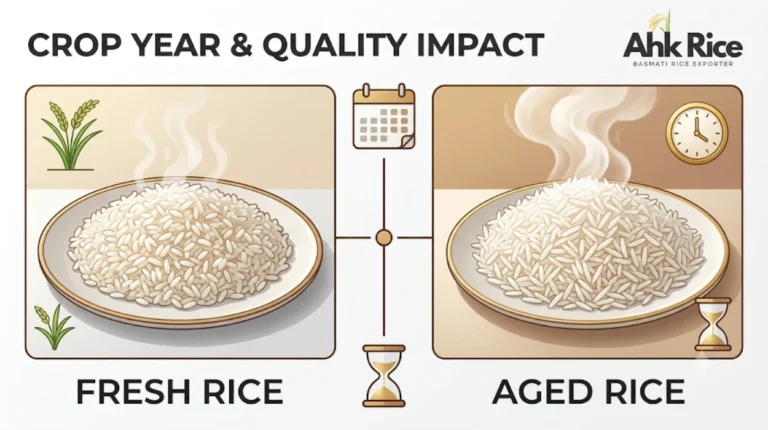
A supplier’s specification sheet provides essential information, but it cannot fully demonstrate cooking performance. Two rice consignments can meet similar raw-grain measurements and still produce different results because of processing, moisture, ageing, grain condition and cooking methods. Importers should therefore evaluate both laboratory or physical specifications and the finished cooked product.
Buyers who need to understand the relationship between raw grain length and cooked performance should first review what grain elongation means in Basmati rice and why 1121 grows so long. This educational background helps importers distinguish raw-grain length from cooked elongation when preparing their acceptance criteria.
AHK Rice supports a specification-led sampling process for Pakistani Basmati rice buyers. The objective is to give the importer a practical basis for approving a variety, documenting quality expectations and moving towards a commercial shipment.
Why Should UAE Importers Choose AHK Rice for Pre-Shipment Samples?
AHK Rice helps importers assess Pakistani Basmati rice against defined grade, processing and packing requirements before placing a bulk order. Buyers can discuss suitable varieties, review sample availability, evaluate cooking quality and establish written acceptance criteria before production and shipment arrangements begin.
Through AHK Rice’s Pakistani Basmati rice export service, importers can discuss sourcing, milling, grading, sorting, packaging and export coordination. The selection process should begin with the buyer’s intended market, target selling price and cooking application rather than variety name alone.
AHK Rice supplies varieties including 1121, Super Kernel, and 1509 Basmati rice. Each serves different commercial priorities. Premium retailers may prioritise long cooked grains and aroma, while distributors and institutional kitchens may place greater weight on consistent cooking results, price per metric tonne and repeat-order reliability.
A useful sampling request identifies the required variety and processing style, such as white, steam or Golden Sella. It also specifies grain length, maximum moisture, broken percentage, packaging format and destination. AHK Rice can then assess the request and confirm which sample options are available.
The buyer should receive clear information about the sample’s identity and declared specifications. This makes the cooking test more meaningful because the results can be linked to a particular grade rather than treated as a general indication of the supplier’s entire product range.
Which Cooking Tests Should UAE Buyers Perform on Rice Samples?
UAE importers should evaluate elongation ratio, aroma, fluffiness, non-stickiness, grain breakage and consistency after cooking. Testing should use a documented method, fixed water-to-rice proportions and repeatable cooking conditions so that buyers can compare varieties fairly and record results against their intended retail or foodservice requirements.
For a detailed comparison, read the cooking tests UAE importers use to assess elongation ratio, aroma, fluffiness and non-stickiness.
Use the following evaluation framework for each sample:
| Test | What the buyer should record | Commercial significance |
|---|---|---|
| Grain elongation | Raw and cooked grain length | Supports premium presentation claims |
| Aroma | Fragrance before and after cooking | Helps assess consumer expectations |
| Fluffiness | Separation and overall appearance | Important for biryani and pilaf |
| Non-stickiness | Clumping after cooking | Useful for restaurants and catering |
| Broken grains | Visible broken pieces before and after cooking | Affects appearance and grade acceptance |
| Texture | Firmness and bite | Supports menu and customer requirements |
| Batch consistency | Results from repeat cooking tests | Helps establish repeat-order criteria |
How should elongation ratio be measured?
Measure several representative grains before cooking and after cooking, then compare their average lengths. Calculate the elongation ratio by dividing average cooked-grain length by average raw-grain length. Use the same measurement method for every sample and record the cooking conditions.
Longer raw grains do not automatically guarantee the best finished dish. The buyer must also assess whether grains remain intact, separate properly and retain the expected texture. A 1121 sample may suit a premium presentation, while another variety may perform better against a particular kitchen’s cost and consistency targets.
How can aroma and non-stickiness be compared fairly?
Cook all samples under consistent conditions and assess fragrance, separation and texture immediately after cooking and after a standard holding period. Record whether the grains remain distinct or form clumps. This is especially relevant to UAE caterers, restaurants and central kitchens preparing large batches for service.
AHK Rice buyers should document the results rather than rely on an informal tasting alone. A signed or emailed evaluation sheet can identify the approved sample, acceptable variation and any conditions that require clarification before commercial production.
Which Pakistani Basmati Variety Should UAE Buyers Sample First?
The right variety depends on the buyer’s selling channel, required cooking appearance, processing preference and target cost. Importers should compare 1121 for premium length, Super Kernel for traditional Basmati characteristics and 1509 for value-oriented sourcing, then approve the grade that meets their documented specifications.
| Variety | Main evaluation priority | Potential buyer fit |
|---|---|---|
| 1121 Basmati | Cooked elongation and presentation | Premium retail, biryani and catering |
| Super Kernel Basmati | Aroma, texture and traditional Basmati character | Ethnic grocery, wholesale and foodservice |
| 1509 Basmati | Cooking performance relative to purchase cost | Price-sensitive distribution and bulk supply |
These are selection guidelines, not guarantees of cooking performance. Milling quality, crop characteristics, processing and storage also affect the final result. AHK Rice should confirm the exact grade and processing specification available for sampling before the buyer compares commercial offers.
Importers should avoid comparing samples prepared with different cooking methods. For example, a steam-processed sample and a Golden Sella sample may require different preparation conditions. The evaluation record should identify the processing type and cooking method so that differences are interpreted fairly.
What Results Can UAE Importers Expect Before Confirming an Order?
A properly managed sample evaluation gives the importer a documented basis for selecting a grade, rejecting unsuitable rice and confirming purchase specifications. It does not guarantee that every future shipment will cook identically, so the approved sample must be connected to the final commercial specification and inspection arrangements.
The expected outcome is a written decision covering the approved variety, processing style, grain specifications, broken percentage, moisture limit, packaging and any required quality documents. Buyers should also agree on how pre-shipment inspection will verify the consignment against the approved specification.
For example, a Dubai wholesaler supplying restaurants may prioritise consistent separation and low breakage. A premium grocery importer may place greater weight on long cooked grains and aroma. A central kitchen may focus on predictable cooking performance across large batches. Each buyer needs a different acceptance framework, even when evaluating the same variety.
AHK Rice can use the buyer’s feedback to clarify the requested grade and prepare a commercial offer. The final order should identify the agreed specifications rather than simply stating “Basmati rice” or referring to an informal tasting result.
Sample approval also does not replace destination-specific import compliance. UAE buyers should confirm applicable food-import registration, labelling, documentation and inspection requirements with their importer or customs representative before dispatch.
How Much Do Pre-Shipment Cooking Samples Cost?
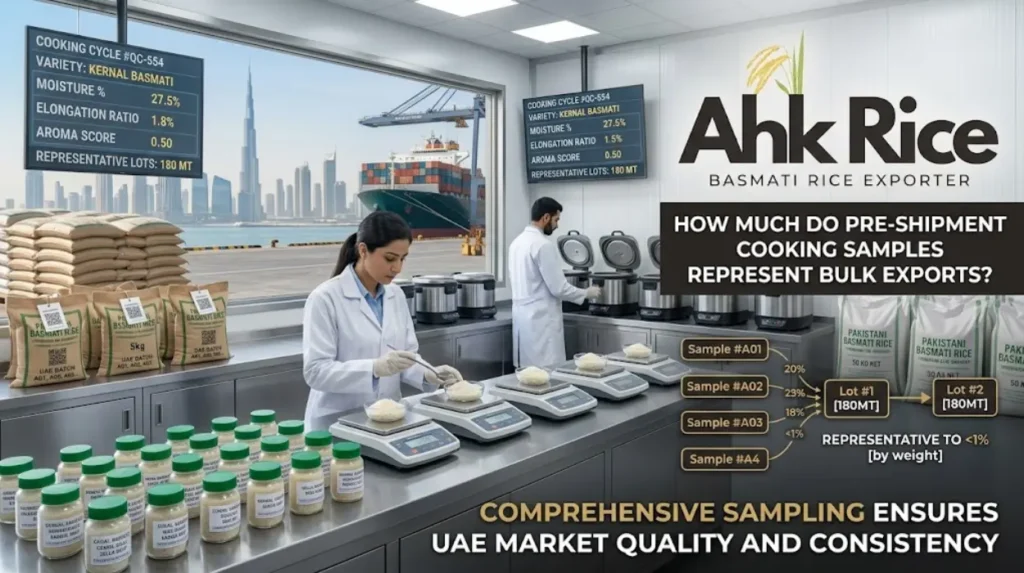
Sample costs depend on the requested quantity, number of varieties, courier destination, packaging and any additional testing or certification requirements. AHK Rice has offered up to 20 kg of Super Kernel Basmati for sampling, subject to confirmation, with the buyer covering courier shipping and applicable phytosanitary charges.
The following figures are planning estimates, not a confirmed quotation. AHK Rice should confirm the final sample quantity, dispatch conditions and courier charge before the buyer approves shipment.
| Cost component | Indicative treatment |
|---|---|
| Rice sample | May be supplied free, subject to availability and approval |
| International courier | Approximately US$35–US$60 for some UAE sample consignments; obtain a current quote |
| Multiple varieties | May increase parcel weight and courier cost |
| Laboratory testing | Additional cost if independent testing is requested |
| Phytosanitary charges | Applicable charges confirmed before dispatch |
| Commercial shipment | Separately quoted according to grade, quantity, packing and Incoterm |
A sample request should identify the destination emirate, delivery address, preferred courier arrangement and number of varieties. AHK Rice can then clarify the available quantity and charges before dispatch. Buyers should not assume that free rice means free international delivery.
For commercial orders, pricing depends on variety, processing, grain length, broken percentage, moisture, order volume, packaging and inspection requirements. Freight and the agreed Incoterm also affect the landed cost. FOB Karachi and CIF UAE offers are not directly comparable unless freight, insurance and included services are clearly identified.
How Long Does Shipping Take From Pakistan to the UAE?
Sample courier delivery and commercial container shipping follow different timelines. A UAE sample parcel may take approximately three to seven days after dispatch, while sea transit from Karachi to UAE ports may take around seven to fourteen days, depending on the route and carrier schedule.
These are indicative planning ranges rather than guaranteed delivery dates. Courier transit excludes sample preparation, collection, customs clearance and any inspection delays. Commercial sea transit excludes production, export documentation, vessel waiting time, destination handling and customs release.
| Shipment stage | Indicative timeframe |
|---|---|
| Sample preparation and dispatch arrangements | Confirm with supplier |
| Courier transit to the UAE | Approximately 3–7 days after dispatch |
| Commercial production and export preparation | Depends on order specifications and readiness |
| Karachi-to-UAE sea transit | Approximately 7–14 days |
| Destination clearance and final delivery | Depends on documents, customs and local transport |
Importers should use the commercial shipping and processing timeline as a planning reference when coordinating approval, production and vessel bookings.
AHK Rice should confirm the applicable shipment schedule for the buyer’s destination port and order readiness. A sample’s arrival date must not be treated as the delivery date for the eventual commercial container.
How Can UAE Importers Start the Sample Approval Process?
Start by submitting the required variety, processing type, technical specifications and UAE delivery details. The supplier then confirms sample availability and costs, prepares the sample for dispatch, and shares the information needed for evaluation before the buyer approves a commercial specification and requests a final offer.
Follow this workflow to reduce delays and prevent misunderstandings.
- Submit the specification. Identify 1121, Super Kernel or 1509 Basmati, the preferred processing type, target quantity, packaging and destination.
- Confirm sample availability. Ask AHK Rice to confirm the available grade, sample weight, courier charge and applicable phytosanitary requirements.
- Arrange dispatch. Approve the delivery details and applicable costs. Obtain tracking information when the parcel is collected.
- Conduct the cooking test. Use a consistent method to assess elongation, aroma, fluffiness, non-stickiness and texture. Record the findings against the requested specifications.
- Issue written approval. Confirm the approved variety, processing style, tolerances, packing and required documentation.
- Request the commercial offer. Review price per metric tonne, Incoterm, order quantity, inspection arrangements, production lead time and shipping schedule before placing the order.
AHK Rice should retain the approved specification as a reference for production and pre-shipment inspection. The buyer should also establish how any deviation will be handled before the order is confirmed. This provides a clearer basis for quality control than relying on a sample alone.
FAQs About Pakistani Basmati Rice Samples for UAE Buyers
Can UAE importers request free Basmati rice samples?
AHK Rice has offered up to 20 kg of Super Kernel Basmati for sampling, subject to confirmation of availability and conditions. Buyers generally cover courier shipping and applicable phytosanitary charges. Confirm the sample quantity and final cost before dispatch.
How long does a rice sample take to reach Dubai?
Courier delivery may take approximately three to seven days after dispatch. The actual time depends on collection, route, customs clearance and delivery arrangements. Sample preparation time is additional.
Which variety is best for UAE biryani restaurants?
1121 is a strong starting point when long cooked grains and premium presentation are priorities. Super Kernel can suit buyers seeking traditional Basmati characteristics. The final choice should follow cooking tests using the restaurant’s preparation method.
What should a Basmati rice cooking test include?
Measure raw and cooked grain length, then calculate elongation ratio. Record aroma, fluffiness, non-stickiness, texture and broken grains. Use consistent cooking conditions and document the variety and processing style for every sample.
Does sample approval guarantee commercial shipment quality?
No. Sample approval establishes a quality reference, but commercial production requires agreed specifications and suitable inspection arrangements. Buyers should confirm tolerances, documentation, packing and the process for handling deviations before shipment.