What Is Pakistani Basmati Rice and How Is It Different from Indian Basmati?
Pakistani Basmati rice is a long-grain aromatic rice grown mainly in Punjab, Pakistan. It is valued for its natural fragrance, slender grains, fluffy cooked texture, and characteristic grain elongation. Indian Basmati shares many of these qualities, but differences in growing regions, varieties, processing specifications, export prices, and supply arrangements influence how buyers evaluate the two origins.
What Is Pakistani Basmati Rice?
Pakistani Basmati rice is a naturally aromatic, long-grain rice cultivated primarily in Punjab, Pakistan. Its recognised varieties include 1121, Super Kernel, and 1509 Basmati rice. Buyers select these varieties according to grain length, aroma, cooking performance, processing grade, packaging requirements, and intended market.
Basmati is distinguished from ordinary long-grain rice by its characteristic aroma, slender grain shape, and elongation during cooking. Its fragrance comes partly from 2-acetyl-1-pyrroline, a naturally occurring aroma compound also found in other fragrant foods.
Pakistan’s Basmati-growing region includes districts such as Gujranwala, Hafizabad, Sheikhupura, Narowal, and Sialkot. The area’s climate, soil conditions, water availability, and seasonal growing patterns contribute to the characteristics of its rice.
Pakistani Basmati enters international markets as raw white rice, steam-processed rice, parboiled rice, and brown rice. Export specifications define the grain variety, moisture content, broken-grain percentage, milling quality, and packaging format.
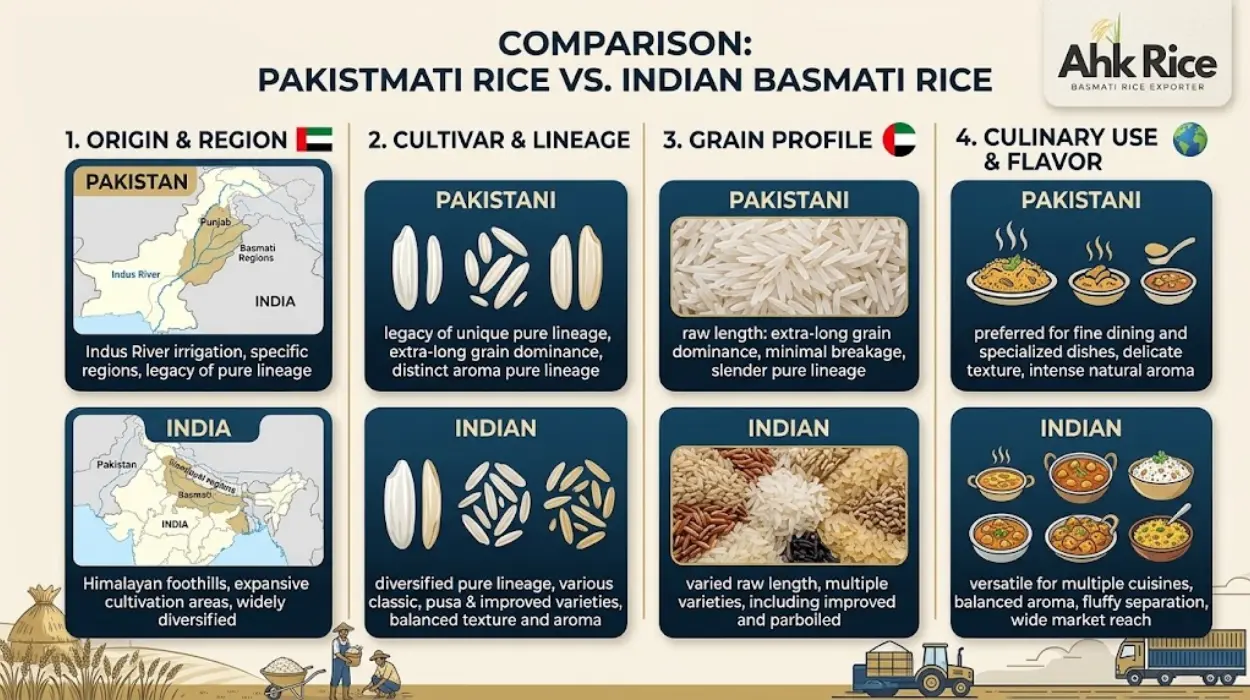
The distinction between Pakistani and Indian Basmati is not simply grain length. Both countries produce several varieties with different characteristics. A meaningful comparison considers the specific variety, crop year, processing method, quality certificate, and delivered price.
Where Is Pakistani Basmati Rice Grown?
Pakistani Basmati rice grows mainly in Punjab, where fertile soils, suitable temperatures, irrigation, and seasonal conditions support aromatic rice cultivation. Important production districts include Gujranwala, Hafizabad, Sheikhupura, Narowal, and Sialkot, although growing conditions and crop quality vary between locations.
Punjab’s agricultural landscape supports rice cultivation through irrigation networks and seasonal rainfall. Farmers prepare fields, establish seedlings or sow rice, manage water levels, and control weeds and pests throughout the crop cycle.
The geographical origin matters because Basmati’s aroma and grain characteristics reflect interactions between rice genetics and growing conditions. However, the district alone does not guarantee a particular grain length, aroma intensity, or cooking result.
India also cultivates Basmati across its northern growing regions, particularly in Punjab, Haryana, and parts of Uttar Pradesh, Jammu and Kashmir, Himachal Pradesh, and Uttarakhand.
Both countries produce premium and commercial grades. Buyers therefore assess actual shipment specifications instead of assuming that every Pakistani or Indian product has identical characteristics.
How Is Pakistani Basmati Rice Processed Step by Step?
Pakistani Basmati rice processing begins with harvested paddy and continues through drying, cleaning, dehusking, milling, grading, quality testing, and packing. Some batches undergo steaming or parboiling. Each stage affects moisture, grain integrity, appearance, cooking performance, and the final export specification.
1. Harvesting and paddy reception
Farmers harvest mature rice plants and transport the paddy to a processing facility. The mill receives and inspects the raw material for visible impurities, moisture, damaged grains, and general condition.
2. Drying and cleaning
The paddy is dried to a suitable storage and milling moisture level. Cleaning equipment removes stones, dust, straw, and other foreign materials. Proper moisture management reduces spoilage risks and supports consistent milling.
3. Dehusking and separation
A husking machine removes the outer husk. Separation equipment distinguishes brown rice from unhulled paddy, which returns for additional processing. Brown rice retains its bran layer.
4. Whitening and polishing
For white rice, milling removes the bran layers. Polishing improves the grain’s surface appearance according to the required finish. Brown rice follows a different route because its bran layer remains intact.
5. Steam treatment or parboiling
Steam-processed rice receives controlled steam treatment as part of the processing method. Parboiling involves soaking paddy, applying heat, and drying it before milling. These processes differ in their treatment sequence and effects on grain structure.
6. Grading and sorting
Screens and grading equipment separate grains by length and size. Optical sorters remove discoloured or defective grains. Mills classify products according to whole-grain recovery, broken percentage, appearance, and the buyer’s contract.
7. Testing and packaging
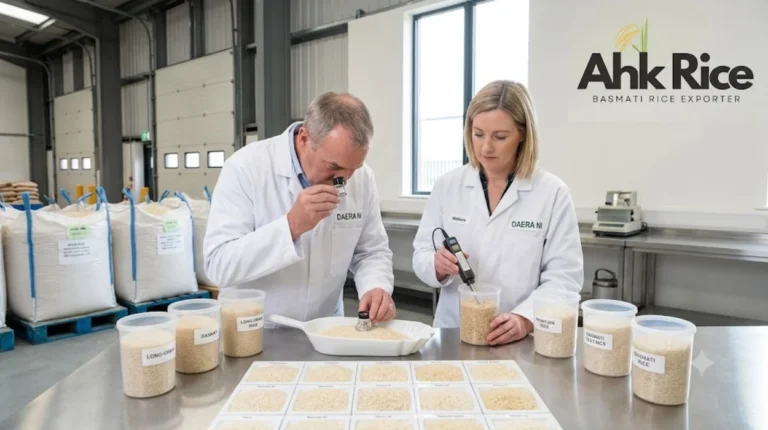
Quality teams measure parameters such as moisture, broken grains, grain dimensions, and foreign matter. Laboratories perform additional tests when required by the destination market. Approved rice is packed in specified bags and prepared for shipment.
What Are the Main Pakistani Basmati Varieties and Grades?
Pakistan exports several Basmati varieties, including 1121, Super Kernel, and 1509. Each variety has distinct grain and commercial characteristics. Export grades also differ by processing method, broken-grain percentage, moisture, colour, and packaging specifications agreed between buyer and supplier.
| Variety or grade | Main characteristics | Common applications |
|---|---|---|
| 1121 Basmati | Exceptionally long slender grains and strong cooked elongation | Premium retail, restaurants, catering |
| Super Kernel Basmati | Traditional aroma and familiar Basmati texture | Ethnic retail, household consumption, foodservice |
| 1509 Basmati | Long grains and a shorter crop duration than traditional varieties | Commercial retail, wholesale, institutional kitchens |
| Steam Basmati | Steam-treated rice with a characteristic cooked texture | Restaurants, catering, household meals |
| Golden Sella Basmati | Parboiled rice with a golden appearance and firm cooked grains | Banquets, biryani, large-scale foodservice |
| Creamy Sella Basmati | Parboiled rice with a lighter cream appearance | Catering, restaurants, bulk distribution |
| Brown Basmati | Bran layer retained after dehusking | Whole-grain retail and health-focused food ranges |
| Broken Basmati | Grain fragments separated during milling | Selected food manufacturing and price-sensitive applications |
These categories describe different dimensions of a product. A variety identifies the rice type, while a processing grade describes how the rice has been treated. A 1121 shipment, for example, can be sold as steam or Sella rice, depending on the processing specification.
Export contracts should also identify whether the product is raw, steamed, or parboiled. The contract should state the maximum broken percentage, moisture limit, grain-length specification, crop year, and packaging weight.
What Makes Pakistani Basmati Different from Indian Basmati?
Pakistani and Indian Basmati share an aromatic, long-grain profile, but individual varieties differ in grain dimensions, fragrance, cooked texture, and commercial positioning. Pakistani Super Kernel and 1121 compete with Indian Basmati varieties, including Pusa 1121, under comparable quality specifications.
The most reliable comparison examines equivalent products rather than treating each country’s entire Basmati output as a single grade.
Grain length and elongation
Both countries produce exceptionally long-grain Basmati. Pakistani Super Kernel is associated with traditional Basmati characteristics, while Pakistani and Indian 1121 varieties are known for substantial grain elongation after cooking.
Raw grain length and cooked grain length are different measurements. Results depend on variety, crop maturity, processing, storage, and cooking technique. Buyers should request the supplier’s measurement method and a cooking sample.
Aroma and taste
Both origins produce naturally fragrant rice. Differences in aroma intensity and flavour depend on variety, crop conditions, storage, and processing. A controlled cooking test provides a more useful comparison than origin labels alone.
Texture and cooking performance
Properly cooked Basmati generally produces elongated grains with a distinct texture. Sella rice often retains firmer grains during extended cooking, while white and steam varieties provide different appearances and texture profiles.
The result depends on soaking time, water ratio, cooking temperature, and the intended dish. Restaurants should test each candidate variety using their standard recipe.
Price and supply
Export prices reflect variety, grade, crop availability, processing, packaging, order quantity, freight, insurance, and contract terms. Neither Pakistani nor Indian Basmati is consistently cheaper across every grade and market.
Buyers comparing offers should calculate the landed cost per metric tonne. This includes the product price, freight, insurance, port charges, duties, and other applicable import costs.
For a detailed commercial comparison, buyers can review Pakistani vs Indian Basmati Rice: Aroma, Grain Length, Price and Supply Compared for USA Buyers before selecting an origin and grade.
What Are the Main Benefits and Uses of Pakistani Basmati Rice?
Pakistani Basmati offers aromatic flavour, slender grains, variety-specific cooking performance, and several processing options. These characteristics support premium retail, household cooking, restaurants, catering, wholesale distribution, and foodservice operations that require consistent grain quality and predictable preparation results.
Retail and household consumption
Retailers stock Basmati in consumer packs for everyday meals and special dishes. Super Kernel suits buyers seeking traditional aroma, while 1121 serves premium segments that prioritise long grains and cooked elongation.
Restaurants and catering
Restaurants use Basmati for biryani, pulao, and rice-based menus. Golden Sella and other parboiled grades are selected when kitchens require firm grains and consistent results across large batches.
Wholesale and institutional supply
Distributors and institutional kitchens purchase rice in larger bags according to consumption volumes and storage capacity. Buyers specify grain grade, packaging weight, delivery schedule, and acceptable quality tolerances to support repeat orders.
Private-label products
Importers can source rice for packaging under their own brands. Private-label programmes require agreed product specifications, approved artwork, accurate origin declarations, compliant labels, and consistent packaging dimensions.
What Quality Standards and Certifications Apply to Pakistani Basmati?
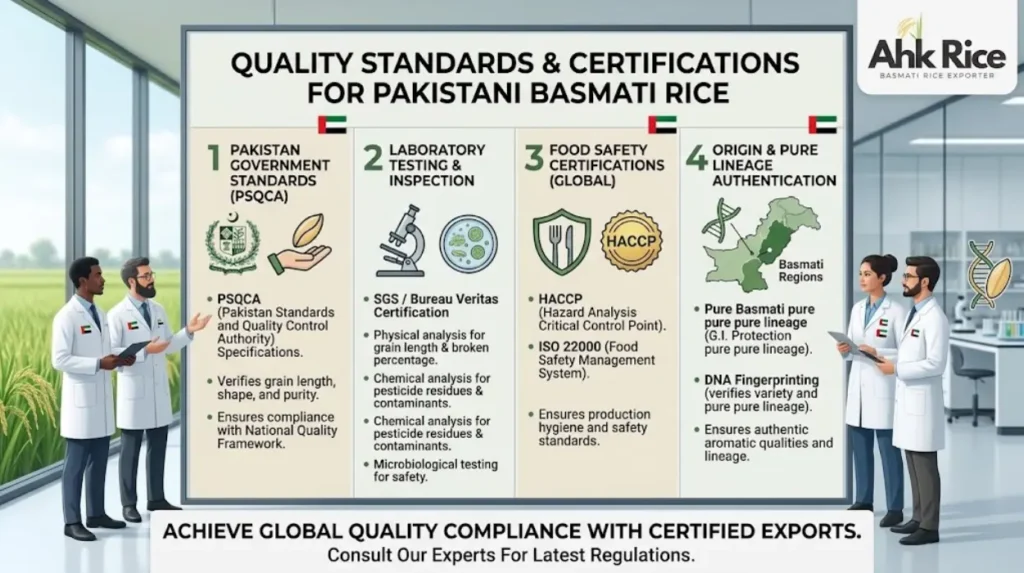
Export-quality Pakistani Basmati is assessed against agreed product specifications and the destination country’s food laws. Relevant controls include food-safety systems, pesticide-residue limits, contaminant testing, accurate labelling, traceability, and export documentation. Certification requirements depend on the buyer, product, and importing jurisdiction.
Food-safety systems such as HACCP and ISO 22000 support hazard management and documented production controls. These certifications concern food-safety management, not automatic proof that every shipment meets every destination requirement.
Laboratory testing can cover pesticide residues, heavy metals, mycotoxins where relevant, moisture, and other contractual parameters. Importers should confirm applicable legal limits and testing requirements before shipment.
Halal certification applies when required by the buyer or destination rules. Packaging must accurately identify the product, country of origin, net weight, and other information required under the destination’s labelling regulations.
Export documentation commonly includes a commercial invoice, packing list, transport document, and applicable certificate of origin or phytosanitary documentation. The exact document set depends on the importing country’s rules and the commodity’s treatment.
Importers should verify certification scope, validity, laboratory accreditation, and shipment-specific records. A certificate held by a mill does not replace checks on the actual consignment.
What Common Misconceptions Exist About Pakistani and Indian Basmati?
The main misconceptions are that all Basmati has the same grain length, one origin always delivers better aroma, longer raw grains guarantee superior cooking, and the lowest quoted price offers the best value. Actual performance depends on variety, grade, processing, handling, and verified specifications.
Misconception 1: Pakistani Basmati is always cheaper. Prices change with crop supply, demand, quality, freight, and contract terms. Compare equivalent grades and landed costs.
Misconception 2: Indian Basmati always has better aroma. Aroma varies between varieties and batches. Compare samples under the same cooking conditions.
Misconception 3: Raw grain length determines every quality attribute. Grain length does not independently establish aroma, cooking integrity, broken percentage, or purity.
Misconception 4: Steam and Sella mean the same thing. They describe different processing categories. Buyers must identify the exact treatment and required cooked characteristics.
Misconception 5: A supplier certificate guarantees every shipment. Quality records and certifications support verification, but shipment-specific inspection and contractual testing remain important.
Where Should the MOFU Article Link Be Inserted?
Place the internal link in the section “What Makes Pakistani Basmati Different from Indian Basmati?”, immediately after the discussion of price and supply. This is the natural transition from introductory education to a detailed comparison for commercial buyers.
Recommended contextual anchor text: compare Pakistani and Indian Basmati for the US market.
Link that anchor to your MOFU article: Pakistani vs Indian Basmati Rice: Aroma, Grain Length, Price and Supply Compared for USA Buyers.
SEO Metadata and Keywords
Primary keyword: Pakistani Basmati rice
Secondary keywords:
- Pakistani vs Indian Basmati rice
- Pakistani Basmati rice varieties
- Indian Basmati rice comparison
- 1121 Basmati rice
- Super Kernel Basmati rice
- 1509 Basmati rice
- Basmati rice processing
- Basmati rice grain length
- Pakistani rice export quality
- Basmati rice certifications
Meta title: Pakistani vs Indian Basmati Rice: Key Differences
Meta description: Learn what Pakistani Basmati rice is, where it grows, how it is processed, its main varieties, quality standards, cooking uses, and differences from Indian Basmati.
Frequently Asked Questions
1. What is Pakistani Basmati rice?
Pakistani Basmati is aromatic long-grain rice grown mainly in Punjab, Pakistan. Popular varieties include 1121, Super Kernel, and 1509, each offering different grain characteristics and cooking performance.
2. Is Pakistani Basmati different from Indian Basmati?
Yes. Both origins produce aromatic long-grain rice, but individual varieties differ in grain characteristics, aroma, processing options, and commercial specifications. Comparing equivalent grades gives buyers a more reliable result.
3. Which Pakistani Basmati variety has the longest grain?
1121 Basmati is recognised for its exceptionally long grains and substantial elongation during cooking. Actual measurements depend on the specific product, processing method, and measurement standard.
4. What is the difference between Steam and Sella Basmati?
Steam rice undergoes steam treatment, while Sella rice is parboiled before milling. Their processing methods influence colour, texture, and cooking behaviour.
5. Where is Pakistani Basmati rice grown?
Pakistani Basmati grows mainly in Punjab, including Gujranwala, Hafizabad, Sheikhupura, Narowal, and Sialkot. Local growing conditions and the selected variety influence the final grain characteristics.