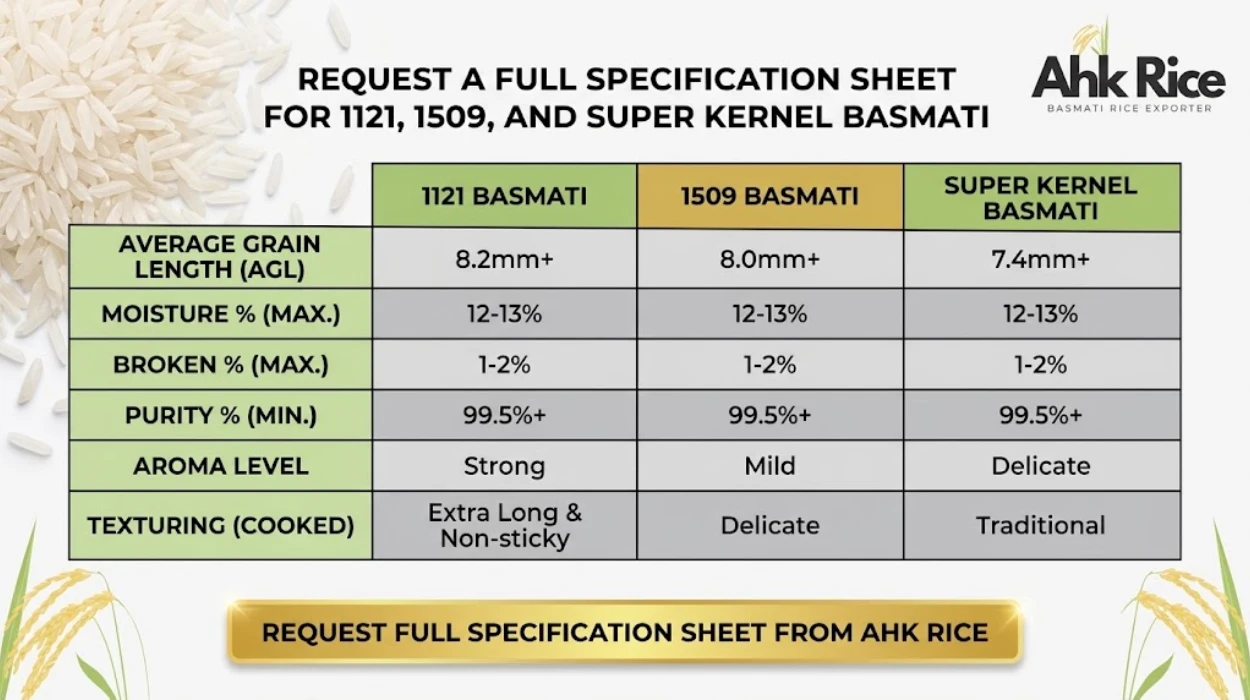
Request a Full Specification Sheet for 1121, 1509 and Super Kernel Basmati from AHK Rice
Importers need verified rice specifications before approving a supplier, calculating landed costs or confirming a container order. Grain length, broken percentage, moisture, purity, processing type and packaging determine whether a shipment meets the buyer’s commercial requirements. A variety name alone does not establish an export-grade specification.
AHK Rice supplies Pakistani Basmati rice to international buyers, with options including 1121, 1509 and Super Kernel. Importers can request grade-specific information to compare products, establish quality limits and prepare purchase specifications. Buyers evaluating these varieties can first review 1121 vs 1509 vs Super Kernel Basmati Rice: Which Variety Fits the US Market? as an educational starting point, then use a written specification sheet to confirm the requirements for their own market.
What is the best solution for comparing 1121, 1509 and Super Kernel Basmati?
The best solution is to request a written specification sheet for each variety and processing type. Compare average grain length, moisture, broken percentage, purity, aroma, cooking performance and packing before approving a commercial sample or negotiating a bulk shipment.
Each variety serves a different commercial purpose. 1121 Basmati is associated with extra-long grains and premium presentation. Super Kernel offers traditional Basmati aroma and suitability for established South Asian retail and foodservice channels. 1509 provides an alternative for buyers prioritising procurement economics, supply planning and high-volume distribution.
A useful specification sheet should identify the variety, raw grain length, grade, processing method, moisture limit, broken percentage, foreign matter tolerance, crop information where available and packing options. It should also state which figures are guaranteed contractual limits and which are indicative product characteristics.
For example, a US importer supplying premium ethnic supermarkets may prioritise 1121 Steam with controlled broken percentage and consistent cooked elongation. A wholesaler supplying restaurants may compare 1509 Steam and Golden Sella according to cooking requirements, handling and purchase economics.
AHK Rice can help buyers define these requirements before finalising a commercial order. Importers should confirm that the specification matches the sample, pro forma invoice, purchase contract and final Certificate of Analysis (COA).
Why should importers choose AHK Rice for Basmati rice specifications?
AHK Rice helps importers evaluate Pakistani Basmati varieties against defined commercial requirements, from grain characteristics and processing options to packing and export documentation. Buyers should confirm availability, tolerances and destination-specific compliance before treating any specification as a contractual commitment.
Through AHK Rice’s Basmati rice supply and export service, buyers can discuss 1121, 1509 and Super Kernel requirements with a supplier based in Punjab, Pakistan. The business supplies these varieties to international markets and supports processing, packaging and export coordination.
The practical advantage is specification-led procurement. Instead of ordering by variety name alone, buyers can define the characteristics that matter to their customers. This reduces the risk of receiving rice that differs from the intended retail grade, foodservice application or cooking profile.
A complete request should cover the following details:
- Variety and processing: 1121, 1509 or Super Kernel, with Steam, White, Golden Sella or another available processing option.
- Grain specifications: Average raw grain length, grade, broken percentage and purity requirements.
- Moisture and quality: Maximum moisture, foreign matter limits, damaged or discoloured grains and applicable quality tolerances.
- Packaging: Retail bags or bulk formats, commonly requested sizes such as 5 kg, 10 kg, 25 kg and 50 kg, subject to availability.
- Documentation: Commercial invoice, packing list, certificate of origin, phytosanitary documentation and any destination-specific certificates required for the shipment.
The buyer should request a revised specification whenever the processing type, quality grade or packing changes. A Steam specification should not automatically be applied to Golden Sella, because processing affects colour, cooking behaviour and the buyer’s intended application.
Which export specifications should buyers compare before placing an order?
Buyers should compare measurable quality limits rather than relying on general descriptions such as premium, extra-long or export quality. The final specification should define acceptable ranges, inspection methods, sampling procedures and the documents required for shipment approval.
The following figures are useful starting points for commercial discussions, not guaranteed specifications for every available lot.
| Specification | 1121 Basmati | 1509 Basmati | Super Kernel |
|---|---|---|---|
| Main commercial position | Premium long-grain presentation | Value-oriented bulk procurement | Traditional aromatic Basmati |
| Indicative raw grain length | Confirm selected grade | Approximately 8.10–8.50 mm, depending on grade and measurement | Approximately 7.0–7.5 mm, depending on grade |
| Processing options | White, Steam, Sella, subject to availability | White, Steam, Golden Sella, subject to availability | White, Steam or other offered grades, subject to availability |
| Moisture limit | Agree in specification | Often targeted at 13% maximum | Agree in specification |
| Broken percentage | Set a contractual limit | Set a contractual limit | Set a contractual limit |
| Packaging | Confirm size and bag type | Confirm size and bag type | Confirm size and bag type |
| Final quality evidence | Approved sample and applicable COA | Approved sample and applicable COA | Approved sample and applicable COA |
These figures should be validated against the specific lot and the agreed measurement method. Grain length can vary with grade, crop and milling conditions. Buyers should also distinguish raw grain length from cooked elongation, because the measurements describe different properties.
For a detailed explanation of how average grain length (AGL), broken percentage, moisture and purity affect procurement, read the complete export-grade specification guide for Pakistani Basmati rice. Use that comparison to establish the required limits before requesting a final quotation.
The specification sheet should also identify the inspection stage. A pre-shipment sample demonstrates the proposed product, while the final COA records the tested shipment or lot according to the agreed inspection procedure. Buyers should not assume that a sample alone guarantees the composition of every future consignment.
What results can buyers expect from a specification-led purchasing process?
A specification-led process gives importers a clearer basis for supplier comparison, quality approval and landed-cost calculations. Results depend on the agreed grade, actual lot quality, inspection arrangements, shipping schedule and compliance requirements in the destination market.
The first expected outcome is a defined product requirement. A buyer can specify the variety, processing method, grain characteristics, moisture limit, broken percentage and packing rather than comparing quotations with inconsistent assumptions.
The second outcome is improved purchasing control. Once both parties approve the same specification and representative sample, the buyer has a documented reference for production, inspection and contractual acceptance. This is particularly important for private-label programmes and distributors serving repeat wholesale customers.
The third outcome is more reliable cost planning. Importers can compare supplier quotations against equivalent grades, packaging weights and delivery terms. They can then assess freight, insurance, customs charges, port handling and inland transportation without treating the lowest FOB price as the lowest total cost.
For example, a distributor comparing two 1121 Steam offers should verify that both use the same broken percentage, moisture limit, bag weight and delivery basis. A lower price may reflect a different grade, packing arrangement or shipment term rather than a better equivalent product.
AHK Rice buyers should request written confirmation of the selected grade, production availability, loading window and applicable export documents before issuing a purchase order. Final outcomes depend on these agreed conditions, not the variety name alone.
How much does a Basmati rice specification sheet and sample cost?
A specification sheet may be provided during supplier discussions, but sample, courier, testing and certification costs depend on the requested service and destination. Buyers should obtain written confirmation of all charges before dispatching samples or authorising inspection.
There is no single universal cost for obtaining a commercial rice sample. The total depends on sample quantity, courier destination, required laboratory tests, handling and any phytosanitary or other applicable charges.
The following cost categories should be confirmed:
| Cost item | What determines the cost |
|---|---|
| Specification sheet | Supplier policy and level of technical detail |
| Rice sample | Quantity, variety, processing and sample policy |
| International courier | Destination, parcel weight, service level and fuel surcharges |
| Laboratory testing | Required parameters and selected accredited laboratory |
| Phytosanitary or other certificates | Applicable rules, shipment purpose and issuing authority |
| Third-party inspection | Inspector, scope, location and timing |
Where AHK Rice approves a free product sample, the buyer should confirm the quantity and eligibility in writing. A previously discussed sample arrangement may cover up to 20 kg of Super Kernel Basmati, with the buyer responsible for courier shipping and applicable phytosanitary charges. This should be reconfirmed before ordering and should not be assumed to apply automatically to 1121, 1509 or every destination.
A commercial quotation is separate from sample costs. Export pricing depends on variety, grade, crop availability, processing, broken percentage, moisture, packing, quantity, Incoterm and destination. Buyers should request a dated quotation with its validity period and clearly stated inclusions.
How long does shipping take to major import markets?
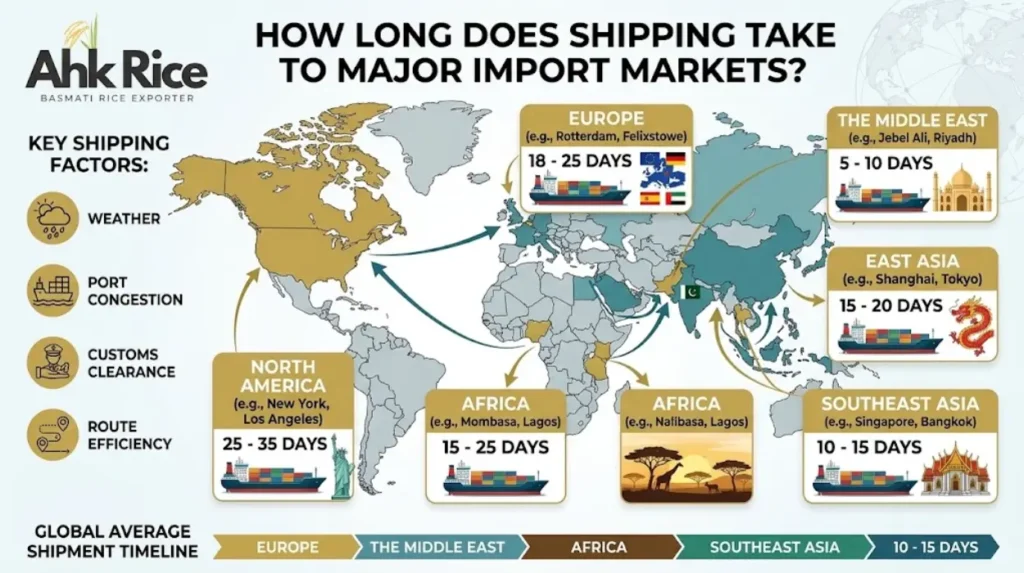
Shipping time depends on the loading port, destination port, carrier schedule, transshipment, customs clearance and seasonal congestion. Buyers should obtain a current sailing estimate and distinguish ocean transit from the full period required to receive cleared cargo.
For planning purposes, the following are indicative ocean-transit ranges from Karachi, Pakistan. They are not live carrier schedules or guaranteed delivery times.
| Destination market | Indicative ocean transit | Main planning considerations |
|---|---|---|
| UAE, including Jebel Ali | Approximately 3–7 days | Vessel frequency, port handling and import clearance |
| Saudi Arabia | Approximately 5–12 days | Destination port, sailing route and customs processing |
| Malaysia, including Port Klang | Approximately 10–18 days | Vessel routing and transshipment |
| Iraq | Approximately 10–20 days | Destination port or onward transport arrangements |
| Morocco, including Casablanca | Approximately 20–30 days | Routing, transshipment and port congestion |
| United States | Approximately 25–40 days | Coast, final port, vessel route and inland delivery |
These ranges are indicative only. Actual transit can fall outside them, and the vessel schedule must be checked when the order is confirmed.
Total lead time also includes production or milling, bag printing where required, inspection, export documentation, vessel cut-off, loading and destination clearance. Retail packaging or a new private-label design may add preparation time.
Before confirming a purchase order, buyers should ask AHK Rice for the estimated cargo-ready date, loading port, proposed destination port, shipping basis and current carrier schedule. The contract should identify which party handles freight, insurance, import clearance and destination charges.
How can buyers request a full specification sheet and commercial sample?
Start by defining the target variety, processing type, quality limits, packaging and destination. Request the specification sheet, review the quotation, approve a representative sample and agree on inspection and shipment conditions before releasing the commercial order.
AHK Rice recommends a structured process that connects product selection with commercial approval.
Step 1: Submit buyer requirements. Identify the destination country, intended use, preferred variety, processing type, quantity and packaging. Include the required moisture limit, broken percentage, grain length and any buyer-specific quality criteria.
Step 2: Request the specification sheet. Ask for available grades, measurement methods, tolerances, packaging options and applicable documentation. Confirm which values are contractual and which are indicative.
Step 3: Review the quotation. Compare the price, quantity, Incoterm, payment terms, quotation validity, estimated loading window and shipment responsibilities. Confirm whether inspection and certificates are included or charged separately.
Step 4: Arrange the sample. Confirm the sample quantity, dispatch date, courier cost, applicable phytosanitary requirements and laboratory testing, if needed. Use the sample to evaluate appearance, aroma, cooking behaviour, elongation and suitability for the target market.
Step 5: Approve the commercial specification. Record the approved sample reference and agreed quality limits in the purchase contract. Confirm packaging artwork, label requirements and the procedure for pre-shipment inspection and COA approval.
Step 6: Confirm shipment and documents. Agree on the loading schedule and required export documents. Verify destination-specific food import, labelling and testing requirements with the importer or relevant authorities before dispatch.
This process gives both parties a clear record of the intended product and acceptance criteria. It also helps buyers identify specification gaps before committing to container quantities.
What should buyers confirm before making the final decision?
Approve a supplier only after the written specification, representative sample, price, packaging, inspection arrangements and delivery terms align with the intended market. A complete specification sheet is the starting point for a controlled purchase, not a substitute for contractual quality commitments.
For premium retail, prioritise the required grain presentation, aroma, purity and cooking performance. For high-volume wholesale, compare the full cost of equivalent grades and packaging. For foodservice, confirm that the selected processing type performs consistently in the buyer’s intended recipes and holding conditions.
AHK Rice can discuss 1121, 1509 and Super Kernel requirements with importers seeking Pakistani Basmati rice for retail, distribution or foodservice. The final decision should be based on the buyer’s written specification, approved sample and confirmed commercial terms.
To request a full specification sheet, discuss sample availability and receive a quotation for your destination market, contact AHK Rice through its quotation request page.
Frequently Asked Questions
What information does a Basmati rice specification sheet contain?
A specification sheet identifies the variety, processing type, grain length, moisture limit, broken percentage and purity requirements. It can also include packaging, quality tolerances and applicable documentation. Buyers should confirm the final values for the selected lot before ordering.
Can I request specifications for 1121, 1509 and Super Kernel together?
Yes, buyers can request information for all three varieties to compare their commercial suitability. Availability of individual grades and processing types must be confirmed. Each product should have its own clearly defined specification.
Are rice samples free from AHK Rice?
Sample availability and eligibility depend on the current arrangement and requested product. A previously discussed offer covered up to 20 kg of Super Kernel Basmati, with courier shipping and applicable phytosanitary charges paid by the buyer. Confirm current terms before dispatch.
How long does delivery take after placing an order?
Ocean transit varies by destination, carrier route and port conditions. Production, packaging, inspection, documentation and customs clearance add to the total lead time. Request a current shipping estimate and cargo-ready date before confirming the order.
How can I receive a quotation for my market?
Provide your destination, preferred variety, processing type, quantity, packing requirements and target quality limits. Ask for the specification sheet and confirm the quotation’s Incoterm, validity, shipping schedule and included costs before placing the order.