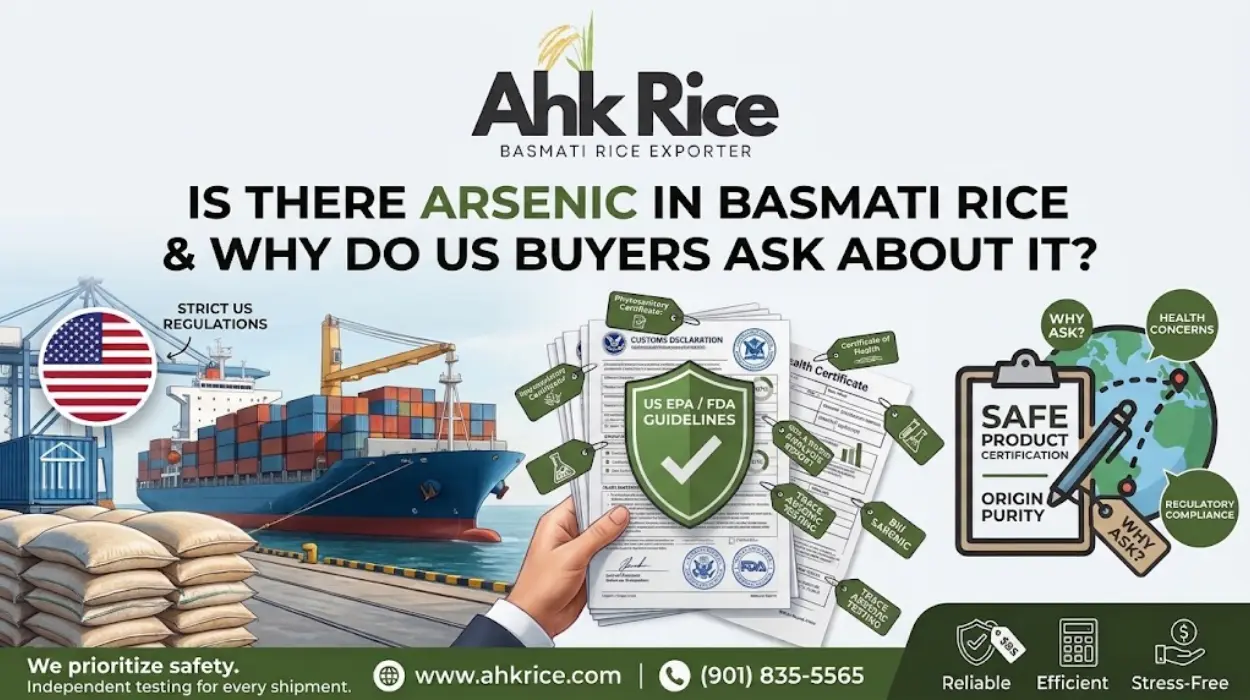
Is There Arsenic in Basmati Rice and Why Do US Buyers Ask About It?
Basmati rice contains naturally occurring inorganic and organic arsenic in varying concentrations. US buyers ask about arsenic because rice absorbs this element from soil and irrigation water, and long-term exposure to inorganic arsenic increases health risks. The concentration depends on growing conditions, rice variety, water quality, and processing.
For importers, understanding arsenic in Basmati rice involves examining agricultural practices, laboratory testing, food safety requirements, and supplier documentation. Pakistani Basmati rice comes primarily from Punjab, where soil conditions, irrigation sources, and crop management influence grain composition. Buyers evaluate these factors when sourcing 1121, Super Kernel, and 1509 Basmati rice for retail, wholesale, and foodservice distribution.
Arsenic testing also supports informed purchasing decisions. Importers need reliable laboratory results for the actual product being shipped, rather than assumptions based on country of origin or rice variety.
What Is Arsenic in Basmati Rice?
Arsenic in Basmati rice refers to naturally occurring or environmentally introduced arsenic absorbed by rice plants during cultivation. Inorganic arsenic receives the greatest food safety attention because repeated exposure over time increases the risk of adverse health effects.
Arsenic is a chemical element found naturally in the Earth’s crust. It enters agricultural environments through soil minerals, groundwater, irrigation water, and certain industrial or agricultural activities. Rice plants absorb arsenic through their roots while taking up water and nutrients.
Two major forms occur in food: inorganic arsenic and organic arsenic. Inorganic arsenic includes arsenite and arsenate. Organic arsenic includes compounds such as arsenobetaine, although different organic compounds have different toxicological properties.
Inorganic arsenic is the principal concern in rice safety assessments. Rice cultivation often involves flooded or waterlogged soil. Under these conditions, chemical reactions increase the availability of certain arsenic compounds for plant uptake.
Arsenic is not unique to Basmati rice. Other rice varieties also absorb it. Concentrations differ according to cultivation conditions, grain characteristics, and environmental exposure.
Why Do US Buyers Ask About Arsenic in Basmati Rice?
US rice importers ask about arsenic because they must evaluate food safety, supplier reliability, regulatory compliance, and consumer expectations. Laboratory results help buyers assess contamination risks, compare shipments, document purchasing decisions, and establish consistent quality requirements.
The United States imports rice for supermarkets, ethnic grocery stores, restaurants, catering companies, and food manufacturers. Buyers in these sectors require dependable products that meet applicable food safety requirements.
Arsenic attracts particular attention because rice is a staple food for many households. People who consume rice frequently can receive repeated dietary exposure. Children also receive attention because their food intake relative to body weight differs from that of adults.
Importers distinguish between a supplier’s general quality claims and evidence from a laboratory. A specification sheet describes agreed product characteristics, while an analytical report records measured results for the tested sample.
Buyers also consider shipment consistency. One acceptable test result does not establish that every future lot has the same arsenic concentration. Sampling plans, traceability, and repeat testing help importers manage this variation.
How Does Arsenic Enter Basmati Rice During Cultivation?
Rice plants absorb arsenic from soil and irrigation water through their roots. Soil chemistry, water composition, growing conditions, and agricultural practices influence the amount available for uptake, which affects the concentration measured in harvested rice grains.
Soil and irrigation water
Arsenic occurs naturally in some soils and groundwater sources. Irrigation water introduces additional exposure when it contains dissolved arsenic. Repeated irrigation can also influence soil concentrations over successive growing seasons.
Flooded growing conditions
Rice commonly grows in flooded or waterlogged fields. Low-oxygen conditions change the chemical forms of arsenic in soil and influence their mobility. These reactions affect how much arsenic becomes available to the plant.
Plant uptake and grain formation
Rice roots absorb water and dissolved substances from the soil. The plant transports some absorbed arsenic into above-ground tissues, including the grain. The distribution between roots, leaves, bran, and the edible grain depends on the chemical form and plant processes.
Harvesting and milling
Harvesting does not automatically remove arsenic already accumulated in the grain. Milling changes the grain’s physical structure and removes outer layers. Because arsenic distribution varies within the kernel, brown rice and polished white rice can have different concentrations.
Which Factors Influence Arsenic Levels in Pakistani Basmati Rice?
Arsenic concentrations in Pakistani Basmati rice depend on the growing environment, irrigation water, soil chemistry, rice variety, and milling process. Country of origin alone does not establish a product’s arsenic level; laboratory analysis provides evidence for the tested lot.
Pakistan’s Basmati-growing areas are concentrated in Punjab. Important production districts include Hafizabad, Gujranwala, Sheikhupura, Narowal, and Sialkot. Their agricultural conditions support several commercially important Basmati varieties.
1121 Basmati is known for its long grain and cooking elongation. Super Kernel is a traditional aromatic variety, while 1509 Basmati is associated with shorter crop maturity and commercial yield advantages. These characteristics describe grain quality and cultivation, not a guaranteed arsenic concentration.
Water quality remains an important consideration. Two farms growing the same variety can produce rice with different arsenic concentrations when their irrigation sources or soil conditions differ.
Processing also matters. Brown rice retains its bran and germ, while white rice undergoes additional milling. Removing outer layers often reduces arsenic concentrations, but the reduction varies by sample and processing method.
Buyers should therefore assess measured results alongside variety, origin, crop year, processing details, and traceability records.
How Do Laboratories Test Basmati Rice for Arsenic?
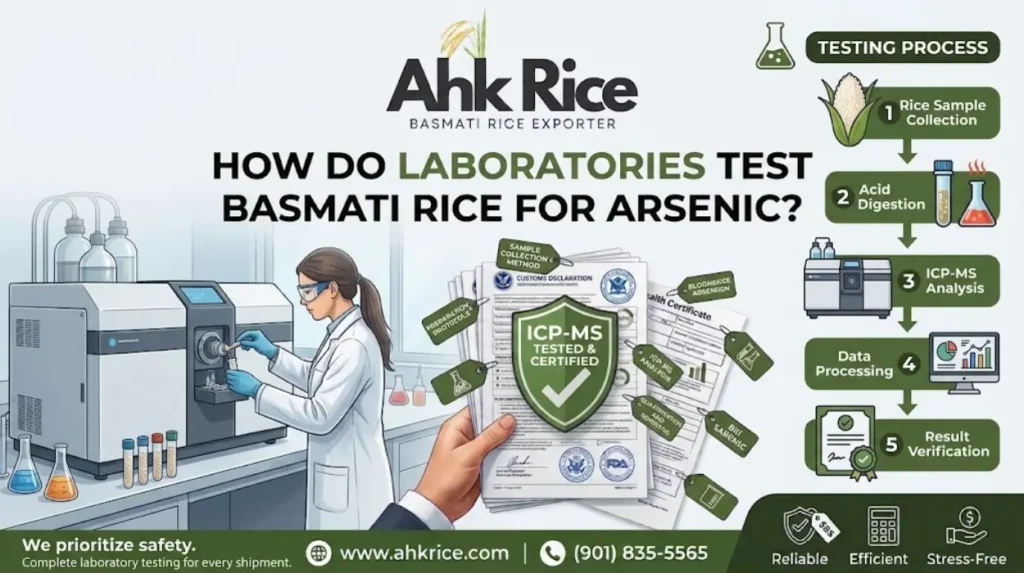
Laboratories measure arsenic in rice using validated analytical methods, commonly inductively coupled plasma mass spectrometry after sample preparation. Total arsenic testing measures the combined arsenic concentration, while speciation analysis distinguishes inorganic arsenic from other chemical forms.
The testing process starts with representative sampling. A laboratory or qualified sampling team collects material from the relevant lot and prepares it according to an established procedure. Poor sampling can produce results that do not represent the full shipment.
The laboratory then homogenizes the sample and prepares it for analysis. Digestion releases arsenic from the rice matrix into a solution suitable for measurement.
Inductively coupled plasma mass spectrometry, or ICP-MS, detects arsenic at low concentrations. Some laboratories use other validated analytical techniques depending on the method, sample, and required reporting limits.
Testing can measure total arsenic or inorganic arsenic. These results are not interchangeable. Total arsenic includes multiple chemical forms, while inorganic arsenic analysis specifically measures the forms receiving the greatest toxicological concern.
A useful laboratory report identifies the sample, analytical method, result, units, reporting limit, and laboratory details. Buyers should also confirm whether the report relates to the actual production lot under consideration.
What Are the Key Components of an Arsenic Testing Report?
An arsenic testing report identifies the tested sample, analytical method, measured concentration, reporting units, laboratory, and relevant quality controls. Importers use these details to interpret results correctly and compare them with applicable product specifications or regulatory requirements.
A complete report typically includes the following components:
- Sample identification: Product name, variety, lot number, and sample receipt details.
- Analytical method: The validated procedure used to measure arsenic.
- Test result: The measured concentration, commonly reported in milligrams per kilogram or micrograms per kilogram.
- Arsenic type: Total arsenic or inorganic arsenic, clearly identified.
- Reporting limit: The lowest concentration the method reliably reports under the stated conditions.
- Laboratory information: Laboratory identity, test date, and relevant accreditation details.
- Quality assurance: Evidence of appropriate calibration, blanks, reference materials, and other applicable quality controls.
Unit conversion matters when comparing reports. One milligram per kilogram equals 1,000 micrograms per kilogram. One milligram per kilogram also equals one part per million by mass.
Buyers should avoid comparing results with different units or treating a result below the reporting limit as proof of absolute absence. They should also distinguish a laboratory’s measurement from a regulatory limit or a buyer’s contractual specification.
What Benefits Does Arsenic Testing Provide to Rice Importers?
Arsenic testing gives importers measurable evidence for food safety assessment, supplier qualification, lot comparison, and purchasing documentation. Combined with traceability and risk-based sampling, laboratory analysis supports more consistent sourcing decisions across retail, wholesale, and foodservice supply chains.
Testing helps buyers compare products using evidence rather than assumptions about a variety or country. It also supports supplier approval procedures and internal quality management.
For supermarkets, results support documented supplier checks and product quality controls. For food manufacturers, testing provides information for ingredient assessment. Restaurant distributors and wholesalers use analytical documentation as part of their supplier evaluation processes.
Testing also helps identify variation between production lots. Importers can use the results to establish monitoring frequencies, investigate unusual measurements, and request additional analysis when a result does not meet an agreed specification.
These benefits depend on representative samples, appropriate analytical methods, and correct interpretation. A single report does not replace an effective food safety program.
Which US Food Safety Requirements Apply to Arsenic in Imported Rice?
US importers must assess applicable federal food safety requirements, including the Food and Drug Administration’s authority over imported foods. Rice importers should verify current FDA guidance and product-specific requirements rather than assume that one universal arsenic limit applies to every rice product.
The US Food and Drug Administration oversees food safety under federal law, including the Federal Food, Drug, and Cosmetic Act. Imported food must comply with applicable US requirements, and the FDA can examine shipments, sample products, and take enforcement action when legal requirements are not met.
FDA guidance on arsenic in food distinguishes between different food categories and exposure considerations. Specific FDA action levels or guidance documents do not automatically establish a universal legal maximum for every type of rice.
Importers should check current FDA publications, applicable regulations, and the circumstances of their products. They should also maintain supplier records, lot identification, and laboratory documentation appropriate to their food safety program.
Import requirements extend beyond arsenic. Applicable controls can include facility registration, prior notice, admissibility requirements, and the Foreign Supplier Verification Programs rule under the FDA Food Safety Modernization Act. The exact obligations depend on the importer, product, and applicable exemptions.
A supplier’s certificate of analysis supports verification, but it does not transfer the importer’s legal responsibilities to the exporter.
What Common Misconceptions About Arsenic in Basmati Rice Should Buyers Avoid?
The main misconceptions are that Basmati rice is arsenic-free, that Pakistani origin guarantees a low concentration, and that every arsenic result represents the same chemical forms. Reliable decisions require product-specific testing, correct units, and evidence-based interpretation.
Misconception 1: Basmati rice contains no arsenic. Rice plants absorb elements from their growing environment. Basmati rice is not automatically free from naturally occurring arsenic.
Misconception 2: All Pakistani rice has the same arsenic level. Growing conditions and irrigation sources vary between farms and production areas. Measurements from one lot do not establish the concentration in another.
Misconception 3: Total arsenic equals inorganic arsenic. Total arsenic includes different chemical forms. Buyers need to identify which form the laboratory measured before comparing the result with a relevant benchmark.
Misconception 4: Washing rice guarantees arsenic removal. Washing can remove some surface material, but it does not reliably eliminate arsenic already present within the grain.
Misconception 5: A supplier’s general certificate proves every shipment complies. A certificate applies to the sample and lot identified in the report. Buyers need appropriate sampling and verification for subsequent shipments.
Which Basmati Rice Markets Use Heavy-Metal Testing?
Rice importers in the United States, United Kingdom, European markets, and Gulf countries assess food safety documentation according to applicable regulations and commercial specifications. Testing requirements vary by destination, product, customer, and identified risk, so exporters must verify each market’s rules.
In the United States, importers evaluate FDA requirements and their own supplier verification programs. Retail chains and food manufacturers also establish internal product specifications.
In the United Kingdom and European markets, importers assess applicable food contaminant legislation and official guidance. They verify the requirements in force for the specific product and destination.
In Gulf markets, buyers review destination-specific food import controls, product documentation, and any testing conditions imposed by competent authorities or customers. Requirements differ across countries and product categories.
For Pakistani Basmati exporters, destination planning involves more than selecting a grain variety. Exporters and importers coordinate product specifications, laboratory reports, packaging information, lot traceability, and shipping documents before dispatch.
How Should Buyers Evaluate Arsenic Testing Before Purchasing Basmati Rice?
Buyers should request a lot-specific laboratory report, confirm whether it measures total or inorganic arsenic, review the method and units, and compare the result with applicable requirements. They should also verify sampling, traceability, and repeat-testing arrangements.
Start by defining the product and intended destination. Specify whether the purchase involves 1121, Super Kernel, or 1509 Basmati and whether the product is white, brown, steamed, or parboiled.
Next, establish the analytical requirements. Identify the arsenic measurement needed, the acceptable reporting limit, the laboratory qualifications, and the relevant regulatory or contractual benchmark.
Then confirm the sample’s connection to the shipment. The report should identify the product and lot clearly enough to support traceability. If a result is inconsistent with previous measurements, request a documented investigation or additional testing.
Finally, include testing responsibilities in the purchasing agreement. Clarify who arranges sampling, who pays laboratory charges, when results are provided, and how non-conforming results are handled.
Understanding these steps helps importers assess arsenic results without confusing origin claims, general quality specifications, and verified laboratory measurements.
Frequently Asked Questions
Does Basmati rice contain arsenic?
Yes. Basmati rice can contain naturally occurring arsenic absorbed from soil and irrigation water. The concentration varies by growing conditions, water quality, rice variety, and processing method. Laboratory testing determines the concentration in a specific sample.
Is Pakistani Basmati rice low in arsenic?
Pakistani Basmati rice does not have one uniform arsenic concentration. Levels vary between farms, growing seasons, and production lots. Buyers should request representative laboratory results rather than assume that country of origin guarantees a particular level.
How do US importers test Basmati rice for arsenic?
US importers use laboratory analysis to assess arsenic concentrations in rice. ICP-MS is a commonly used analytical method. Buyers must distinguish total arsenic results from inorganic arsenic results and verify that the selected test meets their requirements.
Does washing Basmati rice remove arsenic?
Washing rice can remove some surface contaminants, but it does not reliably eliminate arsenic within the grain. Cooking rice in excess water and draining it reduces some inorganic arsenic under certain conditions, although the reduction varies.
Is brown Basmati rice higher in arsenic than white Basmati rice?
Brown rice often contains more arsenic than white rice because the bran remains intact. Milling removes outer grain layers where arsenic can accumulate. The actual difference depends on the rice sample and growing conditions.