Sella vs Steam Basmati for High-Volume Cooking, Holding Time and Plate Yield
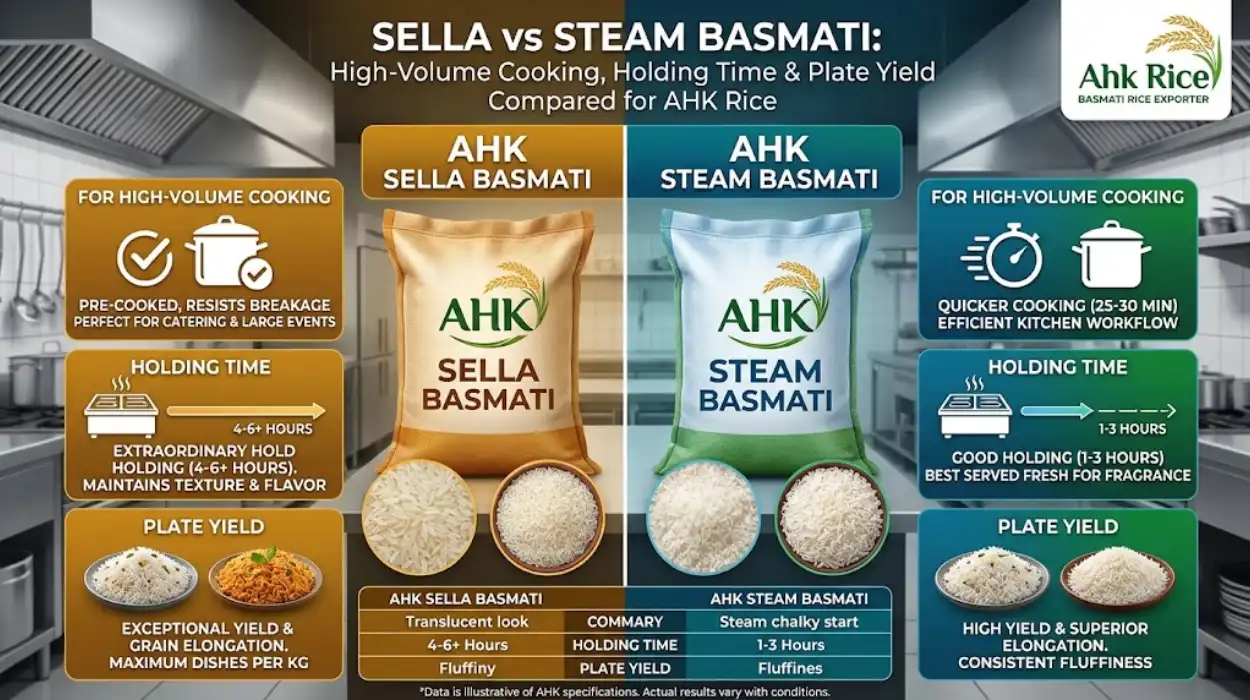
Sella Basmati generally suits restaurant chains, caterers, and institutional kitchens that prioritise grain separation, holding stability, and consistent service, while Steam Basmati suits operations that value a fresh white appearance, aromatic presentation, and efficient high-volume cooking. The best choice depends on the menu, cooking equipment, holding duration, and required serving size.
For foodservice buyers, the difference between these processing methods affects more than rice colour. It influences cooking procedures, texture, portion consistency, and the amount of prepared rice available for service. Understanding these factors helps purchasing teams select the right grain for daily restaurant operations, banquets, and catering contracts. This guide to Pakistani Basmati rice varieties and their characteristics provides useful background before comparing processing methods for commercial kitchens.
What are Sella and Steam Basmati rice?
Sella Basmati is parboiled before milling, while Steam Basmati undergoes steaming as part of its processing without the same full parboiling sequence. Parboiling changes starch structure and grain firmness, making Sella a strong option for bulk cooking and extended foodservice operations.
Sella rice is produced through parboiling, a process that involves soaking paddy, applying heat, drying it, and then milling the grain. The heat treatment changes the starch structure and helps the grains retain their shape during cooking. Golden Sella develops a golden appearance through this process, while other parboiled varieties have different colour characteristics depending on processing conditions.
Steam Basmati is processed using steam treatment and milling rather than the complete soaking and parboiling sequence associated with Sella. It generally retains a white appearance and delivers the familiar presentation expected in dishes such as pulao, biryani, and rice platters.
Both methods are available across Pakistani Basmati varieties, including 1121, Super Kernel, and 1509 Basmati rice subject to the supplier’s processing range. Buyers should evaluate the variety and processing method together because grain length, broken percentage, moisture, and cooking performance also affect the finished dish.
For restaurant procurement, the correct specification includes raw grain length, percentage of broken grains, moisture level, processing type, packaging, and the intended cooking application.
How do Sella and Steam Basmati compare for commercial cooking?
Sella generally provides firmer grains and better resistance to breakage during bulk cooking and extended holding. Steam Basmati offers a white appearance and a familiar aromatic profile. Actual results depend on variety, grade, water ratio, cooking method, and holding conditions.
The following table compares seven attributes relevant to restaurant chains, catering companies, and institutional foodservice buyers.
| Comparison attribute | Sella Basmati | Steam Basmati |
|---|---|---|
| Processing method | Paddy is soaked, heat-treated, dried, and milled | Steam-treated during processing, without the full Sella parboiling sequence |
| Grain appearance | Golden or cream-toned, depending on processing | Generally white or creamy white |
| Cooked texture | Usually firmer with distinct grains | Typically softer and more delicate when correctly cooked |
| Grain separation | Strong when prepared to specification | Good with correct water control and cooking technique |
| Holding performance | Well suited to bulk preparation and longer service windows | Best managed with controlled cooking and holding procedures |
| Plate presentation | Distinct grains suit biryani, buffets, and banquet service | White appearance suits pulao, rice platters, and everyday meals |
| Main operational advantage | Firmness and resilience during handling | Familiar white appearance and aromatic presentation |
These differences are not absolute guarantees. A high-quality Steam Basmati batch can outperform poorly processed Sella, and incorrect cooking can damage either product. Buyers should test samples using their own kitchen equipment and recipes before committing to a recurring supply contract.
How does processing affect holding time and plate yield?
Parboiling changes starch structure and helps Sella grains retain their shape during cooking. This supports bulk preparation, portioning, and buffet service. Steam Basmati also performs well when cooking and holding conditions are controlled, but buyers must validate results through practical kitchen trials.
Holding time describes how long cooked rice maintains acceptable texture, temperature, moisture, and appearance before service. Plate yield refers to the number of usable servings produced from a given quantity of uncooked rice. Both measurements matter when a restaurant chain prepares hundreds of meals per shift.
Sella often performs well in kitchens that cook large batches ahead of peak service. Its firmer texture helps reduce grain damage during transfer from cooking vessels to warming equipment and serving trays. The result can be more consistent portions when staff follow the same water ratio, resting period, and serving procedure.
Steam Basmati supports operations where fresh appearance and aromatic presentation are priorities. Its cooked texture depends on the selected variety and preparation method. Excess water, prolonged cooking, or repeated stirring can cause grains to break or become sticky, reducing the amount of rice suitable for premium plating.
Neither processing method establishes a universal holding-time limit. Food safety requirements, equipment, temperature management, and kitchen procedures determine how long cooked rice can be held. Rice must be handled under the operation’s food safety plan, with appropriate hot holding or rapid cooling and refrigeration procedures.
To compare plate yield accurately, kitchens should weigh the uncooked rice, follow a documented recipe, measure the cooked output, and record the number of acceptable portions. This approach produces a meaningful comparison instead of relying on grain length or supplier descriptions alone.
What are the advantages and disadvantages of Sella and Steam Basmati?
Sella offers advantages in grain firmness, bulk handling, and buffet presentation, while Steam Basmati offers a white appearance and familiar texture. Each method has trade-offs involving cooking procedures, menu expectations, colour, and the consistency required for commercial service.
Sella Basmati: advantages and disadvantages
Sella suits biryani kitchens, banquet caterers, buffet restaurants, and institutional foodservice operations that need distinct grains across large batches. Its firmer cooked structure supports portioning and helps maintain the visual definition of individual grains. These characteristics are useful when rice remains in serving equipment during a busy service period.
The main disadvantage is appearance. Golden Sella does not provide the same white presentation as Steam Basmati, which can matter for restaurants serving dishes designed around pale rice. Its texture may also feel firmer than customers expect when a recipe is developed for conventional white Basmati. Kitchen teams must adjust soaking, water ratios, cooking time, and resting procedures to suit the grade.
For example, a wedding caterer serving several hundred plates of biryani can test Sella to assess grain integrity after cooking, transport, and buffet service. The decision should be based on the finished dish rather than the raw grain alone.
Steam Basmati: advantages and disadvantages
Steam Basmati suits restaurants that prioritise white rice, aromatic presentation, and a familiar eating experience. It works well in pulao, everyday rice platters, and menus where the colour and softness of cooked grains are central to the dish.
Its performance depends on careful water control and cooking discipline. Overcooking, excessive agitation, and poor holding practices can reduce grain separation. A kitchen that prepares rice in small batches and serves it promptly may achieve excellent results, while an operation preparing large batches well before peak service needs to validate the product under its actual conditions.
For example, a restaurant chain selling white rice alongside grilled meats can trial Steam Basmati to evaluate customer acceptance, aroma, portion consistency, and the amount of waste generated during service.
Which method works best for different restaurant markets?
Sella is a strong choice for high-volume biryani, buffet, and catering operations in the United States, while Steam Basmati suits restaurants seeking white-grain presentation and familiar aroma. Buyers in both markets should match the processing method to menu requirements, local customer preferences, and actual procurement costs.
United States: restaurant chains, caterers, and institutional kitchens
The United States foodservice market includes South Asian restaurants, catering businesses, institutional kitchens, and restaurant groups serving diverse customer preferences. Buyers supplying biryani, wedding meals, buffets, and large catering orders often prioritise grain separation and consistent portioning. Sella Basmati deserves consideration when these requirements dominate the menu.
Steam Basmati is relevant to restaurants that feature white Basmati rice alongside grilled meats, curries, and combination platters. It also supports menus where a lighter visual presentation matters more than the firmer texture associated with parboiled rice.
Price comparison: The delivered cost per metric tonne depends on the Basmati variety, processing method, grade, broken percentage, order volume, packaging, freight, insurance, and applicable import charges. Sella and Steam prices should therefore be compared using equivalent specifications and delivery terms. A lower FOB price does not automatically produce a lower landed cost in the United States.
Shelf-life comparison: Dry rice shelf life depends on moisture, packaging integrity, storage temperature, humidity, and pest control. Both properly processed Sella and Steam Basmati can support commercial inventory programmes. Buyers should use the supplier’s documented shelf-life specification rather than assuming Sella always lasts longer. Cooked rice has a separate food safety and holding requirement.
US restaurant chains should also assess import documentation, food safety controls, applicable US Food and Drug Administration requirements, and packaging compliance before approving a supplier. These checks are separate from the culinary comparison between Sella and Steam.
Gulf markets: hotels, banquets, and catering companies
Gulf foodservice markets, including the United Arab Emirates and Saudi Arabia, support restaurants, hotels, wedding venues, institutional caterers, and large-scale meal providers. Basmati rice plays a prominent role in biryani, mandi-style meals, banquet menus, and other rice-based dishes.
Sella Basmati suits catering operations that require firm grains and consistent presentation across large serving batches. Golden Sella is particularly relevant where its colour and texture fit the intended dish. Steam Basmati suits kitchens that prefer white rice for pulao, restaurant platters, and menus requiring a lighter visual appearance.
Price comparison: Neither processing method has a fixed price advantage across the Gulf. Quotations depend on variety, grade, order quantity, packaging, origin, shipment timing, and the agreed Incoterm. Buyers should compare FOB Karachi with CIF destination-port quotations only after confirming that product specifications and included costs are equivalent.
Shelf-life comparison: Both dry products can support wholesale distribution and foodservice inventory when stored correctly. The purchase specification should state the manufacturing or packing date, crop year where relevant, recommended storage conditions, and declared shelf life. Cooked holding performance must be assessed separately through kitchen trials.
Gulf buyers should also check destination-specific import requirements, Arabic-language labelling where applicable, and required food conformity documentation. A product that performs well in a cooking trial still needs to satisfy the destination market’s regulatory and commercial requirements.
How should buyers compare price per metric tonne and shelf life?
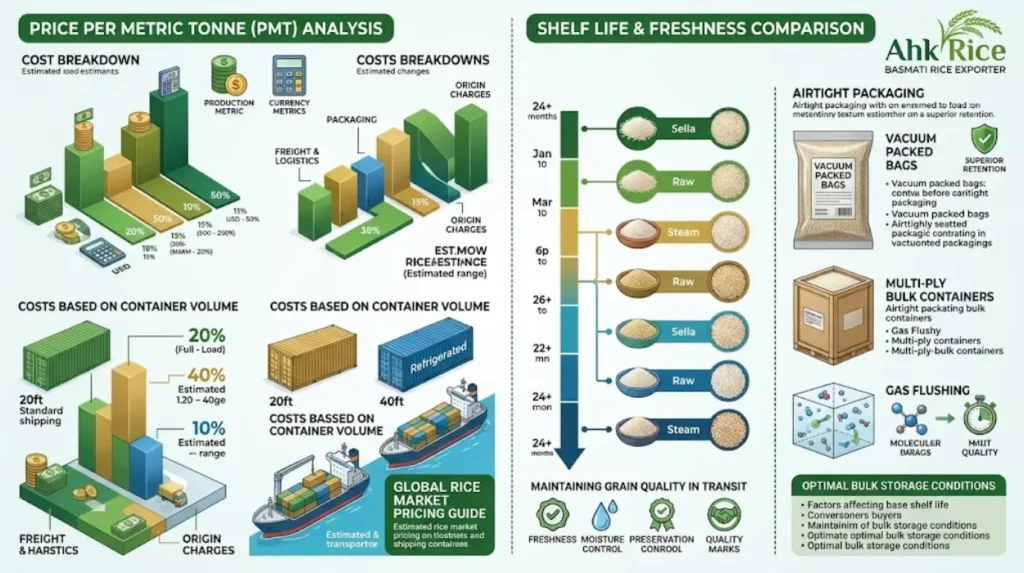
Compare Sella and Steam Basmati using equivalent grades, packaging, shipment terms, and delivery destinations. Evaluate dry-rice shelf life through documented specifications, then measure cooked yield and holding performance in the kitchen. This separates procurement cost from operational value.
A meaningful price comparison begins with the same variety and comparable quality parameters. For example, a buyer comparing 1121 Sella with 1121 Steam should specify raw grain length, broken percentage, moisture, crop year, and packaging. Comparing different varieties or grades can create a misleading price difference.
| Cost or performance factor | Sella Basmati | Steam Basmati |
|---|---|---|
| Price per MT | Supplier quotation based on grade and processing | Supplier quotation based on grade and processing |
| Freight and landed cost | Depends on destination, volume, and Incoterm | Depends on destination, volume, and Incoterm |
| Dry-rice shelf life | Confirm supplier’s declared period and storage conditions | Confirm supplier’s declared period and storage conditions |
| Cooked holding performance | Test firmness and grain separation throughout service | Test texture, aroma, and appearance throughout service |
| Portion yield | Measure cooked output and acceptable servings per batch | Measure cooked output and acceptable servings per batch |
No universal price per metric tonne or shelf-life period applies to every Sella or Steam product. A current quotation and written product specification are necessary for a defensible purchasing decision.
Calculate the effective cost per serving by dividing the total cost of the uncooked rice used by the number of acceptable portions produced. Include preparation losses and discarded cooked rice in the calculation. A slightly more expensive product can offer better value when it produces more consistent portions and less waste.
What decision factors should restaurant chains use?
Choose the processing method by weighting menu suitability, holding performance, plate yield, delivered cost, and supply consistency. Run a controlled trial with the same recipe and equipment before approving a product for recurring orders. Use measured kitchen results rather than assumptions based on processing labels.
The following five-row decision framework helps procurement teams shortlist the right product.
| Decision factor | Choose Sella when | Choose Steam when |
|---|---|---|
| Menu application | Biryani, banquet meals, and high-volume catering require firm grains | White rice platters, pulao, and aromatic presentation lead the menu |
| Holding requirements | Extended service makes grain firmness a priority | Service cycles support the product’s tested texture and appearance |
| Plate yield | Trials show consistent portions and less handling damage | Trials demonstrate suitable cooked output and acceptable waste |
| Customer preference | Diners prefer distinct, firmer grains or golden colour fits the dish | Diners expect white rice and a softer, familiar Basmati texture |
| Procurement and supply | The specification, delivered cost, and supply schedule meet the contract | The specification, delivered cost, and supply schedule meet the contract |
Procurement teams should assign weights to these factors according to operational priorities. A caterer serving large banquets may place greater weight on holding performance, while a restaurant focused on white-rice platters may prioritise appearance and customer preference.
Before approving a supplier, request a product specification sheet and representative sample. Test the rice in the intended recipe, document cooking instructions, and repeat the trial when the product grade or processing specification changes. For a restaurant chain, the approved specification should become the standard for purchasing, receiving inspections, and kitchen preparation.
How can buyers build a consistent Basmati rice supply programme?
Restaurant chains and caterers need repeatable product specifications, reliable shipment schedules, documented quality checks, and consistent cooking results. A supply programme should connect sample approval, commercial specifications, packaging, export documentation, and repeat-order planning to the kitchen’s actual requirements.
A successful supply programme begins with a clear product specification. Buyers should identify the preferred Basmati variety, Sella or Steam processing, grain length, broken percentage, moisture limit, packing format, order quantity, and destination. These details reduce ambiguity between procurement teams, exporters, and kitchen managers.
The next step is sample evaluation. The buyer tests the sample using the intended recipe and equipment, measures cooked output, checks grain separation, and records the holding results. Once approved, the agreed specification becomes the reference for commercial orders and quality checks.
AHK Rice is a Pakistani Basmati rice exporter based in Punjab, supplying 1121, Super Kernel, and 1509 varieties to international markets. Its end-to-end processing, custom packaging, and export coordination support buyers evaluating products for wholesale distribution and foodservice requirements. Actual product availability, specifications, pricing, and shipment schedules should be confirmed for each order.
For businesses planning recurring US restaurant or catering purchases, the next step is to evaluate Basmati rice supply programmes for USA restaurant chains and caterers. A programme built around an approved sample and written specification gives purchasing teams a clearer basis for repeat orders.
Frequently asked questions
Is Sella or Steam Basmati better for high-volume cooking?
Sella is often the stronger starting point when large batches require firm, separate grains and repeated handling. Steam Basmati suits operations prioritising white appearance and familiar aromatic presentation. The best choice depends on recipe testing, equipment, and service conditions.
Which Basmati rice holds its shape longer after cooking?
Sella generally offers firmer grains because parboiling changes the starch structure. However, holding performance depends on the variety, water ratio, cooking method, resting time, and holding conditions. Buyers should test both products using their actual service procedures.
Does Sella Basmati produce more servings per kilogram?
Not automatically. Plate yield depends on water absorption, cooked weight, portion size, and preparation losses. Kitchens should compare both products by measuring the cooked output from the same uncooked weight and calculating the number of acceptable portions.
Is Sella Basmati cheaper than Steam Basmati?
Neither method is consistently cheaper. Prices depend on the Basmati variety, grade, processing, packaging, quantity, freight, and delivery terms. Buyers should compare current quotations for equivalent specifications and calculate the landed cost per metric tonne.
Which processing method is better for US restaurant chains?
Sella suits chains specialising in biryani, buffet service, and high-volume catering where grain firmness matters. Steam suits restaurants that prioritise white rice and aromatic presentation. Multi-location operators should test samples against a standard recipe before approving a chain-wide specification.
Does Sella Basmati have a longer shelf life than Steam Basmati?
Shelf life depends on moisture, processing quality, packaging, storage conditions, and the supplier’s declared specification. Neither processing method guarantees a longer shelf life in every case. Buyers should verify documented shelf-life information and store dry rice according to the supplier’s instructions.
What should buyers request before placing a bulk order?
Request a product specification sheet, representative sample, processing details, grain length, broken percentage, moisture limits, packaging options, quotation, shipment schedule, and applicable export documentation. Approve the sample and commercial specification before confirming the order.