Ship Quarantine-Ready Pakistani Basmati Rice to Indonesia with AHK Rice
Importing Pakistani Basmati rice into Indonesia requires more than selecting the correct grain variety and negotiating an export price. Indonesian importers must coordinate import permissions, plant quarantine requirements, phytosanitary documentation, shipment inspection and customs clearance before releasing commercial cargo. Missing documents or discrepancies between the shipment and its certificates can cause inspection delays, additional storage expenses or rejection.
Buyers should understand what quarantine checks Indonesia applies to imported rice before confirming a supplier. The next step is choosing an exporter that can coordinate product specifications, export documentation, inspection arrangements and shipment preparation. AHK Rice supports Pakistani Basmati rice buyers through sourcing, grading, processing, packaging and export coordination.
What Is the Best Solution for Shipping Quarantine-Ready Pakistani Basmati Rice to Indonesia?
The best solution is to confirm Indonesian import eligibility first, then prepare Pakistani Basmati rice against the approved import conditions, phytosanitary requirements and commercial specifications. A quarantine-ready shipment must have valid market access, accurate documentation, suitable processing and traceability before container loading.
Indonesia regulates rice imports through government import controls. Its rice policy distinguishes general consumption rice from special rice and industrial rice. The National Food Agency (BAPANAS) has stated that special rice, including Basmati, follows a different import arrangement from ordinary consumption rice. Blog+1
However, an exporter must not interpret this distinction as automatic permission to ship. Indonesia’s 2026 rice import restrictions make prior confirmation of the applicable product category, quota and import approval essential. OECD+1
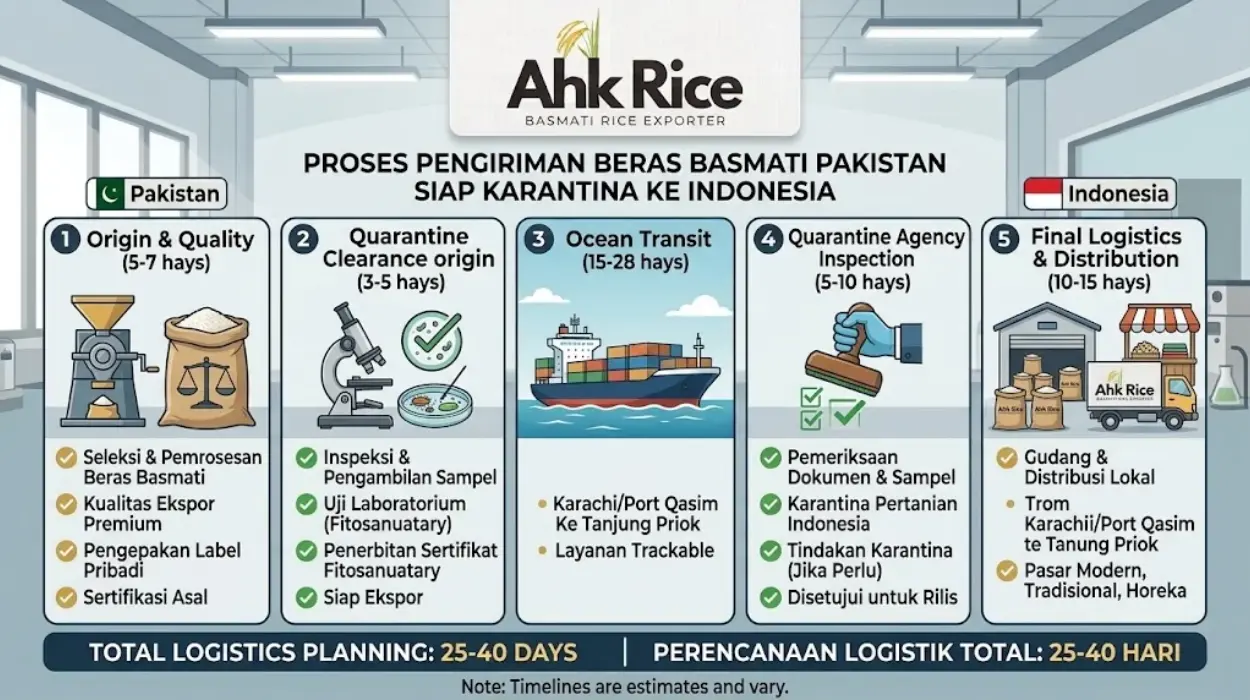
The recommended process has five stages:
- Confirm that Pakistani-origin Basmati rice is eligible under the current Indonesian import policy.
- Obtain the required Indonesian import approvals through the qualified importer.
- Confirm phytosanitary conditions with the Indonesian plant quarantine authority.
- Prepare, inspect, grade and package the rice according to the approved specification.
- Coordinate export certification, container loading and shipment documentation.
AHK Rice follows a coordinated export preparation approach. This helps buyers establish product specifications and documentation requirements before committing to commercial shipment.
Why Choose AHK Rice for Pakistani Basmati Rice Supply to Indonesia?
AHK Rice provides sourcing, processing, grading, packaging and export coordination from Punjab, Pakistan. Buyers receive a structured supply process that connects product quality, shipment preparation and export documentation with their approved purchasing requirements.
Product and processing options
AHK Rice supplies three principal Pakistani Basmati varieties:
- 1121 Basmati: Suitable for premium retail, catering and foodservice applications requiring long grains and aromatic cooking characteristics.
- Super Kernel Basmati: A traditional Punjab-origin variety valued for its aroma, grain appearance and suitability for ethnic grocery markets.
- 1509 Basmati: A long-grain option used by buyers seeking a balance between grain length, yield efficiency and commercial pricing.
Through its Pakistani Basmati rice sourcing and export service, AHK Rice coordinates the following activities:
| Export requirement | AHK Rice service |
|---|---|
| Product selection | 1121, Super Kernel and 1509 |
| Grain preparation | Cleaning, grading and Sortex |
| Quality control | Moisture, broken percentage and grain length |
| Packaging | Custom retail and bulk packaging |
| Export preparation | Commercial documents and coordination |
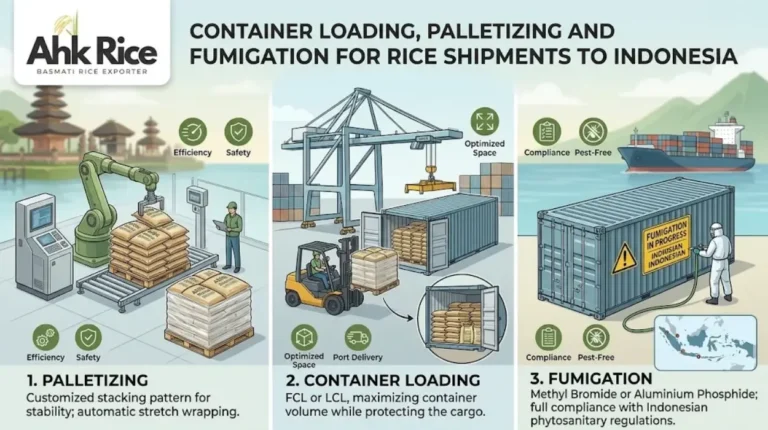
| Shipment | Container preparation and loading coordination |
A buyer importing premium 1121 Basmati, for example, can specify grain length, broken percentage, moisture level and packing weight before production. AHK Rice can use the approved specification as the reference for processing and final quality checks.
This reduces the risk of receiving a shipment that differs from the buyer’s approved commercial sample.
What Indonesian Quarantine Documents Are Required for Pakistani Rice?
The required documents depend on Indonesia’s current import approval and commodity-specific phytosanitary conditions. Buyers should establish the applicable requirements before production and obtain the relevant certificates from the competent Pakistani authorities.
The principal documents to coordinate include:
| Document | Purpose |
|---|---|
| Indonesian import approval | Authorises the permitted import transaction |
| Phytosanitary Certificate | Confirms official plant-health inspection and certification |
| Commercial Invoice | Declares product value and transaction details |
| Packing List | Identifies package quantities and weights |
| Bill of Lading | Confirms ocean carriage |
| Certificate of Origin | Identifies Pakistani origin |
| Treatment Certificate | Provides evidence of treatment when required |
| Insurance Certificate | Supports insured shipments when applicable |
Pakistan’s Department of Plant Protection (DPP) issues phytosanitary certificates according to importing-country requirements. Its export procedure includes inspection, sampling, treatment where necessary and certification under applicable international phytosanitary standards. Pakistan+1
The buyer should also coordinate the shipment with Indonesia’s agricultural quarantine authority, Badan Karantina Indonesia (Barantin). Its integrated quarantine procedures are governed by the relevant Indonesian quarantine framework. JDIH BPK
Phytosanitary Certificate and Indonesian Quarantine Inspection
A phytosanitary certificate is an official document issued by the exporting country’s National Plant Protection Organization. It records the relevant inspection and certification information for the regulated commodity.
For Pakistani rice, the exporter must ensure that the certificate reflects the actual shipment and the importing country’s applicable conditions. Product descriptions, botanical identity, origin and consignment details should match the commercial documents.
Importers should also review the phytosanitary certificate and Indonesian quarantine inspection requirements for rice shipments before confirming their shipment plan.
The certificate does not replace Indonesian import approval. It also does not guarantee automatic clearance. Indonesian officials retain authority to inspect consignments and apply additional measures where required.
What Quarantine Inspection Checks Should Buyers Expect in Indonesia?
Indonesian quarantine inspection focuses on compliance with applicable plant-health requirements, consignment identity and the condition of imported agricultural products. The exact inspection, sampling, laboratory testing or treatment measures depend on the approved import conditions and the assessment of the competent authority.
Buyers should prepare for the following areas:
- Pest contamination: Rice should meet applicable requirements concerning regulated insects and other plant pests.
- Foreign material: The consignment should meet agreed cleanliness and quality specifications.
- Product identity: The rice variety, country of origin and declared commodity should match the documents.
- Packaging condition: Bags and container interiors should be clean, dry and suitable for food cargo.
- Document verification: Officials may compare the phytosanitary certificate, invoice, packing list and transport documents.
- Sampling and testing: Authorities may collect samples or request laboratory analysis when required.
The exporter should maintain a production and inspection record for every commercial batch. This provides supporting evidence when the importer needs to verify product identity or investigate a discrepancy.
How AHK Rice Prepares Rice Before Shipment
AHK Rice can coordinate preparation through several quality-control stages:
- Raw material sourcing from Punjab rice-growing regions.
- Cleaning and removal of unwanted foreign material.
- Sortex processing to improve grain appearance.
- Moisture measurement and broken-grain assessment.
- Final grading against the buyer’s approved specification.
- Packaging inspection before container loading.
For example, a Jakarta distributor ordering 1121 Steam Basmati can approve the grain specification, cooking sample and packaging design before commercial production. The exporter then uses the approved specification as a reference during shipment preparation.
These procedures support product consistency. They do not replace statutory quarantine inspection or guarantee regulatory clearance.
What Results Can Buyers Expect from AHK Rice?
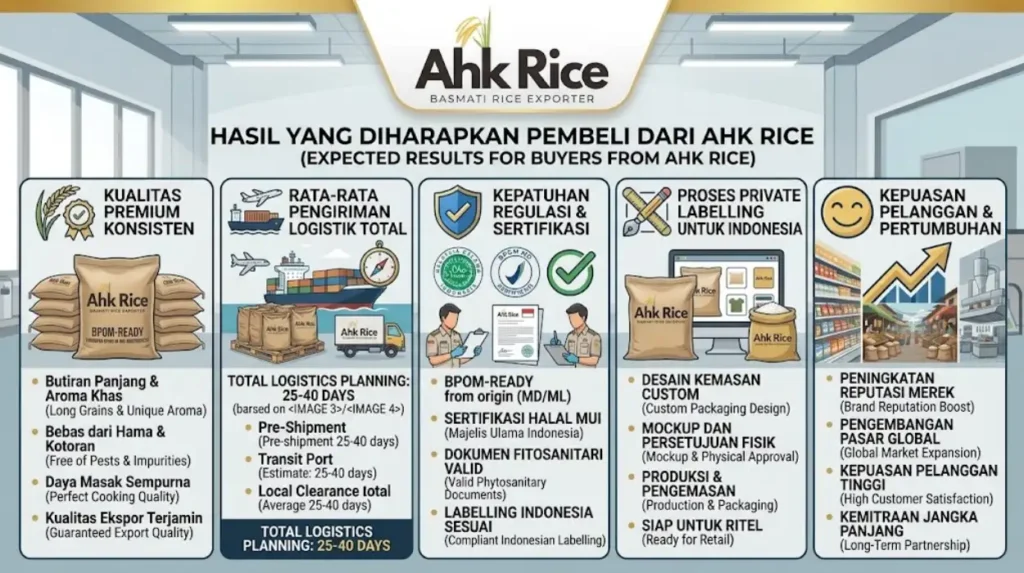
Buyers can expect a more organised procurement and export process, with documented product specifications, sample approval and coordinated shipment preparation. The commercial outcome depends on import eligibility, product approval, shipping arrangements and the buyer’s Indonesian clearance process.
The expected results include:
| Procurement stage | Expected outcome |
|---|---|
| Product selection | Appropriate Basmati variety |
| Sample approval | Agreed grain and cooking characteristics |
| Processing | Consistent grading against specifications |
| Documentation | Coordinated export paperwork |
| Packaging | Buyer-approved packing configuration |
| Loading | Prepared commercial container |
| Delivery | Shipment tracking and transport documentation |
Estimated Shipping Time from Pakistan to Indonesia
Sea freight is generally the practical option for commercial container shipments. Karachi-to-Jakarta transit estimates depend on the carrier, transshipment port, vessel schedule and destination terminal.
An indicative logistics reference from Flexport lists approximately 18 days for an LCL Karachi-to-Jakarta service involving Singapore transshipment. This is not a guaranteed full-container shipping schedule. Flexport
| Destination | Indicative planning guidance |
|---|---|
| Jakarta / Tanjung Priok | Around 18–25 days, subject to routing |
| Surabaya / Tanjung Perak | Obtain a route-specific carrier schedule |
| Other Indonesian ports | Confirm transshipment and inland delivery separately |
These figures are planning estimates, not guaranteed delivery commitments. Buyers should obtain a current FCL sailing schedule before agreeing to delivery dates.
Import approval, customs processing and quarantine inspection can add time after vessel arrival. Therefore, the importer should not calculate its warehouse delivery date using ocean transit alone.
What Is the Pricing Structure for Pakistani Basmati Rice Exports to Indonesia?
The final export price depends on rice variety, grade, processing, packaging, order quantity, shipping route and agreed Incoterms. A reliable quotation separates the product price from logistics, certification, inspection and destination-related expenses.
The principal pricing factors include:
| Cost factor | Pricing consideration |
|---|---|
| Rice variety | 1121, Super Kernel or 1509 |
| Grain specification | Length, broken percentage and quality |
| Processing | Steam, Golden Sella or raw |
| Sortex | Single or double Sortex |
| Packaging | Bulk bags or custom retail packs |
| Quantity | Trial, partial container or FCL |
| Freight | Karachi to the agreed Indonesian port |
| Documentation | Applicable certification and processing fees |
| Destination charges | Port handling, customs and inspection |
FOB Karachi Versus CIF Indonesia
FOB Karachi covers the seller’s responsibilities up to loading the goods on board the nominated vessel under the agreed Incoterms.
CIF includes the cost of goods, ocean freight and marine insurance to the named destination port. It does not automatically include Indonesian import duties, customs clearance, quarantine expenses or inland transportation.
For a first commercial order, buyers should compare both quotations. This helps them identify whether arranging freight independently or purchasing a delivered-to-port service offers better cost control.
Sample Costs and Approval Process
AHK Rice offers a sample-based evaluation process before bulk purchasing.
The sample process follows these steps:
- The buyer selects the variety and requested grade.
- AHK Rice confirms sample availability and the applicable sample specification.
- The exporter prepares the sample for dispatch.
- The buyer arranges courier collection or approves the shipping arrangement.
- The buyer evaluates grain appearance, aroma, cooking performance and elongation.
- Both parties confirm the commercial specification before discussing bulk production.
For eligible sample requests, AHK Rice can offer up to 20 kg of Super Kernel Basmati without charging for the rice itself. The buyer pays courier transportation and applicable phytosanitary or certification charges. Actual sample eligibility, dispatch arrangements and costs must be confirmed before dispatch.
A commercial sample should represent the proposed bulk specification. Buyers should retain the approved sample details to compare against the final production batch.
How Can Indonesian Buyers Get Started with AHK Rice?
Indonesian buyers should begin by confirming import eligibility and sharing their product requirements with AHK Rice. Once the importer verifies the regulatory route, both parties can proceed with sampling, commercial specifications, pricing and shipment planning.
The recommended process is:
- Confirm import eligibility: Verify the current Indonesian rice import policy, permitted category, origin conditions and required approvals.
- Share product requirements: Specify the Basmati variety, processing type, grain length and broken percentage.
- Request samples: Evaluate the sample before approving the commercial specification.
- Confirm packaging: Select bulk or retail packaging and provide artwork or labelling requirements.
- Approve the quotation: Review FOB or CIF pricing, quantity, payment terms and delivery schedule.
- Finalise documents: Coordinate the applicable import approval, phytosanitary certification and export paperwork.
- Approve shipment: Confirm production, inspection arrangements, container loading and shipping documents.
AHK Rice is a Pakistani Basmati rice exporter based in Punjab, supplying 1121, Super Kernel and 1509 varieties to international markets. Its end-to-end processing, custom packaging and export coordination provide buyers with a structured procurement route.
The most important commercial decision is to secure Indonesian regulatory approval before committing to shipment. A properly graded product and complete export file cannot overcome a missing import authorisation or an origin-specific market-access restriction.
Frequently Asked Questions
Can Pakistani Basmati rice be exported to Indonesia?
Pakistani Basmati rice requires confirmation of current Indonesian import eligibility.
The importer must verify the permitted rice category and applicable government approvals.
Origin-specific phytosanitary conditions must also be confirmed.
A phytosanitary certificate alone does not authorise importation.
AHK Rice can coordinate export preparation after the regulatory requirements are established.
Is a phytosanitary certificate mandatory for Pakistani rice exports?
A phytosanitary certificate is issued by Pakistan’s Department of Plant Protection.
It confirms official inspection and certification against applicable requirements.
The certificate must accurately identify the exported consignment.
Additional declarations or treatments depend on importing-country conditions.
The Indonesian importer should confirm the exact certificate requirements before shipment.
How long does shipping from Karachi to Indonesia take?
Karachi-to-Jakarta ocean freight can take approximately 18–25 days, depending on routing.
Transshipment and vessel schedules affect the actual transit period.
Surabaya and other Indonesian ports require separate freight estimates.
Port clearance and quarantine inspection add time after arrival.
AHK Rice can coordinate shipment planning against the selected carrier schedule.
Does AHK Rice provide free Basmati rice samples?
AHK Rice can offer up to 20 kg of Super Kernel Basmati for eligible sample requests.
The buyer pays courier transportation charges.
Applicable phytosanitary and certification expenses are also payable by the buyer.
The buyer evaluates grain appearance, aroma and cooking performance.
Bulk production proceeds against the mutually approved commercial specification.
What affects the price of Pakistani Basmati rice in Indonesia?
The rice variety and processing method influence the export price.
Grain length, moisture, broken percentage and Sortex grading also affect pricing.
Packaging, order quantity and container requirements influence the final quotation.
Freight, insurance and documentation expenses depend on the agreed Incoterm.
AHK Rice prepares quotations according to the buyer’s specifications and destination requirements.
Can AHK Rice arrange custom packaging for Indonesian buyers?
Yes, AHK Rice coordinates custom packaging for international buyers.
Available options depend on the requested bag material and packaging configuration.
Buyers can specify bulk or retail packaging requirements.
Artwork and destination labelling requirements should be approved before production.
Final packaging must comply with applicable Indonesian import and food-labelling regulations.