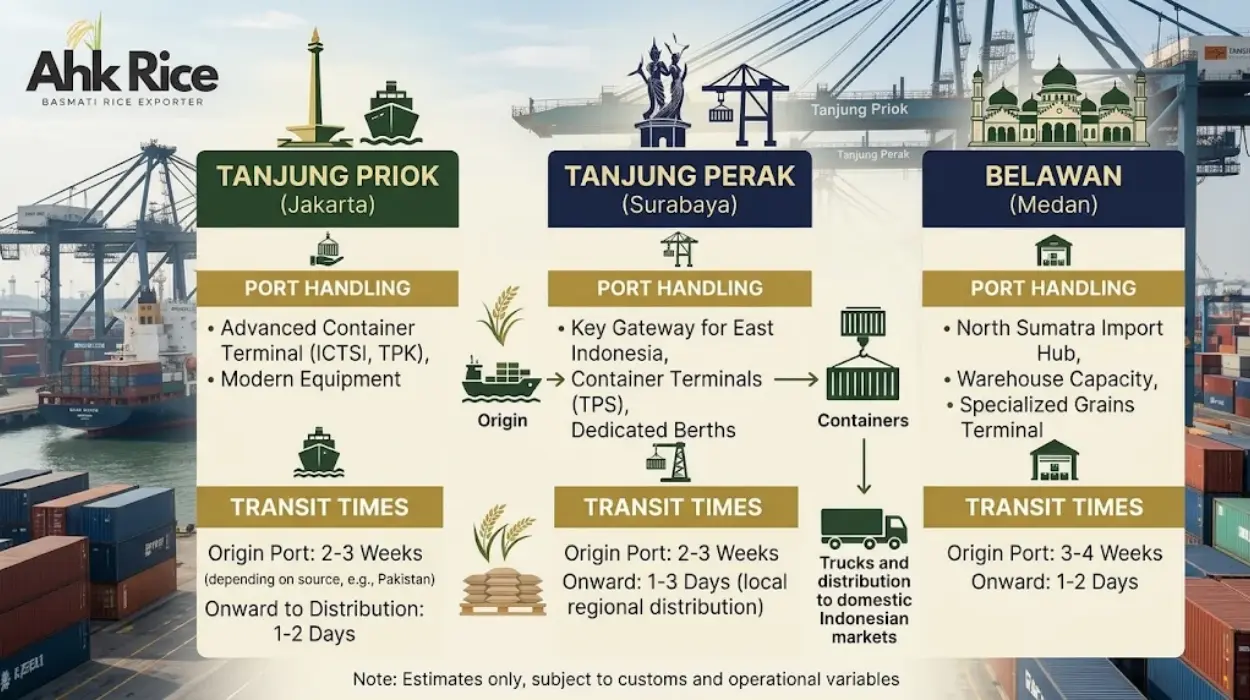
Tanjung Priok, Tanjung Perak and Belawan: Port Handling and Transit Times for Rice Shipments
For Pakistani Basmati rice shipments to Indonesia, Tanjung Priok is the strongest choice for Jakarta and western Java, Tanjung Perak suits Surabaya and eastern Indonesia, while Belawan provides the most efficient port position for Sumatra. The right port depends on destination market, inland delivery distance, cargo handling requirements, container availability, and total transit time.
What are the available solutions for Pakistani rice shipments to Indonesia?
Pakistani rice exporters have three principal Indonesian port options: Tanjung Priok for Jakarta, Tanjung Perak for Surabaya, and Belawan for North Sumatra. Each port supports containerized imports, customs processing, inspection, unloading, storage, and onward domestic distribution.
Tanjung Priok is the main port serving Jakarta and the surrounding industrial and commercial market. It provides direct access to Indonesia’s largest consumer and distribution centre. Importers supplying Jakarta, West Java, retail networks, foodservice companies, and national distributors generally gain the shortest inland route through Tanjung Priok.
Tanjung Perak serves Surabaya and East Java. Its location makes it suitable for importers distributing rice across Java, Bali, East Java, and parts of eastern Indonesia. It also provides a practical alternative when the buyer’s warehouse, mill, distributor, or retail network is concentrated around Surabaya.
Belawan serves Medan and North Sumatra. It is strategically positioned for buyers whose rice demand is concentrated in Sumatra. Choosing Belawan instead of routing cargo through Jakarta or Surabaya reduces inland movement and keeps the import chain closer to the final distribution market.
For buyers still evaluating Indonesian import requirements, the earlier guide on importing Pakistani Basmati rice into Indonesia provides the broader regulatory and documentation context before port selection becomes the main decision.
Main port options
| Port | Primary market | Main advantage | Typical use |
|---|---|---|---|
| Tanjung Priok | Jakarta, West Java | Strong national distribution access | Retail, foodservice, private label |
| Tanjung Perak | Surabaya, East Java | Efficient East Java access | Regional distribution, catering |
| Belawan | Medan, North Sumatra | Direct Sumatra access | Northern Sumatra distribution |
The port should therefore be selected according to the final delivery geography rather than the ocean freight rate alone.
How do Tanjung Priok, Tanjung Perak and Belawan compare?
Tanjung Priok offers the broadest distribution reach, Tanjung Perak provides the strongest position for East Java, and Belawan performs best for North Sumatra. Transit performance depends on shipping service, transshipment, customs clearance, inspection, container availability, and inland delivery.
Ocean transit begins before the container reaches the Indonesian port. A Pakistani shipment normally moves from the export terminal at Karachi toward Indonesia through a carrier’s scheduled service. Direct service availability, transshipment requirements, vessel schedules, and port congestion determine the actual sailing period.
For planning purposes, buyers should separate ocean transit time from port dwell time and inland delivery time. A container can have a predictable sailing schedule but still require additional days for customs, inspection, document verification, terminal handling, and truck appointment.
7-attribute specification comparison
| Attribute | Tanjung Priok | Tanjung Perak | Belawan |
|---|---|---|---|
| Main city | Jakarta | Surabaya | Medan |
| Main region | Java | East Java | North Sumatra |
| Best distribution zone | Jakarta and West Java | East Java and eastern markets | North Sumatra |
| Inland access | Strong for Jakarta region | Strong for Surabaya region | Strong for Medan region |
| Container handling | High-volume container operations | Major container gateway | Major Sumatra gateway |
| Typical rice buyer | National distributor | Regional distributor | Sumatra distributor |
| Strategic strength | National market access | East Indonesia positioning | Sumatra positioning |
A buyer importing 25 containers for Jakarta retail distribution should not compare ports using freight cost alone. A slightly lower ocean rate to another port can become more expensive after inland trucking, storage, additional handling, and longer delivery time.
The same principle applies to East Java and North Sumatra. The closest functional port normally provides better control over the complete landed-cost chain.
What grade of Pakistani Basmati rice suits each Indonesian market?
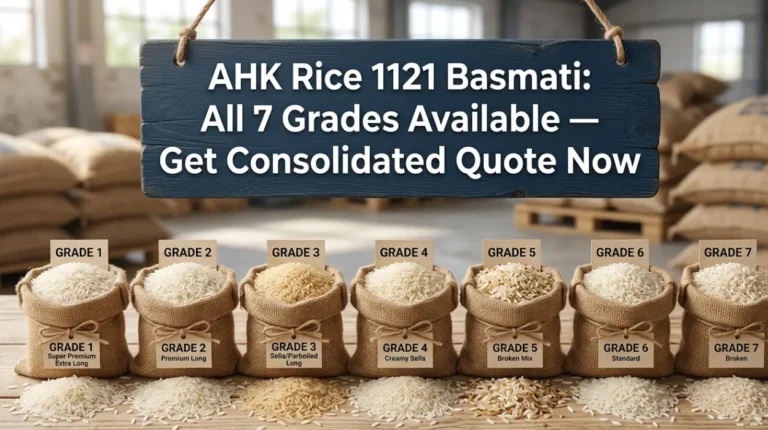
1121 Basmati suits premium retail and foodservice programmes, Super Kernel provides aromatic premium positioning with competitive sourcing economics, and 1509 fits buyers prioritising commercial volume, cooking performance, and price efficiency across Indonesian distribution channels.
AHK Rice supplies 1121, Super Kernel, and 1509 Basmati rice from Punjab. The service model covers processing, grading, packaging, export documentation, and container-ready shipment preparation.
Tanjung Priok is well suited to buyers serving premium retail, private-label supermarkets, restaurants, caterers, and national distribution networks. 1121 Basmati fits buyers that need long grain appearance, aroma, and premium positioning. Super Kernel fits buyers seeking aromatic Pakistani Basmati with a strong balance between grain presentation and procurement economics.
Tanjung Perak supports a different commercial pattern. East Java has extensive foodservice, catering, wholesale, and regional distribution demand. 1509 Basmati fits buyers seeking efficient commercial positioning, while Super Kernel and 1121 serve higher-value retail and foodservice programmes.
Belawan is particularly relevant when the final market is Medan and North Sumatra. Super Kernel and 1121 fit premium ethnic retail and restaurant channels, while 1509 provides a volume-oriented option for wholesalers and institutional buyers.
Grade selection should therefore follow the buyer’s sales channel. Port selection and rice selection are connected because inland logistics influence the landed cost of every grade.
How do price and shelf life compare across Indonesian regions?
Rice price per metric ton changes by grade, packing, quantity, crop year, specification, and Incoterm, while shelf life depends on moisture, packaging, storage conditions, and whether the rice is raw, steamed, or parboiled. Port choice changes landed cost rather than the intrinsic grade price.
For a commercial comparison, buyers should establish a supplier quotation on an FOB Karachi basis and then add ocean freight, insurance where applicable, Indonesian import charges, port handling, customs-related costs, inland transport, and warehouse expenses.
An illustrative planning model is useful:
| Region | Preferred grades | Planning price range* | Shelf-life planning |
|---|---|---|---|
| Jakarta / West Java via Tanjung Priok | 1121, Super Kernel, 1509 | US$1,050–US$1,250/MT | Commonly 12–24 months with controlled storage |
| East Java via Tanjung Perak | 1509, Super Kernel, 1121 | US$1,000–US$1,220/MT | Commonly 12–24 months with controlled storage |
| North Sumatra via Belawan | Super Kernel, 1121, 1509 | US$1,000–US$1,220/MT | Commonly 12–24 months with controlled storage |
*Planning ranges are not live quotations. Final pricing depends on grade, grain length, broken percentage, moisture, crop year, packing, order quantity, destination, and Incoterm.
Shelf life is not a fixed number that changes because a container arrives at Tanjung Priok, Tanjung Perak, or Belawan. Storage conditions determine product stability after import.
Rice should remain protected from moisture, insects, contamination, excessive heat, and direct sunlight. Warehouses require dry conditions, ventilation, palletisation, stock rotation, and appropriate pest-control procedures.
A buyer should therefore compare landed cost per metric ton and usable shelf life, not simply FOB price.
Which method works best for different cases?
Use Tanjung Priok when Jakarta or West Java is the primary market, Tanjung Perak when Surabaya and East Java dominate sales, and Belawan when Medan or North Sumatra is the main destination. The best method minimises combined logistics cost and delivery complexity.
A national distributor with warehouses around Jakarta should prioritise Tanjung Priok because inland transportation remains concentrated around the main commercial market.
A regional distributor operating from Surabaya should prioritise Tanjung Perak. The port reduces unnecessary inland movement and provides a practical base for East Java distribution.
A North Sumatra importer should prioritise Belawan. Shipping rice into Jakarta and moving it across Indonesia creates additional logistics steps that do not improve the product.
A buyer with multiple warehouses requires a broader calculation. The cheapest port for the first container is not always the cheapest port for annual supply. Buyers should model expected container volume, warehouse locations, trucking cost, delivery frequency, and inventory requirements.
What are the pros and cons of each Indonesian port?
Tanjung Priok offers the widest market access but faces high-volume operational complexity; Tanjung Perak provides efficient East Java distribution but is less suitable for Jakarta-centred networks; Belawan reduces North Sumatra inland movement but has a narrower regional distribution role.
Tanjung Priok
The major advantage is market proximity. Jakarta provides access to a large concentration of importers, distributors, retailers, restaurants, and foodservice businesses.
The main disadvantage is operational complexity. High container volumes mean buyers must coordinate vessel schedules, customs, terminal procedures, trucking, and warehouse receiving carefully.
Tanjung Perak
The main advantage is regional efficiency. Importers supplying Surabaya and East Java can keep inland transportation relatively focused.
The limitation is geographical. A buyer whose principal customers are in Jakarta gains little from selecting Tanjung Perak simply because an individual freight quotation is lower.
Belawan
Belawan’s strongest advantage is geographic positioning for Sumatra. Medan-based distributors can receive imported rice closer to their commercial market.
Its limitation is network scope. It is less appropriate as the primary port for a buyer whose main sales network sits across Java.
What factors should buyers use before selecting an Indonesian rice port?
The decision should combine destination warehouse, grade, container volume, landed cost, customs readiness, port handling, delivery time, and inventory requirements. Comparing only ocean freight produces an incomplete procurement decision.
| Decision factor | What to evaluate | Best practical question |
|---|---|---|
| Final warehouse | City and region | Which port minimises inland trucking? |
| Rice grade | 1121, Super Kernel, 1509 | Which grade matches the sales channel? |
| Container volume | FCL quantity and frequency | Can the buyer maintain efficient stock rotation? |
| Landed cost | FOB, freight, duties, handling, trucking | What is the final cost per MT? |
| Delivery planning | Vessel, port, customs, warehouse | How many days from shipment to stock availability? |
This framework also improves supplier comparison. Two suppliers can quote the same FOB price while producing different landed costs because their packaging, container loading, documentation, or shipment routing differs.
For recurring imports, buyers should request the complete commercial specification before confirming the purchase. The specification should identify rice variety, grain length, broken percentage, moisture, crop year, packing format, quantity, Incoterm, shipment port, destination port, and required documents.
What is the most practical approach for a full container rice shipment?
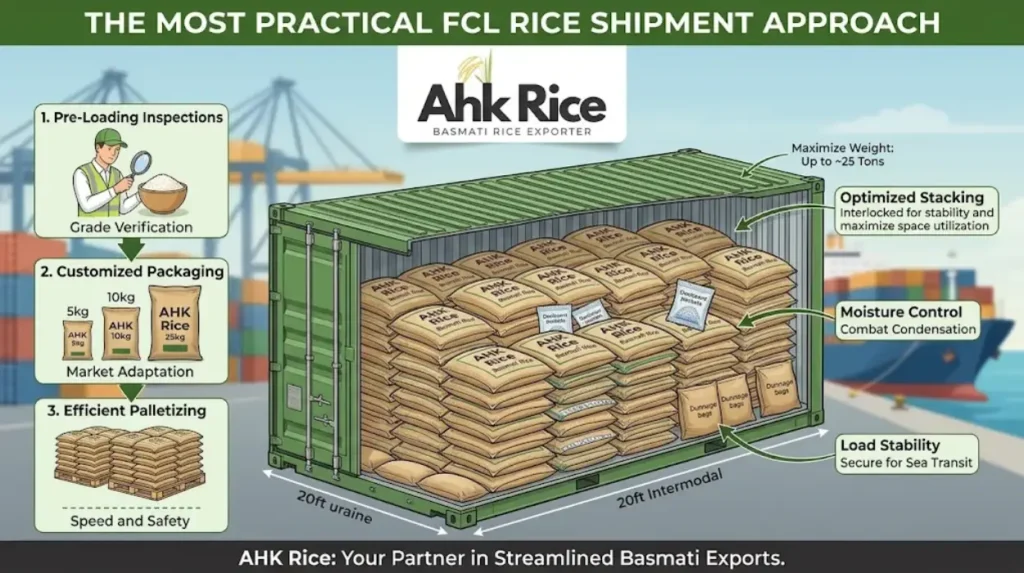
A full container load works best when the importer has confirmed demand, warehouse capacity, import documentation, destination port, rice specification, and receiving schedule before shipment. The process should connect product approval with logistics planning from the beginning.
The first step is specification approval. The importer confirms the required variety, grade, broken percentage, moisture, packaging, quantity, and crop year.
The second step is commercial sampling. A physical sample allows the buyer to assess appearance, aroma, cooking behaviour, grain expansion, and consistency before placing a larger order.
The third step is documentation and compliance. The exporter prepares the required commercial and export documents according to the agreed shipment structure. The importer prepares Indonesian import-side requirements before vessel arrival.
The fourth step is container planning. Rice is packed according to the agreed retail, foodservice, or wholesale format and loaded into the container according to the shipment plan.
The fifth step is destination handling. The container reaches the selected Indonesian port, completes the applicable customs and inspection procedures, and moves to the buyer’s warehouse.
This approach reduces avoidable delays because commercial, regulatory, and logistics decisions are completed before vessel arrival.
How should buyers compare the three ports before booking?
The strongest comparison uses a landed-cost model rather than a freight-only model. Buyers should compare product cost, freight, port handling, customs processing, inland transport, storage, delivery time, and inventory risk for the same rice specification.
For example, a Jakarta importer comparing Tanjung Priok and Tanjung Perak should calculate the complete cost of moving the container to its warehouse. A lower ocean freight quotation to Tanjung Perak does not automatically create a lower landed cost if inland transportation becomes substantially higher.
The same calculation applies to Belawan. For a Medan buyer, a shipment routed directly to Belawan can provide a stronger total logistics position than a lower-priced ocean option requiring additional domestic movement.
The decision should also account for stock requirements. A buyer with reliable monthly demand can schedule recurring FCL shipments. A buyer with irregular demand should control order size and warehouse capacity to avoid unnecessary holding costs.
For buyers ready to move from port comparison to shipment planning, the decision-focused next step is Book a Full Container Load of Pakistani Basmati Rice to Your Indonesian Port.
What are the main takeaways for Indonesian rice importers?
Tanjung Priok, Tanjung Perak, and Belawan serve different commercial geographies. Tanjung Priok is the logical gateway for Jakarta and West Java. Tanjung Perak fits Surabaya and East Java. Belawan is the strongest regional option for Medan and North Sumatra.
The correct rice grade also depends on the market. 1121 and Super Kernel fit premium retail and foodservice positioning, while 1509 provides a strong commercial option for volume-oriented buyers.
Price comparison requires a complete landed-cost calculation. FOB Karachi is only one component. Ocean freight, port handling, customs, inland transportation, packaging, order quantity, and Incoterm all affect the final cost per metric ton.
The best procurement decision connects the rice specification with the destination port. That approach gives importers stronger control over cost, transit planning, inventory, and distribution.
Frequently Asked Questions
Which Indonesian port is best for Pakistani Basmati rice?
Tanjung Priok is best for Jakarta and West Java, Tanjung Perak for Surabaya and East Java, and Belawan for Medan and North Sumatra.
How long does Pakistani rice take to reach Indonesia?
Transit depends on carrier routing, vessel schedules, transshipment, and port operations. Buyers should separate ocean transit from customs, port dwell, and inland delivery time.
Which Basmati grade is suitable for Indonesia?
1121, Super Kernel, and 1509 each serve different commercial requirements. 1121 fits premium positioning, Super Kernel balances aroma and value, and 1509 supports volume-oriented procurement.
Does port selection change rice shelf life?
No. Shelf life depends mainly on rice condition, moisture, packaging, warehouse temperature, humidity, pest control, and storage practices.
Is Tanjung Priok better than Tanjung Perak?
Neither port is universally better. Tanjung Priok is stronger for Jakarta and West Java, while Tanjung Perak is stronger for Surabaya and East Java.