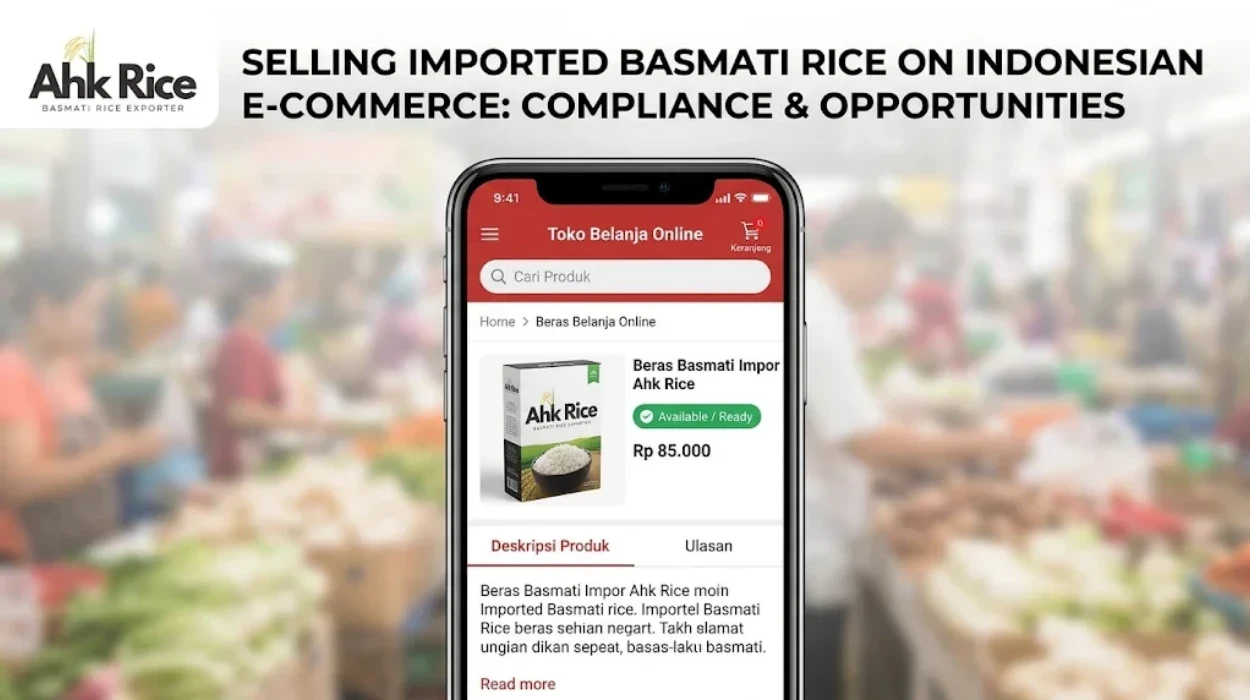
Can Imported Basmati Rice Be Sold on Indonesian E-Commerce Platforms?
Yes. Imported Basmati rice can be sold through Indonesian e-commerce platforms when the rice, importer, packaging, food registration, halal status, and import approvals meet Indonesian requirements. Online listing does not replace import compliance. The product must already be legally prepared for distribution in Indonesia.
Pakistani Basmati rice fits this model because it is an imported agricultural food product with established commercial grades such as 1121, Super Kernel, and 1509 Basmati rice. The important distinction is between importing rice and selling packaged rice to Indonesian consumers. Importation involves trade and customs controls, while retail e-commerce adds product registration, Indonesian-language labelling, halal requirements, packaging controls, and marketplace compliance.
What is Imported Basmati Rice for Indonesian E-Commerce?
Imported Basmati rice for Indonesian e-commerce is packaged Basmati rice brought into Indonesia by an authorised importer and offered to consumers through digital marketplaces after required import, food, halal, packaging, and labelling controls are completed.
Basmati rice is a long-grain aromatic rice associated with the Indian subcontinent. Pakistani Basmati is primarily cultivated in Punjab, including recognised rice-growing areas such as Gujranwala, Hafizabad, Sheikhupura, Narowal, and Sialkot.
Commercial Basmati varieties differ in grain length, processing method, cooking behaviour, broken percentage, aroma, and market positioning. Common Pakistani export varieties include 1121, Super Kernel, and 1509.
The Indonesian consumer does not purchase the agricultural commodity directly. The e-commerce customer normally purchases a finished retail pack. That distinction matters because a commercial shipment in bulk and a retail-ready packaged product follow different compliance considerations.
For example, a 25 kg commercial rice bag supplied to a distributor is different from a 5 kg branded retail pack displayed on an Indonesian marketplace. The retail pack needs consumer-facing information and an appropriate registration pathway.
How does imported Basmati rice reach an Indonesian online marketplace?
The process begins with product classification and import approval, continues through shipment, customs clearance, food and halal compliance, local packaging and labelling, and ends with a legally prepared retail product being listed online.
The first step is selecting the rice specification. The buyer defines variety, grain length, moisture, broken percentage, processing type, packing size, quantity, origin, and intended consumer segment.
The second step is determining the Indonesian import pathway. Indonesia regulates rice imports through its trade framework. Current agricultural import rules include requirements for Persetujuan Impor, commonly called PI, for regulated rice categories. The Ministry of Trade states that import licensing can involve Importer Registration, Producer Importer status, or Persetujuan Impor. Applications are handled electronically through SINSW and connected systems.
The third step is preparing shipment documentation. Commercial documents normally include the commercial invoice, packing list, transport document, product specification, country-of-origin documentation, and other documents required for the applicable import procedure.
The fourth step is customs and regulatory clearance. The Indonesian importer handles the local requirements while the exporter supplies the documents and product information required for the transaction.
The fifth step is retail preparation. Imported rice intended for retail sale must follow applicable food registration and labelling rules. BPOM states that imported processed food sold in retail packaging generally requires the relevant PB-UMKU registration.
The final step is e-commerce publication. The online listing should accurately reflect the approved product name, brand, net weight, country of origin, registration information, halal status where applicable, and other required consumer information.
What are the key components of an online Basmati rice product?
A compliant online Basmati rice product combines the physical rice, approved retail packaging, Indonesian-language label, food registration, halal documentation, importer information, traceability records, and lawful import documentation into one market-ready product.
Product specification
The product specification identifies exactly what the customer receives. It includes the Basmati variety, processing type, grain characteristics, net weight, origin, and grade.
For example, a listing for Pakistani 1121 Basmati should not use generic wording that hides the actual variety. A 1509 product should also remain clearly identified as 1509.
Packaging
Retail packaging protects rice from moisture, contamination, handling damage, and deterioration during storage and distribution. Packaging also provides the physical surface for mandatory consumer information.
Pack sizes can include 1 kg, 2 kg, 5 kg, 10 kg, and 25 kg depending on the target market and approved product format.
Indonesian-language labelling
BPOM requires food labels to use Bahasa Indonesia, with foreign terminology permitted where an Indonesian equivalent does not exist. Required information includes the product name, ingredients, net weight, producer or importer information, production code, expiry information, distribution permit number, and applicable halal information.
For an imported product, the BPOM registration number uses the BPOM RI ML format followed by the applicable digits.
Halal status
Halal compliance is a separate component from food registration. Indonesia applies halal requirements to products circulating in the Indonesian market, including imported products.
For imported products, a foreign halal certificate from a halal institution recognised through the applicable BPJPH mutual-recognition framework can be registered rather than undergoing duplicate certification. BPJPH states that recognised foreign halal certificates must be registered before the product is distributed in Indonesia.
Indonesia also issued BPJPH Regulation No. 4 of 2026 concerning conformity assurance for foreign halal products entering Indonesia. The regulation was issued in August 2026 and remains in force.
What are the benefits of selling imported Basmati rice online?
E-commerce gives imported Basmati rice access to consumers beyond physical grocery stores, while digital product pages provide space for detailed product specifications, pack sizes, origin information, cooking characteristics, and brand positioning.
The first benefit is broader consumer access. A retailer can reach households in Jakarta, Surabaya, Bandung, Medan, and other Indonesian cities without opening a physical store in every location.
The second benefit is product education. Basmati is not a single uniform product. An online listing can explain whether the rice is 1121, Super Kernel, or 1509 and whether it is Steam, Sella, or another approved processing format.
The third benefit is pack-size flexibility. A retailer can offer small household packs while maintaining larger packs for restaurants, caterers, hotels, and foodservice buyers.
The fourth benefit is traceability. A properly prepared product page can connect the retail product to its brand, importer, origin, registration information, and specification.
The fifth benefit is direct consumer feedback. Search behaviour, reviews, repeat purchases, and product questions provide commercial information that physical distribution alone does not provide.
Which Basmati rice products are suitable for Indonesian online retail?
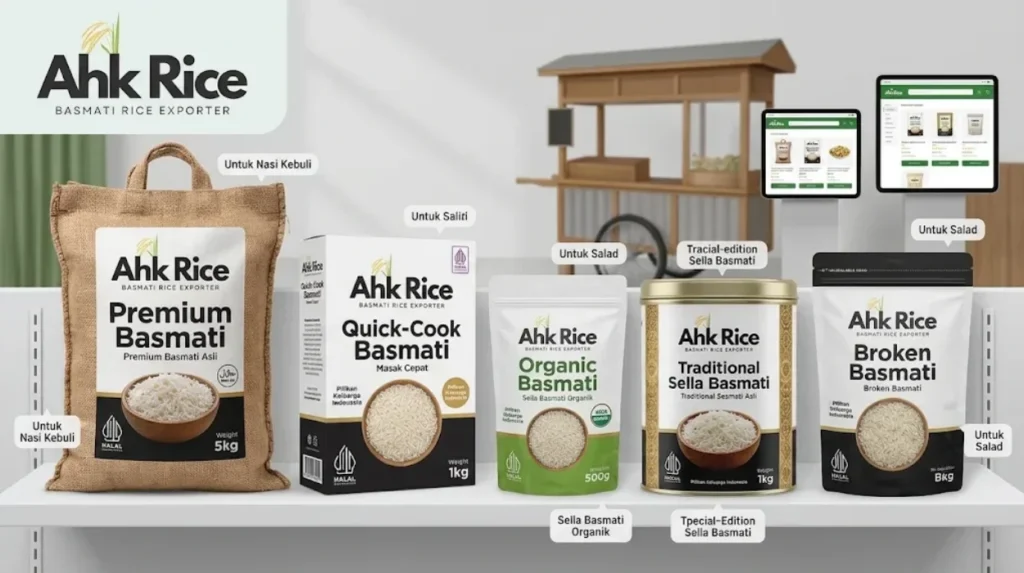
The strongest e-commerce candidates are clearly differentiated retail products with defined varieties, consistent grain quality, consumer-friendly packaging, complete Indonesian labels, valid food registration, and documented halal status where required.
1121 Basmati
1121 is associated with long grain length and strong cooked elongation. It fits premium household, restaurant, catering, and speciality rice positioning where appearance and grain length influence purchasing decisions.
Super Kernel Basmati
Super Kernel is a Pakistani Basmati variety valued for aroma, grain appearance, and traditional Basmati characteristics. It fits premium ethnic grocery and South Asian consumer segments.
1509 Basmati
1509 provides a different commercial proposition. Its long grain, cooking performance, and supply characteristics support retail and foodservice applications where price and consistency are important.
Steam and Sella rice
Processing also changes the product proposition. Steam rice retains a white appearance and suits everyday cooking. Sella processing creates a parboiled product with different cooking and handling characteristics. Golden Sella is widely associated with catering, institutional foodservice, and banquet applications.
A marketplace should not treat these products as interchangeable. Each listing should identify the actual variety and processing type.
What markets and use cases support imported Basmati rice in Indonesia?
Imported Basmati rice serves premium households, South Asian consumers, speciality grocery buyers, restaurants, hotels, caterers, wedding foodservice, and private-label retailers seeking differentiated long-grain rice products.
Household use is one important segment. Consumers purchase Basmati for biryani, pulao, rice-based meals, and other dishes where long grains and aroma are valued.
Restaurants form another segment. Indian, Pakistani, Middle Eastern, Central Asian, and international restaurants use Basmati for menu-specific dishes.
Hotels and catering businesses also create demand. Large-volume users generally evaluate consistency, cooking yield, grain separation, pack size, delivery reliability, and price.
Private-label retail provides another route. An Indonesian distributor can develop a consumer brand around imported Pakistani Basmati while maintaining the required importer and food-registration structure.
E-commerce also supports speciality rice discovery. A consumer searching for “Basmati 1121,” “Pakistani Basmati,” or “Golden Sella” can find a specific product rather than choosing only from generic rice categories.
For buyers planning the next commercial stage, the relationship between product packaging, halal certification, and BPOM registration becomes central. The detailed compliance pathway belongs in the related guide on packaging, halal and BPOM requirements for selling Basmati rice online in Indonesia.
What are the common problems and misconceptions?
The biggest misconception is that an overseas seller can simply upload an imported rice product to an Indonesian marketplace and start selling; import approval, food registration, halal compliance, labelling, packaging, and local importer responsibilities must be addressed first.
“E-commerce removes import requirements”
It does not. Online sales are a distribution channel, not an exemption from Indonesian import controls.
“A foreign halal certificate automatically works”
Recognition depends on the relevant foreign halal institution and BPJPH framework. A recognised foreign certificate still requires the applicable registration process before distribution.
“English packaging is enough”
BPOM requires applicable food label information in Bahasa Indonesia. Imported retail food therefore needs an Indonesian-compliant label rather than relying solely on the original foreign-language packaging.
“Rice never needs BPOM registration”
This statement is too broad. BPOM specifically distinguishes between products requiring registration and categories that are exempt. Imported processed food sold in retail packaging generally falls within the registration framework, while certain products, such as food imported in small quantities for testing or research, have different treatment.
“All Basmati rice has the same market position”
It does not. 1121, Super Kernel, and 1509 differ in grain characteristics, cooking performance, commercial positioning, and buyer expectations.
What should an importer check before listing Basmati rice online?
Before publication, the importer should verify the rice classification, import approval, product registration, halal documentation, Indonesian label, packaging specification, importer identity, traceability records, and marketplace information against the actual physical product.
A practical compliance sequence is:
- Confirm the Basmati variety and processing type.
- Confirm the applicable Indonesian HS classification and import pathway.
- Confirm the importer has the required business and import credentials.
- Secure the required import approvals.
- Prepare food-registration documentation where applicable.
- Complete the halal certification or foreign halal certificate registration pathway.
- Prepare compliant Bahasa Indonesia packaging.
- Confirm the BPOM RI ML information where applicable.
- Check product weight, origin, production code, expiry information, and storage instructions.
- Publish the online listing using the same product identity and information approved for the physical pack.
The result is a consistent chain from Pakistani rice fields and processing facilities to Indonesian import clearance, retail packaging, and the final e-commerce listing.
Frequently Asked Questions
Can imported Basmati rice be sold on Indonesian e-commerce platforms?
Yes. Imported Basmati rice can be sold online when the applicable import, food registration, halal, packaging, labelling, and business requirements are completed.
Does imported Basmati rice need BPOM registration?
Retail-packaged imported food generally requires the applicable BPOM registration. BPOM identifies imported retail food as a category requiring PB-UMKU registration, subject to specific exemptions.
Does Basmati rice need a halal certificate in Indonesia?
Halal requirements apply to products circulating in Indonesia. A recognised foreign halal certificate follows the applicable BPJPH registration pathway rather than automatic acceptance.
Must the rice packaging use Bahasa Indonesia?
Yes. Applicable food-label information must be provided in Bahasa Indonesia. BPOM requires key product and consumer information to appear clearly on the label.
Can Pakistani Basmati rice be sold through private-label brands?
Yes. Private-label sales use a defined importer and product-registration structure. The physical product, approved label, importer information, halal documentation, and online listing must remain consistent.