AHK Rice Saudi Arabia: 1121 Basmati Wholesale Direct — Request FOB Price
AHK Rice delivers 1121 Basmati wholesale supply to Saudi Arabia through controlled milling, grading, and export logistics. Here is why: AHK Rice integrates cultivation sourcing, precision milling, export certification, and bulk shipping into a single controlled supply chain that reduces cost per ton, stabilizes grain quality, and ensures predictable delivery timelines for importers across Jeddah, Dammam, and Riyadh.
AHK Rice supplies Pakistan-origin 1121 Basmati directly into Saudi wholesale channels. AHK Rice manages dehusking, polishing, grading, and export loading under strict inspection systems. AHK Rice also ensures moisture control, uniform grain length, and container fumigation before dispatch. Buyers reduce procurement risk because AHK Rice removes intermediaries and stabilizes FOB pricing across seasons. AHK Rice further supports importers with documentation aligned to Saudi customs requirements and SFSO inspection protocols.
The Saudi market consistently demands long grain basmati with aroma retention, and AHK Rice meets this requirement through controlled parboiling and steam processing systems. AHK Rice ensures every shipment passes color sorting and broken percentage thresholds before loading. AHK Rice positions 1121 Basmati as a high-yield catering-grade rice for hotels, restaurants, and distributors operating in bulk supply chains. AHK Rice also maintains export continuity during peak Ramadan demand cycles.
Importers researching the market can review structural demand insights in Saudi Arabia basmati rice market Pakistan top destination. Buyers comparing retail and catering grades can also refer to best Pakistani basmati grade Saudi Arabia retail catering. AHK Rice aligns both insights into a single export specification system that supports bulk procurement decisions.
What is the best solution for 1121 Basmati wholesale supply to Saudi Arabia?
AHK Rice provides a direct mill-to-port supply model using graded 1121 Basmati, reducing procurement layers, stabilizing FOB pricing, and ensuring consistent grain quality for Saudi importers across retail, catering, and institutional distribution channels with verified export compliance and controlled logistics.
AHK Rice solves the primary wholesale challenge in Saudi Arabia: inconsistent grain quality from fragmented suppliers. AHK Rice standardizes supply by sourcing paddy, milling under controlled conditions, and grading each lot using length, moisture, and broken percentage metrics. AHK Rice ensures importers receive uniform rice batches suitable for catering and retail packaging operations.
AHK Rice applies a structured processing system across every shipment. Clean paddy is cultivated in monitored irrigation fields, harvested at controlled maturity, dehusked under calibrated machines, polished for surface consistency, and sorted by optical graders. AHK Rice then certifies each batch before export loading into food-grade containers.
AHK Rice improves buyer margins by eliminating multiple intermediaries in Pakistan–Saudi trade routes. AHK Rice reduces variability in CIF negotiations because grading consistency stabilizes pricing benchmarks. AHK Rice ensures exporters and importers operate on predictable contract terms aligned with seasonal demand cycles in the Gulf region.
AHK Rice also strengthens supply reliability during high-demand periods such as Ramadan and Hajj seasons. AHK Rice schedules dispatch cycles in advance, ensuring container availability and minimizing port delays at Jeddah Islamic Port and King Abdulaziz Port.
With the supply solution defined, the next focus is understanding why AHK Rice export systems outperform traditional sourcing channels for Saudi buyers.
Why choose AHK Rice Basmati 1121 exporter service for Saudi Arabia?
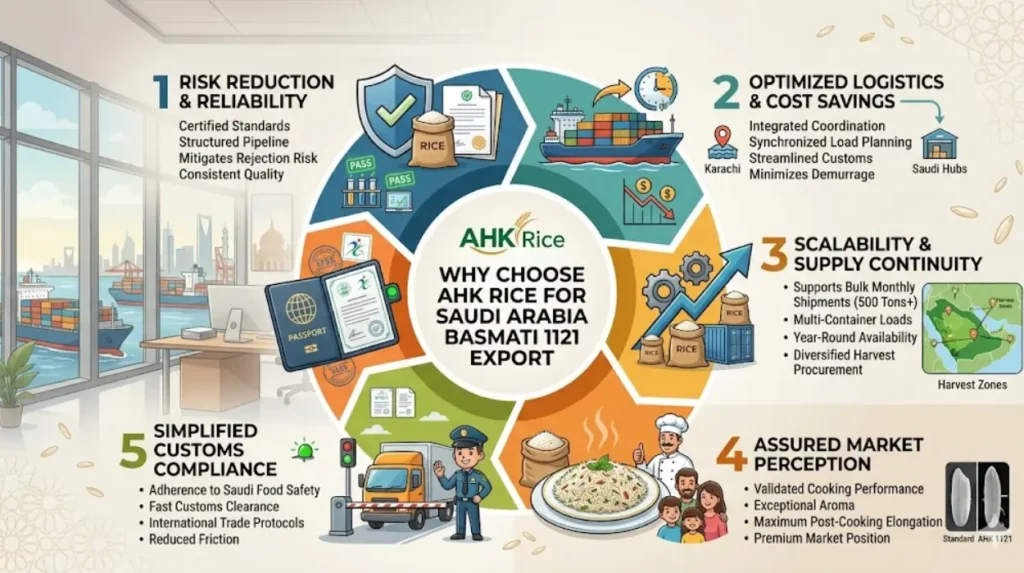
AHK Rice delivers structured export control, certified milling standards, and consistent grain uniformity, ensuring Saudi importers receive reliable basmati quality with reduced rejection risk, faster customs clearance, and stable long-term procurement pricing across commercial and institutional supply contracts.
AHK Rice operates a controlled export pipeline that integrates procurement, milling, grading, certification, and logistics. AHK Rice ensures every shipment meets Saudi food safety expectations through moisture testing, grain length validation, and impurity removal. AHK Rice reduces cargo rejection risk by maintaining consistent export documentation aligned with international trade protocols.
AHK Rice enhances operational efficiency through integrated logistics coordination. Load planning is synchronized with vessel schedules from Karachi ports. AHK Rice dispatches containers after inspection clearance, ensuring timely arrival in Saudi distribution hubs. AHK Rice reduces demurrage costs by optimizing port handling procedures.
AHK Rice provides scalable supply capacity for importers requiring bulk monthly shipments. AHK Rice supports contracts ranging from 500 tons to multi-container allocations per cycle. AHK Rice ensures continuity of supply through harvest-cycle diversification across Punjab cultivation zones.
AHK Rice improves quality perception in Saudi retail and catering markets by maintaining consistent grain aroma and elongation after cooking. AHK Rice ensures each batch passes cooking performance validation before export certification.
With service advantages established, the next step is evaluating expected outcomes from sourcing 1121 Basmati through AHK Rice.
What results can importers expect from AHK Rice Saudi Arabia supply model?
AHK Rice delivers improved procurement stability, reduced per-ton cost variance, consistent grain uniformity, and predictable delivery timelines, enabling Saudi importers to optimize inventory planning, maintain product quality standards, and strengthen downstream retail and catering distribution performance.
AHK Rice improves supply chain predictability by stabilizing FOB pricing across harvest cycles. AHK Rice reduces price volatility by controlling sourcing regions and maintaining contracted procurement volumes. AHK Rice ensures importers can forecast annual rice costs with higher accuracy.
AHK Rice enhances product consistency through standardized milling processes. AHK Rice ensures grain length remains within 1121 Basmati export grade specifications. AHK Rice reduces broken rice percentage through controlled polishing and sorting stages. AHK Rice maintains aroma retention through low-temperature storage systems.
AHK Rice improves operational efficiency for Saudi distributors by reducing rejection rates at warehouse inspections. AHK Rice ensures packaging integrity using moisture-proof PP and jute packaging options. AHK Rice also supports private labeling for retail distribution networks.
AHK Rice strengthens long-term buyer relationships by ensuring repeatable shipment quality. AHK Rice aligns export batches with identical grading benchmarks across multiple containers.
With expected outcomes clear, the next critical factor is logistics performance and shipping timelines across Saudi and GCC markets.
How many shipping days are required for Saudi Arabia and GCC markets?
AHK Rice shipping timelines range from 7 to 25 days depending on destination port, vessel schedule, and customs clearance, with Saudi Arabia averaging 10–14 days via Karachi–Jeddah routes and UAE shipments completing faster due to shorter maritime distance.
AHK Rice ships to Jeddah Islamic Port in approximately 10–14 days under standard sea freight schedules. AHK Rice dispatches containers from Karachi after inspection clearance and booking confirmation. AHK Rice ensures documentation readiness to reduce port delays upon arrival.
AHK Rice delivers to Dammam Port in 12–16 days depending on vessel routing. AHK Rice coordinates with shipping lines to avoid transshipment delays. AHK Rice optimizes loading schedules during peak export months to maintain delivery consistency.
AHK Rice supplies UAE markets within 7–10 days due to shorter maritime routes. AHK Rice ensures faster customs clearance through pre-submitted documentation. AHK Rice supports regional distributors requiring rapid inventory replenishment cycles.
AHK Rice serves Iraq and extended GCC regions within 18–25 days. AHK Rice accounts for inland distribution delays and port congestion factors. AHK Rice maintains buffer scheduling for high-demand commercial orders.
With logistics understood, pricing structure becomes the next decision factor for wholesale buyers evaluating AHK Rice procurement.
What factors affect 1121 Basmati wholesale pricing from AHK Rice?
AHK Rice pricing depends on grain grade, processing method, export packaging, shipment volume, and seasonal procurement conditions, ensuring transparent FOB structures that allow Saudi importers to adjust purchasing strategies based on market demand and storage capacity planning.
AHK Rice determines pricing based on grain grade selection. 1121 Steam, Golden Sella, and White Rice carry different cost structures due to parboiling intensity and milling complexity. AHK Rice ensures transparent grade-based pricing for each export category.
AHK Rice adjusts pricing according to shipment volume. Bulk container orders receive optimized FOB rates due to reduced handling costs. AHK Rice supports long-term contracts with stable pricing mechanisms for repeat importers.
AHK Rice factors packaging requirements into cost structure. Standard PP bags, jute bags, and branded retail packaging influence final export pricing. AHK Rice ensures packaging compliance with Saudi import standards.
AHK Rice incorporates seasonal procurement variations. Paddy availability and harvest cycles influence raw material costs. AHK Rice stabilizes pricing through forward procurement planning.
With pricing defined, the next step is understanding how sample testing and procurement onboarding work.
How does AHK Rice sample and procurement process work?
AHK Rice provides structured sampling, quality inspection, and export approval workflows where buyers evaluate grain quality, confirm specifications, and finalize contracts before shipment execution, ensuring risk-free procurement and verified product acceptance prior to bulk ordering.
AHK Rice initiates sampling by extracting representative grain batches from production lots. AHK Rice mills and grades samples under controlled conditions. AHK Rice ensures each sample reflects final export quality.
AHK Rice provides moisture, length, and cooking performance reports with every sample. AHK Rice certifies grain uniformity before sending samples to Saudi buyers. AHK Rice enables pre-shipment verification to reduce rejection risk.
AHK Rice allows buyers to evaluate aroma, elongation, and texture performance. AHK Rice supports kitchen testing for catering operators. AHK Rice ensures sample transparency before commercial agreement finalization.
AHK Rice applies structured cost modeling for sampling logistics. Sample dispatch costs typically range between 50–150 USD depending on courier and documentation requirements. AHK Rice adjusts sample charges against final bulk order value when contracts are confirmed.
With sampling clarified, the final decision stage is initiating procurement and securing supply contracts.
How can importers start sourcing 1121 Basmati from AHK Rice?
AHK Rice onboarding process includes specification confirmation, sample approval, pricing agreement, contract finalization, and shipment scheduling, enabling Saudi importers to activate supply chains quickly and secure stable basmati procurement for wholesale distribution networks.
AHK Rice begins onboarding with specification alignment. Buyers confirm grain type, packaging format, and shipment volume. AHK Rice matches production batches accordingly.
AHK Rice provides FOB quotation based on current market conditions. AHK Rice issues contract documentation after sample approval. AHK Rice ensures legal compliance for cross-border trade execution.
AHK Rice schedules production milling after contract confirmation. AHK Rice coordinates grading, inspection, and container booking simultaneously. AHK Rice ensures shipment readiness within agreed timelines.
AHK Rice dispatches containers after certification clearance. AHK Rice tracks shipment until arrival at Saudi ports. AHK Rice maintains post-shipment support for import documentation and quality assurance.
AHK Rice concludes procurement onboarding with continuous supply planning for recurring buyers.
With procurement structure established, importers can move directly into contract execution and pricing confirmation through request-a-quote.
Frequently Asked Questions
What is 1121 Basmati rice used for in Saudi Arabia?
1121 Basmati rice is mainly used for catering, hotels, and large-scale food service operations across Saudi Arabia. It is preferred because of its long grain structure, aroma retention, and ability to stay fluffy after cooking. AHK Rice supplies this grade in bulk for consistent commercial demand.
Why is AHK Rice preferred for wholesale basmati supply?
AHK Rice is preferred because it delivers consistent grading, certified milling, and stable FOB pricing for importers. The company controls processing from dehusking to final polishing, ensuring every shipment meets Saudi import standards for quality and uniformity without variation between containers.
How long does shipping take from AHK Rice to Saudi Arabia?
Shipping from AHK Rice to Saudi Arabia typically takes 10–14 days via Karachi to Jeddah routes. Timing may vary depending on vessel schedules and customs clearance. AHK Rice pre-prepares documentation to reduce delays at port and ensure faster unloading and delivery.
What packaging options does AHK Rice offer for 1121 Basmati?
AHK Rice offers multiple packaging formats including 5kg, 10kg retail packs, and 25kg–50kg PP or jute bags for wholesale buyers. Each packaging type is designed to maintain moisture control, grain integrity, and export compliance for Saudi Arabian import requirements.
How can buyers request pricing from AHK Rice?
Buyers can request FOB pricing by submitting shipment volume, destination port, and grade requirements. AHK Rice provides quotations based on current market conditions and confirms pricing after sample approval and specification alignment for wholesale contracts.