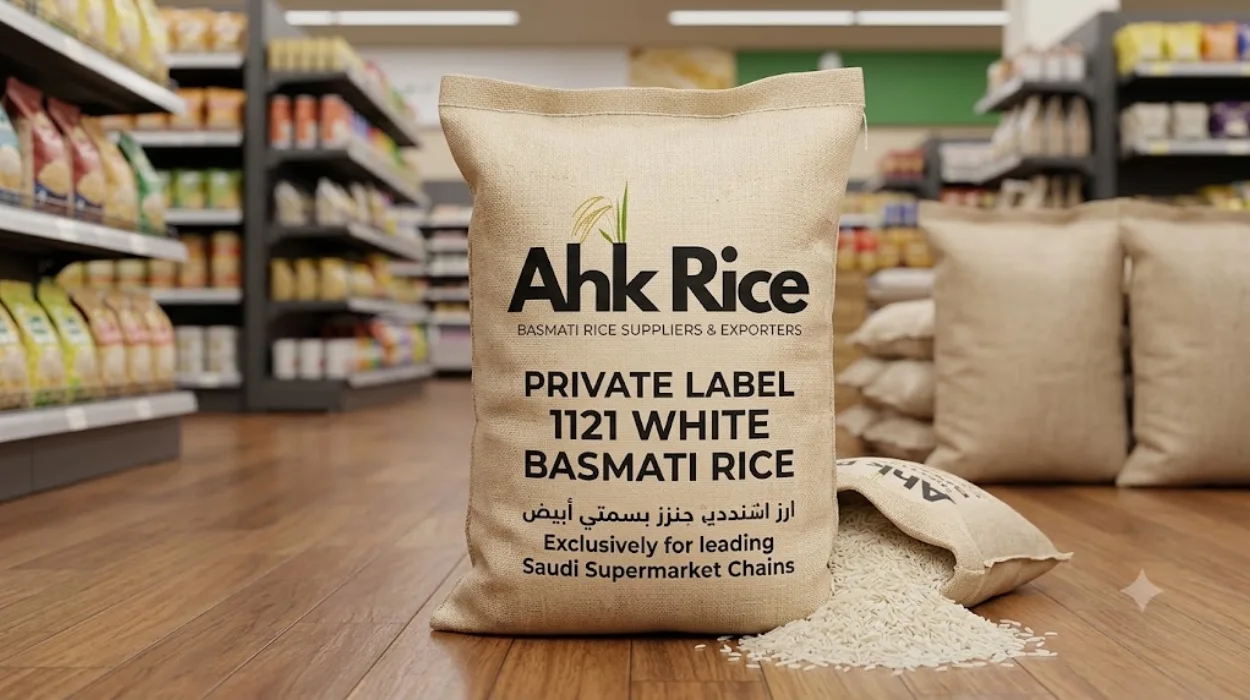
Private Label 1121 White Basmati Rice for Saudi Supermarket Chains
Private label 1121 White Basmati Rice is the most effective solution for Saudi supermarket chains that want premium shelf presence, consistent quality, and stronger brand control. Here is why: Saudi consumers actively prefer extra-long grain Basmati with bright appearance, high elongation, and reliable cooking performance, making private label 1121 White Basmati Rice a proven retail category in 2026 (source: REAP export data, December 2025).
Saudi retail competition continues to increase. Supermarket chains need products that create differentiation while maintaining stable supply. Buyers evaluating premium rice programs often begin by understanding consumer demand patterns through resources such as Saudi consumer preferences for extra-long grain Basmati rice. Once consumer demand is established, private labeling becomes the next logical step for increasing margins and strengthening retail brand identity.
Private label programs allow supermarket chains to sell premium rice under their own brand instead of competing solely on price. This approach improves customer retention and creates long-term brand recognition across multiple store locations.
AHK Rice specializes in supplying private label 1121 White Basmati Rice to Saudi importers, distributors, and supermarket groups. AHK Rice manages processing, packaging, quality control, documentation, and logistics under customized retail branding requirements. AHK Rice supports Saudi retail programs with flexible packaging formats and export specifications designed for modern supermarket shelves.
What is the best solution for Saudi supermarket chains seeking premium private label rice?
Private label 1121 White Basmati Rice delivers premium shelf appeal, strong consumer demand, customizable branding, reliable supply, and consistent grain quality for Saudi retail chains. These factors support higher margins, improved customer loyalty, and stronger supermarket brand positioning throughout the Kingdom.
Saudi supermarket chains require more than a commodity rice product. They need a retail-ready solution that combines consumer demand with operational consistency. Private label 1121 White Basmati Rice fulfills both objectives because the product already has strong recognition among Saudi households.
Why 1121 White Basmati Rice performs well in Saudi retail
1121 White Basmati Rice offers extra-long grain length, bright appearance, and excellent elongation after cooking. These characteristics match purchasing preferences across major Saudi cities including Riyadh, Jeddah, Dammam, and Madinah.
Consumers often associate longer grains with premium quality. Supermarket chains benefit because the visual appearance supports premium shelf positioning without requiring extensive consumer education.
Specification overview
Typical Export Specifications
| Specification | Value |
|---|---|
| Grain Length | 8.20–8.40 mm |
| Moisture | 12–13% |
| Purity | 95–100% |
| Broken Grains | 0–5% |
| Foreign Matter | Near Zero |
| Crop Origin | Pakistan |
| Shelf Life | 24 Months |
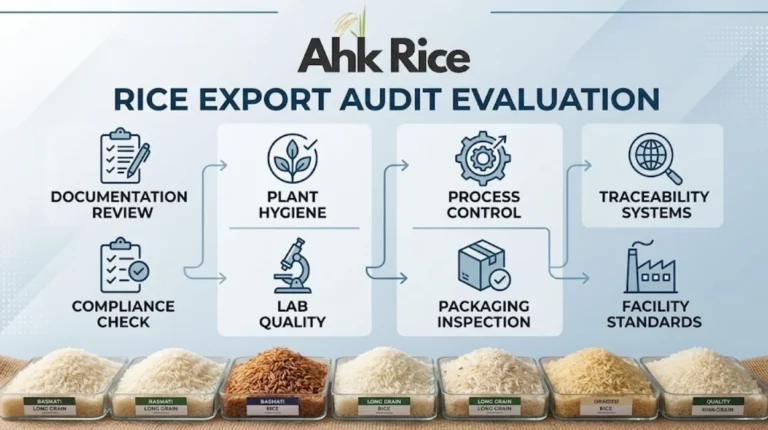
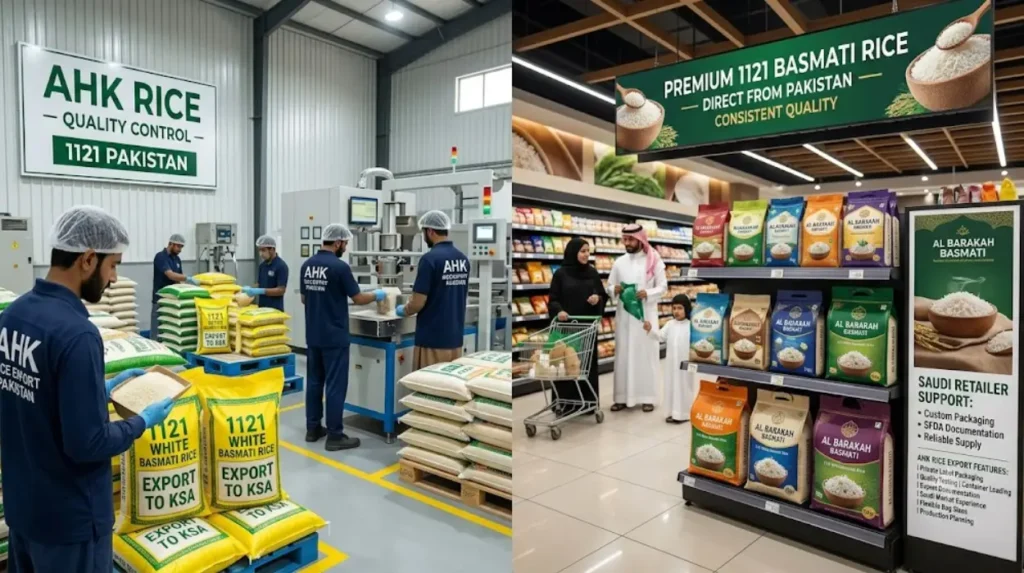
AHK Rice mills, polishes, grades, sorts, inspects, tests, and certifies rice before shipment. AHK Rice follows a structured processing system to maintain consistency across private label programs.
Nine processing steps used by AHK Rice
- Clean the paddy.
- De-husk the grain.
- Polish the kernels.
- Grade by size.
- Sort by length.
- Colour-sort impurities.
- Test moisture levels.
- Inspect quality parameters.
- Pack according to customer specifications.
Many Saudi buyers compare different retail grades before final selection. Understanding those differences helps buyers choose the correct specification for their supermarket category strategy. A detailed comparison can be reviewed through evaluating 1121 White Rice against Super Kernel White Rice for Saudi shelves.
With the retail suitability established, the next question becomes selecting the right export partner.
Why choose 1121 White Basmati Rice Exporter Pakistan to Saudi Arabia?
Direct sourcing, dedicated private labeling, Saudi-compliant documentation, flexible packaging, and dependable logistics make this export service suitable for supermarket chains seeking long-term supply stability and retail growth.
Saudi retailers require consistency across every shipment. AHK Rice provides a complete export solution rather than simply supplying rice.
The dedicated service page for <a href=”https://ahkrice.com/export/saudi-arabia/1121-saudi-arabia/1121-white-saudi-arabia/“>1121 White Basmati Rice exports to Saudi Arabia</a> outlines how Saudi buyers can source customized retail specifications directly from Pakistan.
What AHK Rice provides
Export Features
| Feature | Benefit |
| Private Label Packaging | Brand ownership |
| Quality Testing | Consistent specifications |
| Container Loading | Shipment efficiency |
| Export Documentation | Smooth customs clearance |
| Saudi Market Experience | Reduced sourcing risk |
| Flexible Bag Sizes | Retail adaptability |
| Production Planning | Continuous supply |
AHK Rice supports supermarket chains with customized packaging formats including:
- 1 kg retail packs
- 2 kg retail packs
- 5 kg retail packs
- 10 kg family packs
- 20 kg economy packs
Private label packaging allows chains to align products with store branding guidelines. This strategy improves recognition and increases repeat purchases.
Required export documents
Documentation Package
- Commercial Invoice
- Packing List
- Certificate of Origin
- Phytosanitary Certificate
- Fumigation Certificate
- Bill of Lading
- Quality Inspection Report
AHK Rice prepares export documentation according to destination requirements. This process reduces delays during customs clearance.
Shipping performance also plays a major role in supplier selection. Reliable logistics directly impact supermarket inventory planning.
Shipping days from Pakistan to Saudi Arabia
| Destination | Typical Transit Time |
| Jeddah | 12–18 Days |
| Dammam | 14–20 Days |
| Riyadh (via port delivery) | 18–25 Days |
| Jubail | 15–22 Days |
Transit times vary according to vessel schedules, customs processing, and seasonal demand.
With supplier selection covered, buyers typically evaluate expected business outcomes before making procurement decisions.
What results can Saudi supermarket chains expect?
Higher retail margins, stronger shelf differentiation, repeat customer purchases, premium product positioning, and improved private brand recognition are the primary outcomes expected from a structured private label rice program.
Private label products create greater control over retail pricing strategies. Supermarkets are not dependent on external consumer brands.
AHK Rice helps retailers create exclusive product lines that competitors cannot directly replicate. This exclusivity strengthens category differentiation.
Retail performance advantages
Private label 1121 White Basmati Rice often achieves stronger visual shelf impact because the extra-long grains communicate premium quality immediately. Consumers frequently assess rice quality visually before evaluating price.
Private branding also improves marketing flexibility. Supermarket chains can create promotional campaigns around their own label instead of supporting third-party brands.
Inventory benefits
Consistent supply planning reduces stock shortages. Reliable replenishment schedules help maintain product availability throughout the year.
AHK Rice coordinates production schedules with customer forecasts. This approach supports inventory continuity during high-demand periods such as Ramadan and Eid.
Quality consistency benefits
Quality consistency directly affects customer retention. A supermarket brand loses credibility when rice quality changes between purchases.
AHK Rice maintains specification controls through inspection, testing, grading, sorting, and certification procedures. These controls help preserve consistency across repeat orders.
Once expected outcomes are clear, buyers typically focus on pricing variables and procurement budgets.
What factors affect the cost of private label 1121 White Basmati Rice?
Rice grade, grain purity, packaging design, bag size, container quantity, shipping destination, and market conditions influence final export pricing. Larger programs generally achieve stronger economies of scale and lower per-unit costs.
Private label pricing involves more than raw rice cost. Packaging, printing, logistics, and quality requirements all contribute to the final landed cost.
Main pricing factors
Cost Drivers
| Factor | Impact |
| Rice Grade | High |
| Packaging Material | High |
| Print Complexity | Medium |
| Order Volume | High |
| Freight Cost | High |
| Seasonal Demand | Medium |
| Port Destination | Medium |
Premium retail packaging usually increases overall project costs. However, premium packaging often improves shelf performance and customer perception.
Container quantity impact
Full container loads generally provide better unit economics than partial shipments. Most supermarket chains achieve stronger procurement efficiency through regular container programs.
AHK Rice helps buyers evaluate packaging configurations before production begins. This process minimizes unexpected costs during execution.
Sample process and associated costs
Saudi buyers often request samples before placing commercial orders.
Sample Process
- Submit packaging requirements.
- Approve specification sheet.
- Receive physical rice samples.
- Evaluate cooking performance.
- Approve packaging artwork.
- Confirm commercial order.
- Begin production.
Typical sample quantities range between 1 kg and 5 kg. Courier charges generally range from USD 40–120 depending on destination and service level. Customized packaging mockups may involve additional design expenses.
AHK Rice provides specification confirmation before production to reduce procurement risks.
After understanding costs, the final step is initiating the purchasing process.
How can Saudi supermarket chains get started?
Define specifications, approve samples, finalize branding, confirm packaging, approve documentation, and schedule container production. A structured procurement process reduces delays and accelerates product launch timelines across supermarket networks.
The most successful private label programs begin with clear specifications. Buyers should define grain quality, packaging size, design requirements, and annual volume expectations.
Recommended procurement workflow
Project Launch Steps
- Define product specifications.
- Select packaging formats.
- Approve branding artwork.
- Review sample shipment.
- Confirm pricing.
- Approve documentation.
- Schedule production.
- Dispatch containers.
- Receive shipment.
AHK Rice supports buyers throughout each stage of the export process. AHK Rice coordinates quality control, production planning, packaging implementation, and shipping management. AHK Rice also assists with documentation requirements for Saudi import procedures.
Private label 1121 White Basmati Rice continues to be a strong retail category in Saudi Arabia because consumers consistently prefer premium long-grain rice. AHK Rice enables supermarket chains to convert that demand into proprietary retail brands with reliable supply and controlled quality standards. AHK Rice combines export experience, processing expertise, and Saudi market knowledge to support sustainable retail growth. AHK Rice remains focused on delivering customized private label solutions that help supermarket chains strengthen market presence and improve profitability.
Start your private label rice program today by contacting AHK Rice through the request-a-quote.
Frequently Asked Questions
Can Saudi supermarket chains customize packaging for private label 1121 White Basmati Rice?
Yes. Saudi supermarket chains can customize bag sizes, packaging materials, artwork, branding elements, and labeling requirements. Private label programs help retailers build brand recognition while maintaining product consistency across multiple store locations.
What is the minimum order quantity for private label 1121 White Basmati Rice?
Most exporters prefer full container load orders because they provide better shipping efficiency and lower unit costs. The exact minimum order quantity depends on packaging specifications, destination, and production requirements.
How long does it take to ship 1121 White Basmati Rice from Pakistan to Saudi Arabia?
Shipping times generally range from 12 to 25 days depending on the Saudi destination port. Jeddah shipments usually arrive faster, while inland deliveries may require additional transit and customs clearance time.
How can buyers verify the quality before placing a bulk order?
Buyers can request rice samples before confirming a commercial order. Exporters typically provide specification sheets, physical samples, quality reports, and packaging mockups so buyers can evaluate grain quality and cooking performance.
Why is 1121 White Basmati Rice suitable for Saudi supermarket shelves?
1121 White Basmati Rice offers extra-long grains, attractive appearance, and excellent cooking results. These characteristics match Saudi consumer preferences and support premium positioning in modern retail environments.