Why Rice Processing and Packaging Require Seven to Ten Days
The seven-to-ten-day processing window consistently delivers better export quality than rushed production because it allows complete drying, grading, polishing, packaging, quality inspection, and container preparation before shipment.
International rice buyers often compare suppliers based on shipping schedules alone. However, export readiness depends on much more than loading containers. Every stage between receiving a confirmed order and dispatching the cargo directly affects grain quality, food safety, shelf life, and customer satisfaction. Understanding these production stages helps importers evaluate supplier capabilities instead of relying only on estimated departure dates.
If you want to understand how production timelines fit into the complete export schedule, read our guide explaining the:
Expected delivery timeline for Pakistani Basmati rice imports before exploring the processing stages discussed below.
When evaluating exporters such as:
Receive Timely Basmati Rice Shipments Through AHK Rice Export Process, buyers should compare production systems, quality controls, packaging standards, laboratory testing, and logistics planning rather than focusing only on the promised shipping date.
Why does rice processing normally require seven to ten days before shipment?
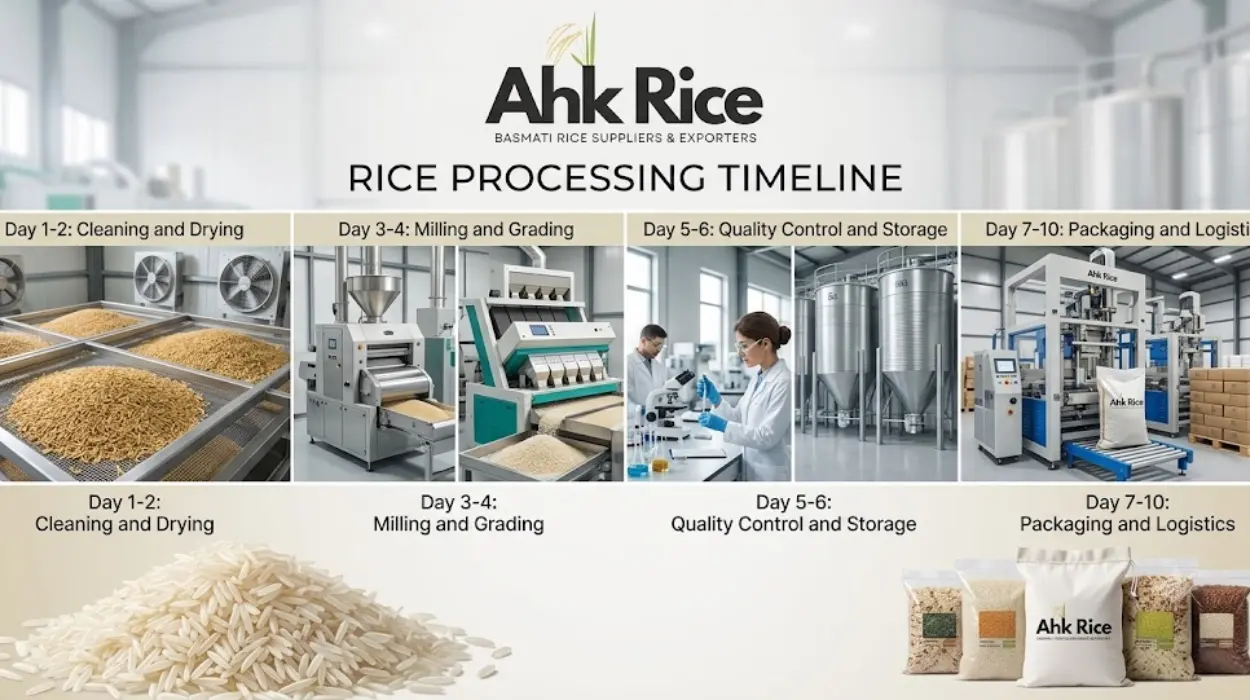
Seven to ten days are required because export-quality rice passes through drying, cleaning, grading, polishing, color sorting, laboratory testing, packaging, palletizing, documentation, and container inspection. Completing every stage in sequence protects grain quality, minimizes export risks, and meets international food safety standards expected in global rice trade during 2026.
Export processing begins after payment confirmation and production scheduling. Raw paddy cannot be loaded immediately because it first undergoes controlled industrial processing.
The first stage removes stones, dust, immature kernels, and foreign materials. Mechanical separators eliminate impurities before the rice enters polishing and grading lines.
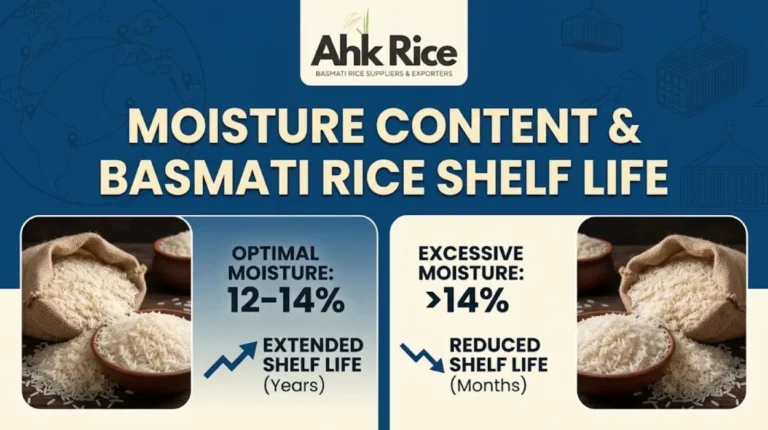
Moisture stabilization follows. Export-grade Basmati typically targets moisture levels around 12–14%, depending on customer specifications and destination climate. Proper stabilization reduces breakage during transportation and improves storage performance.
Color sorting machines then remove damaged, discolored, and defective kernels using optical sensors capable of identifying even slight variations.
Laboratory technicians verify moisture percentage, broken grain ratio, chalkiness, damaged kernels, foreign matter, grain length, and milling quality before approving the batch.
Only after passing these inspections does rice move to automated packaging lines.
Packaging materials are also inspected before filling because damaged bags, weak stitching, or incorrect labeling create export compliance issues.
Finally, cargo undergoes palletization, fumigation where required, container cleanliness inspection, loading supervision, sealing, and export documentation.
Completing every stage without shortcuts generally requires seven to ten working days.
What processing solutions are available for international rice exporters?
Rice exporters typically use three production approaches: rapid processing, standard export processing, and premium quality-controlled processing. Each system balances production speed, inspection frequency, operational costs, documentation, and product consistency according to importer requirements, destination regulations, and contractual quality specifications.
The processing approach selected influences shipment quality more than production speed alone.
Specification Comparison
| Attribute | Rapid Processing | Standard Export Processing | Premium Quality-Controlled Processing |
|---|---|---|---|
| Production Time | 3–5 days | 7–10 days | 8–10 days |
| Cleaning Stages | Basic | Multiple | Multiple with repeated inspection |
| Optical Color Sorting | Single pass | Double pass | Multi-pass sorting |
| Laboratory Testing | Basic | Complete | Complete with additional verification |
| Packaging Inspection | Limited | Full inspection | Full inspection plus random audits |
| Export Documentation | Standard | Standard + compliance verification | Extensive compliance documentation |
| Best Application | Low-risk regional trade | Most commercial exports | Premium retail and food-service markets |
Rapid processing reduces production time but limits inspection opportunities.
Standard export processing balances production efficiency with quality assurance and remains the most common method for international Basmati exports.
Premium processing includes additional laboratory verification, stricter packaging inspection, and enhanced documentation requested by premium importers, supermarkets, and food-service distributors.
How do different processing approaches compare for export performance?
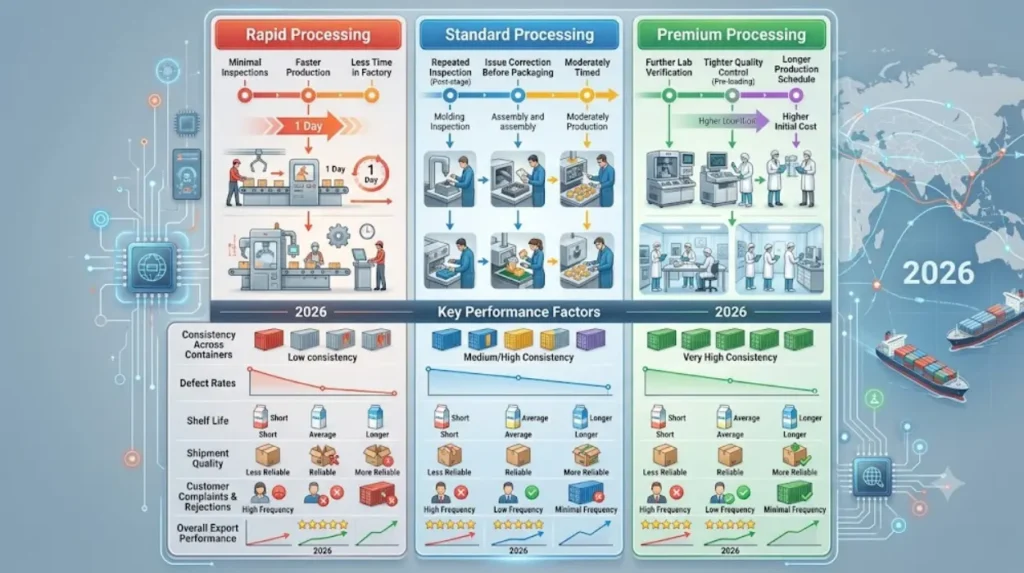
Processing systems differ mainly in inspection frequency, machinery usage, moisture stabilization, packaging quality, documentation accuracy, and consistency. Longer production schedules generally produce lower defect rates, stronger shelf life, and more reliable shipment quality across international supply chains throughout 2026.
Buyers frequently compare exporters based on loading dates. A better comparison evaluates the entire production workflow.
Rapid processing minimizes factory time but provides fewer quality checkpoints.
Standard processing includes repeated inspection after each production stage, allowing issues to be corrected before packaging.
Premium processing adds further laboratory verification and tighter quality control before loading containers.
For buyers importing large commercial quantities, consistency across multiple containers matters more than saving two or three production days.
Well-controlled processing also reduces the probability of customer complaints, rejected shipments, or quality claims after arrival.
Which processing method works best for different importing regions?
Different export markets prioritize different quality characteristics. Gulf countries generally prefer premium appearance and aroma, while African commercial markets often prioritize competitive pricing and acceptable quality consistency. Selecting the appropriate processing strategy depends on customer expectations rather than production speed alone.
Market requirements vary because retail expectations, regulations, and consumer preferences differ across regions.
Market Comparison
| Market Region | Common Grade Preference | Typical Price (USD/MT, 2026)* | Preferred Packaging | Typical Shelf Life |
|---|---|---|---|---|
| GCC (Saudi Arabia, UAE, Qatar, Kuwait, Oman, Bahrain) | 1121 Steam, Super Kernel, 1121 Sella | $1,050–1,350 | 5 kg, 10 kg, 20 kg, 40 kg | 18–24 months |
| Africa (East & West Africa) | 1509 Steam, Super Kernel, White Rice | $780–980 | 25 kg, 50 kg | 12–18 months |
*Indicative export price ranges vary according to quality specifications, packaging requirements, freight costs, and contract volume during 2026.
Importers serving supermarkets usually prioritize polished appearance, uniform grain size, attractive packaging, and strong shelf stability.
Wholesale distributors serving commercial food businesses often emphasize reliable consistency, competitive pricing, and dependable delivery schedules.
Understanding regional preferences allows buyers to select the processing approach that aligns with their customers.
What are the advantages and disadvantages of longer processing schedules?
Longer production schedules improve consistency, food safety, packaging quality, and export reliability while increasing factory time before shipment. Faster schedules reduce waiting periods but create greater risks of quality variation, packaging defects, and inspection failures during international trade.
Every production strategy involves trade-offs.
Advantages
Extended processing allows multiple quality inspections before packaging.
Moisture stabilization becomes more consistent.
Optical sorting removes additional defective grains.
Packaging defects are identified before loading.
Export documentation can be verified carefully.
Container loading becomes more organized.
Disadvantages
Production occupies factory capacity longer.
Export scheduling requires earlier planning.
Urgent orders have less production flexibility.
Practical Example
A distributor supplying supermarkets requests printed retail bags with barcode labels, multilingual nutritional information, and palletized loading.
These additional requirements extend packaging operations compared with standard bulk 50 kg woven bags.
Although production takes longer, the shipment reaches retailers with fewer labeling issues and improved presentation.
Conversely, a wholesaler ordering bulk sacks for commercial distribution may not require extensive retail packaging, reducing production complexity while still maintaining export quality standards.
Which decision factors should buyers evaluate before selecting an exporter?
Importers should compare processing capability, laboratory testing, packaging flexibility, documentation quality, production capacity, inspection systems, and shipment planning together. Evaluating all operational factors provides a more reliable purchasing decision than comparing quoted delivery times alone.
Choosing an exporter requires structured evaluation rather than focusing on a single specification.
Decision Framework
| Decision Factor | Why It Matters | Questions to Ask |
|---|---|---|
| Processing Capacity | Determines production consistency | How many MT are processed daily? |
| Laboratory Testing | Verifies export specifications | Which quality parameters are tested? |
| Packaging Options | Supports different retail markets | Are custom bags available? |
| Quality Control | Reduces shipment variation | How many inspections occur before loading? |
| Logistics Planning | Improves delivery reliability | How are production and shipping schedules coordinated? |
Buyers should also evaluate whether the exporter maintains traceability records from raw material sourcing through finished shipment.
Documentation supporting phytosanitary requirements, fumigation where applicable, certificate of origin, commercial invoices, packing lists, and inspection reports should be prepared before cargo reaches the port.
Factories using automated processing equipment generally achieve more consistent quality than facilities relying heavily on manual handling.
Production planning also matters because exporters managing multiple simultaneous orders require scheduling systems that prevent delays while maintaining quality standards.
How can buyers balance production speed with consistent export quality?
The most effective strategy combines realistic production schedules, verified laboratory testing, appropriate packaging selection, and coordinated logistics planning. Seven-to-ten-day processing consistently balances operational efficiency with international quality expectations better than accelerated production methods for most commercial Basmati exports.
Processing time should be viewed as part of quality assurance rather than an unnecessary delay.
Every additional inspection helps identify issues before cargo leaves the factory.
Every verified moisture reading supports longer storage performance.
Every packaging inspection reduces the chance of damaged products reaching importers.
Every documentation review minimizes customs complications.
International buyers benefit when exporters follow standardized production systems instead of compressing manufacturing schedules.
For most commercial exports in 2026, seven to ten days remains the practical timeframe for delivering export-ready Basmati rice that satisfies quality specifications, packaging requirements, documentation standards, and international shipping expectations.
Frequently Asked Questions
Why can’t Basmati rice be shipped immediately after an order is confirmed?
Basmati rice must complete cleaning, grading, polishing, moisture stabilization, laboratory testing, packaging, and export inspections before it is ready for international shipment.
What factors determine whether rice processing takes seven or ten days?
Order volume, packaging customization, laboratory testing requirements, fumigation, documentation, and container scheduling determine the total processing time.
Which rice processing method is best for export buyers?
Standard quality-controlled processing is the preferred choice because it balances production speed, consistent quality, and compliance with international export standards.
How does premium processing differ from standard processing?
Premium processing includes additional quality inspections, multiple optical sorting stages, stricter laboratory testing, and enhanced packaging verification for high-value markets.
Which Basmati rice grades are most popular in GCC countries?
Importers in GCC markets commonly prefer 1121 Steam, 1121 Sella, and Super Kernel Basmati because of their long grains, aroma, and premium appearance.
Which rice grades are commonly imported by African markets?
Many African buyers choose 1509 Steam, Super Kernel White Rice, and other competitively priced grades that offer consistent cooking performance.
Does longer processing improve rice quality?
Yes. A seven-to-ten-day production schedule improves moisture consistency, grain appearance, packaging quality, and overall export reliability.
How does packaging affect the export process?
Packaging influences handling efficiency, product protection, shelf life, branding, labeling compliance, and transportation safety during international shipping.
What documents are usually prepared during the processing period?
Exporters typically prepare the commercial invoice, packing list, certificate of origin, phytosanitary certificate (where required), and other shipping documents.
What should buyers compare before choosing a rice exporter?
Buyers should compare processing capacity, quality control systems, laboratory testing, packaging options, production timelines, certifications, and logistics management rather than delivery time alone.