Pakistan Basmati Rice Exporter Providing Purity Analysis Reports for Saudi Buyers
Saudi Arabian rice importers need verified purity reports before approving shipments because food safety compliance, contract quality, and buyer confidence depend on accurate laboratory documentation. If you want to understand how laboratory testing is performed before export, first read our guide on:
How purity testing is carried out before rice leaves Pakistan. If you are comparing different documentation requirements requested by Saudi importers, our article explaining:
The purity reports commonly requested by Saudi Arabian buyers provides additional technical insight. When selecting a supplier, AHK Rice’s Saudi Arabia export services provide buyers with complete documentation, export support, and quality verification before shipment.
What is the best solution for Saudi buyers looking for verified Pakistan Basmati rice purity reports?
The best solution is choosing a Pakistan exporter that combines certified laboratory purity analysis, complete export documentation, traceable production batches, pre-shipment inspection, and transparent communication. This approach reduces customs delays, protects product quality, supports regulatory compliance, and gives Saudi buyers confidence before every commercial shipment.
Saudi Arabian food distributors, wholesalers, supermarkets, and hospitality suppliers increasingly require documented proof that imported Basmati rice matches contractual specifications. A simple certificate stating the rice variety is no longer sufficient for many commercial contracts in 2026. Buyers expect laboratory-backed evidence confirming varietal purity, physical quality, moisture level, broken percentage, foreign matter limits, and overall compliance with agreed specifications.
AHK Rice provides this documentation before shipment so buyers can evaluate quality before containers leave Pakistan. Instead of relying only on visual inspection, importers receive measurable data supporting purchasing decisions.
The process begins with production batch identification. Samples are collected according to the agreed shipment lot before independent or accredited laboratory analysis is completed. Once testing is finished, reports are shared with the buyer for approval before final dispatch.
For Saudi importers, this approach offers several commercial advantages:
- Reduced quality disputes
- Better contract transparency
- Faster internal purchasing approval
- Greater confidence during customs clearance
- Lower commercial risk
- Easier supplier evaluation for future contracts
AHK Rice also aligns laboratory reporting with buyer specifications whenever contractual quality parameters differ from standard export specifications.
Why choose Saudi Arabia export services with verified purity documentation?
Saudi Arabia-focused export services combine quality control, documentation accuracy, reliable logistics, experienced export handling, and laboratory verification into one process. Buyers receive complete shipment support from sampling through delivery, helping minimise operational risk and simplify procurement decisions throughout the purchasing cycle.
Saudi Arabia remains one of Pakistan’s largest premium Basmati export destinations. Competition among exporters has increased significantly, making documentation quality an important differentiator.
AHK Rice supports Saudi buyers throughout the complete export cycle rather than supplying rice alone.
The service includes:
- Production planning
- Batch traceability
- Laboratory purity reports
- Export documentation
- Packing verification
- Container loading supervision
- Shipping coordination
- Commercial communication
Saudi buyers often request documentation before releasing final payment or issuing shipment approval. Providing complete reports early shortens procurement timelines.
Another important factor is specification matching.
Every importer has different requirements depending on the customer segment.
For example:
Retail importers often require stricter appearance standards.
Hotel suppliers may prioritise cooking performance.
Foodservice distributors frequently focus on grain consistency.
Premium brands usually request additional laboratory verification for brand protection.
AHK Rice adjusts inspection and reporting according to buyer specifications instead of applying a single generic quality standard.
How does AHK Rice prepare purity analysis reports for Saudi buyers?
Purity analysis follows a structured process involving representative sampling, laboratory examination, specification comparison, buyer review, shipment approval, and document verification. Each stage is documented to provide transparency, consistency, and confidence before export containers are released from Pakistan for Saudi Arabia.
Documentation begins before loading.
Each commercial batch is assigned production records.
Representative samples are collected from the shipment lot.
Testing may include:
- Variety verification
- Physical purity
- Broken grain percentage
- Moisture content
- Chalky grains
- Damaged kernels
- Foreign matter
- Paddy grains
- Milling quality
- Length consistency
Results are reviewed against purchase specifications before final approval.
When required, additional third-party inspection agencies may verify the shipment.
AHK Rice shares the completed reports electronically before vessel departure, allowing Saudi buyers to approve shipment documentation without unnecessary delays.
This process supports better communication between procurement teams, quality assurance departments, customs brokers, and warehouse managers.
What shipping times should Saudi buyers expect from Pakistan?
Shipping schedules depend on the destination port, vessel availability, customs processing, and seasonal congestion. Most Saudi destinations receive Pakistan Basmati rice within approximately two to four weeks after vessel departure, provided documentation and customs requirements are completed without delays.
Transit time is an important commercial consideration when planning inventory.
Typical shipping estimates during 2026 include:
| Saudi Destination | Estimated Transit Time |
|---|---|
| Jeddah Islamic Port | 14–18 days |
| Dammam | 16–22 days |
| Riyadh (via Dammam) | 20–26 days including inland transport |
| Jazan | 18–24 days |
| Yanbu | 17–22 days |
Actual schedules vary according to:
- Shipping line
- Container availability
- Port congestion
- Customs inspection
- Seasonal demand
- Weather conditions
AHK Rice monitors shipment schedules and keeps buyers informed throughout the export process to reduce uncertainty.
What results can Saudi importers expect by choosing AHK Rice?
Buyers can expect greater purchasing confidence, improved quality consistency, lower inspection disputes, stronger documentation, predictable shipment management, and long-term supplier reliability. These outcomes support commercial growth while reducing operational uncertainty throughout the import process from purchase order to warehouse delivery.
Commercial rice importing depends on consistency more than individual shipments.
One successful order is valuable.
Repeated successful deliveries build profitable long-term relationships.
AHK Rice focuses on repeat business by maintaining documented quality standards across every shipment.
Expected outcomes include:
- Improved supplier confidence
- Better product consistency
- Reduced rejection risk
- Easier contract compliance
- Faster buyer approvals
- More predictable inventory planning
For wholesalers supplying supermarkets, verified documentation also supports stronger negotiations with retail customers who increasingly demand traceable food products.
Hospitality distributors benefit from consistent cooking performance because restaurants and hotels depend on predictable grain expansion and presentation.
What factors affect pricing for Pakistan Basmati rice exports to Saudi Arabia?
Export pricing depends on rice variety, crop quality, laboratory requirements, packaging specifications, shipment volume, freight costs, seasonal demand, currency movements, and destination logistics. Buyers should evaluate total procurement value instead of selecting suppliers based solely on the lowest quoted price.
Many buyers compare only the FOB price.
Professional procurement evaluates total landed value.
Pricing commonly varies according to:
| Cost Factor | Impact on Final Price |
|---|---|
| Rice variety | Premium varieties cost more |
| Purity specification | Higher standards increase processing costs |
| Laboratory testing | Additional reports add documentation expenses |
| Packaging | Retail packaging costs more than bulk bags |
| Order quantity | Larger orders generally improve pricing |
| Freight rates | Shipping market conditions affect total cost |
| Seasonal availability | Crop timing influences export prices |
Laboratory analysis itself is a relatively small portion of the overall shipment value. Depending on testing scope and laboratory selection, commercial purity analysis generally ranges from $75 to $300 per batch, while comprehensive third-party inspection packages may cost $300 to $900 for container shipments in 2026. These costs vary according to the required parameters, laboratory accreditation, and inspection scope.
Compared with the potential financial impact of shipment rejection or quality disputes, laboratory verification represents a practical investment in risk reduction.
AHK Rice explains documentation costs clearly before production begins so buyers understand exactly what services are included.
What is the sample approval process before placing a commercial order?
A structured sample approval process allows buyers to verify quality before production begins. Sampling, laboratory analysis, buyer evaluation, specification confirmation, and production approval reduce commercial risk while ensuring exported rice matches contractual expectations before shipment is manufactured.
Professional exporters encourage buyers to evaluate products before confirming large commercial contracts.
The process typically follows these steps:
| Stage | Description |
|---|---|
| Buyer consultation | Product specifications are discussed |
| Sample preparation | Representative rice samples are prepared |
| Laboratory testing | Purity and quality parameters are verified |
| Report submission | Reports are shared with the buyer |
| Sample dispatch | Physical samples are couriered |
| Buyer evaluation | Cooking and quality assessment is completed |
| Contract confirmation | Commercial order is approved |
| Production scheduling | Manufacturing begins |
| Final shipment inspection | Export documentation is completed |
Sample courier charges normally range between $40 and $120, depending on destination, weight, and courier service. Laboratory analysis for samples may be included in quotation packages or charged separately depending on buyer requirements.
AHK Rice recommends completing both physical sample evaluation and laboratory verification before production to minimise commercial misunderstandings.
How can Saudi buyers get started with a reliable Pakistan Basmati rice exporter?
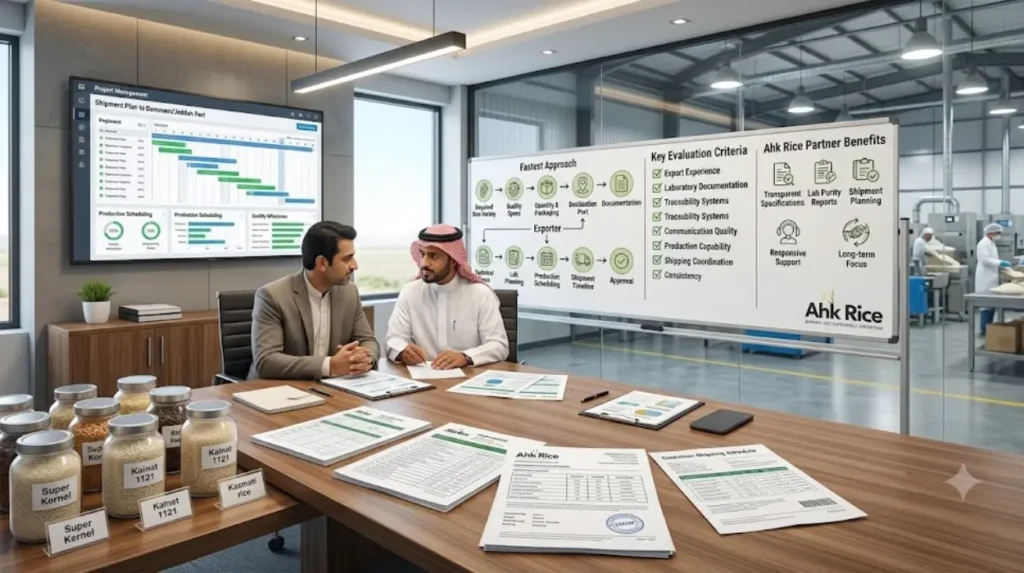
The fastest approach is sharing your required rice variety, quality specifications, quantity, packaging preferences, destination port, and documentation requirements. An experienced exporter can then prepare technical specifications, pricing, laboratory planning, production scheduling, and shipment timelines for approval before manufacturing begins.
Choosing an exporter should involve more than comparing quotations.
Buyers should evaluate:
- Export experience
- Laboratory documentation
- Traceability systems
- Communication quality
- Production capability
- Shipping coordination
- Consistency across previous shipments
AHK Rice works closely with Saudi importers throughout every stage of procurement, from initial enquiry to final delivery documentation. Buyers receive transparent specifications, laboratory purity reports, shipment planning, and responsive commercial support designed for long-term business relationships rather than one-time transactions.
If your organisation requires verified purity analysis reports, technical specifications, competitive export pricing, and reliable shipment planning for Saudi Arabia, contact AHK Rice through our Request a Quote page to discuss your requirements and receive a customised export proposal.
Frequently Asked Questions
What purity analysis reports do Saudi buyers usually request?
Saudi buyers commonly request reports covering varietal purity, moisture content, broken grains, foreign matter, damaged kernels, and other quality parameters to verify that the rice meets contract specifications.
How does AHK Rice verify the purity of Pakistan Basmati rice?
AHK Rice follows a structured quality control process that includes representative sampling, laboratory testing, batch traceability, and report verification before export shipments are approved.
Are third-party laboratory reports available?
Yes. Independent third-party laboratory reports can be arranged based on the buyer’s requirements, providing additional confidence in the quality and authenticity of the shipment.
How long does it take to ship Basmati rice from Pakistan to Saudi Arabia?
Transit times generally range from 14 to 24 days, depending on the Saudi destination port, shipping line schedules, customs procedures, and seasonal conditions.
Can I receive rice samples before placing a bulk order?
Yes. Buyers can request physical samples along with laboratory purity reports to evaluate grain quality, cooking performance, and compliance before confirming a commercial order.
What factors affect the export price of Pakistan Basmati rice?
Pricing depends on the rice variety, purity specifications, packaging type, order quantity, laboratory testing requirements, freight rates, and current market conditions.
Why are purity analysis reports important for Saudi importers?
Purity reports help reduce quality disputes, support customs compliance, verify contract specifications, and provide confidence that the rice meets agreed commercial standards.
How can I start importing Basmati rice from AHK Rice?
Simply share your required rice variety, quantity, packaging specifications, destination port, and documentation needs. AHK Rice will prepare a quotation, sample, and export plan tailored to your requirements.