How Does Crop Year Affect Rice Availability and Supply Planning?
Crop year is one of the most important factors influencing rice availability, pricing stability, inventory management, and procurement decisions. Buyers who understand crop-year dynamics consistently achieve better supply continuity, lower sourcing risk, and improved profit margins than buyers who purchase based only on current market prices.
For importers, wholesalers, food manufacturers, and retail brands, crop year affects every stage of the supply chain. From harvest timing and milling capacity to export scheduling and stock forecasting, understanding how crop years influence rice markets helps businesses make informed purchasing decisions. Before evaluating procurement options, buyers should first understand the fundamentals of rice production cycles through this educational guide on understanding Basmati rice harvesting and production timelines.
AHK Rice, a trusted Pakistani Basmati rice exporter based in Punjab, supplies 1121, Super Kernel, and 1509 varieties to more than 15 countries through integrated processing, custom packaging, and export management. Understanding crop-year behavior allows buyers to evaluate sourcing strategies objectively and select the most suitable procurement model for their market requirements.
What Is a Crop Year and Why Does It Matter?
A crop year represents the complete production cycle from planting and harvesting to processing, storage, distribution, and export. Because rice availability depends on harvest timing, the crop year directly affects inventory levels, market prices, supply continuity, quality consistency, and procurement planning throughout international markets.
A crop year is the annual period during which a rice crop is cultivated and harvested. In Pakistan, Basmati rice planting generally begins during the summer monsoon season, while harvesting occurs during autumn.
After harvest, paddy rice enters milling facilities where husk removal, polishing, grading, sorting, and packaging occur. Export-ready inventory becomes available only after these processes are completed.
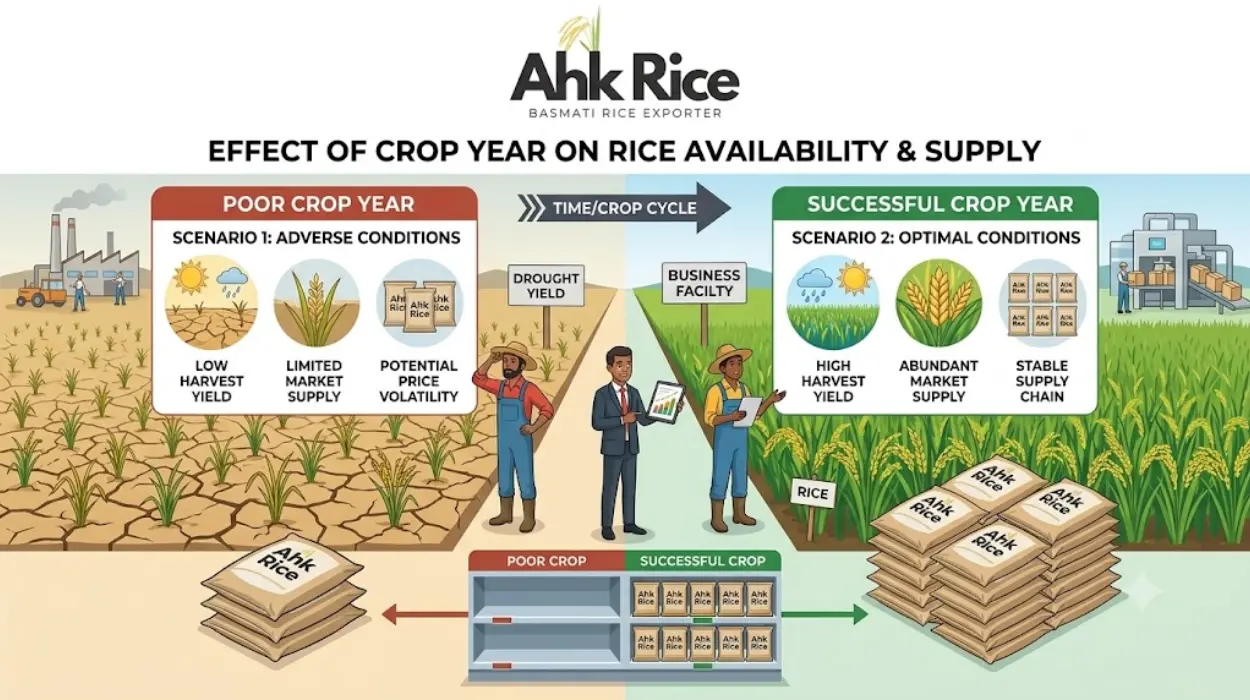
The timing of this cycle determines market supply levels. Immediately after harvest, availability increases significantly. As inventories are consumed throughout the year, available stock gradually declines until the next crop enters the market.
For importers, this cycle influences purchasing decisions, shipment scheduling, warehouse planning, and retail inventory management.
How Does Crop Year Influence Rice Availability?
Rice availability follows predictable seasonal patterns. Supply reaches its highest levels after harvest, gradually decreases during the storage period, and becomes more limited as inventories approach depletion before the next crop enters commercial channels and export markets.
The largest supply volumes enter the market shortly after harvest.
Exporters purchase paddy, process it, and build inventory for domestic and international buyers. During this period, buyers typically experience greater product availability, broader grade selection, and shorter lead times.
As the marketing year progresses, inventories decline.
Premium grades often become less available because high-demand markets absorb stocks earlier than lower-demand grades.
Importers sourcing near the end of a crop cycle may face:
- Reduced stock availability
- Longer procurement times
- Limited grade selection
- Higher replacement costs
- Increased planning complexity
This predictable cycle makes crop-year awareness a critical supply-planning tool.
How Do New Crop and Matured Rice Compare?
New crop rice offers maximum availability and competitive pricing immediately after harvest, while matured rice delivers enhanced cooking performance, aroma development, and consumer acceptance. The optimal choice depends on market expectations, inventory strategy, quality requirements, and commercial objectives.
New Crop vs Matured Rice Specification Comparison
| Attribute | New Crop Rice | Matured Rice |
|---|---|---|
| Availability | Highest | Moderate |
| Purchase Price | Lower | Higher |
| Moisture Content | Higher | Lower |
| Grain Stability | Moderate | High |
| Aroma Development | Developing | Fully Developed |
| Cooking Performance | Good | Excellent |
| Export Demand | Strong | Premium Markets |
New crop rice enters the market immediately after harvest.
Because supply volumes are highest during this period, prices typically remain more competitive.
Matured rice undergoes controlled storage for extended periods. During aging, moisture levels decrease and grain characteristics improve.
This process enhances elongation, texture, aroma, and cooking consistency.
Premium importers often prioritize matured rice because consumers recognize its superior performance.
What Are the Available Supply Planning Solutions?
Importers can manage crop-year risks through spot purchasing, seasonal contracting, inventory stocking, forward procurement, and mixed sourcing models. Each strategy offers distinct advantages regarding flexibility, pricing control, availability assurance, operational complexity, and inventory requirements.
Several procurement approaches are commonly used across international rice markets.
Spot Purchasing
Spot purchasing involves buying rice when immediate demand exists.
Advantages include flexibility and reduced storage costs.
Disadvantages include exposure to price volatility and availability constraints.
Seasonal Procurement
Seasonal procurement occurs shortly after harvest.
Buyers secure inventory during periods of maximum availability.
This strategy often improves cost efficiency.
Forward Contracting
Forward contracts reserve future supply volumes.
Importers gain supply assurance and budgeting predictability.
This model reduces uncertainty during periods of market fluctuation.
Strategic Inventory Stocking
Companies maintain larger warehouse inventories.
This approach improves service reliability and customer fulfillment.
However, inventory carrying costs increase.
Mixed Procurement Strategy
Many large importers combine multiple methods.
Part of annual demand is secured through contracts while additional volumes are purchased based on market conditions.
This balanced approach reduces overall risk.
How Do Different Supply Planning Approaches Compare?
No single procurement strategy performs best across every situation. Companies must balance inventory costs, availability risks, market volatility, demand forecasting accuracy, and operational flexibility when selecting the most effective crop-year sourcing approach for their business model.
Supply Planning Strategy Comparison
| Strategy | Cost Control | Availability Security | Flexibility | Inventory Requirement | Risk Level |
|---|---|---|---|---|---|
| Spot Buying | Moderate | Low | High | Low | High |
| Seasonal Purchasing | High | Medium | Medium | Medium | Medium |
| Forward Contracts | High | High | Low | Medium | Low |
| Inventory Stocking | Medium | High | Low | High | Low |
| Mixed Strategy | High | High | High | Medium | Low |
Businesses with predictable annual demand often benefit from contractual procurement.
Organizations facing fluctuating demand frequently prefer hybrid sourcing models.
The most successful importers typically use a combination of planning tools rather than relying on a single procurement method.
How Does Crop Year Affect Pricing Per Metric Ton?
Crop-year timing significantly influences rice pricing. Prices are generally most competitive immediately after harvest when supply volumes peak, while costs tend to rise as inventories decline, premium grades become scarce, and replacement risks increase.
The relationship between supply and pricing is straightforward.
Higher inventory levels create competitive market conditions.
Lower inventory levels create upward pricing pressure.
Illustrative Price Comparison
| Product Timing | Average Price Range (USD/MT) |
|---|---|
| New Crop 1121 Basmati | $900–$1,050 |
| Mid-Season Stock | $1,000–$1,150 |
| Matured Premium Stock | $1,100–$1,350 |
Actual prices vary according to crop conditions, exchange rates, freight costs, packaging specifications, and destination market requirements.
The pattern remains consistent: abundant supply typically supports lower prices while limited supply increases procurement costs.
Which Markets Prefer New Crop Rice and Which Prefer Matured Rice?
Market preferences vary according to consumer expectations, culinary traditions, retail positioning, and pricing objectives. Some regions prioritize cost efficiency and availability, while others emphasize aroma, grain elongation, aging characteristics, and premium eating quality.
Middle East Markets
Many Gulf countries purchase significant volumes of matured Basmati rice.
Consumers strongly value aroma development and cooking performance.
Premium retail channels frequently prefer aged 1121 and Super Kernel varieties.
United Kingdom and European Markets
European importers often maintain a balanced approach.
Retail brands commonly combine quality requirements with inventory efficiency objectives.
Both new crop and matured rice remain commercially viable depending on target consumers and product positioning.
Understanding regional preferences helps buyers align procurement strategies with market expectations.
How Does Crop Year Affect Shelf Life?
Crop year influences storage behavior and shelf-life performance because grain moisture levels, aging duration, storage conditions, and processing standards collectively determine product stability, cooking consistency, inventory longevity, and export suitability across global distribution networks.
Properly stored rice maintains quality for extended periods.
Matured rice generally demonstrates greater stability because moisture reduction has already occurred during controlled aging.
Shelf Life Comparison
| Product Type | Typical Commercial Shelf Life |
|---|---|
| New Crop Rice | 18–24 Months |
| Matured Rice | 24–36 Months |
Actual shelf life depends on:
- Packaging quality
- Storage temperature
- Humidity control
- Warehouse management
- Transportation conditions
Effective inventory planning considers both crop year and expected product turnover.
Which Supply Planning Method Works Best for Different Buyers?
Different buyers require different procurement models. Procurement strategy should align with annual volume requirements, cash flow capabilities, warehouse capacity, customer expectations, inventory turnover rates, and overall business objectives rather than relying on market trends alone.
Decision Framework
| Buyer Type | Recommended Strategy | Main Benefit |
|---|---|---|
| Small Importer | Seasonal Purchasing | Competitive Pricing |
| Retail Brand | Mixed Strategy | Balanced Risk |
| Food Manufacturer | Forward Contracts | Supply Stability |
| Distributor | Inventory Stocking | Availability Assurance |
| Large Wholesaler | Contract + Seasonal Mix | Cost Optimization |
The best solution depends on operational requirements rather than product characteristics alone.
Businesses with long planning horizons generally achieve stronger supply continuity than businesses relying entirely on reactive purchasing.
What Factors Should Buyers Evaluate Before Planning Supply?
Successful crop-year planning depends on forecasting accuracy, inventory capacity, supplier reliability, market demand patterns, financing resources, and product specifications. Evaluating these factors systematically improves procurement decisions and reduces operational risks throughout the supply chain.
Key decision factors include:
- Annual consumption volume
- Seasonal demand fluctuations
- Warehouse capacity
- Cash flow availability
- Product grade requirements
- Supplier performance history
- Lead-time expectations
- Market growth forecasts
Organizations that evaluate these variables before procurement cycles begin consistently achieve more predictable supply outcomes.
Conclusion
Crop year affects far more than harvest timing. It influences rice availability, grade selection, procurement costs, inventory planning, shelf life, and supply-chain stability throughout international markets.
New crop rice offers maximum availability and attractive pricing immediately after harvest. Matured rice provides enhanced quality characteristics that many premium markets demand. The most effective procurement strategy depends on business objectives, customer expectations, inventory capacity, and market positioning.
Companies that integrate crop-year analysis into procurement planning gain greater control over costs, reduce supply disruptions, and improve long-term inventory management performance.
For buyers evaluating supplier partnerships and long-term sourcing options, the next step is reviewing how to secure consistent Basmati rice supply with a structured procurement strategy (insert BOFU article link here).
Frequently Asked Questions
Does crop year affect rice prices?
Yes. Rice prices typically remain more competitive immediately after harvest due to higher inventory availability. Prices often increase later in the marketing cycle as stocks decline and premium grades become less accessible.
Is matured rice always better than new crop rice?
Not necessarily. Matured rice offers superior aroma and cooking performance, but new crop rice often provides better pricing and wider availability. The best choice depends on market requirements and commercial objectives.
When should importers purchase rice for the best availability?
Availability is generally highest shortly after harvest when exporters have maximum inventory levels and the broadest selection of grades and specifications.
Which Basmati varieties are most commonly exported?
Popular export varieties include 1121 Basmati, Super Kernel Basmati, and 1509 Basmati. Each serves different market requirements based on grain characteristics, pricing, and consumer preferences.
Why is crop-year planning important for importers?
Crop-year planning helps importers forecast availability, manage inventory efficiently, reduce procurement risk, improve budgeting accuracy, and maintain uninterrupted supply throughout the year.