Partner with AHK Rice for Audited Basmati Rice Supply in Illinois, USA
Illinois distributors choosing a Pakistani Basmati rice supplier should prioritize documented factory controls, repeatable specifications, export compliance, and shipment reliability rather than selecting solely on FOB price. A supplier that can demonstrate its processing, inspection, packaging, and documentation systems reduces quality, compliance, and replenishment risks.
For Illinois buyers, factory audit documentation is especially useful when the rice will enter established wholesale, retail, food-service, or private-label distribution channels. It gives procurement teams evidence that the supplier can repeatedly produce and release rice against an agreed specification.
If you are evaluating why audit evidence matters before selecting a supplier, review:
Why Illinois distributors request factory audit documentation before moving into supplier selection.
What is the best solution for audited Basmati rice supply to Illinois?
The strongest solution is a supplier-controlled export program combining audited processing, documented quality checks, pre-shipment verification, compliant packaging, complete export documentation, and planned ocean logistics. This approach gives Illinois distributors measurable controls before production, loading, shipment, and final receiving.
The objective is not simply to buy Basmati rice from Pakistan. The objective is to establish a repeatable supply chain in which product specifications remain controlled from paddy selection through container loading.
AHK Rice operates from Bucheki, Nankana Sahib, Punjab, and supplies Pakistani Basmati varieties including 1121, Super Kernel, and 1509. Its published export model covers sourcing, processing, grading, color sorting, packaging, documentation, and container loading.
For an Illinois distributor, the practical starting point is a written product specification. This should define variety, grain length, moisture target, broken percentage, foreign matter, damaged grains, milling degree, packaging format, net weight, labeling requirements, and acceptable tolerances.
The factory audit then verifies whether the supplier’s operating practices can consistently support that specification.
A useful audit file should cover raw-material receiving, storage conditions, milling, polishing, grading, color sorting, laboratory testing, pest-control practices, packaging, traceability, sanitation, finished-goods storage, loading controls, and document management.
The buyer can then compare the supplier’s documented process with the actual requirements of the distribution business.
Why choose the USA service from AHK Rice?
The USA service is suitable for buyers needing Pakistani Basmati rice with coordinated processing, packaging, documentation, sampling, container preparation, and international shipping support. It connects product specifications with the operational steps required for commercial U.S. import distribution.
The USA rice export service is designed around the requirements of American importers, distributors, wholesalers, retailers, and food-service businesses.
AHK Rice supplies the U.S. market with products such as 1121 Basmati, Super Kernel, and 1509. Buyers can specify white, steamed, parboiled, brown, or other required processing formats according to the commercial application.
The main advantage for an Illinois distributor is coordination. Instead of treating milling, testing, packaging, export documentation, and shipping as separate supplier activities, the order can be managed as one export workflow.
This matters when a distributor has fixed receiving windows or customer commitments. A delayed quality approval can affect production scheduling. A packaging error can create relabeling work. A documentation problem can delay customs clearance. A specification mismatch can create inventory that does not fit the intended sales channel.
AHK Rice’s published quality information also identifies certifications including ISO 22000:2018, HACCP, ISO 9001:2015, GMP, and Halal. Buyers should still request current copies and confirm which certificates apply to the specific facility and shipment before contracting.
Factory audit evidence should also be treated separately from certification. Certification demonstrates conformity to a particular standard or management system, while an audit requested by a buyer can examine the specific operational controls relevant to that buyer’s rice specification.
For a deeper comparison of audit criteria, the related guide on:
How rice processing facilities are evaluated during export audits can be used alongside the supplier’s current audit documentation.
What should an Illinois distributor verify before placing an order?
An Illinois distributor should verify product specifications, factory audit records, current certifications, laboratory testing, food-facility information, traceability, packaging controls, export documents, shipment history, and sample approval before committing to a recurring commercial rice supply agreement.
The first checkpoint is the product specification. A supplier should confirm exactly which variety and grade will be produced. For example, a buyer purchasing 1121 Basmati should not rely on the broad description “premium Basmati” alone.
The second checkpoint is process control. The buyer should understand where paddy is sourced, how it is cleaned, how milling and grading are performed, how broken grains are separated, and whether optical color sorting is available.
The third checkpoint is laboratory control. Depending on the contract, testing can cover moisture, broken percentage, grain dimensions, foreign matter, damaged grains, purity, and relevant contaminant or residue parameters. The exact testing plan should reflect the buyer’s specification and U.S. regulatory requirements.
The fourth checkpoint is traceability. A commercial lot should be identifiable through production and packing records so that quality issues can be investigated without relying on assumptions.
The fifth checkpoint is export compliance.
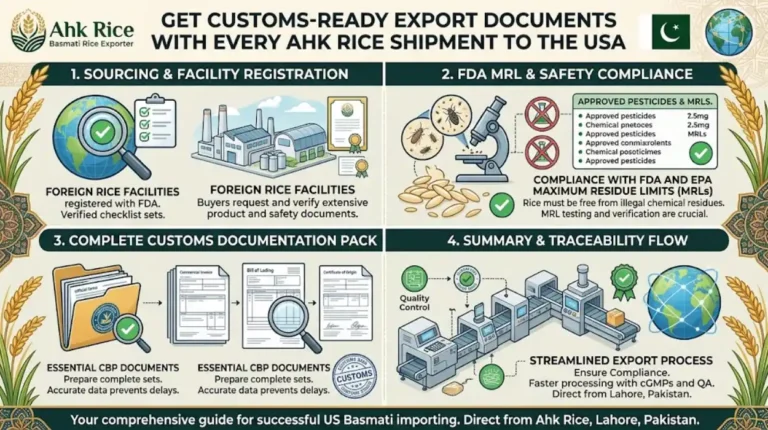
For U.S. food imports, FDA requirements include applicable foreign food facility registration and Prior Notice procedures. Imported food may also be inspected at entry. The importer remains responsible for ensuring that the imported food meets U.S. requirements.
FSVP responsibilities also need to be assigned between the U.S. importer and foreign supplier. The commercial contract should clearly identify who maintains the required records and who acts in each compliance role.
APHIS requirements should also be checked for the specific commodity, origin, treatment, and port conditions. Requirements can change according to commodity and country, so an importer should verify the current applicable rules before shipment.
This is where audit documentation becomes commercially valuable. It does not replace U.S. regulatory compliance. It provides operational evidence that supports supplier qualification and risk management.
How does the sample process work, and what does it cost?
A practical sample process begins with specification confirmation, moves through sample preparation and courier dispatch, then proceeds to buyer testing and approval before commercial production. Sample cost is usually driven by courier, certification, testing, packaging, and requested sample quantity.
AHK Rice publishes sample options on its U.S. product pages, including samples of up to 20 kg for certain products, with courier costs generally handled by the buyer. Some samples may also require a phytosanitary certificate or other documentation depending on the shipment and destination requirements.
A commercial sample workflow can be structured as follows.
Step 1: Confirm the specification
The buyer provides variety, grade, processing type, packaging preference, target quantity, destination, and quality parameters. This prevents the supplier from sending a generic sample that does not represent the eventual commercial order.
Step 2: Prepare the representative sample
The supplier selects and packs a sample corresponding as closely as possible to the proposed commercial specification. For a distributor, the sample should represent the actual grade rather than an upgraded promotional grade.
Step 3: Arrange courier shipment
The buyer can use its courier account or agree on another shipping arrangement. Courier charges depend on destination, weight, service level, and current carrier pricing.
Step 4: Complete applicable documentation
If a certificate or export document is required for the sample, the related government or administrative cost should be identified before dispatch. The buyer should receive the tracking number and shipment documents.
Step 5: Test and approve
The Illinois distributor can conduct internal testing or use an independent laboratory. The evaluation should cover the parameters that will appear in the commercial purchase specification.
Step 6: Freeze the approved specification
Once approved, the final specification should be attached to the purchase order or sales contract. This creates a reference point for production and pre-shipment inspection.
A practical sample budget should therefore avoid promising a universal dollar amount. Courier charges change frequently, while certification and laboratory costs depend on the shipment. A buyer should request a sample-cost breakdown before dispatch.
How many shipping days should Illinois buyers plan for?
Illinois buyers should plan commercial shipments as a multi-stage process rather than using one fixed transit number: production and loading may require several days, ocean transit commonly takes several weeks, and U.S. port, customs, rail, or truck movement adds additional time.
For a Pakistan-to-Illinois shipment, the supply chain normally involves factory preparation in Punjab, inland movement to Karachi, port handling, vessel departure, ocean transportation, U.S. port discharge, customs and regulatory processing, inland rail or truck transportation, and final delivery.
A realistic planning model is more useful than promising an exact number of days.
For example, an order may require approximately 7–15 days for specification confirmation, production, final inspection, packaging, documentation, and container loading when the required stock and packaging are available. Ocean transit and transshipment can then require several additional weeks depending on the selected service and U.S. gateway.
Illinois delivery adds another logistics stage. Cargo entering through an East Coast or Gulf gateway may require inland rail or truck movement toward Chicago-area distribution facilities. A West Coast routing may use rail or truck connections into Illinois depending on the carrier and service design.
For planning purposes, an Illinois distributor should commonly allow roughly 45–65 days from confirmed order readiness to final inland delivery, while recognizing that vessel schedules, transshipment, port congestion, customs examinations, weather, and inland capacity can move the actual timeline outside that range.
The correct contractual approach is therefore to separate:
- Production and loading time
- Vessel booking time
- Port handling time
- Ocean transit
- U.S. customs and regulatory clearance
- Inland transportation
- Final delivery appointment
AHK Rice can coordinate the export stages, but the final delivery schedule depends on the shipping line, port, customs process, inland carrier, and agreed Incoterm.
For Illinois buyers, this distinction is important because a supplier can complete production on schedule while the vessel or inland leg changes the final arrival date.
What results can Illinois distributors expect from an audited supply program?
The expected result is greater specification consistency, clearer supplier accountability, better documentation readiness, fewer avoidable quality disputes, and stronger purchasing visibility. Audit documentation cannot eliminate every logistics or regulatory risk, but it makes controllable risks easier to manage.
Consider an Illinois distributor ordering 1121 Basmati for multiple retail customers. Without a documented specification, the supplier may interpret “premium 1121” differently from the buyer.
With an approved specification, sample, audit file, laboratory report, packaging proof, and pre-shipment inspection process, both sides have measurable reference points.
The same principle applies to Super Kernel or 1509. The commercial value comes from matching the rice grade to the buyer’s sales channel rather than selecting a product based only on a catalogue description.
An audited supply program can also improve purchasing decisions over several shipments. The distributor can compare shipment results against the approved specification and identify recurring issues.
For example, if three consecutive containers meet the same moisture, broken-grain, purity, packaging, and weight requirements, the buyer has stronger evidence for continuing the supplier relationship.
AHK Rice can support this approach through its integrated processing and export model. Its public company information states that it manages activities from paddy procurement through container loading and offers grading, color sorting, customized packaging, and export documentation.
The result is not simply “better rice.” The commercial outcome is a more controlled procurement process.
What factors affect the price of audited Basmati rice supply?
The final price depends on rice variety and grade, crop and raw-paddy conditions, processing requirements, testing, packaging, order volume, inspection requirements, Incoterm, destination, freight market conditions, insurance, documentation, and any special compliance requirements.
FOB price should therefore be evaluated against the complete landed-cost model.
AHK Rice publicly lists an indicative starting price of around $1,100 per metric ton FOB Karachi for one U.S.-market 1121 product page, but that figure should not be treated as a fixed 2026 quotation for Illinois orders.
Rice prices move according to variety, grade, crop availability, milling yield, grain specifications, packaging, order quantity, and market conditions.
A buyer ordering standard bulk PP bags will normally have a different cost structure from a private-label distributor requiring printed packaging, retail-ready units, special artwork, pallets, additional testing, or inspection.
The Incoterm also matters. FOB Karachi places a different logistics and cost responsibility on the buyer than a delivered arrangement.
Audit requirements can add costs when the buyer requests an independent third-party audit, additional laboratory analysis, special certification, or repeated pre-shipment inspection. These costs should be quoted separately rather than hidden inside an unexplained product premium.
For an Illinois distributor, the correct comparison is therefore:
Product cost + processing + packaging + inspection/testing + export documentation + ocean freight + U.S. charges + inland transportation = landed cost.
That calculation provides a more useful supplier comparison than FOB price alone.
How should an Illinois distributor start with AHK Rice?
Start by sending the required rice specification, annual or trial quantity, packaging format, Illinois delivery point, preferred Incoterm, documentation requirements, and audit expectations. A supplier can then prepare the sample, commercial specification, pricing structure, and shipment plan.
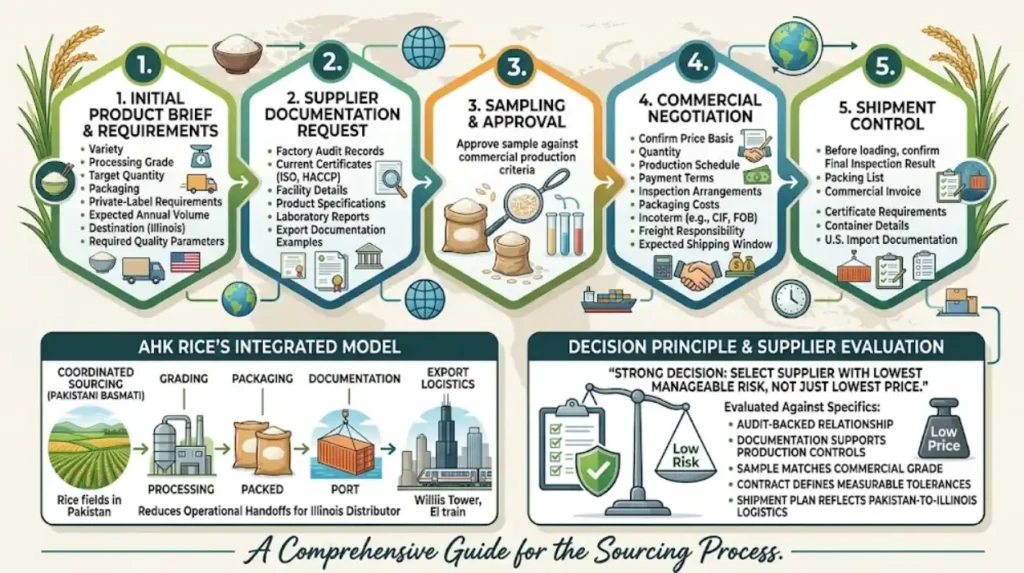
The first step should be a written product brief. Include the variety, processing grade, target quantity, packaging, private-label requirements, expected annual volume, destination, and required quality parameters.
The second step is supplier documentation. Request the relevant factory audit records, current certificates, facility details, product specifications, laboratory reports, and export documentation examples.
The third step is sampling. Approve the sample against the same criteria that will be used for commercial production.
The fourth step is commercial negotiation. Confirm price basis, quantity, production schedule, payment terms, inspection arrangements, packaging costs, Incoterm, freight responsibility, and expected shipping window.
The fifth step is shipment control. Before loading, confirm the final inspection result, packing list, commercial invoice, certificate requirements, container details, and applicable U.S. import documentation.
AHK Rice is positioned for buyers that want one supplier to coordinate Pakistani Basmati sourcing, processing, grading, packaging, documentation, and export logistics. For an Illinois distributor, that integrated model can reduce the number of operational handoffs involved in a recurring import program.
The strongest decision is not simply to select the lowest quoted metric-ton price. It is to select the supplier whose documentation, product controls, commercial terms, and logistics process provide the lowest manageable risk for the intended distribution model.
AHK Rice should therefore be evaluated against the same specification and evidence requirements used for any serious international supplier qualification. An audit-backed relationship is most valuable when the documentation supports actual production controls, the sample matches the commercial grade, the contract defines measurable tolerances, and the shipment plan reflects the realities of Pakistan-to-Illinois logistics.
For an Illinois distributor ready to move from supplier evaluation to a defined commercial specification, sample, and shipment quotation, request a quote.
Frequently Asked Questions
What makes AHK Rice suitable for Illinois Basmati rice distributors?
AHK Rice provides Pakistani Basmati rice with documented processing, grading, packaging, quality control, export documentation, and shipment coordination for U.S. buyers.
What Basmati rice varieties can Illinois buyers source from AHK Rice?
Illinois distributors can source varieties including 1121 Basmati, Super Kernel, and 1509 Basmati in specifications suited to retail, wholesale, food-service, and private-label requirements.
Does AHK Rice provide factory audit documentation?
Yes. Buyers can request relevant factory audit records and supporting quality documentation to evaluate processing controls, traceability, sanitation, testing, packaging, and production procedures.
Can Illinois distributors request rice samples before placing a bulk order?
Yes. AHK Rice can arrange representative product samples so buyers can evaluate grain appearance, cooking characteristics, purity, moisture, broken percentage, and other agreed specifications before commercial production.
How much does a Basmati rice sample from Pakistan cost?
Sample costs depend on quantity, courier service, destination, testing, certification, and documentation requirements. Buyers should request a current sample-cost breakdown before dispatch.
How long does Basmati rice shipping from Pakistan to Illinois take?
A Pakistan-to-Illinois shipment can commonly require around 45–65 days from order readiness to final inland delivery, depending on production, vessel schedules, port clearance, ocean transit, and inland transportation.
What factors affect the price of Basmati rice for Illinois importers?
Price depends on rice variety, grade, crop conditions, processing, order quantity, packaging, testing, inspection, Incoterms, ocean freight, documentation, and inland delivery requirements.
Can AHK Rice provide customized packaging for Illinois distributors?
Yes. AHK Rice supports customized packaging, allowing distributors to specify packaging formats, weights, branding, and other requirements according to their commercial distribution needs.