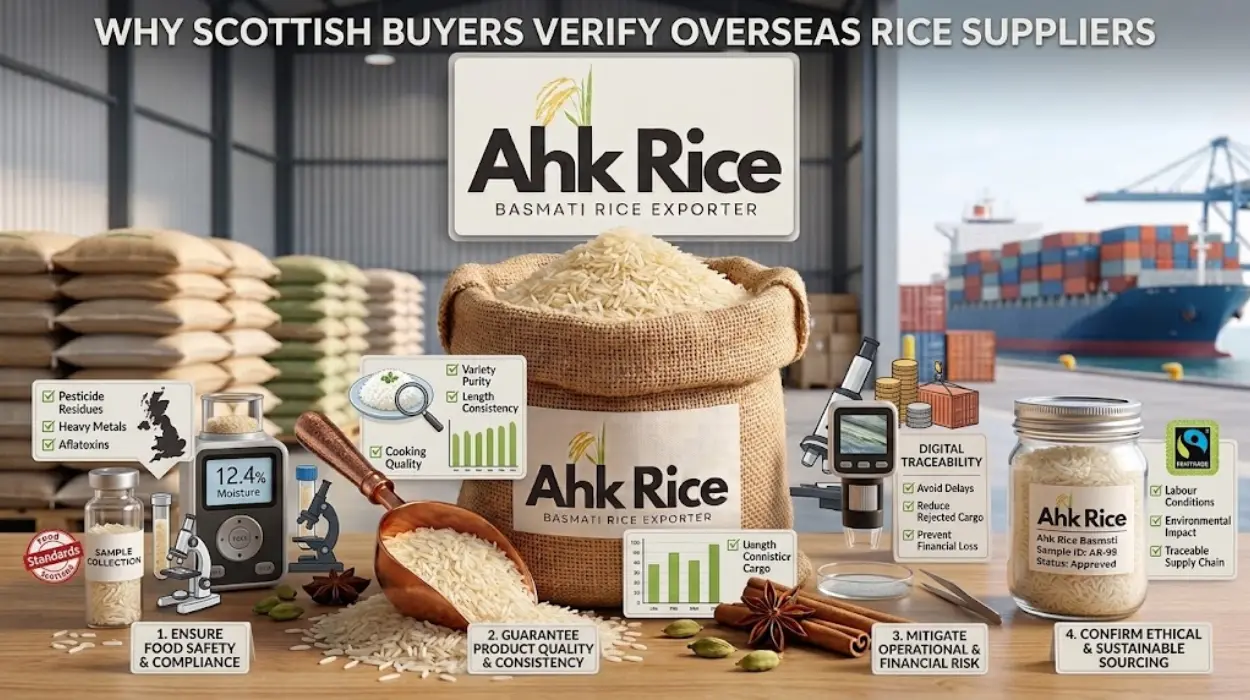
Why Do Scottish Buyers Verify Overseas Rice Suppliers Before Purchase?
Scottish buyers verify overseas rice suppliers before purchase to confirm food safety, product specifications, traceability, documentation, processing controls, and delivery reliability. Here is why: imported rice must meet GB food standards, while the buyer remains responsible for sourcing safe and correctly described food.
What Does Overseas Rice Supplier Verification Mean?
Supplier verification is a structured review of the exporter, rice specification, processing facility, certifications, laboratory records, traceability system, packaging, and export documents before commercial purchase. Scottish buyers use these checks to control quality and supply-chain risks.
Overseas supplier verification starts with the exporter’s legal identity and production capability. Buyers review the company name, factory address, product range, processing capacity, export history, and available documentation. A supplier must connect its commercial identity with the physical facility producing the rice.
Product verification follows the supplier review. Buyers compare the proposed rice with the required variety, grade, grain length, broken percentage, moisture level, foreign matter specification, crop year, packaging format, and quantity. Examples include 1121 Basmati, Super Kernel Basmati, and 1509 Basmati.
UK customs classification also depends on how rice is processed. HMRC classifies rice under heading 1006 across categories including husked, milled, polished, parboiled, and broken rice. Basmati is described as aromatic, fragrant, slender, long-grain rice.
Supplier verification therefore connects three areas: the exporter, the product, and the import requirements. A Scottish buyer needs all 3 areas to match before placing a purchase order.
Why Do Scottish Buyers Verify Pakistani Basmati Rice Suppliers?
Scottish buyers verify Pakistani Basmati suppliers to control food-safety, specification, traceability, customs, packaging, and commercial risks before rice enters the Scottish supply chain. These checks establish documented evidence for each purchase.
Food safety is the first reason. Imported food entering Scotland must meet GB standards for public and animal health. Food Standards Scotland states that imported food must comply with GB requirements, with additional controls applying to higher-risk products.
Traceability is another core reason. UK food businesses must maintain records identifying suppliers, customers, product types, quantities, transaction dates, and delivery dates. These records support rapid withdrawal or recall when food safety problems occur.
Specification control protects the buyer from receiving a different grade than the contracted product. A purchase order for 1121 Steam requires verification of the processing method, grain specification, broken percentage, moisture, packaging, and agreed tolerance.
Commercial verification also protects stock planning. A Scottish wholesaler, restaurant distributor, or ethnic food retailer needs predictable quantities and consistent specifications across repeated shipments. Supplier records provide evidence before the buyer commits to larger volumes.
Where Is Pakistani Basmati Rice Grown?
Pakistani Basmati rice is cultivated primarily in Punjab, where suitable soil, irrigation, climate, and agricultural conditions support aromatic long-grain rice production. Punjab is the main production context for Pakistan’s Basmati export supply.
Punjab supports rice cultivation through irrigated agricultural areas and established rice-processing infrastructure. The production chain begins with paddy cultivation and continues through harvesting, drying, milling, grading, sorting, packing, and export preparation.
Pakistan’s export sector supplies several Basmati specifications. AHK Rice operates from Punjab and supplies 1121, Super Kernel, and 1509 varieties to international markets.
The product identity matters during supplier verification. A buyer must distinguish variety from processing grade. For example, 1121 White and 1121 Golden Sella share the 1121 variety but use different processing methods.
This distinction also affects buyer applications. Retail packs, wholesale sacks, restaurant supply, catering contracts, and foodservice distribution can require different specifications. The supplier therefore needs to match the product to the buyer’s intended use.
How Is Pakistani Basmati Rice Processed Before Export?
Export rice passes through cleaning, dehusking, milling, polishing, grading, optical sorting, quality inspection, packing, and dispatch controls before shipment. Each stage removes defects or establishes a measurable specification for the finished product.
What Are the Main Processing Steps?
1. Clean the paddy.
Cleaning removes stones, dust, straw, and other field material before further processing.
2. De-husk the grain.
De-husking removes the outer husk and produces brown rice for subsequent milling.
3. Mill the rice.
Milling removes bran layers and produces the required white-rice appearance and finish.
4. Polish the grain.
Polishing refines the surface and establishes the visual finish required for the selected grade.
5. Grade the rice.
Grading separates grains according to length, broken percentage, and other defined specifications.
6. Sort the rice.
Optical sorting identifies defective grains, discoloured grains, foreign material, and other visual impurities.
7. Inspect the batch.
Quality inspection checks the finished product against the agreed specification.
8. Pack the rice.
Packing places the approved product into the agreed retail, foodservice, or wholesale packaging.
9. Dispatch the shipment.
Dispatch controls connect the finished batch with export documentation, container loading, shipping, and delivery arrangements.
These steps give Scottish buyers a traceable production sequence. The buyer can request evidence for processing controls rather than relying only on a supplier’s product description.
Which Pakistani Basmati Grades Do Scottish Buyers Encounter?
Scottish buyers can encounter White, Steam, Sella, Creamy Sella, and Brown processing grades across Pakistani Basmati varieties, including 1121, Super Kernel, and 1509. The final choice depends on cooking, retail, foodservice, and specification requirements.
1121 Basmati
1121 Basmati is a long-grain aromatic variety widely used in international rice markets. Available processing forms include 1121 White, 1121 Steam, 1121 Golden Sella, 1121 Creamy Sella, and 1121 Brown.
Super Kernel Basmati
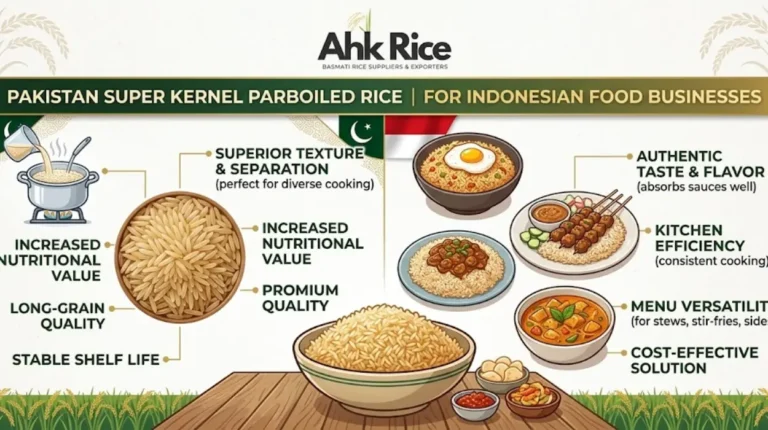
Super Kernel is a Pakistani Basmati variety used across wholesale, retail, and foodservice applications. Available processing forms include Super Kernel White, Super Kernel Steam, Super Kernel Sella, and Super Kernel Parboiled.
1509 Basmati
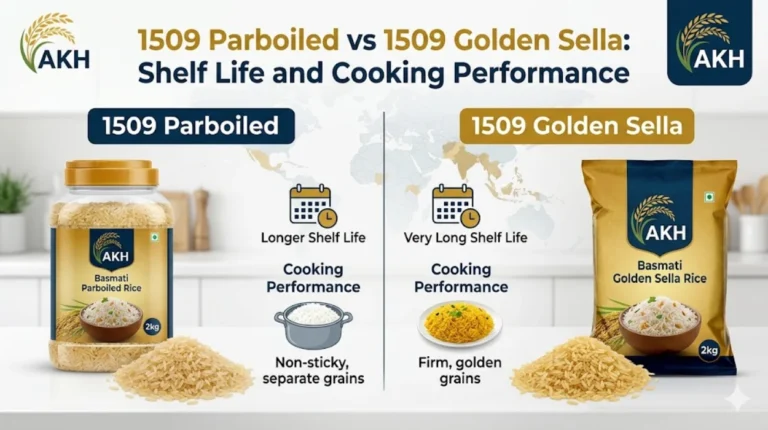
1509 is another Pakistani long-grain Basmati variety used for export supply. Available processing forms include 1509 White, 1509 Golden Sella, and 1509 Steam.
Scottish buyers compare these grades through measurable specifications. Grain appearance, cooking characteristics, processing method, broken percentage, moisture, packaging, and intended application form the practical comparison.
What Certifications and Documents Should Buyers Check?
Scottish buyers should review applicable food-safety certifications, laboratory reports, product specifications, traceability records, company documentation, and export documents before purchase. The exact document set depends on the product, origin, destination, and applicable UK controls.
Food-safety certification provides evidence of a supplier’s management system. Buyers commonly review certifications connected with recognised food-safety standards, alongside factory audit records and documented quality procedures.
Laboratory testing provides product-specific evidence. Relevant testing can cover moisture, microbiological parameters, pesticide residues, contaminants, foreign matter, and other specification requirements. Testing requirements depend on the applicable product and legal controls.
Traceability documentation connects the finished bag to the production batch. A buyer should be able to identify the supplier, product, quantity, transaction, delivery, and batch information. UK guidance specifically requires traceability records through the food supply chain.
Import documentation also requires accuracy. Current UK rice import arrangements include tariff and licensing rules that vary according to rice classification, origin, quantity, and quota arrangements. Current 2026 guidance specifically identifies Pakistan under certain rice quota provisions.
How Does Supplier Verification Work Before a Scottish Purchase?
Supplier verification follows a defined sequence: identify the exporter, verify the factory, confirm the rice specification, review certifications, inspect test evidence, approve packaging, check documents, and evaluate shipment capability.
What Should Buyers Check First?
1. Verify the exporter. Confirm the registered company identity, factory location, contact details, product range, and export documentation.
2. Verify the factory. Review processing equipment, quality controls, storage conditions, cleaning systems, sorting technology, and production capability.
3. Verify the product. Match variety, processing grade, grain specification, moisture, broken percentage, foreign matter, crop year, and packaging.
4. Verify laboratory evidence. Review current reports against the buyer’s specification and applicable UK requirements.
5. Verify certifications. Check certificate scope, issuing body, validity, site identity, and covered processing activities.
6. Verify traceability. Confirm batch coding and records connecting paddy, processing, packing, and shipment.
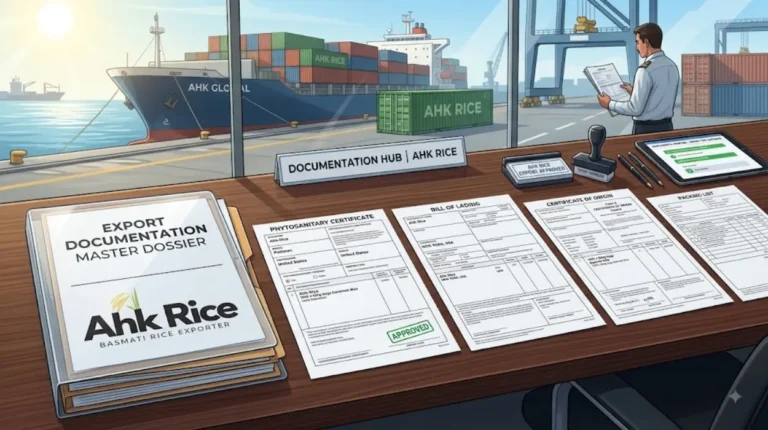
7. Verify export documents. Match commercial invoices, packing lists, certificates of origin, shipping documents, and other required paperwork.
8. Verify logistics. Confirm container loading procedures, shipment schedule, port arrangements, and document release process.
This sequence reduces uncertainty before a purchase order becomes a shipment. Buyers seeking a deeper commercial evaluation can compare these criteria in a dedicated guide on how businesses evaluate Pakistani Basmati rice export partners.
What Benefits Does Supplier Verification Provide?
Supplier verification gives Scottish buyers documented control over quality, compliance, traceability, purchasing risk, and shipment consistency before money and inventory become committed. The process turns supplier selection into a specification-based decision.
Quality control improves because the buyer establishes measurable requirements before purchase. Examples include maximum broken percentage, moisture specification, foreign matter limits, packaging weight, grain appearance, and processing grade.
Compliance control improves because documents are checked before shipment. This approach supports accurate customs declarations and reduces document discrepancies during import clearance.
Traceability improves because each shipment links to defined supplier and product records. UK guidance requires food businesses to maintain traceability information for effective withdrawal and recall procedures.
Commercial planning also improves. A verified supplier gives the buyer a defined specification for repeat purchasing. The buyer can compare future lots against the original approved standard.
What Common Problems Do Scottish Buyers Find During Verification?
Common verification problems include incomplete certificates, inconsistent specifications, weak traceability, unclear factory ownership, unsuitable packaging, missing laboratory evidence, and inaccurate export documentation. Each problem creates a separate purchasing or compliance risk.
Certificate errors often involve expired documents, incorrect factory names, or certificates covering activities outside the purchased product.
Specification gaps occur when suppliers describe rice using broad terms such as “premium Basmati” without defining measurable values. A proper specification states the variety, grade, grain requirements, broken percentage, moisture, packaging, and tolerances.
Traceability gaps occur when batch numbers do not connect processing records with finished cartons or bags. This prevents efficient product tracking during quality investigations.
Documentation errors also create import problems. UK guidance requires accurate information for import licensing and customs processes, while current rice arrangements contain origin-specific provisions.
A common misconception is that a low purchase price proves supplier value. Price only describes one commercial variable. Supplier verification compares price with specification, compliance, consistency, documentation, and shipment performance.
Which Markets Import Pakistani Basmati Rice?
Pakistani Basmati rice serves international markets across the Middle East, Europe, Africa, and Asia, with buyers selecting grades according to retail, wholesale, catering, and foodservice requirements.
Common destination markets include the United Kingdom, UAE, Saudi Arabia, Qatar, other GCC markets, Morocco, North Africa, and the Philippines. Each market applies different commercial specifications and import procedures.
UK buyers focus strongly on food safety, traceability, labelling, customs classification, packaging, and documented supplier controls. Scotland follows GB import requirements, with Food Standards Scotland responsible for food import oversight in Scotland.
Market selection therefore starts with product suitability. A supplier serving multiple markets needs a documented process for adapting packaging, specifications, export documents, and shipment requirements.
The same Basmati variety can appear in different commercial formats. Scottish buyers therefore verify the exact grade and specification rather than purchasing solely by variety name.
What Should Scottish Buyers Remember Before Purchasing Overseas Rice?
Scottish buyers should verify the supplier, factory, product, processing grade, laboratory evidence, certification, traceability, packaging, documentation, and logistics before approving an overseas rice purchase.
The verification process starts with the exporter and ends with shipment readiness. Every stage should produce evidence that connects the supplier, rice batch, specification, documents, and destination requirements.
Pakistani Basmati rice offers several varieties and processing grades. The correct purchasing decision depends on measurable product requirements rather than a variety name alone.
For Scottish importers, verification also supports legal food-supply responsibilities. Imported food must meet GB standards, while food businesses need traceability records covering their supply chain.
Supplier verification therefore functions as a practical purchasing control. It establishes what the buyer is purchasing, who produced it, how it was processed, how it was tested, and how the shipment will move into the Scottish market.
Frequently Asked Questions
Why do Scottish buyers verify overseas rice suppliers?
Scottish buyers verify overseas suppliers to confirm food safety, product specifications, traceability, certifications, documentation, packaging, and shipment capability before purchase.
What Pakistani Basmati varieties do overseas suppliers offer?
Common Pakistani Basmati varieties include 1121, Super Kernel, and 1509. Each variety has multiple processing grades for different commercial applications.
What documents should Scottish rice buyers review?
Buyers should review supplier documentation, product specifications, laboratory reports, applicable certifications, traceability records, commercial documents, packing lists, certificates of origin, and required import documentation.
Does Pakistani rice need quality testing before export?
Quality testing provides evidence that the shipment meets the agreed product specification and applicable requirements. Testing parameters depend on the product, destination, and relevant legal controls.
What is the difference between rice variety and processing grade?
A variety identifies the rice type, such as 1121 or Super Kernel. A processing grade identifies how that rice is processed, such as White, Steam, Sella, or Brown.
Why is traceability important for Scottish food businesses?
Traceability allows businesses to identify suppliers, products, quantities, transactions, and deliveries. These records support effective withdrawal and recall procedures.