Why Should Maryland Importers Verify Rice Quality Before Purchase?
Maryland importers should verify rice quality before purchase because product specifications determine food safety, commercial yield, consumer acceptance, regulatory compliance, and the final landed cost. A low FOB price does not compensate for excess broken kernels, inconsistent moisture, damaged grains, contamination, incorrect variety, or non-compliant documentation.
Rice imported into Maryland enters the U.S. food regulatory system. FDA requires imported food to be safe, sanitary, and accurately labeled. Importers are responsible for meeting applicable U.S. requirements, while imported shipments remain subject to FDA review at entry.
For Pakistani Basmati rice, verification also needs to distinguish variety from commercial grade. Pakistan produces aromatic rice in Punjab and other rice-growing regions, while Basmati production remains concentrated in selected Punjab districts. USDA’s 2025/26 estimate places Pakistan’s milled rice production at about 9.8 million metric tons, demonstrating the scale of the country’s rice supply.
What does rice quality verification mean for Maryland importers?
Rice quality verification is the documented process of checking a rice shipment against agreed specifications before purchase and shipment. It covers variety, grain length, broken percentage, moisture, foreign matter, damaged kernels, milling quality, appearance, aroma, food safety, packaging, and export documentation.
The verification process starts with a written purchase specification. The specification identifies the exact rice product rather than relying on a generic term such as “premium Basmati.”
For example, a buyer sourcing Pakistani Basmati can specify 1121 Basmati, Super Kernel Basmati, or 1509 Basmati. Each specification can then define grain length, broken percentage, moisture limit, milling degree, sortex quality, packaging format, crop year, and required laboratory tests.
This distinction is important because the term “Basmati” describes an aromatic rice category, while a commercial purchase contract contains measurable quality parameters. Pakistan’s Trade Development Authority maintains a formal Basmati specification framework that includes recognized varieties such as PK 1121 aromatic and other Basmati types.
Verification therefore converts a product description into measurable acceptance criteria.
Where is Pakistani Basmati rice grown?
Pakistani Basmati rice is primarily associated with selected rice-growing districts of Punjab, where climate, soil, irrigation, and traditional cultivation support aromatic long-grain varieties. Basmati production is more geographically concentrated than Pakistan’s broader non-Basmati rice production.
Punjab is central to Pakistan’s Basmati supply chain. USDA reports that Basmati cultivation is limited to a few districts in Punjab, while other rice-growing zones support long-grain and coarse varieties.
The production environment affects grain characteristics. Temperature during crop development, water availability, harvesting conditions, drying practices, and storage conditions influence moisture, kernel integrity, aroma, and milling performance.
Pakistan’s rice supply also extends beyond Punjab. Sindh produces substantial quantities of non-Basmati rice and other long-grain varieties. The distinction matters for importers because geographic origin alone does not establish the quality of a specific shipment.
A Maryland buyer therefore needs lot-level evidence rather than relying only on the country-of-origin statement.
Which Pakistani rice varieties can Maryland importers verify?
The main Pakistani Basmati varieties relevant to this purchasing model are 1121, Super Kernel, and 1509. Each variety has different grain characteristics, cooking behavior, market positioning, and specification requirements, so buyers need variety-specific inspection criteria.
1121 Basmati
1121 Basmati is a long-grain aromatic variety recognized in Pakistan’s Basmati specification framework. Its unusually long grain and post-cooking elongation make it widely used for premium rice applications.
Verification focuses on grain length, uniformity, broken kernels, moisture, milling quality, whiteness, foreign matter, and aroma. A buyer also needs to confirm that the shipment actually matches the contracted 1121 specification.
Super Kernel Basmati
Super Kernel Basmati is another Pakistani premium aromatic rice specification used in export trade. It is assessed through measurable physical and milling characteristics rather than the product name alone.
The buyer’s specification can include kernel dimensions, broken percentage, moisture, damaged kernels, foreign material, milling degree, and packaging requirements.
1509 Basmati
1509 Basmati is an aromatic long-grain variety used in Pakistani rice exports. It is commonly evaluated according to grain appearance, length, moisture, broken percentage, milling quality, and cooking performance.
For all three varieties, the exact commercial specification needs to appear in the purchase contract. The same variety name does not automatically establish identical quality between two suppliers.
How is rice processed before export?
Export rice processing converts harvested paddy into cleaned, milled, sorted, graded, inspected, and packed rice through controlled stages. Each stage removes a different quality risk, from field impurities and husk to broken kernels, discolored grains, foreign matter, and inconsistent packaging.
Paddy receiving and sampling
The process begins when harvested paddy arrives at the processing facility. Samples are taken to assess incoming quality.
The sample identifies factors such as moisture, impurities, immature grains, damaged kernels, and general paddy condition. This stage establishes the starting quality before milling.
Drying and conditioning
Paddy requires controlled moisture management before milling. Excess moisture affects milling performance and storage stability, while excessive drying increases the risk of kernel breakage.
Controlled drying and conditioning help maintain kernel integrity before the husking stage.
Dehusking
A husker removes the outer rice hull from paddy. The output contains brown rice and residual paddy kernels.
The objective is efficient husk removal while protecting the rice kernel from unnecessary mechanical damage.
Paddy separation
A paddy separator separates remaining unhusked paddy from brown rice. Recovered paddy returns to the appropriate processing stage.
This prevents excessive paddy kernels from entering the finished rice stream.
Whitening and polishing
Whitening removes the bran layers from brown rice and produces white milled rice. Polishing improves surface appearance according to the contracted specification.
The milling degree needs to match the buyer’s requirements because excessive processing can influence appearance and yield.
Length grading and sorting
Length graders separate whole kernels from different broken-kernel fractions. Optical sorters then remove discolored, defective, or visually inconsistent grains.
Sortex processing is particularly important for premium Basmati because visual uniformity affects retail presentation and consumer acceptance.
Final inspection and packing
The finished rice is sampled again before packing. Laboratory and physical checks confirm whether the lot meets the agreed specification.
Packaging then protects the product during inland transportation, container loading, ocean transit, customs clearance, and warehouse storage.
Which quality parameters should Maryland importers check?
Maryland importers need a measurable specification covering physical quality, milling quality, food safety, packaging, and documentation. The most important checks include variety identity, grain length, broken percentage, moisture, foreign matter, damaged kernels, appearance, and laboratory results.
Physical quality
Physical quality describes what the buyer can measure in the rice itself. Important factors include whole kernels, broken kernels, chalky kernels, damaged grains, red grains, foreign material, paddy kernels, and other varietal types.
USDA’s official milled-rice standards classify U.S. milled rice into numerical grades from U.S. No. 1 through U.S. No. 6 and assess factors including broken kernels, damaged kernels, chalky kernels, red rice, seeds, paddy kernels, and foreign material.
These U.S. grades are not automatically identical to a Pakistani exporter’s commercial Basmati grade. The contract needs to state which specification governs acceptance.
Moisture
Moisture affects storage stability and milling performance. A buyer needs a defined maximum moisture specification and a documented test result for the shipment.
The same moisture value also needs to be interpreted with storage and transit conditions. Rice moving through international logistics experiences changes in temperature and humidity, making proper packing and container handling important.
Broken percentage
Broken percentage measures the proportion of kernels that do not remain whole. It directly affects the visual appearance and commercial value of premium long-grain rice.
For example, a buyer ordering premium whole-kernel Basmati needs a tighter broken-kernel specification than a buyer purchasing rice intended for foodservice or blending.
Foreign matter and damaged kernels
Foreign matter includes material other than rice and seeds. Damaged kernels include grains affected by factors such as insects, heat, water, or other damage. USDA’s rice terminology and inspection framework specifically identify these quality factors.
These parameters matter because they influence both product quality and food-safety evaluation.
Aroma and cooking characteristics
Aromatic identity is central to Basmati. Buyers can evaluate aroma through sensory assessment and verify variety through supplier documentation and testing where required.
Cooking characteristics also matter for retail and foodservice applications. Grain elongation, separation, texture, and appearance after cooking affect consumer acceptance.
USDA’s Agricultural Marketing Service opened discussion in 2025 on potential revisions to U.S. rice standards, including aromatic odor, moisture limits, and broken-kernel inspection criteria. This confirms that rice quality assessment remains an active standards issue in 2026.
What food-safety and export documents should be verified?
Food-safety verification connects the physical rice specification with U.S. import compliance. Maryland importers need supplier records, facility information, FSVP documentation, prior notice compliance, accurate labeling, applicable certificates, laboratory evidence, and shipment records matched to the imported lot.
The Foreign Supplier Verification Program, or FSVP, requires covered U.S. food importers to perform risk-based verification of foreign suppliers. Activities include hazard analysis, supplier evaluation, verification activities, corrective actions, and recordkeeping.
FSVP is different from a supplier’s commercial quality certificate. A Certificate of Analysis can demonstrate test results, while FSVP is the importer’s regulatory framework for verifying foreign-supplier food safety.
FDA also requires Prior Notice for imported foods, subject to applicable exemptions. Imported food must meet U.S. safety and labeling requirements and can be inspected at entry.
For plant and agricultural products, APHIS requirements depend on the specific commodity and country of origin. APHIS directs importers to its Agricultural Commodity Import Requirements database for applicable requirements.
A phytosanitary certificate is therefore not a universal substitute for quality testing. Its applicability depends on the commodity and current import requirements.
Relevant commercial documentation can include a commercial invoice, packing list, certificate of origin, certificate of analysis, inspection certificate, phytosanitary certificate when required, and bill of lading.
The exact document set depends on the product, entry requirements, contract, and destination.
How does pre-purchase verification work?
Pre-purchase verification begins with the buyer’s specification and ends with documented acceptance of a representative sample or production lot. The sequence normally covers specification approval, supplier evaluation, sample testing, production monitoring, final inspection, laboratory analysis, and document reconciliation.
The first step is specification approval. The buyer defines the variety, grade, tolerance levels, packaging, quantity, and required tests.
The second step is supplier evaluation. The importer reviews the supplier’s processing capability, food-safety controls, previous records, certifications, laboratory arrangements, and export experience.
The third step is sample approval. A representative pre-shipment sample is tested against the purchase specification.
The fourth step is production control. The processor monitors cleaning, milling, sorting, grading, and packing.
The fifth step is final inspection. The finished lot is sampled using an agreed sampling method.
The sixth step is laboratory verification. Tests address the parameters identified in the risk assessment and contract.
The seventh step is document reconciliation. The lot number, production details, packaging information, test results, invoice, packing list, and shipping documents are checked for consistency.
For buyers that need the detailed sequence of inspection and documentation before loading, the related guide on:
How export rice specifications are verified before shipment provides the next level of technical detail.
What benefits does quality verification provide?
Quality verification reduces specification disputes, regulatory risk, rejected shipments, inconsistent retail performance, and hidden landed costs. It also gives importers measurable evidence for supplier comparison, inventory planning, customer specifications, and repeat purchasing decisions.
Lower rejection risk
A shipment tested before dispatch gives the buyer evidence of conformity before the cargo reaches the United States. Problems identified before loading are easier to correct than problems discovered after arrival.
Better cost control
Rice quality affects usable yield. A shipment with excessive broken kernels or damaged grains can reduce the quantity suitable for a premium product line.
Verification therefore protects more than the purchase price. It protects the economic value of the cargo.
Consistent retail quality
Retail buyers need repeatable appearance and cooking performance. Consistent grain length, low defect levels, correct variety, and stable moisture support predictable product performance.
Stronger supplier comparisons
A standardized specification allows Maryland importers to compare suppliers using the same measurements. This produces a more meaningful comparison than evaluating suppliers only by price per metric ton.
Better regulatory records
FSVP requires covered importers to maintain evidence supporting their supplier-verification activities. Quality reports, laboratory results, supplier records, and corrective-action documentation can form part of a broader compliance record.
What are the common misconceptions about rice quality verification?
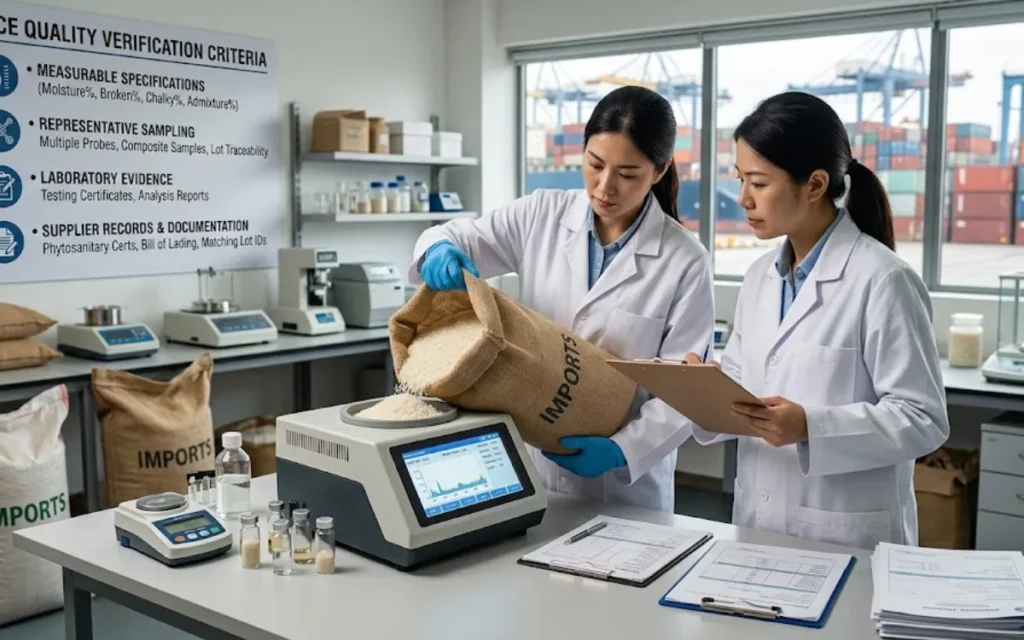
The most common misconception is that a familiar variety name, attractive grain appearance, or low FOB price proves shipment quality. Quality verification requires measurable specifications, representative sampling, laboratory evidence, supplier records, and documentation matched to the actual imported lot.
“Basmati” automatically means premium quality
Basmati identifies an aromatic rice category and recognized varieties. It does not establish every commercial parameter of a shipment.
A contract still needs measurable specifications for grain length, broken percentage, moisture, defects, packaging, and food-safety requirements.
A certificate alone proves quality
A certificate is evidence, not a substitute for a defined acceptance standard. The buyer needs to know who issued it, what sample was tested, which lot it represents, which methods were used, and whether the results match the contract.
FDA approval means the buyer does not need supplier verification
FDA does not operate a general pre-approval system for individual imported food shipments. Imported food must comply with U.S. requirements and remains subject to FDA oversight. Covered importers also have FSVP responsibilities.
U.S. rice grades and Pakistani commercial grades are identical
They are separate specification frameworks. USDA maintains U.S. standards for milled rice, while Pakistani exporters use commercial specifications for products such as Basmati varieties. Buyers need to identify the governing standard in the purchase contract.
The lowest FOB price is the lowest procurement cost
FOB price excludes several downstream cost variables. Quality failures can create inspection costs, repacking expenses, customer complaints, inventory disruption, rejected cargo, and additional logistics costs.
A Maryland importer therefore needs to compare price and specification together.
What should Maryland importers verify before purchasing Pakistani rice?
Maryland importers should verify the exact variety, commercial specification, grain dimensions, broken percentage, moisture, defects, foreign matter, milling quality, laboratory results, packaging, supplier controls, FSVP evidence, and applicable U.S. import documentation before committing to a shipment.
A practical verification sequence is:
- Define the exact Pakistani rice variety.
- Establish measurable quality tolerances.
- Approve a representative reference sample.
- Verify supplier processing and food-safety controls.
- Confirm applicable U.S. import requirements.
- Test production or pre-shipment samples.
- Match laboratory results to the purchase specification.
- Verify packaging and labeling.
- Reconcile lot numbers with export documents.
- Retain quality and compliance records.
Pakistan remains a major global rice exporter. USDA’s 2026 reporting projects 2025/26 Pakistani rice exports at approximately 4.7 million metric tons, with 518,401 metric tons of Basmati exports recorded during November 2025 through May 2026.
That scale gives Maryland importers access to established Pakistani supply chains, but volume does not eliminate the need for lot-specific verification. Quality is established by measurable evidence.
The correct purchasing approach is therefore simple: define the specification before negotiating the price, verify the supplier before approving the shipment, and test the rice before accepting the lot.
Frequently Asked Questions
Why should Maryland importers verify rice quality before purchase?
Maryland importers should verify rice quality to confirm that the shipment matches the agreed variety, grade, moisture level, broken-kernel percentage, food-safety requirements, packaging specifications, and U.S. import requirements before payment and shipment.
What rice quality parameters should Maryland importers check?
Key parameters include rice variety, grain length, broken kernels, moisture, foreign matter, damaged kernels, chalky grains, milling quality, colour, aroma, packaging, and laboratory test results.
Which Pakistani Basmati varieties are commonly exported to U.S. buyers?
Common Pakistani Basmati varieties include 1121 Basmati, Super Kernel Basmati, and 1509 Basmati. Each variety requires its own commercial specification and quality tolerances.
Where is Pakistani Basmati rice grown?
Pakistani Basmati rice is primarily associated with selected rice-growing areas of Punjab, where soil, climate, irrigation, and cultivation practices support aromatic long-grain rice production.
How is Pakistani Basmati rice processed for export?
The process includes paddy receiving, sampling, drying, dehusking, paddy separation, whitening, polishing, length grading, optical sorting, quality inspection, laboratory testing, and final packaging.
What does rice moisture indicate?
Rice moisture indicates the amount of water contained in the grain. Controlled moisture supports storage stability, milling performance, and product quality during international transportation.
Why is broken-kernel percentage important?
Broken-kernel percentage affects the commercial grade, appearance, cooking presentation, and usable value of rice. Premium Basmati specifications generally require tighter control of broken kernels.
What is a Certificate of Analysis for rice?
A Certificate of Analysis, or COA, records laboratory test results for a specific rice sample or lot. It can cover parameters such as moisture, broken kernels, foreign matter, and food-safety tests.
Does a certificate alone prove that rice is high quality?
No. A certificate provides test evidence for defined parameters. Importers still need a written product specification, representative sampling, supplier verification, and document matching to confirm that the shipment meets contractual requirements.
What is FSVP for Maryland rice importers?
The Foreign Supplier Verification Program, or FSVP, is an FDA framework requiring covered U.S. food importers to perform risk-based verification of foreign suppliers and maintain supporting records.
Is FDA approval required before importing Pakistani rice?
Imported rice must comply with applicable U.S. food-safety, labeling, and import requirements. FDA regulates imported food and shipments remain subject to examination and other entry controls.
Are Pakistani commercial rice grades the same as U.S. rice grades?
No. Pakistani commercial specifications and U.S. rice grading standards are separate frameworks. The purchase contract needs to identify the specific standard, variety, tolerances, and acceptance criteria.
What documents should a Maryland rice importer verify?
Documents can include the commercial invoice, packing list, certificate of origin, Certificate of Analysis, inspection documentation, bill of lading, applicable phytosanitary certificate, and records required for U.S. food-import compliance.
When should rice quality be tested?
Quality verification should begin before purchase and continue through pre-shipment inspection. The final production lot needs to be sampled and tested against the agreed specification before shipment.
How does rice quality affect the landed cost?
Poor quality can create additional inspection, repacking, storage, disposal, customer-return, replacement, and logistics costs. Comparing only the FOB price does not provide a complete procurement-cost assessment.
What is the difference between a rice sample and a production lot?
A sample represents a defined quantity of rice selected for testing. A production lot is the actual quantity manufactured and packed under specified conditions. The final inspection needs to confirm that the production lot matches the approved sample and specification.
How can importers reduce rice quality disputes?
Importers can reduce disputes by defining measurable specifications in the contract, approving reference samples, agreeing sampling methods, specifying laboratory tests, conducting pre-shipment inspection, and matching test results with the shipped lot.
Why is variety verification important for Basmati rice?
Variety verification helps ensure that the buyer receives the contracted product. 1121, Super Kernel, and 1509 Basmati have distinct commercial characteristics, so the variety name needs to match the agreed specification and supporting documentation.