Why Are Wholesale Buyers Expanding Basmati Rice Procurement Programs?
Wholesale buyers are expanding Basmati rice procurement programs because the category supports multiple retail, foodservice, and distribution channels while Pakistani production provides several grain varieties, processing formats, and packaging options. Pakistan’s 2026/27 rice production is forecast at 9.8 million metric tons, with exports forecast at 5.0 million metric tons.
What is a Basmati rice procurement program?
A Basmati rice procurement program is a planned purchasing system that defines varieties, grades, volumes, quality limits, packaging, delivery schedules, documentation, and supplier controls for repeated wholesale rice purchases across multiple sales channels.
A one-time rice purchase focuses on one shipment. A procurement program covers repeated purchasing over a defined period. A wholesaler can establish monthly, quarterly, or annual requirements based on sales volume and inventory turnover.
The program begins with product specifications. These include rice variety, grain length, milling condition, moisture, broken percentage, foreign matter, damaged grains, packaging format, and acceptable quality tolerances.
The next component is volume planning. A buyer estimates consumption for supermarkets, restaurants, distributors, catering companies, ethnic grocery stores, and food manufacturers. For example, a distributor serving 40 retail stores can establish separate demand forecasts for 5 kg, 10 kg, 20 kg, and bulk commercial packs.
Supplier capacity then becomes important. A supplier must be able to process, grade, pack, inspect, document, and load the required quantity within the agreed production window.
This approach explains why procurement is moving from isolated container purchases toward structured sourcing programs.
Why is Basmati rice becoming a larger wholesale procurement category?
Wholesale buyers are expanding Basmati procurement because long-grain appearance, aroma, cooking performance, variety choices, and established international demand allow distributors to serve retail, foodservice, catering, and ethnic-food channels with differentiated rice products.
Basmati rice is an aromatic long-grain rice traditionally associated with the Indian subcontinent. Pakistani Basmati production is concentrated mainly in Punjab, where suitable soil, irrigation, climate, and agricultural practices support aromatic rice cultivation.
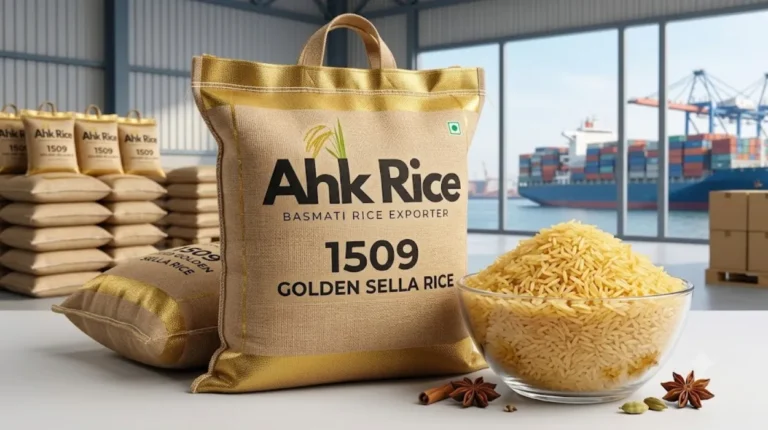
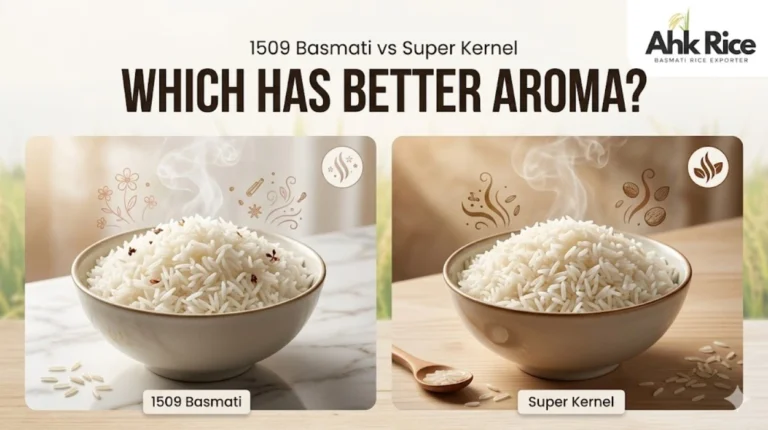
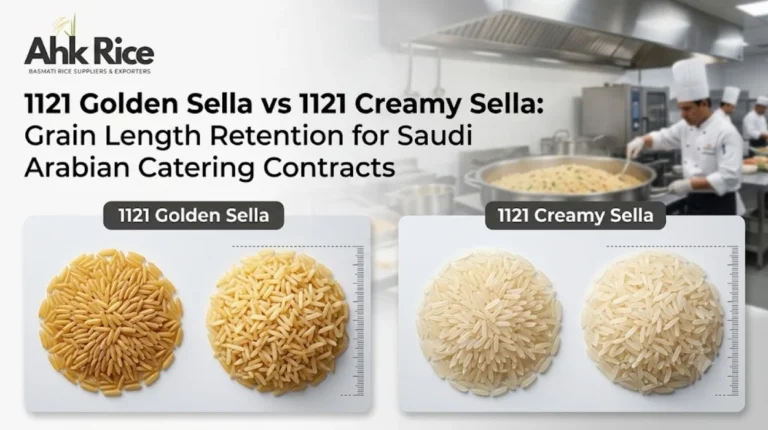
Pakistan supplies commercial varieties including 1121 Basmati, Super Kernel, and 1509. These varieties differ in grain characteristics, processing options, cooking behavior, and market positioning.
The 1121 variety is known for its exceptionally long grain. Super Kernel is a premium Basmati category used across retail and foodservice channels. 1509 is another long-grain Basmati variety used in white, steam, and parboiled-style formats.
The expansion is also connected to international trade capacity. USDA forecasts Pakistan’s 2026/27 rice production at 9.8 million metric tons and exports at 5.0 million metric tons, compared with projected 4.7 million metric tons of exports in 2025/26.
Higher planned export availability gives wholesale buyers a larger base for recurring procurement.
How does a wholesale Basmati procurement program work?
A wholesale procurement program moves through demand forecasting, product specification, supplier qualification, sampling, price confirmation, production, inspection, export documentation, shipment, customs clearance, delivery, and post-arrival quality verification.
The first stage is demand forecasting. Buyers calculate expected consumption using historical sales, customer contracts, seasonal demand, promotional activity, and inventory levels.
The second stage is specification development. A buyer defines the exact product instead of purchasing under a broad term such as “premium Basmati.”
A specification can state:
- Variety: 1121 Basmati
- Processing: white, steam, or parboiled-style Sella
- Grain length: defined by the agreed commercial specification
- Broken rice: maximum permitted percentage
- Moisture: contractual maximum
- Foreign matter: contractual maximum
- Packaging: retail or bulk
- Net weight: 5 kg, 10 kg, 20 kg, 25 kg, or another agreed format
- Marking: private label or standard packaging
- Quantity: containers or metric tons
- Destination: named port and inland location
The third stage is supplier qualification. Buyers assess milling capacity, processing equipment, laboratory controls, packaging capability, export experience, documentation systems, and production continuity.
The fourth stage is sample approval. A buyer evaluates grain appearance, aroma, moisture, cooking expansion, texture, broken percentage, and purity before approving a production specification.
The fifth stage is commercial confirmation. Price, quantity, Incoterms, payment terms, shipment window, packaging, and documentation requirements become part of the purchase contract.
Production then moves through milling, cleaning, sorting, grading, processing, packaging, inspection, container loading, and export clearance.
What are the key components of Basmati rice procurement?
The main components are product identity, quality specifications, supplier capacity, volume planning, price control, packaging, certification, export documentation, logistics, inventory management, and performance monitoring across every recurring shipment.
Product identity establishes exactly what the buyer is purchasing. Variety and processing type prevent different products from being treated as interchangeable.
Quality specifications establish measurable acceptance criteria. A commercial specification can cover grain length, average grain length, broken grains, moisture, chalky grains, damaged grains, immature grains, foreign matter, discoloration, milling degree, and cooking characteristics.
Supplier capacity determines whether the seller can fulfill repeated orders. A buyer ordering 500 metric tons per month needs evidence that the supplier can process and prepare that volume consistently.
Packaging connects procurement with the sales channel. Retail buyers need branded consumer packs, while foodservice distributors often require larger sacks. Private-label programs require controlled artwork, labeling, batch identification, and packaging consistency.
Documentation connects the physical shipment with the commercial transaction. Common export documents include the commercial invoice, packing list, certificate of origin, bill of lading, inspection records, and phytosanitary documentation where required.
Pakistan’s Department of Plant Protection states that phytosanitary certification involves inspection, sampling, treatment where applicable, and certification according to importing-country requirements and ISPM-12. Its export procedure also lists documents such as an import permit where required, commercial invoice, packing list, treatment certificate where applicable, and container information.
Which Basmati grades and processing formats do wholesale buyers procure?
Wholesale procurement includes white Basmati, steam-processed rice, Sella or parboiled-style rice, premium long-grain grades, broken rice, and variety-specific products such as 1121, Super Kernel, and 1509, depending on market requirements.
Commercial terminology varies between suppliers and markets, so buyers must define grades through measurable specifications.
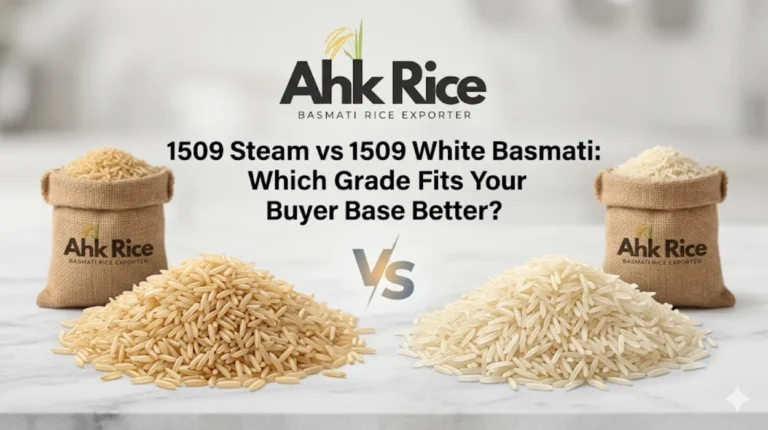
White Basmati is milled rice processed without the steam or parboiling treatment used for other formats. It is widely used in retail and foodservice applications.
Steam Basmati is treated with steam during processing. The process affects grain firmness, cooking behavior, and appearance while retaining the characteristic long-grain format.
Sella refers to parboiled-style processing. Paddy is subjected to controlled soaking and heat treatment before drying and milling. This changes the physical structure of the grain and produces a firmer cooked texture.
1121 Basmati is a major long-grain variety. Its very long grain makes it suitable for premium rice dishes and foodservice applications where cooked grain appearance matters.
Super Kernel is a premium Basmati variety used in retail and commercial channels.
1509 is another Basmati variety used for white and processed formats. Buyers select it according to target price, grain specifications, cooking requirements, and customer demand.
Broken rice is classified according to the proportion of broken kernels. It serves different applications from whole-grain premium rice and is commonly used in food manufacturing and price-sensitive channels.
Which markets import Basmati rice?
Basmati rice is imported across the Middle East, Europe, North America, Africa, and other international markets, with buyers selecting varieties and processing formats according to local consumption patterns, regulations, retail requirements, and foodservice demand.
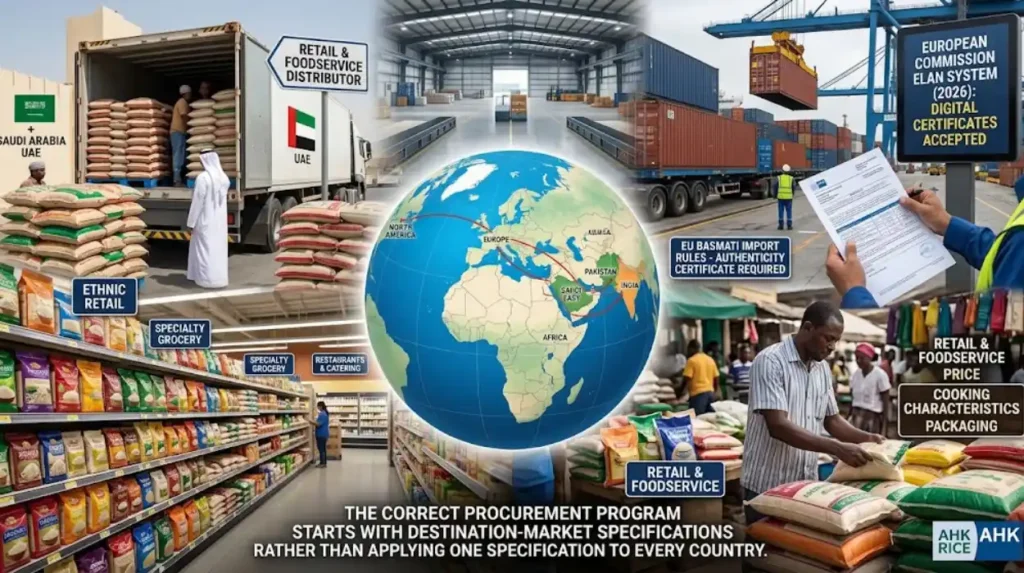
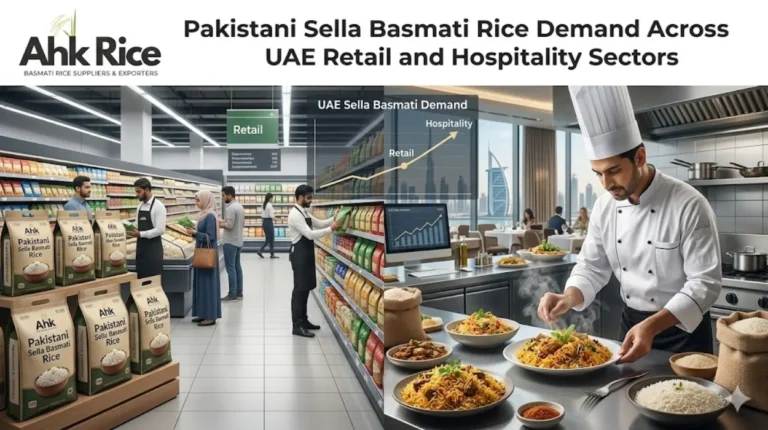
The Middle East is a major destination for South Asian rice. Saudi Arabia and the United Arab Emirates have established demand for Basmati across households, restaurants, catering operations, wholesalers, and foodservice distributors.
European buyers also operate under specific Basmati import rules. EU regulations identify eligible Basmati varieties and provide a framework involving import licensing and authenticity certification. Certain qualifying Pakistani Basmati imports receive zero import duty under the applicable arrangements.
In 2026, the European Commission’s ELAN system includes authenticity certificates for Basmati rice issued by competent authorities in Pakistan and India. ELAN entered voluntary use in January 2026, while mandatory use for issuing authorities is scheduled for January 2028.
North American markets use Basmati across ethnic retail, restaurants, catering, institutional foodservice, and specialty grocery channels. African markets also purchase long-grain rice for retail and foodservice distribution, with product selection driven by price, cooking characteristics, packaging, and consumer preference.
The correct procurement program therefore starts with destination-market specifications rather than applying one specification to every country.
What certifications and documents apply to Basmati rice exports?
Basmati rice exports require product, plant-health, commercial, and destination-specific documentation, while certification requirements depend on the importing market, product classification, buyer contract, and applicable food-safety and customs rules.
A phytosanitary certificate verifies plant-health compliance for regulated agricultural products. Pakistan’s active trade information framework identifies phytosanitary certification as an export requirement for rice and related plant products when required by the importing country.
A certificate of origin identifies the country where the exported rice originates. Importers use it for customs, tariff treatment, and trade documentation.
An authenticity certificate has particular importance for Basmati entering the European Union under the applicable Basmati import regime. EU rules require authenticity documentation for qualifying Basmati imports, and the certificate has a defined validity period.
Laboratory certificates can document parameters such as moisture, broken grains, purity, pesticide residues, microbiological results, or other buyer-specified characteristics.
Food-safety certifications such as HACCP- or ISO-based systems are different from government export certificates. They demonstrate that a facility operates under a defined food-safety management framework. Buyers should distinguish voluntary commercial certifications from legally mandatory import documents.
The importing country’s regulations remain the controlling requirement. A certificate accepted in one market does not automatically satisfy another market.
What benefits do expanded procurement programs provide?
Structured procurement gives wholesalers stronger control over availability, quality consistency, pricing, inventory, packaging, documentation, and supplier performance while reducing dependence on individual spot purchases and unplanned replenishment decisions.
The first benefit is supply continuity. A planned procurement schedule aligns purchasing with expected consumption and supplier lead times.
The second benefit is specification consistency. Repeated orders use the same approved variety, processing method, packaging, and quality limits.
The third benefit is inventory control. Buyers can establish reorder points based on average consumption, supplier lead time, transit time, customs clearance, and safety stock.
The fourth benefit is purchasing visibility. A buyer can compare contracted quantities against shipped quantities, delivered quantities, and remaining purchase commitments.
The fifth benefit is channel segmentation. One wholesale program can contain multiple specifications. For example, a distributor can purchase 1121 Steam for premium restaurants, Super Kernel White for retail, and 1509 Sella for price-sensitive foodservice customers.
The sixth benefit is documentation control. Every shipment can be linked to a purchase order, lot, inspection record, packing list, container number, and destination.
These controls turn rice purchasing into a measurable supply-chain process.
Where are expanded Basmati procurement programs used?
Expanded procurement programs are used by rice wholesalers, supermarket distributors, restaurant suppliers, ethnic grocery distributors, catering companies, food manufacturers, institutional buyers, and private-label importers requiring repeated volumes and consistent product specifications.
A supermarket distributor can use the program to replenish retail packs across multiple stores.
A restaurant supplier can use separate specifications for restaurants that require long cooked grains and restaurants that prioritize cost per serving.
A catering company can forecast requirements around weddings, hotels, seasonal events, and institutional contracts.
A private-label importer can define packaging artwork, bag weight, label information, batch coding, and product specifications before recurring production.
A food manufacturer can purchase a defined grade for recipes where grain size, moisture, cooking time, and texture influence the finished product.
Each use case requires different procurement controls. A restaurant buyer prioritizes cooking performance and consistency. A retail buyer also requires packaging, labeling, shelf presentation, and inventory turnover.
What problems and misconceptions affect Basmati procurement expansion?
The main procurement problems are buying by variety name alone, comparing suppliers only by price, ignoring landed cost, underestimating lead time, accepting inconsistent specifications, and treating certificates as substitutes for independent quality verification.
The first misconception is that a variety name defines the entire product. It does not. Two shipments labeled 1121 can differ in processing, broken percentage, moisture, milling quality, packaging, and contractual tolerances.
The second misconception is that the lowest FOB price is the lowest procurement cost. Landed cost also includes freight, insurance where applicable, duties, port charges, clearance, inland transportation, inspection, storage, financing, and potential quality losses.
The third misconception is that a supplier’s stated production capacity equals available export capacity. Export capacity also depends on raw-material procurement, milling schedules, processing lines, packaging materials, laboratory release, documentation, container availability, and port operations.
The fourth misconception is that certification eliminates inspection. Certificates establish compliance with defined requirements. Buyers still need contractual specifications, sampling procedures, laboratory testing, and arrival inspections.
The fifth misconception is that one specification fits every market. European Basmati imports have specific regulatory controls, while other destinations apply different food-safety, plant-health, labeling, and customs requirements.
A procurement program therefore needs market-specific specifications and shipment-level verification.
How should buyers connect procurement expansion with supplier selection?
Procurement expansion should lead directly into supplier qualification, because increasing order volume requires verified processing capacity, quality systems, documentation accuracy, market compliance, shipment reliability, and the ability to maintain one approved specification across repeated deliveries.
Once a buyer decides to expand procurement, supplier evaluation becomes the next logical stage.
The buyer should compare suppliers using measurable criteria. These include annual processing capacity, monthly export capacity, approved varieties, processing formats, laboratory controls, packaging capability, quality tolerances, documentation accuracy, production lead time, shipment history, and destination-market experience.
The supplier should also demonstrate how an approved specification moves through the production chain. The process normally begins with paddy sourcing and continues through cleaning, de-stoning, husking, milling, polishing, sorting, grading, optional steam or parboiling treatment, final inspection, packaging, container loading, export documentation, and shipment.
This is where procurement strategy connects with supplier selection. Buyers expanding their programs need to understand not only why Basmati demand is increasing, but also how to evaluate the companies responsible for fulfilling recurring international orders.
For the next stage of the purchasing process, the logical consideration topic is:
How wholesale importers select international rice suppliers, including supplier capacity, specifications, quality verification, certifications, pricing, logistics, and performance controls.
Frequently Asked Questions
Why are wholesale buyers expanding Basmati rice procurement programs?
Wholesale buyers are expanding Basmati procurement to secure consistent supply, support growing retail and foodservice demand, control quality, and establish predictable purchasing schedules.
Which Basmati rice varieties do wholesale buyers commonly procure?
Common varieties include 1121 Basmati, Super Kernel, and 1509. Buyers select varieties according to grain length, cooking performance, processing type, price, and destination-market demand.
What Basmati rice grades are available for wholesale procurement?
Wholesale buyers can procure white Basmati, Steam Basmati, Sella or parboiled-style rice, premium long-grain grades, and broken rice. Exact specifications depend on the contract and importing market.
Where is Basmati rice grown in Pakistan?
Basmati rice is primarily cultivated in Punjab, where soil, irrigation, climate, and agricultural conditions support aromatic rice production.
How is Basmati rice processed before export?
Processing generally includes paddy cleaning, de-stoning, husking, milling, polishing, sorting, grading, optional steaming or parboiling, quality inspection, packaging, and container loading.
Which countries import Pakistani Basmati rice?
Pakistani Basmati rice is exported to markets across the Middle East, Europe, North America, Africa, and other international destinations. Saudi Arabia, the UAE, and European markets are important destinations.
What certifications apply to Basmati rice exports?
Requirements depend on the destination. Common documents include certificates of origin, phytosanitary certificates where required, laboratory reports, commercial invoices, packing lists, and destination-specific authenticity or food-safety documentation.