Expand Idaho Basmati Rice Supply Through AHK Rice Exports
Idaho buyers can expand Basmati rice supply more reliably by replacing spot purchasing with specification-controlled sourcing, approved samples, planned production, documented inspection, and scheduled Pakistan-to-USA shipments. For wholesalers, distributors, retailers, restaurants, and foodservice operators, the objective is not simply to buy Pakistani Basmati at a competitive FOB price. Our objective is to consistently receive the correct grade, quantity, packaging, documentation, and arrival window.
Idaho’s demand should be evaluated alongside the broader growth of imported Basmati in U.S. specialty-food, restaurant, and ethnic retail channels. Buyers can first understand the market rationale through:
Why Is Demand for Imported Basmati Rice Growing Across Idaho? before converting that demand into a structured procurement program. Pakistan remains a major rice-exporting country, and USDA’s April 2026 outlook forecasts Pakistan’s 2026/27 rice production at 9.8 million metric tons and exports at about 5.0 million metric tons. For more insight explore:
How Do Buyers Scale Rice Imports Without Supply Disruptions?
What is the best solution for expanding Basmati rice supply in Idaho?
The strongest Idaho supply model combines an approved rice specification, pre-shipment sampling, controlled production, third-party inspection, export documentation, container scheduling, and planned replenishment. This reduces dependence on spot purchases and gives Idaho buyers clearer control over quality, landed cost, inventory timing, and repeat-order performance.
The first decision is product specification. A buyer should identify the variety, processing grade, grain length, moisture limit, broken-grain tolerance, foreign-matter requirement, packaging, quantity, and intended use before requesting a quotation.
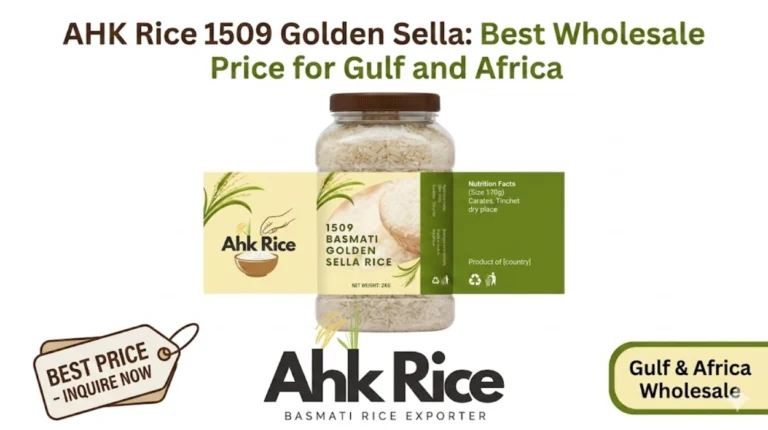
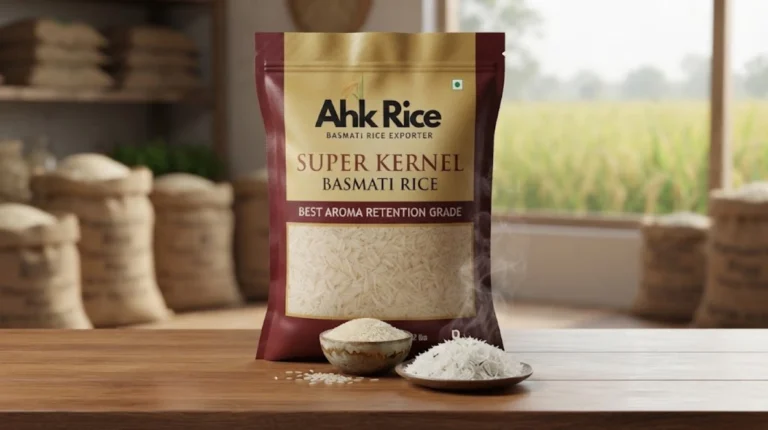
For premium Idaho retail and restaurant programs, 1121 Basmati is a practical starting point because of its extra-long grain profile and cooking elongation. Super Kernel can provide a strong aromatic alternative, while 1509 can be considered where the buyer needs to balance long-grain presentation with procurement economics. AHK Rice supplies 1121, Super Kernel, and 1509 from Punjab and manages processing, grading, sorting, packaging, inspection, documentation, and container loading.
The procurement model should also separate the product decision from the logistics decision. Idaho is inland, so the buyer should not calculate supply only from Karachi departure to a U.S. port. The complete schedule must include ocean movement, U.S. port handling, customs clearance, rail or truck movement, and final warehouse receiving.
For Pacific Northwest routing, Idaho buyers should allow a longer logistics window than importers located close to Southern California or Gulf gateways. AHK Rice’s current U.S. guidance gives a general door-to-door range of about 25–35 days for major U.S. routes, while Pacific Northwest routing can require materially more time depending on the gateway, transshipment, vessel schedule, and inland connection. A recent AHK Rice logistics assessment for Oregon, which uses a similar Pacific Northwest corridor, indicates approximately 36–61 days for ocean movement before additional inland delivery and clearance time.
For Idaho procurement, a safer commercial plan is therefore to build the purchase order around an arrival window rather than a vessel departure date.
Why should Idaho buyers choose AHK Rice for USA Basmati supply?
AHK Rice gives Idaho buyers a direct Pakistan-origin sourcing channel with integrated milling, grading, sorting, packaging, inspection, export documentation, and shipment coordination, allowing procurement teams to manage product specifications and logistics through one export relationship instead of multiple intermediaries.
AHK Rice operates from Bucheki, Nankana Sahib, Punjab, and supplies Pakistani Basmati to international buyers. Its export operation covers the stages between sourcing and container loading, including processing, grading, color sorting, customized packaging, quality control, and documentation.
For Idaho importers, the value is operational control. A buyer can approve one specification and then require the same commercial parameters across subsequent shipments. This is important when rice is being distributed through several wholesale customers or retail locations.
The USA service also supports sample approval before bulk purchasing. AHK Rice states that samples can be sent to U.S. buyers by air courier, with typical sample delivery of approximately 5–7 days. Bulk orders then move through production, inspection, container loading, ocean freight, U.S. clearance, and final delivery.
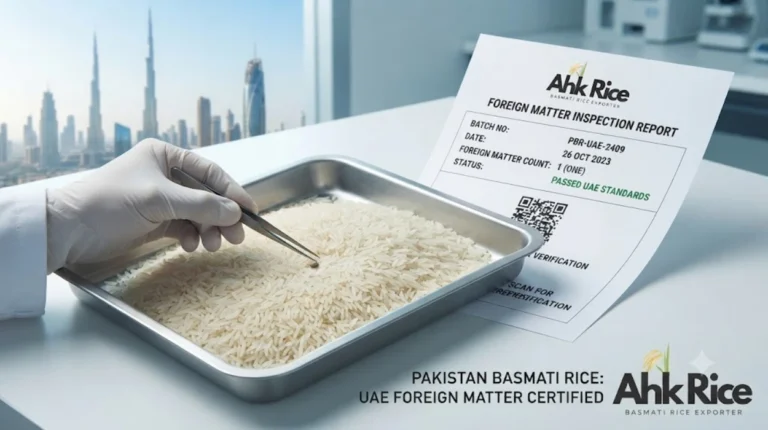
The compliance side is equally important. FDA states that imported food must meet applicable U.S. legal requirements, including safety, sanitary production, labeling, facility registration where applicable, and Prior Notice. U.S. food importers also have responsibilities under the Foreign Supplier Verification Program.
This makes supplier documentation part of the commercial decision. In 2026, FDA enforcement continues to demonstrate that FSVP failures can create serious import problems, including detention or refusal risks.
Buyers evaluating the USA Basmati rice export service can therefore assess the complete supply chain rather than comparing only the rice price.
How does the AHK Rice sample process work for Idaho buyers?
The sample process should confirm the exact commercial specification before production begins: the buyer defines requirements, AHK Rice prepares representative samples, courier delivery follows, the buyer tests cooking and appearance, revisions are made if necessary, and the approved sample becomes the production reference.
A practical sample process begins with a specification sheet. The Idaho buyer should state the variety, processing form, grain length, moisture, broken percentage, packaging format, required quantity, target market, and destination.
AHK Rice can then prepare the relevant Basmati sample. Its USA export information states that up to 20 kg of rice can be supplied as a sample, while the client covers associated sample costs. Buyers can also use their own courier account.
The cost structure should be separated into three categories:
| Sample cost | Typical treatment |
|---|---|
| Rice sample | Up to 20 kg may be supplied without a rice charge under AHK Rice sampling terms |
| Courier | Paid by buyer or charged according to courier arrangement |
| Phytosanitary/sample documentation | Buyer responsibility where required |
Sample freight is not a fixed global price because it changes according to parcel weight, courier, destination, service level, customs requirements, and documentation. A buyer should therefore request the current courier cost instead of using an outdated estimate.
Once the sample arrives, the Idaho buyer should test raw appearance, aroma, grain length, cooking elongation, texture, broken percentage, and consistency with the intended application. Restaurant buyers should also conduct a cooking test using their normal preparation method.
The approved sample should then be referenced in the purchase order. This creates a practical quality benchmark for production and future repeat shipments.
How many shipping days should Idaho buyers plan for Pakistan-to-USA delivery?
Idaho buyers should plan beyond the headline ocean-transit figure because the shipment includes production, container booking, Karachi handling, ocean transportation, U.S. port clearance, inland rail or truck movement, and warehouse receiving. A practical procurement schedule should include contingency for route-specific delays.
AHK Rice states a general USA door-to-door timeline of approximately 25–35 days for major U.S. destinations, but Idaho requires route-specific planning because it is inland and may depend on Pacific Northwest or alternative U.S. gateways.
A working planning model for Idaho can be structured as follows:
| Stage | Planning window |
| Quote and specification confirmation | 1–2 days |
| Sample courier, where required | 5–7 days |
| Production and container preparation | Up to 10 days after production confirmation |
| Inspection and export documentation | 3–5 days |
| Ocean movement | Route-dependent; Pacific Northwest can require 36–61 days |
| U.S. clearance and terminal handling | Variable |
| Inland delivery to Idaho | Variable by gateway and warehouse |
| Total procurement planning | Build a route-specific buffer rather than relying on one fixed transit number |
AHK Rice has published a production and loading workflow targeting completion within ten days after production confirmation.
This distinction matters for Idaho because a shipment that arrives at a U.S. port on schedule can still miss the buyer’s warehouse receiving date if customs, terminal availability, rail, trucking, or appointment scheduling adds time.
The better approach is to establish a required warehouse arrival date first. The exporter can then work backward through production, inspection, container booking, vessel departure, port arrival, clearance, and inland transportation.
What results can Idaho buyers expect from a structured AHK Rice supply program?
A structured AHK Rice procurement program can give Idaho buyers more predictable specifications, clearer shipment milestones, better inventory planning, and stronger repeat-order control while reducing the operational uncertainty associated with emergency purchases and unplanned spot-market sourcing.
The first result is specification consistency. Instead of changing varieties or grades whenever inventory becomes tight, the buyer can establish an approved product specification and use it for repeat purchasing.
The second result is better inventory visibility. International rice orders involve production, inspection, documentation, container movement, customs, and final delivery. AHK Rice describes its export process around these milestones, helping buyers connect the physical shipment with its commercial and quality records.
The third result is better purchasing timing. Pakistan’s 2026/27 rice export outlook is substantial, but production and export availability do not mean every grade is available at every price at every moment. USDA forecasts about 5.0 million metric tons of total Pakistani rice exports for 2026/27, making Pakistan a significant origin while reinforcing the need for grade-specific procurement planning.
For an Idaho distributor selling 1121 Basmati to several customers, for example, the stronger model is to forecast monthly demand, define a minimum stock level, schedule container arrivals before inventory reaches that threshold, and retain a buffer for route disruption.
This changes procurement from reactive buying into a replenishment system.
What factors determine the delivered price of Basmati rice in Idaho?
Idaho Basmati pricing depends on variety, processing grade, rice specification, quantity, packaging, inspection, Incoterm, ocean freight, destination port, inland transportation, customs costs, and market conditions; therefore, the lowest FOB quotation is not necessarily the lowest delivered cost.
AHK Rice currently publishes USA product pricing examples rather than one universal Idaho price. Its 1121 USA product page lists pricing from approximately $1,100 per metric ton FOB Karachi, while Super Kernel USA information lists pricing starting around $1,100 per metric ton on a CIF basis for specified configurations. These figures are product-page indications, not fixed Idaho landed quotations.
A buyer should therefore request a quotation against the exact commercial specification.
For example, the delivered cost of 100 MT of 1121 Basmati can change because of:
- White, Steam, Sella, or another processing grade.
- Grain length and broken-grain tolerance.
- Packaging material and bag size.
- Private-label printing requirements.
- Inspection and certification requirements.
- FOB, CFR, or CIF commercial terms.
- Karachi-origin ocean freight.
- Destination port and terminal charges.
- Customs brokerage and clearance.
- Inland rail or trucking to Idaho.
- Currency and freight-market movements.
- Order volume and shipment frequency.
The right comparison is therefore landed cost per metric ton, not simply FOB price per metric ton.
A buyer should also compare the cost of a missed shipment. If an Idaho distributor runs out of a high-volume Basmati SKU, emergency replacement purchasing can involve higher prices, expedited logistics, lost sales, and customer dissatisfaction.
A slightly higher planned procurement cost can therefore produce a lower total supply-chain cost when it prevents stockouts.
How should Idaho buyers start an AHK Rice supply program?
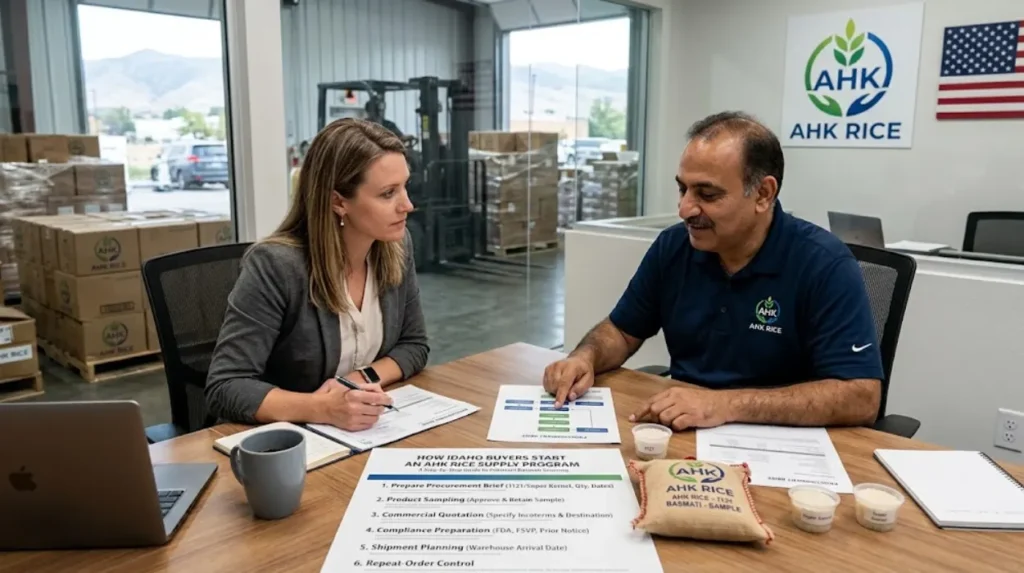
Start with the exact product specification, forecast quantity, required warehouse arrival dates, packaging format, destination gateway, and compliance requirements; then approve a representative sample, confirm the commercial quotation, finalize shipment terms, and schedule repeat containers against inventory demand.
The first step is to prepare a procurement brief. It should identify whether the buyer needs 1121, Super Kernel, 1509, or another Basmati specification, along with processing grade, packaging, monthly quantity, and target delivery location.
The second step is sampling. Do not approve a large shipment from a generic product description. Approve the actual commercial specification and retain the accepted sample as the reference.
The third step is quotation. Ask for the price under the chosen Incoterm and specify the destination port or delivery point. This prevents comparisons between an FOB offer and a delivered offer that appear similar but contain different cost components.
The fourth step is compliance preparation. The U.S. importer should confirm its FDA, labeling, Prior Notice, and FSVP responsibilities. FDA confirms that imported food is subject to U.S. requirements and that Prior Notice must be submitted before qualifying food shipments arrive.
The fifth step is shipment planning. For Idaho, the buyer should establish a required warehouse arrival date and work backward to the vessel booking and production schedule. This is more reliable than ordering only when inventory becomes critically low.
The final step is repeat-order control. Every subsequent purchase should reference the approved specification, packaging, inspection requirements, quantity, delivery window, and documentation standard.
AHK Rice is suited to this model because it combines Pakistan-origin sourcing with processing, grading, sorting, packaging, inspection, documentation, and shipping coordination.
For an Idaho buyer, the commercial decision is therefore straightforward: choose a specification first, validate it through sampling, calculate the full landed cost, allow a realistic Pakistan-to-Idaho lead time, and build replenishment around inventory requirements rather than emergency purchasing. AHK Rice can then serve as the export-side supply partner for repeat Pakistani Basmati shipments into the U.S. market. To begin with your required grade, quantity, packaging, and Idaho delivery point, request a quote.
Frequently Asked Questions
How can Idaho buyers import Basmati rice from Pakistan?
Idaho buyers can import Basmati rice by selecting the required grade, approving a product sample, confirming pricing and Incoterms, completing U.S. import compliance, and scheduling production and container shipment with AHK Rice.
Which Basmati rice varieties can Idaho buyers source from AHK Rice?
AHK Rice supplies major Pakistani Basmati varieties including 1121 Basmati, Super Kernel Basmati, and 1509 Basmati. Buyers can select White, Steam, Sella, or other specifications according to their market requirements.
How long does Pakistan-to-Idaho Basmati rice shipping take?
The complete timeline depends on production, vessel schedules, port handling, customs clearance, and inland transportation. Idaho buyers should use a route-specific delivery schedule rather than relying only on ocean-transit estimates.
What does the AHK Rice sample process include?
The process includes specification confirmation, sample preparation, courier delivery, buyer testing, approval, and production against the approved specification. Buyers should evaluate grain appearance, aroma, cooking performance, texture, and broken-grain levels.
How much does a Basmati rice sample cost?
Sample costs depend on the required quantity, courier, destination, and documentation. AHK Rice’s USA export information allows samples of up to 20 kg, while associated sample and courier costs are handled according to the agreed arrangement.
What factors affect the price of Basmati rice delivered to Idaho?
Pricing depends on rice variety, processing grade, grain specification, order quantity, packaging, private labeling, inspection, Incoterms, ocean freight, destination port, customs costs, inland transportation, and market conditions.
What certifications and documents are needed to import rice into Idaho?
U.S. importers must meet applicable FDA requirements and handle responsibilities involving food compliance, facility registration where applicable, labeling, Prior Notice, and Foreign Supplier Verification Program requirements. Additional documents can depend on the shipment and product specification.
Can AHK Rice provide customized packaging for Idaho buyers?
Yes. AHK Rice offers customized packaging options for export buyers, allowing specifications such as bag size, packaging format, and private-label requirements to be incorporated into the commercial order.