AHK Rice Pakistan 1121 Parboiled Basmati Supply for Indonesian Wholesalers
For Indonesian wholesalers, Pakistan 1121 Parboiled Basmati is best purchased through a specification-controlled supply program that verifies grain length, moisture, broken percentage, processing, sample performance, packaging, documentation, and shipment timing before bulk production begins.
For the educational background, buyers can first understand:
What makes Pakistan 1121 Parboiled Basmati suitable for Indonesia’s wholesale trade before moving into supplier selection. The distinction matters in 2026 because Indonesia is maintaining a strong domestic rice-sufficiency policy, while Basmati remains recognized as a special rice category rather than ordinary consumer rice. Before approving a supply program, Indonesian wholesalers can compare the technical and commercial differences in:
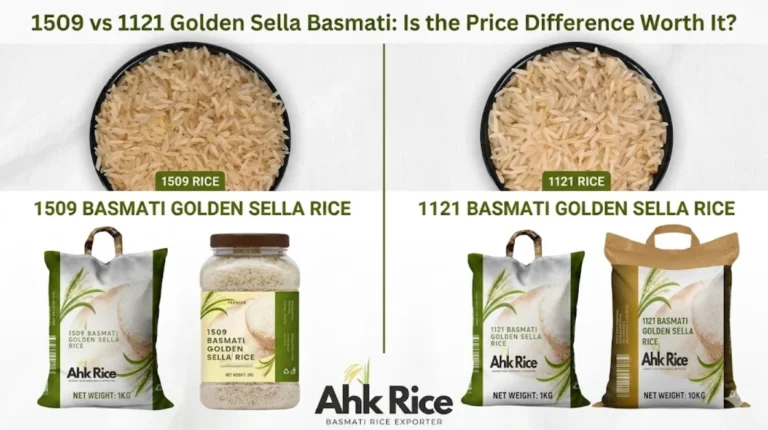
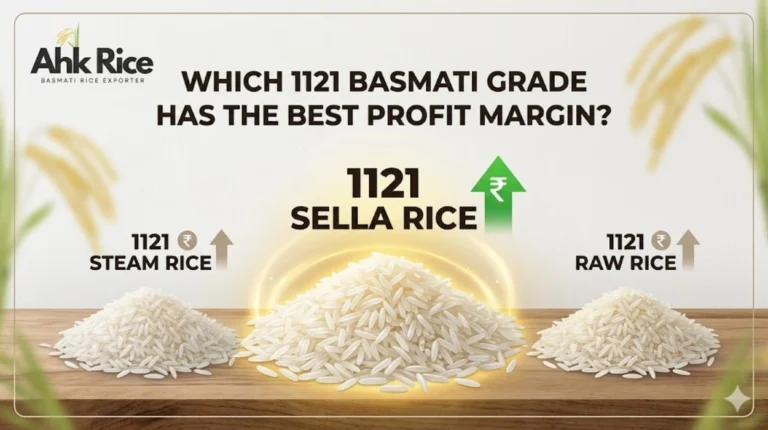
Pakistan 1121 Parboiled and Sella rice to determine which specification better fits their customers
AHK Rice supplies Pakistan-origin 1121 Basmati through an export workflow covering processing, grading, sorting, packaging, inspection, documentation, and container preparation. Indonesian wholesalers considering this program can use the Indonesia Basmati supply service to align the product specification with quantity, packaging, destination port, and commercial terms.
What is the best solution for Indonesian wholesalers buying 1121 Parboiled Basmati?
The best solution is an approved 1121 Parboiled Basmati specification linked to a physical sample, documented quality tolerances, pre-shipment inspection, compliant packaging, complete export documents, and a defined Karachi-to-Indonesia shipping schedule before production starts.
The purchasing specification should identify the 1121 variety, parboiled or Sella processing, average grain length, moisture limit, broken percentage, purity, foreign matter, colour, packaging, crop year, quantity, destination port, and Incoterm.
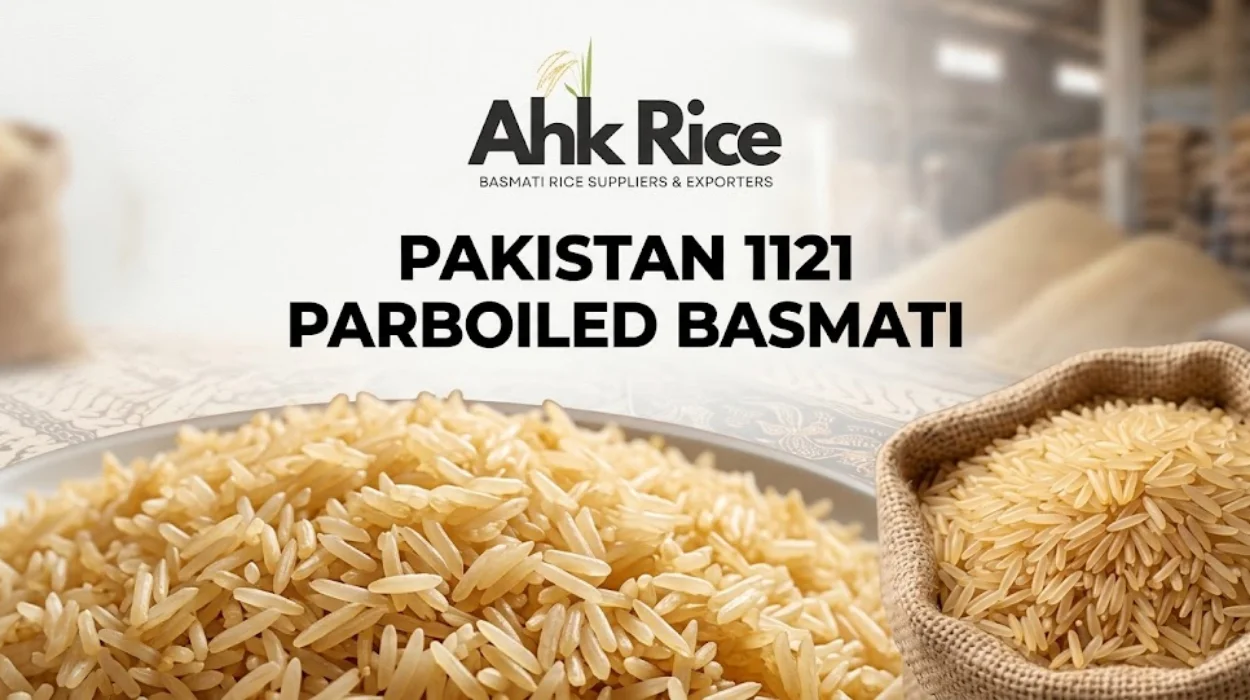
For premium wholesale distribution, 1121 is attractive because its extra-long grain creates a visible difference after cooking. AHK Rice commercial references place 1121 around 8.3–8.4 mm average grain length, with specifications varying according to the contracted grade.
The supplier should not quote simply “1121 Basmati.” Two shipments carrying the same variety name can have materially different moisture, broken percentage, processing, packaging, and price structures.
AHK Rice therefore uses a specification-led approach. The buyer approves the physical product first, then the commercial specification becomes the reference for production and shipment.
This is particularly important in Indonesia because Basmati is treated as a special rice category. Bapanas has stated that Indonesia does not authorize ordinary consumer-rice imports under the 2026 framework, while Basmati is among the special rice categories that can fall under separate import arrangements.
Why choose AHK Rice for Indonesia-bound 1121 Parboiled Basmati?
AHK Rice is suitable when an Indonesian wholesaler needs one coordinated export workflow covering Pakistani sourcing, milling, parboiling, grading, sorting, packaging, inspection, documentation, container loading, and shipment coordination rather than multiple disconnected suppliers.
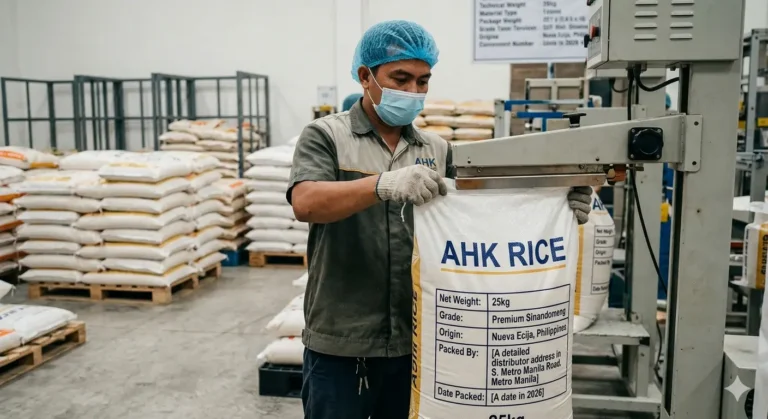
AHK Rice operates from Punjab, Pakistan, and supplies 1121, 1509, and Super Kernel Basmati varieties. Its processing workflow can include cleaning, dehusking, parboiling or steam processing, drying, polishing, grading, sorting, inspection, packing, and container loading.
For a wholesaler, the benefit is commercial control. Instead of negotiating product quality with one party, packaging with another, inspection with another, and logistics with another, AHK Rice can coordinate the major export stages through one supply relationship.
AHK Rice can also support customized packaging for wholesale or private-label distribution. Packaging should be fixed before production because bag material, weight, printing, palletization, and labeling affect the quotation.
Quality control should remain specification-specific. A buyer requiring maximum 1% broken rice, for example, should not approve a quotation based on a generic “premium 1121” description.
AHK Rice also identifies third-party inspection options through recognized inspection organizations. Buyers should confirm the inspection scope and cost before the purchase order because independent inspection is an additional commercial requirement.
The 2026 sourcing environment also makes documentation important. Pakistan’s Ministry of Commerce continues to update its export framework, including 2026 rice-related notifications and the Drawback of Local Taxes and Levies for Rice Order 2026.
What specifications should Indonesian wholesalers put into the purchase order?
A commercial purchase order should define 1121 Parboiled Basmati by measurable technical parameters, including grain length, moisture, broken grains, purity, foreign matter, processing type, colour, packaging, crop year, quantity, inspection method, and destination terms.
A practical specification can be structured as follows:
| Specification | Commercial control |
|---|---|
| Variety | Pakistan 1121 Basmati |
| Processing | Parboiled/Sella according to approved sample |
| Average grain length | Approximately 8.3–8.4 mm, subject to contract |
| Moisture | Common target around ≤12–12.5% |
| Broken grains | Buyer-defined, commonly ≤1–2% for premium grades |
| Purity | Contracted percentage and foreign-matter tolerance |
| Packaging | 5 kg, 10 kg, 25 kg, 40 kg, 50 kg or customized |
| Inspection | Supplier QC and optional third-party inspection |
| Incoterm | FOB, CFR, or CIF |
| Destination | Jakarta/Tanjung Priok, Surabaya, or agreed port |
These values should be treated as commercial references rather than universal legal limits. The final specification must be agreed between buyer and exporter before production.
For Indonesian wholesalers, the physical cooking test is just as important as laboratory measurements. The approved sample should be cooked using the same method used by the wholesaler’s restaurant, catering, retail, or foodservice customers.
The buyer should check cooked elongation, separation, firmness, aroma, colour, texture, and breakage after cooking. A rice sample that performs well in raw-grain inspection but poorly in commercial kitchens should not proceed to bulk procurement.
How does the sample process work and what does it cost?
The sample process should move from specification confirmation to representative sample preparation, courier dispatch, dry-grain inspection, cooking evaluation, approval, and commercial quotation; sample rice may be provided without product charge, while courier and required certification costs remain buyer expenses.
The first step is specification confirmation. The Indonesian wholesaler provides the required grade, quantity, packaging, destination, moisture target, broken percentage, and processing preference.
The second step is sample preparation. AHK Rice states on its Indonesia product materials that samples of up to 20 kg can be provided, while the client covers shipping.
The third step is courier dispatch. The actual sample freight cost should be quoted at the time of shipment because courier rates depend on weight, dimensions, destination, service level, and carrier.
The fourth step is buyer testing. The wholesaler should inspect both raw and cooked rice.
A useful sample checklist is:
| Test | Buyer should evaluate |
|---|---|
| Grain appearance | Length, uniformity, colour |
| Broken percentage | Visible breakage and test result |
| Moisture | Laboratory or moisture-meter result |
| Aroma | Raw and cooked fragrance |
| Cooking | Water absorption and cooking time |
| Elongation | Cooked grain expansion |
| Texture | Firmness and separation |
| Holding | Performance after commercial cooking |
| Packaging | Material, print, size, sealing |
The fifth step is approval. The buyer should approve the exact sample that represents the production specification.
The sixth step is commercial quotation. AHK Rice can then quote according to quantity, packaging, destination, inspection, and Incoterm.
This sample-first process protects both parties because the contract is based on a product the buyer has actually evaluated rather than only a product description.
How many shipping days should Indonesian wholesalers plan for?
Indonesian wholesalers should plan approximately 18–28 days for the Karachi-to-Indonesia sea transit under normal schedules, while adding separate time for production, inland movement, port handling, vessel booking, transshipment, customs, and final delivery.
For Jakarta distribution, Tanjung Priok is the natural planning destination. For East Java and surrounding distribution networks, Surabaya can be more practical.
A useful planning model is:
| Shipment stage | Planning consideration |
|---|---|
| Specification and sample | Before purchase order |
| Production and packing | Agreed production schedule |
| Inland transport | Punjab to Karachi |
| Port handling | Karachi terminal and documentation |
| Ocean transit | Approximately 18–28 days |
| Indonesian clearance | Depends on importer and approvals |
| Inland delivery | Depends on final warehouse |
The 18–28-day figure should not be interpreted as a guaranteed door-to-door delivery period. Vessel schedules, transshipment, port congestion, documentation, customs clearance, and local delivery can extend the total cycle. AHK Rice’s Indonesia-focused materials similarly identify approximately 18–28 days for Karachi-to-Tanjung Priok or Surabaya sailing.
AHK Rice can coordinate production, packing, documentation, container loading, and shipment preparation. The buyer should still confirm the vessel schedule and destination requirements before fixing inventory replenishment dates.
For wholesalers carrying safety stock, the practical calculation is therefore production time + inland movement + port handling + ocean transit + Indonesian clearance + warehouse delivery, not simply the ocean sailing period.
What Indonesian import requirements should buyers verify in 2026?
Indonesian wholesalers should verify their importer eligibility, applicable rice category, HS classification, import authorization, food and agricultural requirements, labeling, and shipment documentation before signing a purchase contract because special-rice rules differ from ordinary consumer-rice rules.
Indonesia’s National Food Agency identifies Basmati as a special rice category and has referenced HS 10063050 for Basmati. Its 2026 policy framework distinguishes special rice from ordinary consumer rice.
This distinction is commercially important. A wholesaler should not assume that because a rice product is legally exportable from Pakistan, the same product automatically has unrestricted import access into Indonesia.
The Indonesian importer should verify the applicable authorization before production. The exporter should then prepare documents according to the agreed transaction and destination requirements.
Typical export documentation can include:
- Commercial invoice
- Packing list
- Bill of Lading
- Certificate of Origin
- Phytosanitary documentation
- Fumigation documentation where applicable
- Inspection certificate where requested
- Product specification
- Packing and labeling information
AHK Rice can coordinate the Pakistan-side export documentation process, while the Indonesian importer remains responsible for confirming its local import permissions and clearance requirements.
This step should happen before payment and production, not after the container has already been loaded.
What factors determine the final 1121 Basmati price?
The final 1121 Parboiled Basmati price depends on grade, crop year, processing, broken percentage, moisture, quantity, packaging, season, inspection, Incoterm, freight, insurance, and destination charges, so Indonesian buyers should compare equivalent specifications rather than isolated FOB prices.
A supplier quotation can be structured around these cost components:
| Cost factor | Why it changes the price |
|---|---|
| 1121 grade | Premium specifications increase value |
| Parboiling/Sella | Processing adds handling and production cost |
| Broken percentage | Lower tolerance can increase price |
| Crop year | Fresh versus aged supply changes inventory cost |
| Quantity | Larger orders can improve unit economics |
| Packaging | Custom printing and materials add cost |
| Inspection | Independent inspection creates additional fees |
| Freight | Varies by vessel and destination |
| Incoterm | FOB, CFR and CIF allocate costs differently |
| Destination | Port and inland charges affect landed cost |
AHK Rice has published indicative Indonesia-oriented pricing for Basmati products, but these figures should not be treated as fixed August 2026 quotations. Market prices move according to crop availability, export demand, freight, currency, specification, and contract size.
Pakistan’s 2026 rice outlook also shows why exporters and buyers need current quotations. USDA forecasts Pakistan’s 2026/27 rice production at approximately 9.8 million metric tons and exports at about 5.0 million metric tons, subject to normal harvest conditions and market developments.
The correct commercial comparison is therefore landed cost per metric ton for the same specification and same delivery basis.
What results can Indonesian wholesalers expect from a controlled supply program?
A controlled supply program gives Indonesian wholesalers greater specification consistency, fewer quality disputes, better landed-cost visibility, clearer inventory planning, and stronger control over repeat shipments compared with buying 1121 Basmati through undocumented spot transactions.
The first result is product consistency. The approved sample establishes a physical benchmark before production.
The second result is purchasing clarity. The buyer knows the grain, moisture, broken percentage, processing, packaging, and inspection requirements before the purchase order.
The third result is improved margin planning. Instead of comparing an attractive FOB number, the wholesaler can calculate the actual landed cost.
The fourth result is better inventory planning. Knowing the expected production and ocean-transit cycle allows the wholesaler to plan replenishment before existing stock becomes critical.
The fifth result is stronger supplier accountability. If the contract contains measurable tolerances, the buyer has objective criteria for evaluating the delivered product.
AHK Rice’s integrated workflow is designed around these controls. AHK Rice coordinates processing, grading, packaging, quality procedures, export documentation, and shipment preparation so the approved product specification remains connected to the final cargo.
How should Indonesian wholesalers decide whether 1121 Parboiled Basmati is commercially viable?
Indonesian wholesalers should approve 1121 Parboiled Basmati only when the sample meets the cooking requirement, the written specification is commercially acceptable, the landed cost supports margin, import permissions are confirmed, and the supplier can repeat the approved specification.
Use this five-step decision framework:
| Decision | Pass condition |
|---|---|
| Product | Sample meets grain and cooking requirements |
| Quality | Moisture, broken and purity tolerances are documented |
| Compliance | Indonesian import eligibility is confirmed |
| Economics | Landed cost supports the target wholesale margin |
| Supply | Production and shipping schedule fits inventory needs |
A wholesaler serving premium restaurants may prioritize long cooked grains, strong separation, and aroma. A supermarket distributor may place more emphasis on packaging, retail presentation, and shelf stability. A high-volume regional distributor may prioritize landed cost and repeatability.
The same 1121 variety can therefore have different commercial specifications depending on the customer segment.
AHK Rice should be evaluated on the complete supply program rather than only the quoted price. The strongest supplier is the one that can connect sample approval, technical specification, production, inspection, documentation, and shipping into one repeatable process.
How can an Indonesian wholesaler get started?
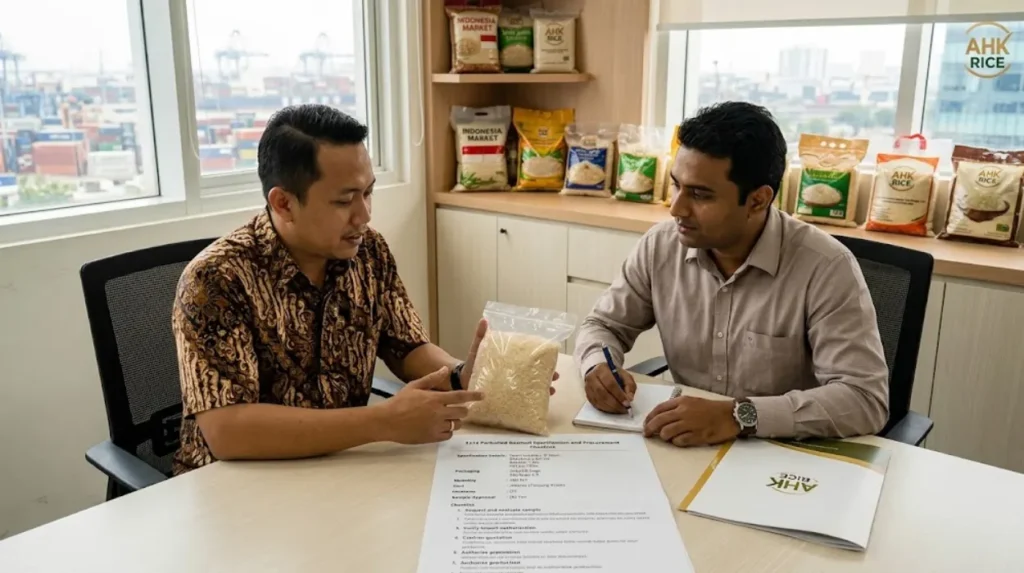
Start by sending the required 1121 Parboiled Basmati specification, quantity, packaging, destination port, and preferred Incoterm; approve the representative sample, verify Indonesian import eligibility, confirm the quotation, and then authorize production against the approved specification.
A practical procurement sequence is:
- Define the 1121 Parboiled/Sella grade.
- Set grain, moisture, broken, purity, and foreign-matter requirements.
- Confirm packaging size and material.
- Select Jakarta, Surabaya, or another destination port.
- Request and evaluate the physical sample.
- Confirm inspection requirements.
- Verify Indonesian import authorization and documentation.
- Compare FOB, CFR, or CIF landed economics.
- Approve the purchase order.
- Monitor production, inspection, container loading, and vessel dispatch.
AHK Rice gives Indonesian wholesalers a direct route for this specification-led procurement model. AHK Rice can support the product-selection stage, AHK Rice can coordinate export preparation, and AHK Rice can organize the shipment according to the agreed commercial specification.
For Indonesian wholesalers ready to confirm grade, quantity, destination, packaging, and Incoterm, request a customized 1121 Parboiled Basmati quotation.
Frequently Asked Questions
Is Pakistan 1121 Parboiled Basmati suitable for Indonesian wholesalers?
Yes. 1121 Parboiled Basmati can suit premium wholesale, foodservice, restaurant, catering, and specialty retail channels where long grain, cooked separation, aroma, and premium positioning are commercially valuable.
What grain length does Pakistan 1121 Basmati have?
Commercial 1121 specifications commonly target approximately 8.3–8.4 mm average raw grain length. The exact measurement should be stated in the purchase specification and verified against the approved sample.
How much sample rice can AHK Rice provide?
AHK Rice states that samples of up to 20 kg can be provided for its Indonesia supply programs. The buyer covers sample shipping, while any required additional certification or laboratory testing should be confirmed separately.
How many days does shipping from Pakistan to Indonesia take?
Karachi-to-Indonesia sea transit can be planned at approximately 18–28 days under normal schedules. Total delivery time is longer because production, port handling, vessel availability, clearance, and inland delivery must also be included.
Is Basmati rice allowed to be imported into Indonesia in 2026?
Indonesia does not permit ordinary consumer-rice imports under its 2026 policy framework, but Basmati is treated as a special rice category. Importers must verify the applicable authorization and current requirements before contracting.
Which documents should Indonesian wholesalers request?
Wholesalers should typically request the commercial invoice, packing list, Bill of Lading, Certificate of Origin, phytosanitary documentation, fumigation documentation where applicable, inspection documentation, and the agreed product specification.
Should Indonesian buyers compare FOB or CIF pricing?
They should compare equivalent landed-cost calculations. FOB can appear cheaper while transferring freight and insurance responsibility to the buyer. CIF can simplify comparison, but Indonesian destination charges and import costs still need to be calculated.
Why should wholesalers approve a sample before bulk production?
Sample approval creates a physical benchmark for grain appearance, aroma, cooking performance, moisture, breakage, and processing. The approved sample can then be linked to the written commercial specification.
How does AHK Rice support Indonesian wholesalers?
AHK Rice coordinates Pakistan-side sourcing, processing, grading, sorting, packaging, quality control, export documentation, container loading, and shipment preparation. The buyer should confirm the exact scope for each contracted shipment.