How Does Basmati Rice Sample Approval Work Before a USA Bulk Order?
Basmati rice sample approval is the process of testing and accepting a representative rice sample before confirming a bulk import order. USA importers use this process to verify grain length, aroma, moisture, broken percentage, cooking performance, purity, and compliance requirements before authorizing commercial shipment.
For rice importers, distributors, private-label brands, and foodservice suppliers, sample approval establishes the quality standard for the purchase contract. It also gives the exporter a reference for processing, grading, packaging, and pre-shipment inspection. A clear approval process reduces disputes between the approved sample and the rice delivered in bulk.
Pakistani Basmati rice comes from Punjab, where suitable growing conditions support aromatic varieties such as 1121, Super Kernel, and 1509 Basmati rice. Before importing these varieties into the United States, buyers need to understand how exporters prepare samples, document specifications, conduct quality checks, and maintain consistency throughout production.
What Is Basmati Rice Sample Approval Before a USA Bulk Order?
Basmati rice sample approval is the buyer’s formal acceptance of a representative rice sample against agreed specifications. It establishes measurable quality requirements for the commercial order, including variety, grain dimensions, broken percentage, moisture, aroma, cooking characteristics, packaging, and applicable import compliance requirements.
The process begins when a USA importer identifies a suitable rice variety and defines the required specifications. The exporter prepares a sample that represents the proposed commercial grade. The buyer then evaluates the sample before approving production or placing a binding bulk order.
A sample is not simply a small quantity of rice sent for tasting. It is a reference for the characteristics that the supplier and buyer agree to deliver.
For example, a retailer sourcing 1121 Basmati rice can request a defined grain-length range, maximum broken percentage, moisture limit, and processing grade. A foodservice distributor purchasing 1509 Basmati rice can prioritize cooking consistency, cost efficiency, and performance in large-volume kitchens.
The approved sample becomes a quality reference when the contract clearly identifies its specifications, approval date, sample identification, and relationship to the commercial shipment.
How Does the Basmati Rice Sample Approval Process Work?
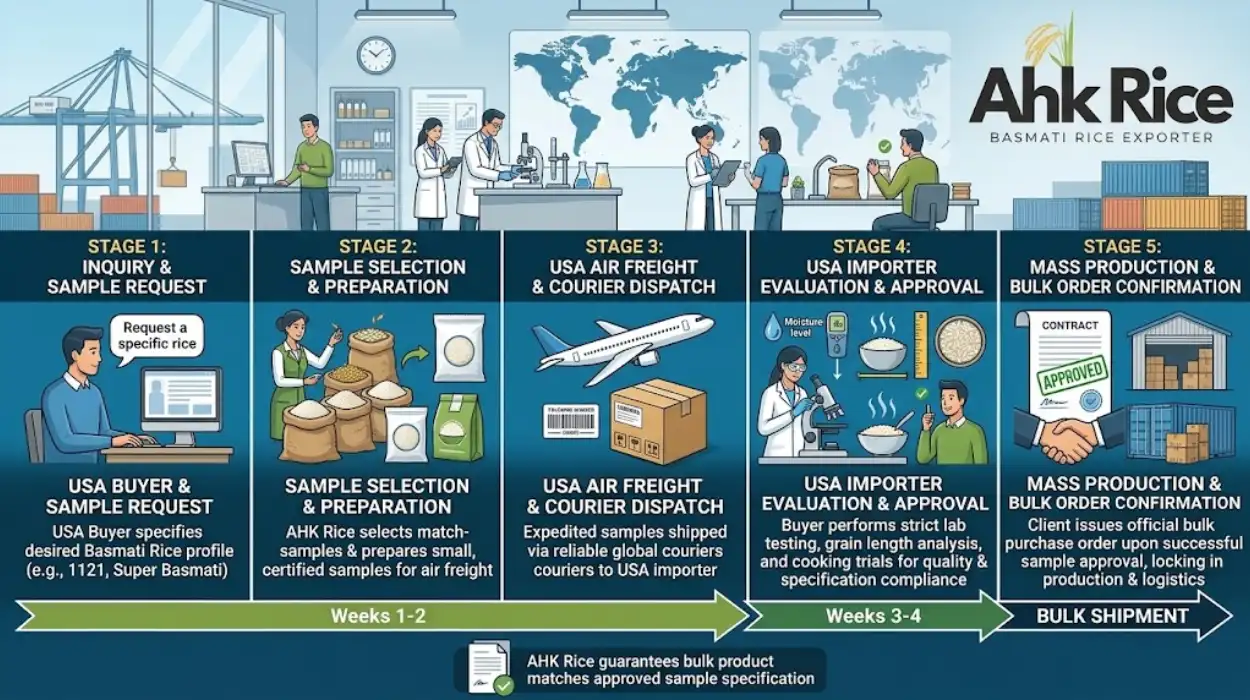
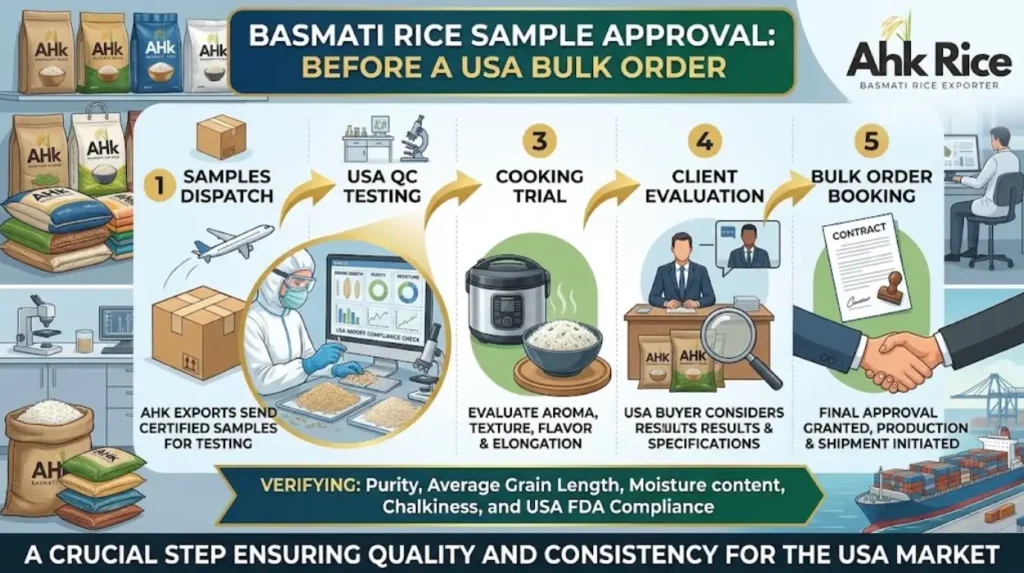
The sample approval process follows 7 stages: buyer requirements, variety selection, sample preparation, laboratory and cooking tests, specification review, written approval, and bulk production verification. Each stage records measurable requirements so both parties understand the quality standard before shipment.
1. Define the Buyer’s Requirements
The importer specifies the rice variety, processing type, quantity, packaging, destination, and quality limits. The buyer also identifies applicable US import requirements and requests supporting documentation where necessary.
2. Select the Rice Variety and Grade
The exporter identifies a suitable variety, such as 1121, Super Kernel, or 1509. The selection depends on grain appearance, aroma, cooking performance, target market, and budget.
3. Prepare a Representative Sample
The exporter prepares a sample from the proposed grade or production lot. The sample receives an identification code linked to its variety, processing type, quality specifications, and preparation date.
4. Conduct Physical and Cooking Tests
The buyer examines grain length, broken kernels, color, foreign matter, aroma, moisture, and cooking behavior. Laboratory testing addresses additional requirements, including pesticide residues and contaminants, according to the product specification and applicable regulations.
5. Compare Results With the Specification
The buyer compares the sample against the agreed quality limits. Any deviation requires clarification, correction, or a revised sample before approval.
6. Issue Written Approval
The buyer confirms acceptance by email or an agreed approval document. The approval records the sample code and relevant specifications. The purchase contract identifies the approved reference and defines the permitted quality tolerances.
7. Verify Bulk Production
The exporter checks the commercial lot against the approved specification. Pre-shipment inspection and representative sampling establish whether the finished order meets the contractual requirements.
This sequence separates sample acceptance from shipment acceptance. Approval confirms the intended standard, while production checks verify the actual bulk rice.
What Are the Key Components of Basmati Rice Sample Approval?
The main components are variety identity, grain length, broken percentage, moisture, purity, aroma, cooking performance, laboratory results, packaging, and documentation. Buyers establish acceptable limits for each relevant attribute before approval to create a measurable standard for the commercial shipment.
Variety and Grain Dimensions
Variety identity determines the expected characteristics of the rice. Pakistani 1121 Basmati is known for its long grains and cooked elongation. Super Kernel is valued for its characteristic aroma and grain appearance. The 1509 variety combines long grain characteristics with a shorter growing cycle.
Raw grain length must be measured using an agreed method. The buyer should distinguish average grain length from the length of individual kernels and specify whether the measurement applies to raw or cooked rice.
Broken Percentage and Purity
Broken percentage measures the proportion of kernels that do not meet the agreed whole-grain classification. A premium retail product generally requires a stricter broken-grain limit than a product intended for applications where appearance is less important.
Purity checks identify unwanted material and grains that do not match the declared grade. Sorting and grading records help document the quality of the finished lot.
Moisture, Aroma, and Cooking Performance
Moisture affects storage stability and rice handling. The contractual limit must reflect the intended product and relevant requirements.
Aroma evaluation checks the characteristic fragrance associated with Basmati rice. Cooking tests examine grain elongation, texture, separation, and consistency. These properties matter to restaurants, caterers, retailers, and private-label brands.
Laboratory Testing and Documentation
Laboratory tests address risks that visual inspection cannot establish. Depending on the buyer’s requirements, testing covers pesticide residues, heavy metals, and microbiological or other relevant hazards.
Supporting documents can include a certificate of analysis (COA), lot identification records, inspection reports, and applicable export certificates. A COA reports specified analytical results; it does not independently establish compliance with every US import requirement.
Which Pakistani Basmati Rice Grades Can USA Importers Approve?
USA importers can evaluate 1121, Super Kernel, and 1509 Basmati rice in raw, Steam, or applicable Sella processing forms. The appropriate grade depends on grain appearance, aroma, cooking behavior, target customers, packaging requirements, and the commercial specification.
1121 Basmati Rice
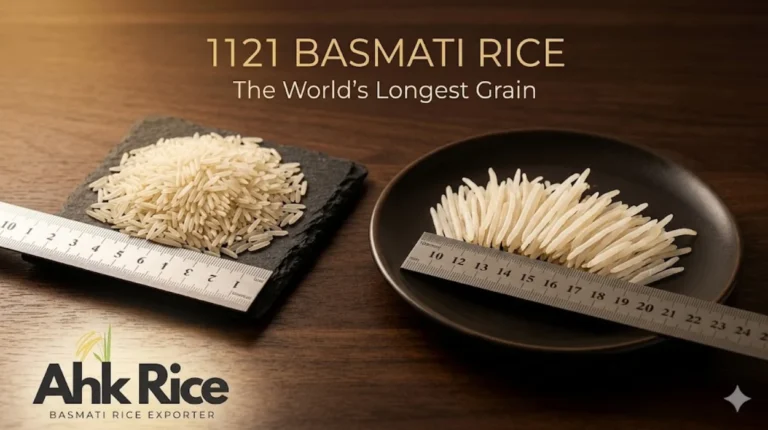
1121 Basmati is recognized for its extra-long grain profile and substantial cooked elongation. Importers serving premium grocery stores, specialty food distributors, and catering businesses often evaluate its appearance and cooking performance.
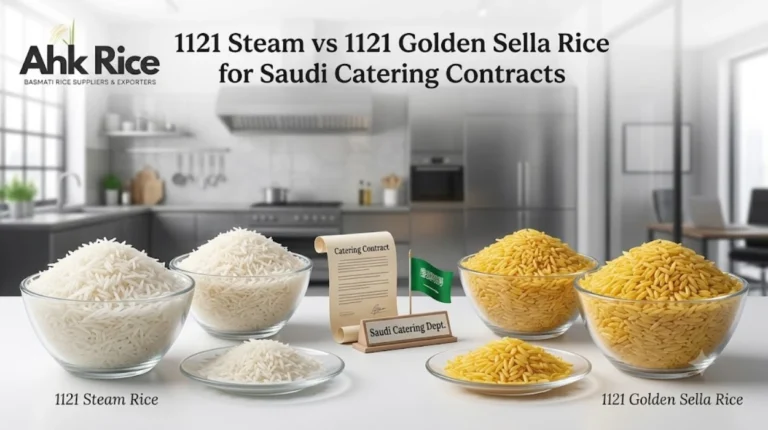
Sample approval should specify the exact processing form, such as white, Steam, Golden Sella, or Brown, rather than referring to 1121 alone.
Super Kernel Basmati Rice
Super Kernel is a traditional Pakistani Basmati variety associated with aromatic cooking and a distinctive grain profile. Buyers commonly assess its aroma, grain uniformity, broken percentage, and suitability for ethnic retail markets and foodservice distribution.
The approved specification must distinguish the required grade from other Super Kernel products.
1509 Basmati Rice
1509 is a long-grain variety valued for its shorter crop cycle and commercial efficiency. Importers evaluate its grain dimensions, cooking performance, and suitability for retail or bulk foodservice applications.
Steam, Golden Sella, Creamy Sella, and Brown Rice
Steam processing uses steam treatment during production to influence the grain’s cooking and handling characteristics. Sella rice undergoes parboiling, while Golden Sella receives a more pronounced golden appearance through its processing method. Creamy Sella has a lighter appearance than Golden Sella. Brown Basmati retains its bran layer.
These products require separate sample approval because processing affects color, texture, cooking time, and finished-grain behavior.
What Are the Benefits of Approving a Rice Sample Before Bulk Import?
Sample approval establishes a shared quality reference before commercial production. It helps buyers compare suppliers, assess cooking performance, document purchasing requirements, identify specification differences, and reduce disagreements about grain appearance, processing quality, packaging, and laboratory results.
The first benefit is purchasing clarity. An importer can compare samples from different exporters against the same specification instead of relying on product descriptions alone.
The second benefit is quality control. A documented reference helps the exporter identify the required grade, processing method, and acceptable tolerances before production begins.
The third benefit is commercial planning. Buyers can test whether the rice suits their customers, equipment, recipes, and packaging formats.
The fourth benefit is traceability. Sample identification, production-lot records, COAs, and inspection reports create a documented relationship between the approved product and the shipped goods.
These benefits depend on representative sampling and enforceable specifications. A sample approval email alone does not guarantee that every kernel in a container matches the sample.
Which US Import Requirements Apply to Approved Basmati Rice Samples and Bulk Shipments?
USA importers must distinguish product-quality approval from regulatory clearance. Commercial shipments require applicable FDA, US Customs and Border Protection, and agricultural import compliance, with documentation and controls determined by the product, importer, origin, and current regulations.
FDA Requirements
Imported food generally falls under applicable US Food and Drug Administration requirements. Depending on the transaction, relevant obligations include food facility registration, prior notice, and Foreign Supplier Verification Program (FSVP) responsibilities.
FSVP generally requires the US importer to establish and follow risk-based verification procedures for covered foreign food suppliers. Receiving an approved sample does not satisfy these responsibilities.
Agricultural and Customs Requirements
Importers must verify applicable agricultural admissibility requirements and customs entry obligations before shipment. Requirements depend on the commodity, country of origin, product form, and entry circumstances.
The commercial invoice, packing list, transport documents, and any required certificates must accurately describe the shipment. A phytosanitary certificate is required only when applicable to the particular import and its governing conditions.
Food Safety and Product Testing
Buyers should identify applicable contaminant limits, pesticide tolerances, and testing requirements before confirming production. Relevant controls depend on US law and the product’s intended use.
The sample approval record should specify the required tests and documentation. Neither a supplier’s general quality claim nor a sample’s acceptable appearance replaces regulatory compliance checks.
What Problems Occur During Rice Sample Approval?
Common problems include unrepresentative samples, unclear specifications, inconsistent processing, undocumented substitutions, unsuitable cooking tests, and missing compliance records. Buyers and exporters prevent these issues by identifying samples, agreeing on tolerances, documenting changes, and inspecting representative bulk lots before shipment.
A sample taken from an unrelated production lot does not reliably represent the intended order. Buyers should request a sample linked to the proposed grade and, where practical, the production lot.
Another problem is vague language. Terms such as premium quality or extra-long grain do not establish measurable acceptance limits. Contracts should define grain dimensions, broken percentage, moisture, processing type, and other critical attributes.
Cooking conditions also influence results. Water ratios, soaking time, cooking equipment, and resting periods must remain consistent when comparing samples.
Finally, an approved sample can lose its value when the exporter changes the variety, processing method, or grade without authorization. Contractual controls should require written approval for material changes and define how replacement samples are evaluated.
For a complete explanation of maintaining consistency from the approved reference through final shipment, see the guide to sample-to-shipment matching and bulk rice quality control.
How Do Buyers Confirm That Bulk Rice Matches the Approved Sample?
Buyers verify bulk rice through documented specifications, representative sampling, production records, agreed tolerances, laboratory testing, and pre-shipment inspection. The final checks compare the commercial lot with the approved reference and establish whether the shipment meets contractual and regulatory requirements.
The exporter should maintain records linking the approved sample to the production specification and finished lot. These records include variety, processing method, grading requirements, packaging details, and applicable laboratory results.
An independent inspection can provide additional assurance when the contract specifies the inspection scope, sampling method, acceptance criteria, and reporting procedure.
The buyer should also confirm the quantity, bag weights, labels, lot identification, and shipping documents before dispatch. Any significant discrepancy requires resolution under the purchase contract.
Sample approval is therefore one stage of a broader quality management process. When the sample, specification, production records, and inspection results remain connected, the buyer has a stronger basis for evaluating shipment conformity.
Frequently Asked Questions
What is Basmati rice sample approval?
Basmati rice sample approval is the buyer’s acceptance of a representative sample against agreed specifications before confirming or producing a bulk order.
What should a Basmati rice sample include?
A sample should represent the specified variety and processing grade. Buyers evaluate grain length, broken percentage, moisture, aroma, purity, cooking performance, and applicable laboratory results.
How long does rice sample approval take?
The timeline depends on sample delivery, cooking tests, laboratory analysis, and buyer review. Basic physical checks can be completed quickly, while laboratory testing and international courier delivery require additional time.
Does sample approval guarantee the bulk shipment will match?
No. Sample approval establishes the reference standard. Representative sampling, production records, agreed tolerances, and pre-shipment inspections verify whether the actual shipment conforms to that standard.
Which Basmati rice varieties can USA importers request?
Importers can evaluate Pakistani 1121, Super Kernel, and 1509 Basmati rice. They should specify the processing type, grade, grain dimensions, broken percentage, moisture limit, and intended application.