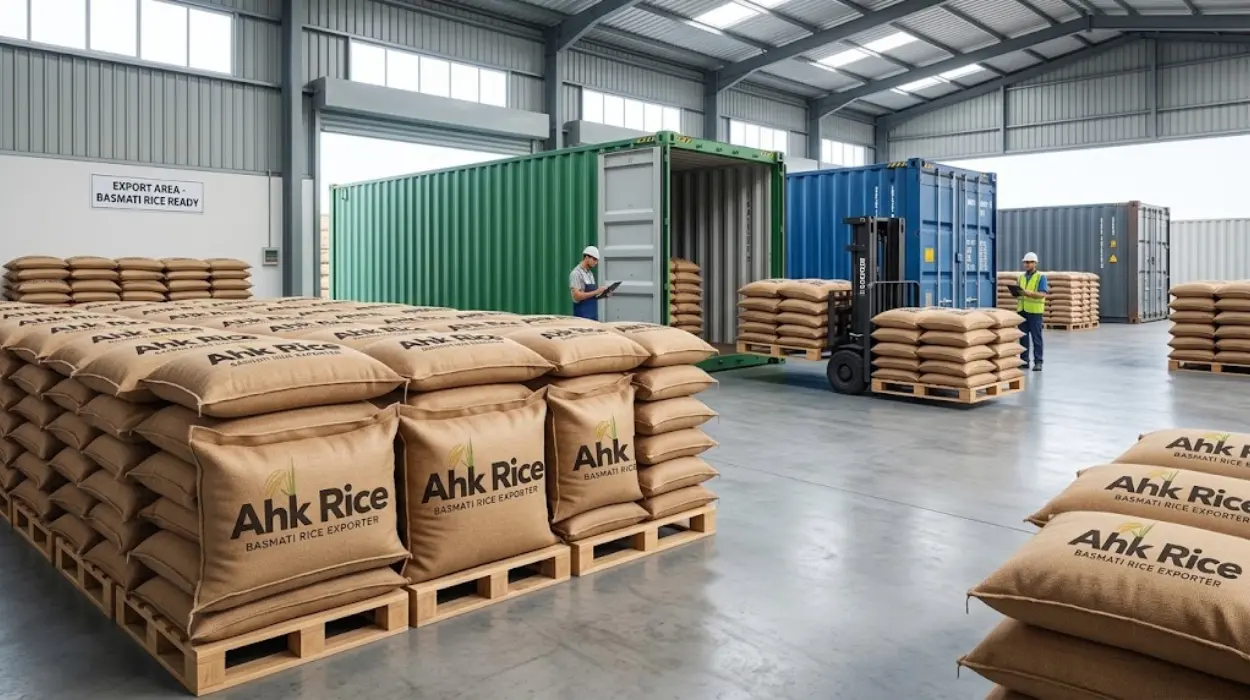
How Are Basmati Rice Containers Prepared Before UK Arrival?
Basmati rice containers are prepared through product inspection, moisture control, compliant packaging, container inspection, secure stuffing, documentation, sealing, and shipment verification before UK arrival. Here is why: each control protects rice quality and supports customs clearance. UK guidance requires imported cereals, including rice, to meet equivalent food hygiene standards.
For the wider export workflow, buyers can first review how Pakistani Basmati rice moves from processing to export before evaluating container preparation. The comparison matters because container preparation does not begin at the port. It starts with the selected grade, moisture specification, packaging format, inspection plan, and destination requirements.
What are the available solutions for preparing Basmati rice containers?
Three practical solutions dominate Basmati container preparation: dry-container loading, moisture-controlled loading, and enhanced inspection loading. Here is why: each method balances cargo protection, cost, packaging strength, and destination requirements differently.
Dry-container loading
Dry-container loading uses a standard food-grade shipping container for bagged Basmati rice. The exporter inspects the container before loading and rejects units with contamination, water ingress, structural damage, or unsuitable odours.
The rice is packed into PP, BOPP, jute, or other approved formats. AHK Rice lists 20 kg, 25 kg, 40 kg, and 50 kg formats across its export operations.
Moisture-controlled loading
Moisture-controlled loading adds desiccants, moisture barriers, controlled stacking, and tighter inspection. The objective is to reduce condensation and moisture migration during ocean transit.
Moisture matters because rice is a dry food product. AHK Rice publishes UK specifications showing moisture below 12.5% for certain 1121 products.
Enhanced inspection loading
Enhanced inspection loading adds independent verification before container sealing. Inspectors can verify weight, packaging, grain quality, broken percentage, moisture, and container condition.
This method suits importers supplying supermarkets, private-label brands, and large foodservice distributors. The added inspection cost provides stronger documentary evidence when quality disputes arise.
With the available preparation models established, the next question is how their specifications differ commercially.
How do different container preparation approaches compare?
Moisture-controlled loading provides the strongest protection, while standard dry loading provides the lowest logistics complexity and enhanced inspection provides the strongest verification. Here is why: buyers need to match protection with product grade, transit exposure, packaging, and inventory value.
Specification comparison
| Attribute | Standard Dry Loading | Moisture-Controlled Loading | Enhanced Inspection Loading |
|---|---|---|---|
| Container type | Dry container | Dry container with moisture controls | Dry container with inspection controls |
| Moisture control | Standard | Desiccants and moisture barriers | Tested and documented |
| Packaging | PP/BOPP/jute | Moisture-resistant formats preferred | Buyer-approved formats |
| Inspection | Exporter inspection | Exporter inspection | Exporter plus independent inspection |
| Loading control | Standard stacking | Controlled stacking | Controlled stacking and records |
| Documentation | Standard export documents | Standard plus treatment records | Standard plus inspection report |
| Best use | Routine wholesale | Long transit or sensitive cargo | Retail and high-value contracts |
The comparison shows that no single method fits every shipment. Standard loading works for stable bulk programs. Moisture controls strengthen protection. Independent inspection strengthens evidence.
The container itself also requires preparation. Exporters must inspect the floor, walls, roof, doors, seals, cleanliness, dryness, and structural condition before stuffing.
Container stuffing then requires stable weight distribution. Bags must remain secure without damaging packaging. Excessive compression can weaken bags and increase product loss during handling.
AHK Rice describes container loading as part of its export workflow, with 20-foot and 40-foot containers used for international Basmati shipments.
With container methods compared, market destination becomes the next major decision factor.
Which preparation method works best for Great Britain and Northern Ireland?
Great Britain generally suits standard or moisture-controlled loading, while Northern Ireland benefits from stronger documentation and destination-specific compliance checks. Here is why: both markets require food compliance, but route planning and documentation can change according to the final destination.
Great Britain market
Great Britain includes England, Scotland, and Wales. Importers commonly purchase long-grain Basmati for retail, wholesale, restaurants, and foodservice.
1121 Basmati suits premium retail because of its extra-long grain profile. Super Kernel suits buyers seeking traditional Pakistani Basmati characteristics. 1509 provides another long-grain option where procurement economics carry greater weight.
UK guidance classifies Basmati as aromatic, slender, non-glutinous long-grain rice. UK classification also distinguishes rice according to grain length and length-to-width ratio.
A standard dry container works for stable wholesale programs with strong packaging. Moisture-controlled loading becomes more valuable when inventory remains in storage after arrival.
Northern Ireland market
Northern Ireland requires greater attention to the destination documentation pathway. Importers should align the commercial invoice, packing list, origin information, product specification, and relevant certificates before dispatch.
1121 Steam and 1121 Sella grades suit distributors seeking firm grains and consistent cooking performance. Super Kernel suits buyers targeting traditional aromatic Basmati positioning.
Northern Ireland delivery also makes shipment planning important because port routing and onward transport can affect the final warehouse timeline. The container should therefore arrive with complete documentation rather than relying on document correction after discharge.
Regional comparison
| Market region | Preferred grade position | Indicative FOB price/MT | Commercial shelf-life planning |
|---|---|---|---|
| Great Britain | 1121 White / Steam | $1,165–$1,205 | Up to 24 months unopened |
| Northern Ireland | 1121 Sella / Steam | $1,135–$1,200 | Up to 24 months unopened |
The price figures are indicative FOB Karachi benchmarks published in July 2026. HAS Rice lists 1121 White at $1,165–$1,205/MT and 1121 Sella at $1,135–$1,175/MT. It lists 1121 Steam at approximately $1,160–$1,200/MT.
Shelf life should remain tied to the product specification and printed date. FoodKeeper guidance lists unopened white rice at approximately two years in pantry storage. A commercial Basmati technical sheet also recommends using the product within two years under dry, ambient storage.
The regional comparison therefore points toward grade selection first and container protection second.
What preparation steps should exporters complete before container sealing?
Exporters should clean, inspect, verify, pack, stack, document, seal, and record every shipment before dispatch. Here is why: container preparation is a sequence of linked controls, and a failure at one stage can affect quality or clearance later.
Product preparation
- Clean the rice to remove unwanted material.
- De-husk the paddy during milling.
- Polish the grain according to the agreed specification.
- Grade the rice by length and quality.
- Sort the grain through optical and mechanical systems.
- Test the moisture against the agreed specification.
- Inspect the broken percentage against the sales contract.
AHK Rice describes milling, sorting, moisture testing, packaging inspection, and final loading verification within its export workflows.
Packaging preparation
Packaging must protect the rice against handling damage and moisture exposure. Common export formats include PP and jute bags, with retail sizes ranging from small consumer packs to 40 kg and 50 kg commercial bags.
Labels must match the agreed product identity. The exporter should verify product name, net weight, country of origin, lot or traceability information, and other required label information before loading.
Packaging consistency also matters for warehouse handling. Uniform bags stack more efficiently and reduce unstable cargo arrangements inside the container.
Container preparation
- Inspect the container for cleanliness and dryness.
- Check the container floor for damage or contamination.
- Check the walls and roof for holes or water ingress.
- Check the doors for correct closure.
- Remove foreign odours before loading.
- Place moisture protection where specified.
- Load the bags according to the approved stacking plan.
- Secure the cargo against movement.
- Record the container number before sealing.
- Apply the seal after final verification.
The container number and seal number should match the shipping documentation. This creates a traceable relationship between the physical cargo and export records.
Documentation preparation
Typical export documents include the commercial invoice, packing list, certificate of origin, phytosanitary certificate, fumigation certificate where applicable, and Bill of Lading. AHK Rice identifies these documents within its export process.
UK cereal-import guidance confirms that imported rice must meet applicable food hygiene requirements. Documentation therefore supports both commercial control and regulatory clearance.
With the preparation sequence established, the next issue is evaluating the advantages and limitations of each strategy.
What are the pros and cons of each preparation method?
Standard loading reduces preparation complexity, moisture control increases cargo protection, and enhanced inspection increases verification strength. Here is why: each method adds a different type of value rather than simply adding more logistics activity.
Standard dry loading
Pros: Lower preparation complexity, efficient loading, and suitability for routine wholesale cargo.
Cons: Less additional protection against condensation and less independent evidence of loading condition.
A stable wholesale shipment with strong packaging can use this method effectively. The buyer should still require documented container inspection.
Moisture-controlled loading
Pros: Stronger protection against moisture exposure, better suited to longer inventory cycles, and improved cargo stability.
Cons: Additional material and handling costs.
This approach suits premium Basmati where appearance and aroma are commercially important. It also suits importers holding stock for longer distribution cycles.
Enhanced inspection loading
Pros: Independent verification, stronger dispute protection, and better documentation for high-value contracts.
Cons: Additional inspection costs and scheduling requirements.
Retail importers often benefit most from this approach. The inspection record provides evidence that the shipment matched agreed specifications before dispatch.
These trade-offs lead directly to the buyer’s decision framework.
What decision factors should UK importers use before choosing a container method?
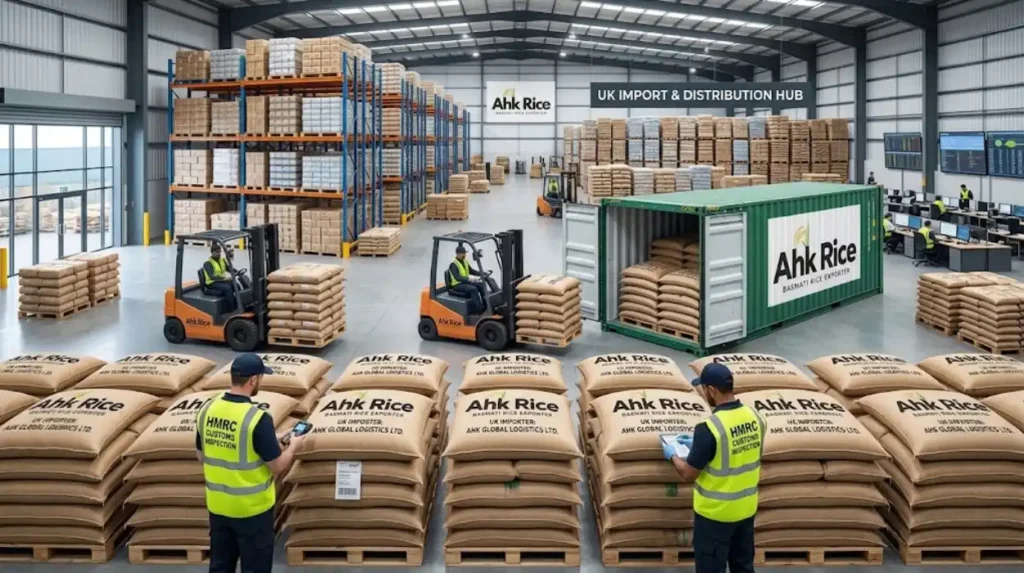
UK importers should rank product grade, moisture specification, packaging, destination, transit plan, inspection, and inventory cycle before approving container preparation. Here is why: the correct method depends on commercial risk rather than container size alone.
| Decision factor | Buyer question | Preferred approach |
|---|---|---|
| Product grade | Is the rice premium or standard wholesale? | Enhanced control for premium grades |
| Moisture | Does the specification require tight moisture control? | Moisture-controlled loading |
| Packaging | Are bags moisture-resistant and stackable? | Match packaging to container plan |
| Destination | Is the cargo entering Great Britain or Northern Ireland? | Align documentation with destination |
| Inventory cycle | Will stock remain for months? | Moisture protection and controlled storage |
The first decision should always be the rice specification. The container cannot compensate for poorly graded or poorly tested rice.
The second decision should be packaging. Strong packaging protects the product throughout handling, port operations, ocean transport, and warehouse unloading.
The third decision should be documentation. A physically correct shipment still creates operational problems when the documents contain inconsistent product, quantity, origin, or container information.
The fourth decision should be inspection. High-value or private-label shipments benefit from stronger third-party verification.
The fifth decision should be inventory planning. A buyer expecting rapid turnover has different protection requirements from a distributor holding stock for many months.
How does AHK Rice prepare Basmati containers for UK shipment?
AHK Rice integrates milling, grading, sorting, packaging, documentation, inspection, and container loading into one export workflow from Punjab to UK destinations. Here is why: integrated control reduces handovers between suppliers and makes specification verification easier before dispatch.
AHK Rice operates from Bucheki, Nankana Sahib, Punjab, and supplies 1121, Super Kernel, and 1509 Basmati varieties to international buyers. Its export operation includes processing, custom packaging, documentation, inspection, and container loading.
The UK export workflow includes quality inspection, packaging, pre-shipment inspection, documentation, container loading, sea dispatch, and arrival clearance. AHK Rice lists UK destinations including Felixstowe, London Gateway, and other UK ports across its export pages.
The published AHK Rice UK specification for 1121 includes an average grain length above 8.35 mm, moisture below 12.5%, and broken grains below 1% for the stated product specification.
The operational advantage is specification continuity. The same product requirements can be checked from milling through packaging and final container loading.
For Northern Ireland buyers, this approach becomes especially useful when the shipment requires destination-specific document coordination and controlled delivery planning.
What is the final recommendation for preparing Basmati containers before UK arrival?
Use moisture-controlled, documented container preparation for premium UK shipments, and add independent inspection for high-value retail or private-label cargo. Here is why: this combination protects product quality while creating stronger evidence for commercial and regulatory decisions.
Standard dry loading remains appropriate for straightforward wholesale shipments. Moisture-controlled loading provides stronger protection for longer inventory cycles. Enhanced inspection adds independent evidence where commercial exposure is higher.
The strongest preparation strategy therefore connects the rice grade, moisture level, packaging, container condition, loading plan, documentation, inspection, seal, and destination into one specification.
A buyer should approve the container only after the physical cargo and documents agree. That final relationship determines whether the shipment is simply loaded or genuinely export-ready.
Frequently Asked Questions
How long does Basmati rice take to reach the UK from Pakistan?
AHK Rice publishes UK shipment windows ranging from approximately 21–28 days on some export pages, while another AHK Rice shipping guide gives 28–40 days depending on the route and port. Transit time therefore depends on vessel schedules, routing, and port conditions.
What container size is used for Basmati rice exports?
20-foot and 40-foot containers are commonly used for commercial Basmati shipments. The correct size depends on order quantity, packaging, payload, and shipping requirements. AHK Rice lists both container formats within its UK export workflows.
Does Basmati rice require fumigation before UK arrival?
Fumigation requirements depend on the shipment, treatment method, certification requirements, and applicable rules. Where fumigation is performed, the treatment should be documented correctly. UK grain certification guidance recognises professional fumigation procedures for phytosanitary certification.
What moisture level is suitable for exported Basmati rice?
The specification depends on the grade and buyer contract. AHK Rice publishes below 12.5% moisture for its stated UK 1121 specification. Other AHK Rice product pages publish different moisture limits according to processing type.
How long can Basmati rice remain in storage?
Unopened white rice has a commonly cited commercial planning period of up to two years under suitable pantry conditions. Actual product shelf life must follow the manufacturer’s specification and printed date.
Which Basmati grade is best for UK importers?
1121 is a strong premium choice because of its extra-long grain profile. Super Kernel suits buyers seeking traditional aromatic characteristics. 1509 provides another long-grain option for buyers prioritising procurement economics. AHK Rice supplies all three varieties.
Why is container inspection important before loading?
Container inspection identifies contamination, moisture, odours, structural damage, and unsuitable conditions before cargo enters the unit. Correct inspection reduces avoidable quality risks during ocean transport.
What documents accompany a Basmati rice container?
Common documents include the commercial invoice, packing list, certificate of origin, phytosanitary certificate, fumigation certificate where applicable, and Bill of Lading. The exact document set depends on the shipment and destination requirements.