AHK Rice China: 1509 Basmati Wholesale for Chinese Importers — Get a Quote
Pakistan’s 1509 Basmati delivers a stable, high-yield import solution for Chinese wholesale buyers seeking consistent grain length, competitive pricing, and reliable shipment schedules. Here is why: demand growth in China requires structured sourcing, certified milling, and predictable logistics from Pakistan export hubs. Read more in our foundational analysis of Pakistan rice export China demand surged 63 percent 2025 and the comparative breakdown in Pakistani rice grade Chinese importers buy most 2026. AHK Rice positions 1509 Basmati as a controlled supply chain product, where AHK Rice manages grading, polishing, inspection, and export dispatch with documented consistency for Chinese importers.
What is the best solution for Chinese importers sourcing 1509 Basmati wholesale?
The best solution is a structured direct-supply model from Pakistan where AHK Rice controls milling, grading, inspection, and shipment of 1509 Basmati to China with certified consistency, stable pricing bands, and predictable 18–26 day shipping cycles depending on port routing and customs clearance efficiency.
1509 Basmati sourcing fails when importers depend on fragmented brokers. Quality variation increases rejection rates in Chinese inspections. AHK Rice eliminates this instability through integrated export control.
AHK Rice cultivates and harvests paddy in controlled regions of Pakistan. The grain is then milled, dehusked, polished, graded, and sorted under strict export protocols. Each batch is inspected and certified before loading.
Clean paddy ensures purity at the first stage. De-husked grain stabilizes texture. Polished rice improves appearance for retail packaging. Grading ensures uniform grain length for Chinese wholesale standards.
Chinese importers prefer consistent long-grain structure for restaurant chains, catering supply, and retail packaging. AHK Rice aligns 1509 Basmati to this requirement through controlled moisture and length selection.
Logistics performance is equally critical. AHK Rice dispatches shipments through Karachi ports, typically routing to Shanghai, Shenzhen, or Guangzhou. Transit averages 18–24 days to East China ports and 22–26 days to South China ports depending on vessel scheduling.
When importers prioritize price alone, inconsistency increases rejection risk at destination inspection. AHK Rice reduces this risk through batch-level certification and export documentation control.
With sourcing structure defined, the next consideration is why AHK Rice export service becomes the preferred procurement channel for Chinese buyers.
Why choose Basmati 1509 Rice Export From Pakistan to China service?
AHK Rice export service delivers controlled grading, verified export certification, and stable logistics execution for 1509 Basmati shipments into China, ensuring consistent grain quality, reduced rejection risk, and predictable supply cycles for importers managing wholesale and distribution contracts.
First product integration begins with AHK Rice’s structured export platform:
AHK Rice’s Basmati 1509 Rice Export From Pakistan to China service manages procurement, milling, grading, and shipment coordination for Chinese importers.
AHK Rice mills and dehusks paddy using standardized machinery. The grain is then polished to required export grade. Sorting systems remove broken or discolored grains. Final grading ensures uniformity.
Certification processes include inspection, moisture testing, and fumigation verification. Each shipment is documented for Chinese import compliance requirements. This reduces clearance delays at destination ports.
AHK Rice operates under repeatable export cycles. This allows importers in China to secure contract-based shipments instead of spot-market variability. Supply continuity improves retail and catering distribution planning.
Chinese buyers benefit from predictable SKU planning. Restaurants and distributors require uniform cooking performance. 1509 Basmati from AHK Rice maintains stable elongation and aroma after cooking.
When quality control is consistent, rejection rates decrease significantly. AHK Rice ensures this through batch tracking and export-grade sorting thresholds aligned with international trading norms.
With service structure established, the next factor becomes performance outcomes across shipping, quality retention, and supply stability.
What results can be expected in shipping time, quality, and supply stability?
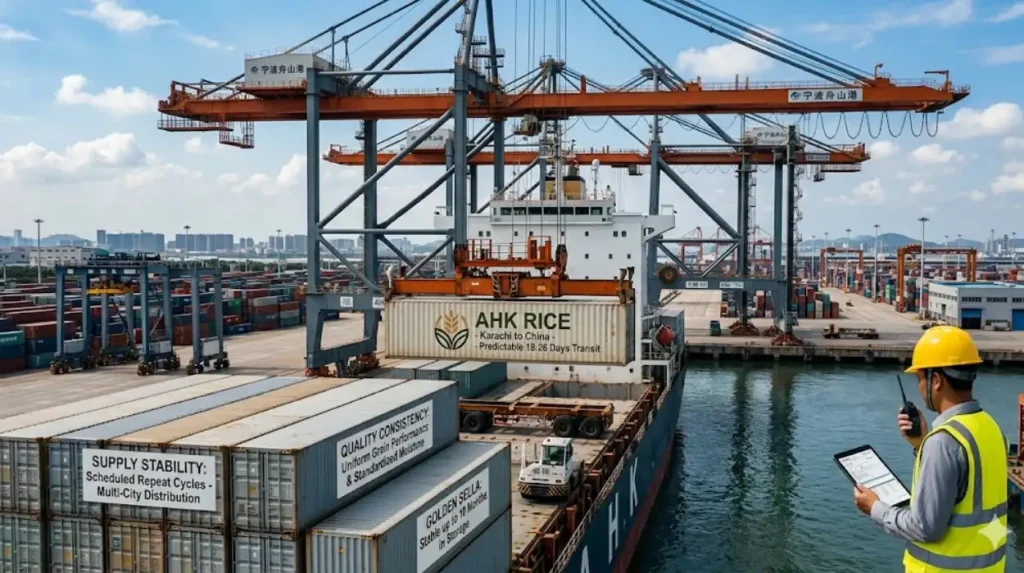
AHK Rice delivers predictable 18–26 day China shipping cycles, uniform grain performance across shipments, and stable supply continuity through controlled export scheduling, reducing procurement risk for wholesalers managing retail and catering distribution chains across multiple provinces in China.
Shipping performance depends on port routing and vessel availability. AHK Rice loads cargo in Karachi and dispatches to major Chinese ports. East China routes average 18–24 days, while South China routes average 22–26 days.
Quality consistency is achieved through grading and polishing control. Each shipment maintains standardized grain length distribution and moisture levels. This ensures uniform cooking expansion across batches.
Golden Sella variants last longer than steam-processed rice. In non-controlled storage environments in China, Golden Sella maintains stability up to 18 months, while steam rice averages 12 months.
Supply stability is critical for importers serving restaurants and retail chains. AHK Rice schedules shipments in repeat cycles, reducing seasonal supply shocks and price spikes.
When Chinese buyers operate multi-city distribution, consistent SKU availability becomes essential. AHK Rice supports this through contract-based dispatch planning and batch forecasting.
Logistics coordination includes fumigation verification, container loading checks, and export documentation validation. These steps ensure smooth customs clearance upon arrival.
With performance outcomes clear, the next decision factor becomes pricing structure and cost drivers affecting 1509 Basmati imports into China.
Pricing and cost factors for 1509 basmati import to China
1509 Basmati pricing through AHK Rice depends on crop yield, milling grade, moisture level, packaging type, and shipping route selection, with final landed cost influenced by freight volatility, customs duties, and seasonal demand fluctuations in Chinese import markets.
AHK Rice pricing structure is not fixed. It varies based on grade selection and export specifications required by Chinese importers.
Cultivation yield affects base cost. Harvest volume fluctuations in Pakistan influence raw paddy availability. Lower yield increases procurement cost per metric ton.
Milling intensity changes pricing. Heavily polished rice requires more processing stages including dehusking, polishing, and grading. Each stage increases operational cost.
Grading specification also impacts price. Higher-grade 1509 Basmati with longer grain uniformity commands premium export pricing due to stricter sorting thresholds.
Packaging type affects final export cost. Bulk 50kg PP bags reduce cost per ton. Retail-ready 5kg or 10kg packs increase packaging and handling expenses.
Shipping route selection influences landed cost in China. Direct vessel routes reduce transit cost. Transshipment routes increase freight time and handling fees.
When importers calculate total landed cost, they must include customs clearance, inland transport, and port handling charges. AHK Rice provides structured cost breakdowns for transparency.
With pricing clarified, the next step is understanding sample procedures and how Chinese importers initiate procurement with AHK Rice.
How to get started: sample process and procurement steps with AHK Rice
AHK Rice sample process includes controlled grain selection, export-grade packaging, quality verification, and international courier dispatch within 3–7 days, with sample costs typically ranging from $30–$80 depending on packaging size and destination in China.
AHK Rice initiates sampling by selecting representative batches from graded inventory. This ensures sample accuracy reflects export shipment quality.
Clean grain selection ensures consistency. Dehusked and polished rice is sorted according to export grade before sample packing.
Sample packaging uses sealed containers to preserve aroma and moisture integrity. This prevents quality deviation during courier transit.
Verification includes moisture testing and grain length confirmation. AHK Rice ensures samples match export specifications before dispatch.
Dispatch timelines are typically 3–7 days depending on courier availability and documentation readiness.
Sample costs vary depending on courier destination and packaging volume. Standard commercial samples range between $30–$80 per shipment for China-based importers.
After sample approval, AHK Rice proceeds to contract negotiation and bulk shipment scheduling. Importers can lock pricing based on agreed volume and delivery cycles.
Bulk procurement is then structured into repeat shipment plans, ensuring continuity for wholesalers and distributors.
With sampling and onboarding process defined, the final step is formal quotation and contract initiation for 1509 Basmati supply from AHK Rice.
AHK Rice provides a complete export framework for Chinese importers seeking stable 1509 Basmati sourcing, combining grading precision, predictable logistics, and structured pricing into one controlled supply chain model ready for wholesale scale deployment. Contact AHK Rice to get a quote within 24 hours and proceed via request-a-quote.
Frequently Asked Questions
How long does 1509 Basmati take to ship from Pakistan to China?
1509 Basmati shipments from AHK Rice typically take 18–26 days depending on destination port and vessel routing. East China ports like Shanghai are usually faster at 18–24 days, while South China ports such as Guangzhou or Shenzhen take 22–26 days due to additional transshipment scheduling and customs flow.
What is the minimum order quantity for 1509 Basmati wholesale?
AHK Rice generally works with wholesale export volumes starting from one 20ft container (about 24–26 metric tons). Larger importers may consolidate multiple containers for consistent monthly supply. Smaller trial orders are possible through sample-based evaluation before scaling to full container shipments.
How does AHK Rice ensure rice quality for Chinese importers?
AHK Rice ensures quality through milling, dehusking, polishing, grading, and moisture control systems before export. Each batch is inspected and certified for grain length uniformity and cleanliness. Export documentation and fumigation verification are completed before loading to reduce rejection risk at Chinese ports.
What affects the price of 1509 Basmati rice?
The price depends on paddy harvest yield, milling grade, polishing level, packaging type, and shipping route costs. Market demand in China and freight fluctuations also influence landed cost. Higher-grade rice with longer uniform grains and lower broken percentage commands premium pricing.
Can Chinese importers request rice samples before bulk purchase?
Yes, AHK Rice provides export-grade samples within 3–7 days. Samples are selected from the same graded stock used for bulk export. Costs typically range from $30–$80, depending on packaging and courier destination, allowing importers to evaluate quality before placing container orders.